


Skin Texture Products That Actually Remodel Your Skin
Most advice about uneven texture starts with scrubbing. That's the wrong starting point. Roughness, enlarged-looking pores, fine lines, acne bumps, dehydration, and dark marks can look similar in a mirror while arising from very different biological processes. A stronger scrub may remove surface scale temporarily, but it can also create inflammation that makes sensitivity, roughness, and discoloration harder to control.
Effective skin texture products work as part of a system. They manage the outermost layer, support the barrier, influence cellular renewal, address excess melanin when pigmentation is involved, and protect the skin from additional ultraviolet damage. The objective isn't to make the skin feel stripped. It's to improve the conditions that allow skin to look smoother, more even, and more resilient.
The Biological Reality of Uneven Skin Texture
Texture is not just dead skin
The common explanation is that texture equals dead cells sitting on the surface. Surface buildup can contribute to dullness and roughness, but it doesn't explain every line, depression, pore, or change in firmness. The deeper issue is that the dermis changes as skin ages and accumulates environmental stress.
A study of sun-protected hip skin found that collagen fibrils in aged dermis were rougher, stiffer, and harder than those in younger dermis. The research examined healthy adults averaging 25 ± 5 years old and 75 ± 6 years old, with six participants in each group, and used atomic-force microscopy and nanoindentation to measure collagen properties. Across participants ranging from 25 to 89 years old, age also correlated positively with collagen roughness, stiffness, and hardness. The full collagen-structure study linked these changes partly to collagen fragmentation mediated by matrix metalloproteinase-1 and to increased cross-linking associated with advanced glycation end products.
That matters because a scrub can't reorganize fragmented collagen or reverse cross-linking. It can only affect the surface. Physical abrasion may make skin feel polished for a short time, yet excessive pressure can create microscopic injury and trigger inflammation. That response is particularly unhelpful when the visible concern includes redness, acne, or post-inflammatory hyperpigmentation.
Collagen support changes the treatment conversation
Chronological aging also reduces the skin's collagen-building activity. In sun-protected skin, type I procollagen content was 68% lower in adults aged 80 and older than in adults aged 18 to 29. The same study found that fibroblasts from younger participants produced an average of 82 ± 16 ng per 5 × 10⁴ cells, compared with 56 ± 8 ng per 5 × 10⁴ cells from older participants. The study on age-related collagen synthesis also described thicker collagen bundles and less open space between bundles in young adult dermis.
This is why useful texture routines have two layers. Exfoliating acids can improve the appearance of retained surface scale and congestion. Moisturizers can improve surface feel and optical smoothness. Retinoids address renewal and dermal signaling. Sunscreen limits further ultraviolet injury that can undermine all three.
Clinical perspective: If your skin is rough because of structural aging, more aggressive scrubbing gives you more irritation, not more collagen.
A thoughtful overview of how to improve smoother skin naturally can help place topical care in a broader routine, but the biological distinction remains important. Surface refinement and dermal remodeling are related goals, not interchangeable ones.
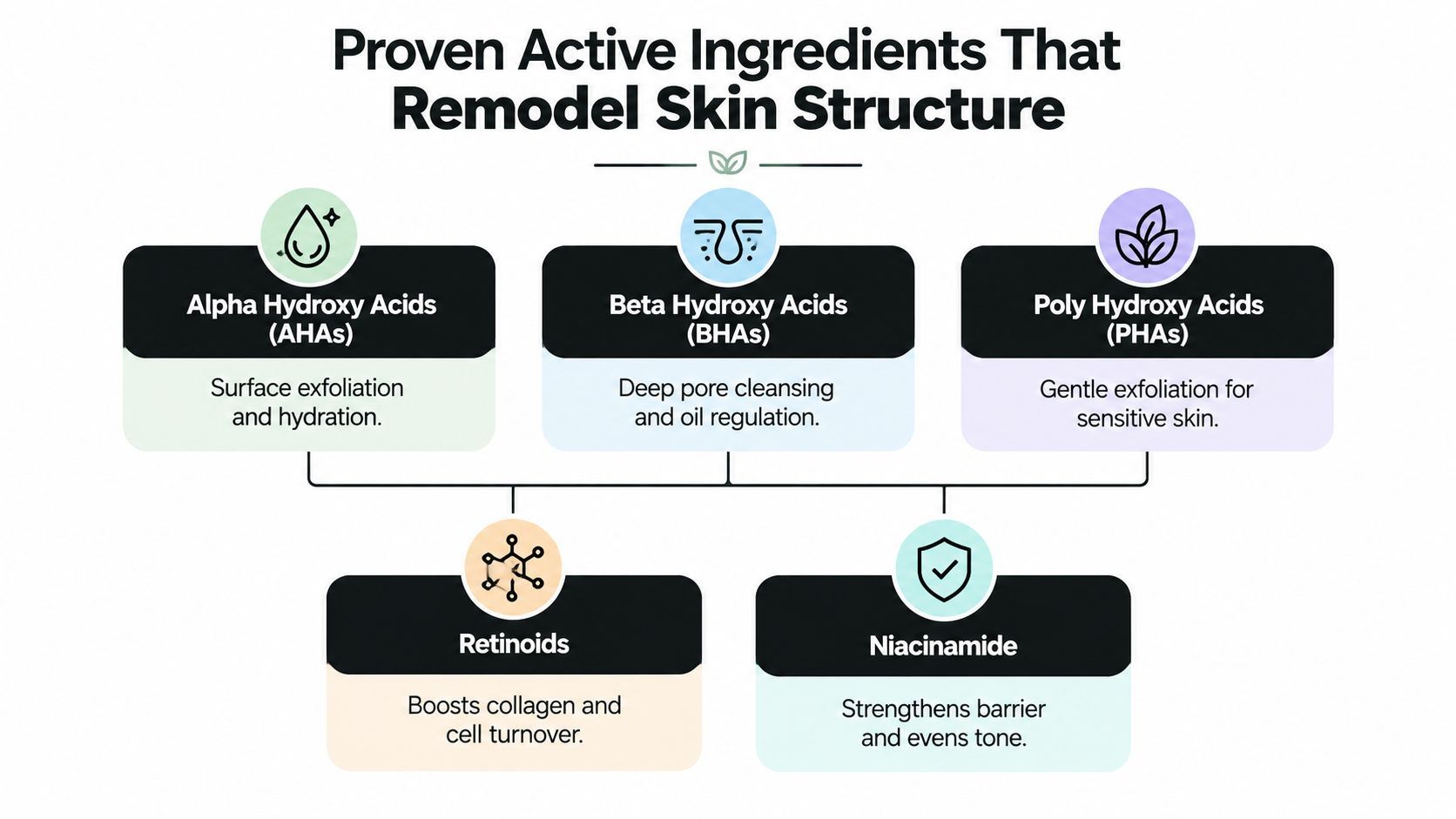
Proven Active Ingredients That Remodel Skin Structure
Surface polishing has limits. Acids mainly alter the stratum corneum, retinoids influence epidermal renewal and dermal signaling, and barrier-supportive ingredients determine whether skin can tolerate either approach. Match the active to the biology of the texture concern rather than combining products indiscriminately.
Acids refine the surface
Alpha hydroxy acids, such as glycolic and lactic acid, loosen the connections between surface corneocytes and promote more even shedding. They fit concerns involving dullness, retained scale, and roughness. Their water affinity may also make skin appear more hydrated, but that optical change does not rebuild the dermis.
Beta hydroxy acids, especially salicylic acid, are oil-soluble. They therefore suit pore congestion, blackheads, and follicular bumps better than purely dry roughness. Familiarity does not guarantee gentleness. Concentration, vehicle, frequency, and barrier condition all affect irritation risk.
Poly hydroxy acids offer a slower exfoliating option for people who react to stronger acids. They can support surface renewal while contributing to hydration. Even so, a product described as gentle can irritate skin when combined with other resurfacing agents.
The Skin Perfection Liquid Exfoliant Peel AHA BHA PHA combines AHA, BHA, and PHA in a non-abrasive leave-on formula. Its listed ingredients include 2% salicylic acid, glycolic acid, lactic acid, lactobionic acid, kojic acid, hyaluronic acid, and hexapeptides. Use it as a multi-target exfoliating product, not alongside another acid on the same night.
Retinoids work deeper than polishing
Retinoids regulate cell renewal and can influence both the epidermis and dermis. In a randomized, vehicle-controlled study of 36 elderly participants, 0.4% retinol used up to three times weekly for 24 weeks improved fine wrinkling compared with vehicle, with wrinkle-score changes of −1.64 versus −0.08 and P<.001. Biopsies also showed increased glycosaminoglycan expression and procollagen I immunostaining. The retinol remodeling study supports consistent use rather than expecting an immediate surface effect.
The retinoid form changes the trade-off. Tretinoin acts more directly and usually causes more irritation. Retinol requires conversion within the skin and may work more gradually, but it can suit patients who need a tolerable long-term routine. A clinical review reports that topical tretinoin increased extracellular collagen formation by approximately 80% in the papillary dermis after one year, while continuous 0.05% tretinoin for six months improved photoaging signs, including roughness and hyperpigmentation. The vitamin A review describes this balance between efficacy and tolerability.
Peptides may provide signaling support. Niacinamide and humectants help maintain the barrier conditions that stronger actives require. Growth-factor discussions, including this clinical overview of growth factors for skin, can be complemented by procedural context from Georgia Plastic & Reconstructive Surgery. These approaches should remain distinct from the better-established roles of retinoids, acids, moisturization, and photoprotection.
Diagnosing Your Specific Texture Concerns
“Bumpy” isn't a diagnosis. The right active depends on whether the surface is retaining scale, the follicle is congested, inflammation has left pigment behind, or the dermis has changed with age.
Use the pattern, not the marketing label
| Visual Symptom | Likely Biological Cause | Primary Active Strategy |
|---|---|---|
| Fine roughness and dull surface | Retained surface scale, dehydration, or slower renewal | Gentle AHA or PHA, moisturizer, and consistent photoprotection |
| Enlarged-looking pores and blackheads | Follicular oil and keratin congestion | Controlled BHA use, non-comedogenic moisturization, and no picking |
| Small acne-related bumps | Active follicular inflammation or comedones | Acne-focused care, cautious BHA use, and treatment of the inflammatory trigger |
| Dark marks after acne, cuts, burns, or procedures | Post-inflammatory hyperpigmentation | Control inflammation first, then consider pigment-targeting actives and daily ultraviolet protection |
| Symmetrical facial brown patches | Possible melasma | Clinical classification, strict photoprotection, and controlled pigment suppression |
| Fine lines with laxity and roughness | Age-related epidermal and dermal remodeling | Gradual retinoid use, moisturization, and photoprotection |
Post-inflammatory hyperpigmentation, or PIH, follows an identifiable inflammatory event. It can develop after acne, cuts, burns, lupus, laser or light treatments, and cryotherapy, and it's especially common in darker skin types classified as Fitzpatrick types III through VI. The clinical review of PIH explains why persistent irritation can prolong discoloration instead of clearing it. If new acne or dermatitis continues, repeatedly adding acids treats the surface while leaving the pigment trigger active.
Melasma is different. It's a chronic acquired disorder of facial pigmentation, not scattered sun spots. Solar lentigines, often called sun spots, are also not interchangeable with melasma or PIH. A dermatologist may use a Wood's lamp or dermatoscope to estimate pigment depth, and biopsy can be considered if another condition cannot be excluded. The American Academy of Dermatology guidance on melasma recommends broad-spectrum sunscreen with SPF 30 or higher, along with shade and a wide-brimmed hat.
Why one exfoliant fails
Tyrosinase is a central control point in melanin production. Hydroquinone reduces pigmentation by interfering with enzymatic oxidation of tyrosine and DOPA, while azelaic acid also inhibits tyrosinase. Merck Manual's explanation of hyperpigmentation helps clarify why a pigment routine must do more than remove surface cells.
An acid can accelerate shedding and improve feel, but it doesn't address every signal driving melanogenesis. If a peel causes inflammation, it may worsen PIH. A targeted routine therefore asks two questions: what created the texture, and what could make it persist?
Safe Layering Strategies for Sensitive Skin
The fastest way to lose progress is to damage the barrier while trying to accelerate renewal. Stinging, persistent redness, tightness, scaling, and sudden sensitivity are not proof that an active is working. They're signals to reduce the load.
Introduce one variable at a time
Start with a gentle cleanser, a bland moisturizer, and daily broad-spectrum sunscreen. Once the skin feels stable, add one resurfacing active rather than combining an acid, retinoid, scrub, and brightening serum at once. That gives you a way to identify both benefit and irritation.
Patch testing doesn't guarantee that a product won't irritate the face, but it can reveal an obvious reaction before broader use. Apply a small amount to a limited area according to the product's directions, then observe the skin before expanding application.
For sensitive, dry, rosacea-prone, or eczema-prone skin, frequency should follow tolerance rather than ambition. Dermatology guidance suggests BHA roughly one to three times weekly and gentler AHAs about once weekly for sensitive skin, while advising against multiple acids or strong acids combined with retinoids on the same night. The dermatology guidance on exfoliation safety also emphasizes that acid type, concentration, formulation, and individual response all matter.
Separate treatment nights
A practical schedule might use an acid on one evening, a retinoid on another, and recovery nights between them. The popular “skin cycling” sequence can function as a flexible heuristic, but it hasn't been directly validated as a complete clinical protocol. Treat it as a way to create recovery space, not as a mandatory four-night prescription.
Practical rule: When your skin is reacting, reduce frequency before reducing moisturizer. Barrier support is what allows useful actives to remain in the routine.
Avoid applying strong acids to freshly shaved, sunburned, cracked, or visibly inflamed skin. Be cautious around the eyelids, nostril creases, and corners of the mouth, where the barrier is more vulnerable. A clear guide to layering skin care can help organize compatible steps, but no layering chart overrides burning, swelling, or worsening dermatitis.
Step-by-Step Routines for Morning and Night Resurfacing
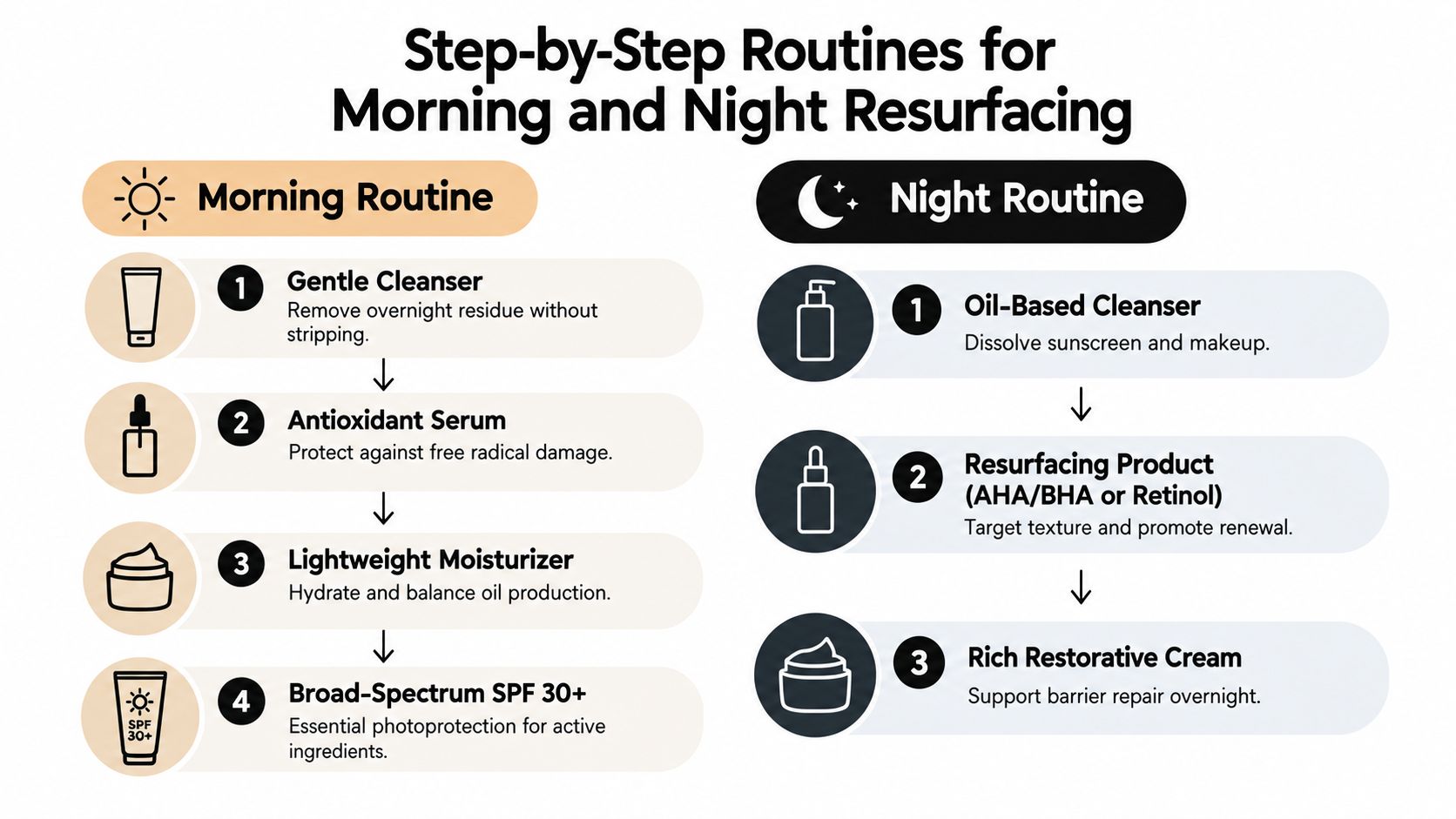
Resurfacing only works in a protected environment. Morning care should defend the skin from ultraviolet and visible-light exposure, while evening care can focus on controlled renewal and recovery.
Morning routine
- Cleanse without stripping. Use a gentle cleanser, or rinse with water if cleansing leaves your skin tight. The goal is to remove residue without creating the dryness that makes texture more visible.
- Apply an antioxidant or pigment-supporting serum. Antioxidants help support defense against environmental stress. If pigmentation is the dominant concern, choose a formula that addresses melanin production rather than relying only on exfoliation.
- Moisturize according to barrier needs. A lightweight lotion may suit oilier skin, while a richer cream can reduce water loss in dry or reactive skin. Hydration changes how light reflects from the surface, but it shouldn't be confused with collagen remodeling.
- Finish with broad-spectrum sunscreen. This step protects the progress made at night. For melasma and persistent pigmentation, dermatology guidance supports sunscreen with ultraviolet protection and, where appropriate, iron oxides for visible-light protection.
Evening routine
- Remove sunscreen and makeup thoroughly. An oil-based first cleanse can dissolve resistant products, followed by a gentle water-based cleanser if needed.
- Choose one resurfacing category. Use an AHA, BHA, or PHA product when surface roughness or congestion is the priority. Use a retinoid on a separate night when long-term renewal and fine lines are the priority. Start below the maximum frequency suggested on the label if your skin is sensitive.
- Support recovery immediately. Apply a moisturizer after the active, or use a moisturizer before and after the retinoid if that buffering approach improves tolerability. Don't add a second exfoliant just because the first one feels comfortable.
The AHA BHA PHA Dark Spot Whitening Serum contains kojic acid, glycolic acid, lactic acid, salicylic acid, lactobionic acid, hyaluronic acid, and hexapeptides. Its intended role is to combine exfoliation, hydration, and pigment-focused care, so it should be treated as an active product within the routine rather than as a neutral hydrating serum.
Evidence favors coordinated pigment management. A systematic review pooling 56 studies reported a melanin-index effect size of approximately SMD −0.85 and a clinician-rating effect size of approximately SMD −0.70, while noting limitations involving sample size and study heterogeneity. The systematic review of medical skincare interventions found stronger effects with tyrosinase inhibitors and better tolerability with antioxidants and sunscreen products.
Here's a visual walkthrough of the sequence:
Troubleshooting Barrier Damage and Over-Exfoliation
Over-exfoliation often appears before a person recognizes it. A product that used to feel comfortable starts to sting. Water burns. The face feels tight despite moisturizer, looks unusually shiny or flaky, and develops redness or reactive bumps in areas that weren't previously problematic.
Stop the active load first
Pause acids, retinoids, scrubs, peels, strong vitamin C formulas, and fragranced products while the skin is stinging or visibly inflamed. Don't try to correct the reaction with another exfoliant. That usually adds injury to an already impaired barrier.
Use lukewarm water and a non-foaming or low-irritation cleanser. Apply a bland moisturizer with barrier-supportive ingredients, and use an occlusive layer on the driest areas if your skin tolerates it. During the day, continue sunscreen if application doesn't burn. If sunscreen stings, physical protection such as shade and a wide-brimmed hat becomes especially important while you arrange appropriate care.
Reintroduce slowly
Wait until cleansing and moisturizing no longer cause stinging and the skin has returned to its usual comfort and appearance. Then reintroduce one active at a lower frequency, not the entire previous routine. A retinoid and acid should remain on separate nights until you know the barrier can tolerate both over time.
Persistent swelling, blistering, severe pain, crusting, spreading rash, or eye involvement warrants medical evaluation rather than home experimentation. The same applies when symptoms don't improve after removing the suspected irritants. The step-by-step guide to repairing a damaged skin barrier can help structure recovery, but it isn't a substitute for diagnosis when the reaction is significant.
Recovery principle: The right time to restart resurfacing is when the barrier is quiet, not when you're impatient with the texture.
The Case for System-Based Skincare Solutions
Random product stacking fails because it confuses intensity with precision. A routine containing several acids, a retinoid, abrasive tools, and multiple brighteners may create more inflammation than improvement. Skin needs an appropriate stimulus, enough recovery, and protection from the exposure that continues to drive roughness and pigment.
A system-based approach assigns each product a job:
- Renewal: Use an acid or retinoid according to the specific texture pattern and your tolerance.
- Pigment control: Address tyrosinase activity and the inflammatory trigger instead of relying on surface exfoliation alone.
- Barrier preservation: Use moisturization and recovery nights so treatment remains sustainable.
- Photoprotection: Apply broad-spectrum sunscreen consistently to prevent new damage and protect gains.
- Adherence: Keep the routine simple enough to follow without constantly changing products.
This is the logic behind the “More Actives, Less Additives” philosophy associated with Mesoderm RX. The brand's catalog describes formulas that avoid hydroquinone, parabens, sulfates, phthalates, mineral oil, petrolatum, dyes, and added fragrance, while offering vegan and cruelty-free products made in the USA. Those attributes don't replace clinical judgment, but a minimal-additive approach can be useful for people who need to limit potential irritants while using results-driven actives.
Topical care isn't the only route to structural improvement. Professional procedures require careful patient selection, technique, and aftercare, particularly for people prone to PIH. Readers comparing options can review information about texture-focused skin needling, while remembering that controlled injury is still injury and can worsen pigmentation when used indiscriminately.
The practical conclusion is straightforward. Match the active to the mechanism, introduce it gradually, protect the skin every morning, and judge progress over sustained use rather than by the immediate sensation of tightness or peeling.
Mesoderm RX offers active-focused options for exfoliation, dark-spot care, barrier-conscious hydration, and daily sun protection that can be organized around your specific texture concern. Visit Mesoderm RX to build a simpler routine based on controlled resurfacing, pigment management, and consistent photoprotection.