


Choose Your Sensitive Skin Exfoliant Safely
Most sensitive skin advice starts with avoidance. Don’t exfoliate. Don’t use acids. Don’t do anything that might “trigger” your skin.
That advice is too blunt to be useful.
A sensitive skin exfoliant isn’t dangerous by definition. The problem is usually the wrong mechanism, the wrong acid, the wrong concentration, or the wrong routine built around it. Exfoliation should not function like sanding down the skin. It should act as a controlled biological cue that helps loosen excess dead surface cells without pushing the barrier into inflammation.
That distinction matters because the category has already moved in this direction. The global exfoliators market was valued at USD 6,854.6 million in 2023, and chemical exfoliants accounted for about 70% of the share, largely due to their suitability for sensitive and acne-prone skin, according to Grand View Research’s exfoliators market report. Patients aren’t looking for rougher scrubs. They’re looking for smarter control.
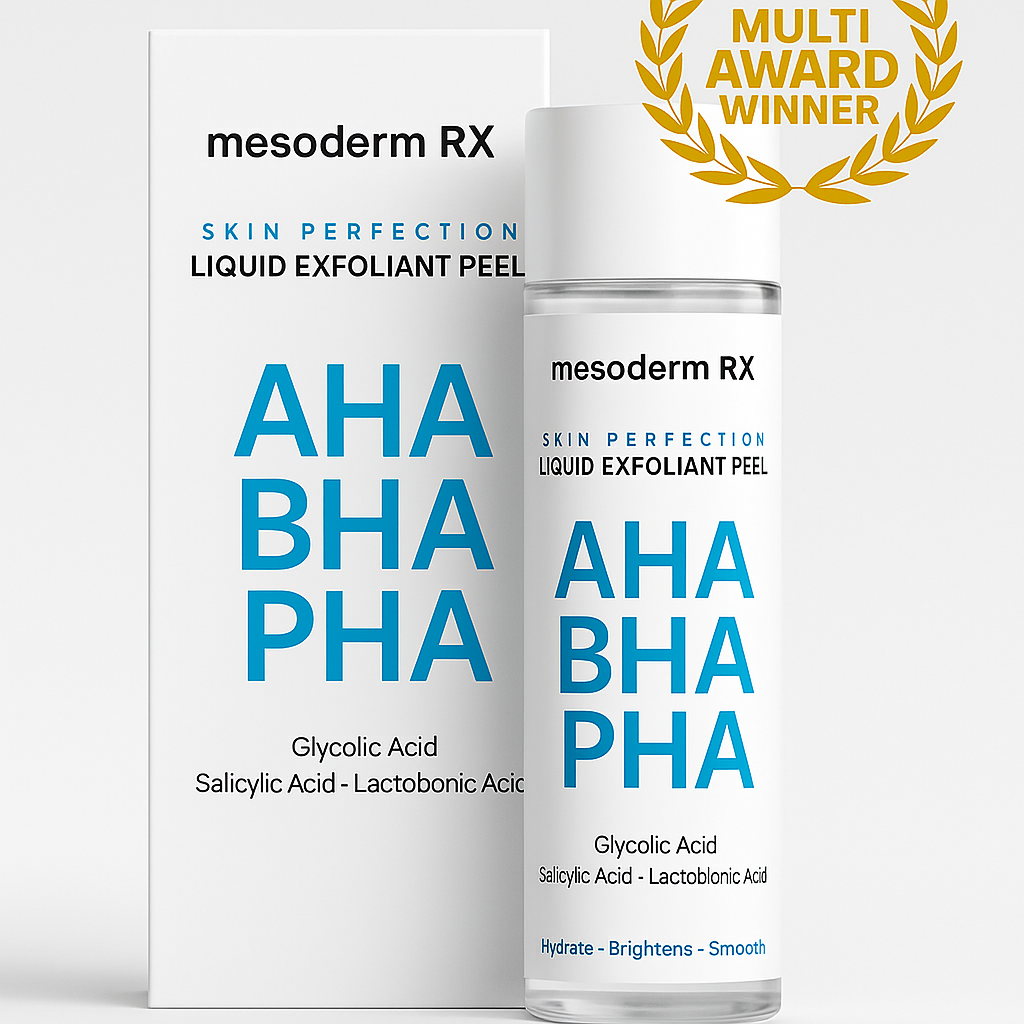
Featured Product
Skin Perfection Liquid Exfoliant Peel AHA BHA PHA
EXFOLIATES, CLEARS PORES, AND REVEALS RADIANT SKIN.
Shop Now →The New Exfoliation Paradigm for Sensitive Skin
Sensitive skin has been taught to fear exfoliation because people still picture the old model. Grainy scrubs. Stinging peels. Redness treated as proof that something is “working.” Clinically, that approach makes little sense for reactive skin.
The better model is controlled renewal. Skin already sheds cells through a natural process. A well-formulated exfoliant guides that process more evenly. It doesn’t need to abrade the barrier to be effective.
Scrubbing is not the goal
When sensitive patients say exfoliation “never works” for them, they’re often describing irritation from friction, overuse, or a badly chosen active. That’s not a failure of exfoliation itself. It’s a failure of product design and protocol.
A useful way to think about this is to separate removal from signaling:
- Removal-focused exfoliation tries to force skin smoothness through friction or aggressive acid exposure.
- Signal-focused exfoliation encourages orderly shedding with lower irritation potential.
- Barrier-aware exfoliation respects that reactive skin needs precision more than intensity.
Clinical reality: The safest exfoliation for sensitive skin usually looks less dramatic, not more.
That shift is also why more clinicians now discuss alternatives to traditional peel thinking. If you want a broader overview of procedures and non-aggressive options, the ProMD Health Easton guide to alternatives is a useful companion read.
Why modern formulations changed the conversation
Better exfoliation for sensitive skin comes from chemistry, not force. Molecular size, delivery system, and the presence or absence of unnecessary irritants change how an exfoliant behaves on skin. That’s one reason many consumers have also moved toward simpler formulas. Mesoderm RX has a helpful perspective on clean skincare for sensitive skin, especially if you’re trying to reduce avoidable triggers around your actives.
Sensitive skin doesn’t need to be left dull, flaky, congested, or uneven. It needs a narrower margin of error.
Understanding Your Skin Barrier and Reactivity
Sensitive skin is often treated like a fixed identity. In practice, it’s usually better understood as a state of barrier dysfunction. Some people are naturally more reactive, but many episodes of “sensitivity” happen because the outer barrier has been disrupted and is no longer regulating water loss and irritant exposure well.

What the barrier is actually doing
The outermost layer of skin, the stratum corneum, is not dead weight. It’s an active defensive structure. It holds moisture in, slows penetration of irritants, and supports orderly shedding of surface cells.
When that layer is intact, skin can tolerate more. When it’s disrupted, ordinary products start to sting.
A leaky roof illustrates this principle. If the roof is sound, rain stays out. If there are gaps, water gets in and damage spreads far beyond the original weak point. The same pattern happens in skin. Once the barrier is compromised, irritants pass through more easily, inflammation rises, and the skin starts overreacting to things it previously handled well.
Why reactive skin flakes and burns at the same time
Many people assume flaking means they need stronger exfoliation. Often the opposite is true.
A damaged barrier doesn’t shed neatly. Surface cells build up unevenly, then loosen in patches. That creates roughness and visible flakes, but underneath, the skin may already be inflamed and dehydrated. If you hit that skin with a harsh scrub or a strong acid, you worsen both problems at once.
Common signs of barrier-driven reactivity include:
- Stinging from mild products that never used to bother you
- Tightness after cleansing even when the cleanser is marketed as gentle
- Patchy roughness that coexists with redness
- Shiny but dehydrated skin, where the surface looks slick but feels uncomfortable
Sensitive skin often isn’t “too weak” for exfoliation. It’s too inflamed for careless exfoliation.
Why desquamation matters
Skin sheds cells through desquamation, a tightly regulated process in which surface cells detach from one another and lift away. Good exfoliation works with that biology. Bad exfoliation overrides it.
That’s why barrier repair and exfoliation shouldn’t be treated as competing goals. In sensitive skin, they have to work together. If the barrier is unstable, even a technically good acid may feel like the wrong product. If the barrier is supported, gentle exfoliation becomes much more predictable.
Common Exfoliation Failures and Why They Happen
Most bad exfoliation experiences follow the same pattern. The patient picks a product based on strength, tingling, or instant smoothness. The barrier gets hit too hard. Then sensitivity gets blamed on exfoliation as a category, instead of on the method.
That’s the wrong diagnosis.
A recent national survey found that 63.2% of dermatologists are now comfortable recommending daily gentle exfoliation for sensitive skin types, reflecting trust in modern micro-dose formulations, as reported in Cosmoderma’s survey on daily gentle exfoliation. The shift matters because clinicians are not endorsing old-school irritation. They’re endorsing better formulation logic.
Failure pattern one: abrasive scrubs
Physical scrubs fail sensitive skin when the particles are irregular, sharp, or used with too much pressure. The skin may feel smoother for a few hours, but friction can create microscopic surface injury and trigger redness.
The problem is not just what you remove. It’s what you provoke. Mechanical irritation can increase inflammation, make broken capillaries look more obvious, and leave skin more reactive the next time you apply even basic skincare.
Failure pattern two: DIY acids and “natural” shortcuts
Lemon juice, baking soda mixtures, and internet peel hacks are common reasons a routine collapses. They’re unpredictable, poorly buffered, and unconcerned with barrier safety.
“Natural” does not mean physiologically appropriate for facial skin. Sensitive skin usually does worst with ingredients that are inconsistent, highly acidic, highly alkaline, or both over time.
Failure pattern three: wrong acid, wrong person
Even chemical exfoliation can fail when people choose based on marketing instead of skin behavior. Small, fast-penetrating acids can be excellent tools in the right patient. They can also be too much for someone with flushing, barrier instability, or a history of post-inflammatory darkening after irritation.
Common mistakes include:
- Chasing the strongest formula because weaker products seem less serious
- Layering multiple exfoliants in one evening
- Combining acids with retinoids on skin that already feels warm, dry, or tight
- Using an acne product everywhere when sensitivity is concentrated on the cheeks or around the mouth
If your skin gets red first and clearer later, that routine is usually backwards.
What works is more selective. The right sensitive skin exfoliant should create a cleaner shedding pattern without creating an inflammatory event.
Choosing Your Gentle Exfoliant Acid Type
The most useful question isn’t “Should I use an acid?” It’s which acid behaves in a way your skin can tolerate.
For sensitive skin, molecular size is one of the most overlooked decision points. In general, larger molecules penetrate more slowly and less aggressively. That slower entry often translates into a gentler clinical experience.

Why size changes tolerance
Polyhydroxy acids, or PHAs, are especially relevant here. PHAs like gluconolactone are ideal for sensitive skin because their larger molecular size limits skin penetration, providing effective exfoliation while also acting as hydrating humectants, as explained in Snow Fox Skincare’s guide to acids for sensitive skin. That combination matters. You’re not just resurfacing. You’re doing it in a way that is less likely to strip a reactive barrier.
Mandelic acid applies a similar principle within the AHA family. It is larger than glycolic acid, so it tends to move through the skin more slowly. For many sensitive patients, that makes it easier to use consistently.
Comparing the main exfoliant families
Not every acid family serves the same patient or the same problem. Here’s the practical comparison.
| Acid Type | Primary Benefit | Molecular Size | Sensitivity Risk |
|---|---|---|---|
| PHA | Gentle surface smoothing and hydration support | Large | Low |
| Mandelic acid AHA | Tone, texture, and mild resurfacing with slower absorption | Larger than glycolic | Lower than more aggressive AHAs |
| Other AHAs | Surface renewal and visible brightening | Varies | Moderate to higher, depending on formula |
| BHA | Oil-soluble pore clearing for congestion | Different penetration behavior due to oil solubility | Variable |
| Enzymes | Mild loosening of surface buildup | Not typically discussed by molecular size in the same way | Usually lower, but formula still matters |
What each category does well
PHAs are usually the safest starting point when the barrier is easily disturbed. They give you a shallower, slower exfoliation profile.
Mandelic acid makes sense when you want more visible resurfacing than a PHA alone may provide, but still want a gentler AHA option.
BHAs can be very useful if sensitivity coexists with clogged pores or oil congestion. But “good for acne” doesn’t automatically mean “good for all reactive skin,” especially if the rest of the formula is drying.
Enzymes can help patients who dislike acid language altogether, though the gentleness still depends on the complete product.
For a practical overview of how AHA and BHA products differ in real routines, Mesoderm RX offers a concise guide to AHA and BHA products.
What to choose first
If your skin burns easily, start with PHA-first formulas.
If your main concern is dullness, uneven tone, and rough texture, with some sensitivity but not severe reactivity, mandelic-acid-based formulas are often the more useful next step.
If your skin is both reactive and congested, the best products usually rely on small amounts of multiple exfoliating pathways rather than one aggressive active trying to do everything.
The Safe and Effective Exfoliation Protocol
The right exfoliant can still fail if the protocol is careless. Sensitive skin needs a sequence, not enthusiasm.

Step one, patch test like it matters
Patch testing isn’t a formality. It tells you whether your skin can tolerate the formula before your whole face has to find out at once.
Apply the product to a small discreet area for several nights in a row before first full-face use. You’re not only watching for obvious redness. Watch for delayed warmth, tightness, scaling, or that distinct sensation that your skin suddenly dislikes everything else you apply after it.
Step two, start with low-friction chemistry
For sensitive skin, I prefer patients begin with an acid profile that already leans gentle. Mandelic acid penetrates more slowly than glycolic acid, reducing irritation, and dermatologists recommend starting with concentrations below 10-15% for safe at-home use on sensitive skin, according to Curology’s guide to choosing an exfoliator for sensitive skin.
That matters because tolerance is built through repetition, not bravado.
Step three, keep the routine boring on exfoliation night
A safe introduction usually looks like this:
- Cleanse gently. No scrub, brush, or cleansing acid.
- Apply the exfoliant to fully dry skin. Damp skin can increase penetration and make a borderline formula feel harsher.
- Wait and observe. Mild transient sensation can happen. Ongoing sting is a stop signal.
- Follow with a plain moisturizer. The goal is to reduce friction and support water retention.
- Skip competing actives that night. Retinoids and additional acids are common reasons a good exfoliant gets blamed for a bad outcome.
Practical rule: If you can’t tell which active caused the reaction, you used too many actives.
If you’re comparing office-based procedures with at-home approaches, this overview of advanced skin exfoliation gives useful context on where professional peels fit and where gentler maintenance routines make more sense.
Step four, increase frequency only after calm skin proves it
Don’t judge an exfoliant by the first use. Judge it by what your skin looks like the next morning, and again after repeated use.
Signs to continue include smoother feel, more even texture, and no persistent redness. Signs to pause include burning with moisturizer, diffuse tightness, or sudden flaking that makes the skin look polished but uncomfortable.
A short visual explainer can help if you’re trying to simplify the sequencing:
For patients who are still deciding between gentler acid profiles, Mesoderm RX also has a clear primer on what lactic acid does for skin. It’s useful when comparing hydration-forward exfoliation with mandelic or PHA-led options.
Achieving Clarity Without Compromise
Exfoliation can improve texture, brightness, and tone. It cannot protect your barrier for you. It also cannot protect you from the pigment fallout that follows irritation and UV exposure.
That is why a sensitive skin exfoliant should never be treated as a standalone fix. The clinical win comes from the system around it. Gentle renewal, barrier support, and daily sun protection have to work together, especially in skin that darkens easily after inflammation.

The trade-off most people miss
People often chase visible smoothing fast, then act surprised when the skin becomes shinier, redder, or more unpredictable. That is not progress. It is surface disruption.
The better trade-off is slower but steadier. You want exfoliation that your skin can repeat consistently. Consistency matters more than intensity because repeated low-grade inflammation will sabotage tone correction, especially if you’re also dealing with dark spots, blotchiness, or post-inflammatory hyperpigmentation risk.
That’s also why broad-spectrum sunscreen is not optional after exfoliation. If you remove excess surface buildup and then leave fresh skin unprotected, you increase the odds that irritation and UV exposure will undo your progress.
What a complete routine should include
A workable sensitive-skin system usually has these parts:
- A controlled exfoliant chosen for behavior, not hype
- A plain supportive moisturizer that reduces water loss and calms the barrier
- A daily sunscreen used consistently, not only when outdoors for long periods
- Restraint with actives so the skin can stay predictable
Clearer skin should feel calmer over time. If it feels progressively angrier, the routine is poorly designed.
Where devices and treatments fit
Some patients also ask whether devices can replace exfoliation. In-office tools and hydro-dermabrasion style treatments can be useful in selected cases, but they still need barrier-aware planning. If you’re evaluating device-based options, this overview of advanced aesthetic facial equipment is a useful reference for understanding the category. The key point is the same either way. Tools do not rescue an aggressive routine. They only work well when the skin is being managed conservatively.
The endpoint is not dramatic peeling. It is calm, even, more reliable skin.
That’s the standard sensitive skin should be held to. Not fear. Not avoidance. Precision.
If you want a routine built around high-potency actives without the usual overload of fragrance, dyes, and unnecessary fillers, explore Mesoderm RX. Their approach is straightforward: more actives, fewer additives, with formulas designed to brighten, smooth, and support skin that needs results without constant irritation.