


Retinol Alternative for Sensitive Skin: Clinical Guide
The most popular advice for sensitive skin is often the least clinically useful: “push through the burn” until your complexion adjusts. Peeling, tightness, and persistent stinging aren't proof that a retinoid is working. They can indicate that inflammation has outrun your skin's ability to maintain its barrier.
A better retinol alternative for sensitive skin isn't a gentler bottle with a fashionable ingredient. It's a complete treatment system that addresses collagen support, pigment production, surface texture, inflammation, and barrier preservation at the same time. Bakuchiol has the strongest direct evidence among alternatives, but the vehicle, supporting actives, application schedule, and photoprotection determine whether your results are sustainable.
The Biological Reality of Retinoid Dermatitis
Retinoid irritation isn't a cosmetic inconvenience. It's a biological response that begins when retinoid-driven cellular activity and barrier disruption exceed the skin's tolerance. The stratum corneum becomes less effective at retaining water, inflammatory signaling increases, and the surface develops the familiar pattern of dryness, scaling, erythema, burning, and sensitivity.
Topical retinoid therapy commonly produces peeling, erythema, irritation, and dryness. The peak of cutaneous irritation typically occurs during the first 1–2 weeks before subsiding, while tolerability remains lower in sensitive skin than in normal skin, as described in this clinical review of topical retinoid therapy.
Why sensitive skin reacts differently
Sensitive skin doesn't necessarily lack the ability to benefit from vitamin A derivatives. It often has a narrower margin between therapeutic stimulation and inflammatory injury. Once the barrier is compromised, water escapes more readily through the epidermis, and irritants penetrate more easily. Cleansers, acids, fragrance, wind, and ultraviolet exposure can then amplify the reaction.
That cycle matters for pigmentation. Inflammation can stimulate melanocytes, the pigment-producing cells in the epidermis. A routine intended to fade discoloration may therefore create the inflammatory conditions that sustain post-inflammatory hyperpigmentation.
Clinical rule: Burning isn't a treatment target. A tolerable routine that you can maintain is more useful than a theoretically stronger routine that repeatedly triggers dermatitis.
The “retinol uglies” narrative also encourages the wrong diagnosis. A brief adjustment period can occur with retinoids, but persistent redness, cracking, painful tightness, or escalating sensitivity means the barrier is asking for less exposure, not more determination. If you're trying to understand why peeling keeps returning, this guide to retinoid-related skin peeling explains the problem in practical terms.
The correct response is to reduce inflammatory pressure and choose a pathway that supports renewal without directly forcing the same receptor-mediated activity. That's why a retinol alternative for sensitive skin should be selected according to mechanism and formulation, not marketing language.
Bakuchiol and the Evidence for Receptor-Free Renewal
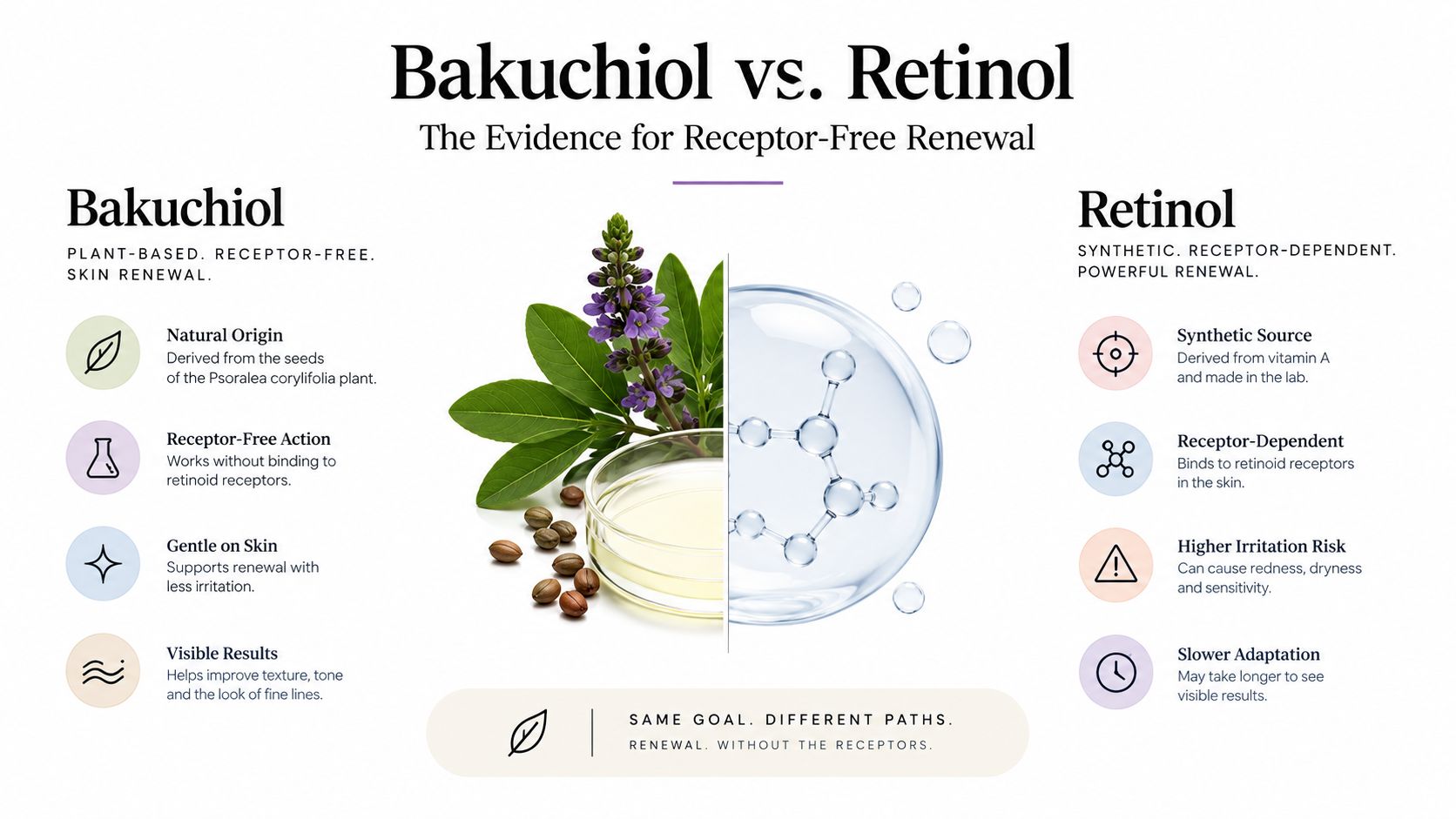
Bakuchiol can provide retinoid-like support for visible photoaging without directly activating retinoic acid receptors. Its activity appears to overlap with pathways involved in collagen support, pigmentation, and the appearance of photoaging. That mechanism makes it a useful retinol alternative for sensitive skin, but it does not make every bakuchiol product automatically non-irritating.
The clinical advantage is practical. Direct receptor activation can drive renewal while also provoking scaling, burning, and persistent redness in reactive skin. Bakuchiol takes a different route toward similar visible outcomes, allowing a barrier-preserving formulation strategy rather than relying on increasing retinoid strength.
What the head-to-head evidence shows
A randomized, double-blind head-to-head study found that bakuchiol performed as well as retinol for reducing fine lines and improving skin color, while producing less peeling and burning. Harvard Health's review of bakuchiol summarizes the proposed explanation: bakuchiol does not directly activate retinoic acid receptors.
A later review examined a 12-week randomized study in 44 patients using either 0.5% bakuchiol cream twice daily or 0.5% retinol cream daily. Both groups achieved significant reductions in wrinkle surface area and hyperpigmentation, with no statistical difference in efficacy. Bakuchiol was better tolerated, according to this review of retinol-to-bakuchiol clinical data. For a closer look at how retinol concentrations behave on reactive skin, see our guide to retinol 1.0 cream.
Another 4-week study of 60 women with sensitive, mildly to moderately photodamaged skin evaluated a bakuchiol cleanser and moisturizer. The products improved smoothness, clarity, radiance, and overall anti-aging measures without major irritation signals. These findings do not establish bakuchiol as identical to prescription tretinoin in every clinical setting. They do show that sensitive skin can pursue visible improvement without accepting repeated discomfort as the price of treatment.
What bakuchiol can and can't replace
Bakuchiol can anchor a barrier-conscious renewal routine, while other ingredients handle pigment regulation, antioxidant support, and hydration. Peptides and a moisturizer that reduces water loss can broaden the routine without forcing one active to do every job.
Featured Product
Advanced Triple Action Age-Defying Serum
Defy the signs of aging and restore your youthful glow with a serum that works to smooth, firm, and brighten your skin.
Shop Now →
Sunscreen remains necessary, and combining several aggressive products can still provoke inflammation. Choose a well-preserved, fragrance-conscious formula and introduce it gradually. The Anti-Aging Powerhouse is listed as a kit designed to support the moisture barrier, the appearance of fine lines and wrinkles, firmness, resiliency, and hydration. Its product category and directions should be followed as listed, rather than assuming serum-specific dropper dosing.
Bakuchiol is a foundation for renewal, not a complete prescription. A clinically sensible routine pairs it with targeted pigment control and resurfacing support while keeping irritation low.
Secondary Actives for Resurfacing and Pigment Control
Retinoids are popular because one active appears to address multiple concerns. Sensitive skin needs the same breadth of treatment, but it often needs that breadth distributed across several better-tolerated ingredients.
Start with the diagnosis. Post-inflammatory hyperpigmentation, or PIH, develops when inflammation causes excess melanin production after acne, dermatitis, picking, or another injury. Melasma is a chronic, often relapsing pigment disorder influenced by hormonal and ultraviolet factors. Sun spots, also called solar lentigines, are localized areas of accumulated pigment related to long-term exposure. These conditions can overlap visually, but they don't have identical biology or treatment priorities.
Assign each active a specific job
Tyrosinase is a key enzyme in melanin production. Tyrosinase inhibitors such as azelaic acid, kojic acid, and arbutin can interrupt melanin formation and lighten hypermelanosis, offering a depigmenting pathway that may be more suitable for sensitive skin than traditional hydroquinone protocols, as explained in this NIH-reviewed discussion of hyperpigmentation treatment.
Azelaic acid is particularly useful when pigment and blemish-related inflammation occur together. Tranexamic acid is another option for pigment-focused routines, especially when the clinical priority is controlling discoloration without relying on a retinoid. The evidence for pigment treatment supports combination strategies with topical agents and photoprotection rather than indiscriminate layering, as outlined in this review of PIH treatment options.
| Active Ingredient | Biological Target | Sensitive Skin Advantage |
|---|---|---|
| Bakuchiol | Overlapping renewal and photoaging pathways without direct retinoic acid receptor activation | Supports visible smoothing with a lower irritation burden than retinol |
| Azelaic acid | Pigment production and inflammation-related pathways | Addresses discoloration and blemish-associated redness in one pathway |
| Tranexamic acid | Pigment signaling associated with discoloration | Useful for targeted pigment control without surface exfoliation |
| Peptides | Cellular signaling associated with firmness and structural support | Adds anti-aging support without intentionally removing the stratum corneum |
| Niacinamide | Barrier-support processes and tone irregularity | Helps support resilience while complementing pigment and hydration work |
| Polyhydroxy acids | Gentle surface exfoliation and hydration | Larger molecules and humectant behavior can make them more comfortable than stronger acids |
Why PHAs deserve a place
Low-percentage polyhydroxy acids, or PHAs, can loosen accumulated surface cells while contributing humectant support. They're not automatically irritation-free, but they can be a more controlled resurfacing choice when conventional acid exfoliation causes burning.
Peptides don't “replace collagen” in the skin. Their practical role is signaling support within a broader routine. Niacinamide likewise isn't a universal cure, but it can help a sensitive-skin protocol by supporting barrier function and improving the appearance of uneven tone.
The most effective design is usually systems over single products. One renewal active, one pigment pathway, one structural-support pathway, and a reliable barrier base are easier to assess than a crowded cocktail. For a focused discussion of this pigment pathway, see tranexamic acid benefits for skin.
Why Most Sensitive Skin Routines Fail
Most failures aren't caused by choosing the wrong fashionable active. They come from applying too many biologically active products before the skin has demonstrated that it can tolerate even one.
A typical overloaded routine might combine a retinol alternative, an exfoliating acid, an enzyme mask, a pigment serum, a strong cleanser, and an astringent toner. Each product may look reasonable in isolation. Together, they can create cumulative barrier fatigue, especially when the user interprets early irritation as evidence that the routine is “working.”
The common diagnostic errors
The first error is treating all dark marks as the same condition. If the mark followed inflammation, continued irritation can prolong PIH. If the pattern is consistent with melasma, aggressive exfoliation alone usually won't address the factors driving recurrence. If the lesion is a discrete sun spot, the treatment plan may differ again.
The second error is confusing visible peeling with accelerated improvement. Peeling can make the surface look temporarily smoother, but it doesn't prove that collagen remodeling or pigment control is occurring efficiently. It can also make the skin more reactive to products that were previously tolerated.
The third error is ignoring the product vehicle. A formula can contain a gentle active but still include fragrance, drying solvents, harsh surfactants, or an uncomfortable pH for the individual user. Sensitive skin reacts to the whole formulation, not to the hero ingredient printed on the front label.
Pregnancy and daytime use require nuance
Recent consumer coverage describes bakuchiol as generally suitable for sensitive skin and during pregnancy without increasing sun sensitivity, but it also emphasizes that the evidence base is uneven. This review of retinol alternatives for sensitive skin supports a cautious approach, particularly when a product combines several actives.
That means “pregnancy-safe” shouldn't become a blanket marketing shortcut. Discuss any active routine with your obstetric clinician during pregnancy, and assess the entire formula rather than assuming that every alternative behaves the same way. For daytime use, the central issue is still ultraviolet exposure. A retinol alternative may not increase sun sensitivity in the same way as a retinoid, but pigment treatment remains incomplete without consistent broad-spectrum sun protection.
Structuring a Barrier-First Anti-Aging Protocol
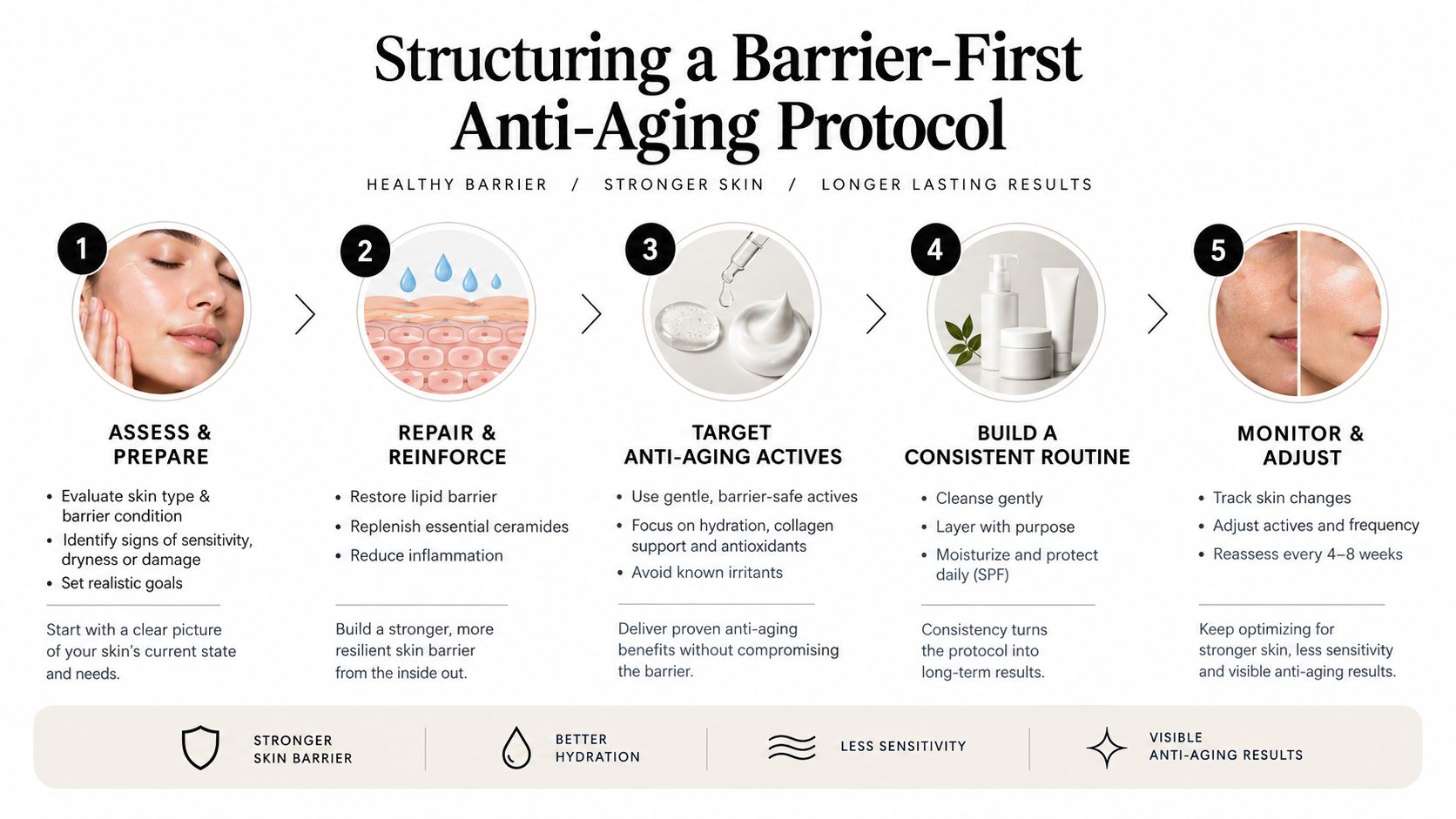
A sensitive-skin routine should be easy to audit. If redness appears, you need to know which product caused it and which step to remove. The following structure separates protection, hydration, renewal, and pigment correction so that each component has a defined role.
Morning sequence
- Cleanse only as much as needed. Use a mild cleanser if you have residue, sweat, or oil to remove. If cleansing leaves tightness, shorten contact time and avoid hot water.
- Apply a hydrating layer. Humectants and a simple moisturizer can reduce the immediate stress placed on the stratum corneum. Don't add an exfoliating toner just because the skin feels dull.
- Use one support active. Peptides or niacinamide can fit here if the formula is well tolerated. Start with one, not both, when your baseline sensitivity is unclear.
- Seal the routine. Apply moisturizer according to dryness and climate. A richer lipid-supporting product may be appropriate when the skin is flaky, while a lighter emulsion may suit an oilier but reactive complexion.
- Finish with sunscreen. Photoprotection is essential for preventing further pigment stimulation and protecting anti-aging progress. If discoloration is your concern, reapplication and physical sun avoidance matter as much as the serum you choose.
Evening sequence
Cleanse gently, then apply your selected pigment or renewal active to fully dry skin. Introduce bakuchiol on alternating evenings rather than beginning with daily use. On the remaining evenings, use only hydration and barrier support.
A useful starting pattern is to apply the renewal product twice during the first week, then pause and assess. If the skin remains comfortable, continue with spaced applications during the next weeks. Don't increase frequency while you have persistent stinging, new scaling, or redness that lasts beyond the application period.
Adjustment rule: Tightness means reduce exposure. Burning means stop the active and return to cleansing, moisturizing, and protection until the skin is comfortable.
Clinical testing of a bakuchiol-containing serum on sensitive-skin subjects over 4 weeks found no reported local redness, itching, tingling, erythema, wheal, edema, or systemic adverse reactions, alongside a 24.90% reduction in transepidermal water loss and a 31.81% reduction in redness after 28 days, according to this NIH-indexed clinical report on a bakuchiol serum. That result supports the principle of choosing a system that respects the barrier, not merely selecting an active with a gentle reputation.
The Critical Role of Delivery Systems and Formulation
The same active can behave differently depending on the vehicle that delivers it. Sensitive skin doesn't need ingredients dumped onto the surface in a concentrated burst. It benefits from controlled exposure, compatible lipids, and a formula that reduces unnecessary friction and evaporation.
Advanced delivery systems include solid lipid nanoparticles, nanostructured lipid carriers, liposomes, niosomes, cyclodextrins, and microemulsions. These systems can encapsulate or organize active molecules, helping regulate their release and improve distribution through the upper skin layers. The goal isn't to bypass the skin recklessly. It's to avoid a harsh surface peak that produces burning before the active can provide a useful effect.
How to evaluate the vehicle
Read beyond the ingredient list. Look for a formula that combines the active with humectants, emollients, occlusive support, and a preservation system appropriate for the product. Fragrance and astringent components aren't automatically intolerable for everyone, but they add variables when the skin is already reactive.
Delivery systems aren't only relevant to retinol. They can improve the experience of alternative actives by influencing how quickly the formula spreads, absorbs, and releases. This is why two bakuchiol serums with similar label claims can produce different results in real routines.
For context, a 2024 review of retinoid delivery systems described advanced carriers that reduced irritation compared with a standard control cream. One study reported a 66.67% reduction in desquamation and a 68.97% reduction in stinging, reinforcing that the formulation vehicle can materially affect tolerability.
The practical lesson is straightforward. Don't judge a product only by its active concentration. Judge whether its delivery architecture makes consistent use realistic.
Clinical Solutions from Mesoderm RX
A useful product range for sensitive skin should separate pigment correction from renewal. It should also limit avoidable irritants and distribute work across compatible actives, rather than asking one ingredient to address every concern.
Mesoderm RX describes its formulations with the principle “More Actives, Less Additives.” Its Skin Perfection Liquid Exfoliant combines AHA, BHA, and PHA acids with kojic acid and hexapeptides. The listed ingredients include glycolic acid, lactic acid, salicylic acid, lactobionic acid, hyaluronic acid, kojic acid, and hexapeptides, supporting exfoliation, tone improvement, pore clarification, hydration, and calming.
That combination still requires restraint. A multi-acid formula can irritate reactive skin when applied too often or layered onto a compromised barrier. Introduce it separately from bakuchiol, avoid active irritation, and adjust frequency according to stinging, redness, and peeling.
For delicate zones, Mesoderm RX lists Intimate Whitening Cream, formulated with tranexamic acid and niacinamide for targeted brightening. Intimate-area skin is susceptible to friction, over-cleansing, and cumulative irritation, so keep this product away from the face and follow its directions.

Other targeted options include an AHA, BHA, and PHA dark-spot serum and an Advanced Age-Defying Serum containing DMAE, collagen, vitamin C, and alpha lipoic acid. Use these as separate, measured components of a routine. Combining every active in one application increases the chance of irritation without necessarily improving results.
A retinol alternative for sensitive skin succeeds when it reduces inflammation while addressing renewal, uneven tone, or visible aging. Choose one renewal pathway, add pigment control deliberately, preserve the barrier, and keep sunscreen in the protocol.
Mesoderm RX offers brightening, resurfacing, and anti-aging formulas that can support a barrier-first approach when selected according to skin tolerance. Visit Mesoderm RX to explore options for uneven tone, dark spots, and visible signs of aging.