


Hyperpigmentation Treatment for Dark Skin Guide
Most advice for dark spots starts with the wrong prescription: use something stronger. In melanin-rich skin, stronger often means more irritation, and irritation can create more pigment than the original blemish. Effective hyperpigmentation treatment for dark skin isn't about bleaching the surface. It's about identifying the trigger, controlling inflammation, reducing melanin production, and protecting the skin from ultraviolet and visible light every day.
Dark marks after acne, eczema, shaving bumps, ingrown hairs, rashes, or procedures are often post-inflammatory hyperpigmentation, or PIH. Melasma and sun-related discoloration require different decisions. The diagnosis matters because a product that helps one pattern may do very little for another, while an unnecessarily aggressive routine can prolong the problem.
Why Standard Dark Spot Treatments Fail on Melanin-Rich Skin
The one-size-fits-all approach fails because pigment-rich skin has a narrow margin between useful stimulation and damaging inflammation. Scrubbing, repeatedly applying strong acids, using high-strength peels at home, or layering several irritating actives can compromise the barrier. The resulting redness and irritation may fade, but melanocytes can remain activated after the visible inflammation settles.
That response is particularly important in Fitzpatrick skin types IV through VI. PIH is described as more prominent and prolonged in skin types III through VI, and the condition is reported more frequently among people with skin of color, including African American, Hispanic or Latino, Asian, Native American, Pacific Islander, and Middle Eastern populations (clinical review of PIH in skin of color). This isn't a reason to avoid treatment. It means treatment must create less inflammation than the condition itself.
The routine may be feeding the spots
Look beyond the dark spot serum. Common sources of repeated irritation include:
- Physical friction: Scrubbing brushes, rough towels, tight masks, and repeated rubbing can maintain low-grade inflammation.
- Acne manipulation: Picking, squeezing, and shaving over active lesions extend the inflammatory process.
- Over-exfoliation: Using an acid, retinoid, vitamin C product, and brightening cream together can overwhelm the barrier.
- Unmanaged disease: Active acne, eczema, folliculitis, or contact dermatitis continues to generate new pigment.
- Inconsistent protection: Sun and visible-light exposure can reactivate pigment while treatment is trying to suppress it.
A dark spot that keeps returning isn't necessarily resistant to treatment. It may be receiving a fresh inflammatory signal every few days.
Practical rule: If a routine causes persistent stinging, burning, peeling, or tenderness, reduce the irritation before adding another pigment inhibitor.
Why “fast” correction often backfires
A harsh peel can make the surface look temporarily brighter by removing pigmented cells, but controlled injury still produces inflammation. The same problem applies to aggressive scrubs and poorly selected light devices. Earlier guidance has warned that procedures can worsen pigment in richly pigmented skin when used carelessly, which is why current practice favors conservative settings and layered care (systematic review of PIH treatments in skin of color).
The more reliable strategy is slower and more disciplined. Calm the trigger, preserve the barrier, introduce one corrective pathway at a time, and make photoprotection routine rather than occasional. The objective isn't the lightest possible skin. It's an even, healthy tone without provoking a second cycle of pigmentation.
The Biology of Pigment Production in Skin of Color
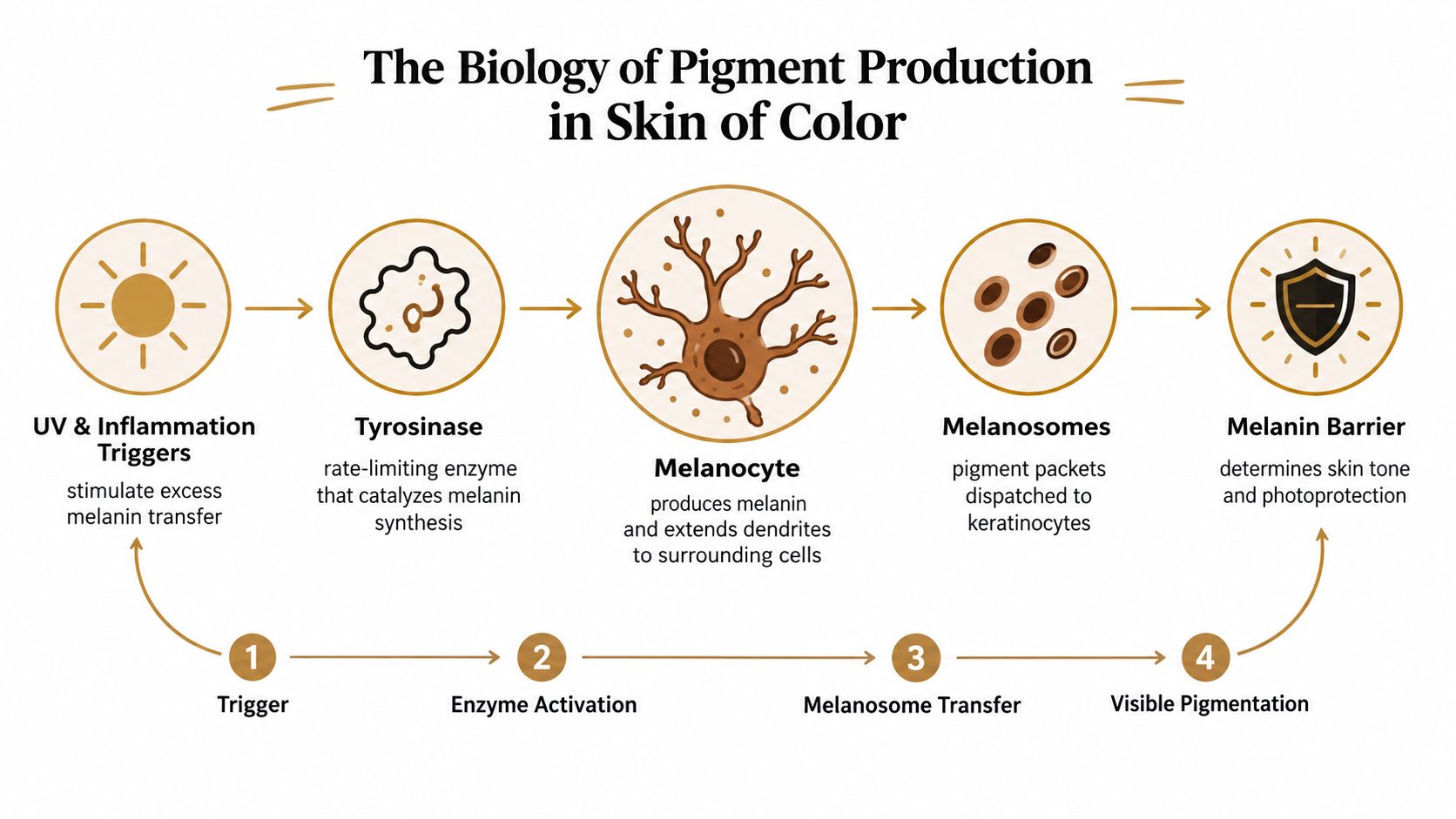
Melanin is produced by melanocytes, specialized cells located in the basal layer of the epidermis. A trigger such as ultraviolet radiation, visible light, acne-related inflammation, or physical injury can increase signaling around the melanocyte. The enzyme tyrosinase then helps drive the chemical steps that convert the amino acid tyrosine into melanin.
Melanin is packaged into structures called melanosomes. Melanocytes transfer those pigment packets into surrounding keratinocytes, the cells that make up most of the epidermis. In darker skin, melanosomes tend to remain more persistent and are distributed in a way that produces greater visible pigmentation. That biology provides valuable natural photoprotection, but it also means inflammation can leave a more noticeable and longer-lasting mark.
PIH, melasma, and sun spots aren't interchangeable
PIH is a response to prior inflammation or injury. A blemish, rash, burn, scratch, or procedure can leave brown, gray-brown, or deepened discoloration after the original problem appears resolved. The trigger is part of the diagnosis. If inflammation continues, pigment production can continue too.
Melasma is a patterned pigment disorder, often appearing as broader patches on areas such as the cheeks, forehead, upper lip, or jaw. Hormonal influences, ultraviolet exposure, visible light, and individual susceptibility can contribute. It may coexist with PIH, but it shouldn't automatically be treated as an acne mark.
Sun-related discoloration reflects cumulative exposure and may appear as scattered spots or uneven tone on exposed areas. It has a different history from a mark that appeared directly after a pimple or rash.
The distinction changes the treatment plan. PIH requires control of the inflammatory cause. Melasma requires especially strict light management and a maintenance strategy. Sun-related spots require evaluation before a treatment is chosen, particularly if a lesion changes in appearance or doesn't fit the expected pattern.
Why calming the skin changes the outcome
Tyrosinase inhibition can reduce new melanin synthesis, but it doesn't remove the stimulus that activated the melanocyte. A person treating acne with irritating products, for example, may suppress one pathway while creating another inflammatory signal. This is why systems outperform isolated “strong” products in many patients.
A carefully selected topical can address pigment production, while moisturizer supports the barrier and sunscreen limits renewed stimulation. Depending on the diagnosis, a clinician may use hydroquinone, retinoids, azelaic acid, cysteamine, tranexamic acid, or other agents.

Featured Product
Pigment Restraint Cream
A brightening cream made to target the look of stubborn discoloration, whether it’s from post-blemish marks, sun exposure, or dullness that years of serums haven’t improved.
Shop Now →Clinically Proven Topical Actives and Safe Concentrations
Topical treatment should be selected by mechanism, tolerance, and diagnosis, not by the most dramatic label on the shelf. The safest routine usually starts with one primary brightening treatment, a barrier-supporting moisturizer, and reliable sunscreen. Add a second active only after the first is tolerated.
Hydroquinone remains a clinically established option for adults with PIH. A recent review describes first-line use commonly involving hydroquinone 2% to 4%, with reassessment after 8 to 12 weeks, while cysteamine or ascorbic acid may be considered when hydroquinone isn't tolerated (review of PIH management in skin of color). Because irritation and inappropriate prolonged use can create problems, hydroquinone is best selected and monitored by a qualified clinician.
Match the active to the job
- Tranexamic acid: Useful when the treatment plan needs to influence pigment signaling without relying solely on direct tyrosinase inhibition. A practical overview of its cosmetic and dermatologic role is available in this guide to tranexamic acid benefits for skin.
- Niacinamide: Supports barrier function and can help moderate the transfer of melanosomes into keratinocytes. It's often a sensible choice for people who don't tolerate aggressive exfoliation.
- Alpha arbutin: Provides a gentler pigment-focused approach through interference with tyrosinase activity. It can fit a maintenance routine when the skin is reactive.
- Kojic acid: Targets tyrosinase, but sensitivity is possible. Introduce it cautiously and don't combine it immediately with several other irritating agents.
- Azelaic acid: Particularly useful when acne or follicular inflammation accompanies discoloration, because the treatment plan can address both the active trigger and the residual mark.
- Retinoids: Encourage more orderly cell turnover and can complement pigment inhibitors, but dryness and dermatitis are treatment-limiting risks in sensitive skin.
The exact concentration isn't automatically the measure of quality. A lower-strength formula used consistently on intact skin can outperform a high-strength product that causes peeling and abandonment.
Layer pathways without overloading the barrier
Use a simple sequence. Cleanse gently, apply the selected treatment to dry skin, then moisturize. If you use a retinoid at night, don't automatically add an exfoliating acid on the same evening. If you use a kojic acid or hydroquinone product, watch for increasing sensitivity before adding vitamin C or another inhibitor.
Patch testing is sensible, but it doesn't guarantee that facial skin will tolerate repeated use. Start on a limited area, maintain a stable schedule, and pause when you develop significant burning, swelling, or dermatitis. A professional can also decide whether a combination plan is appropriate, rather than asking you to build one by trial and error.
Photoprotection as a Core Therapeutic Step
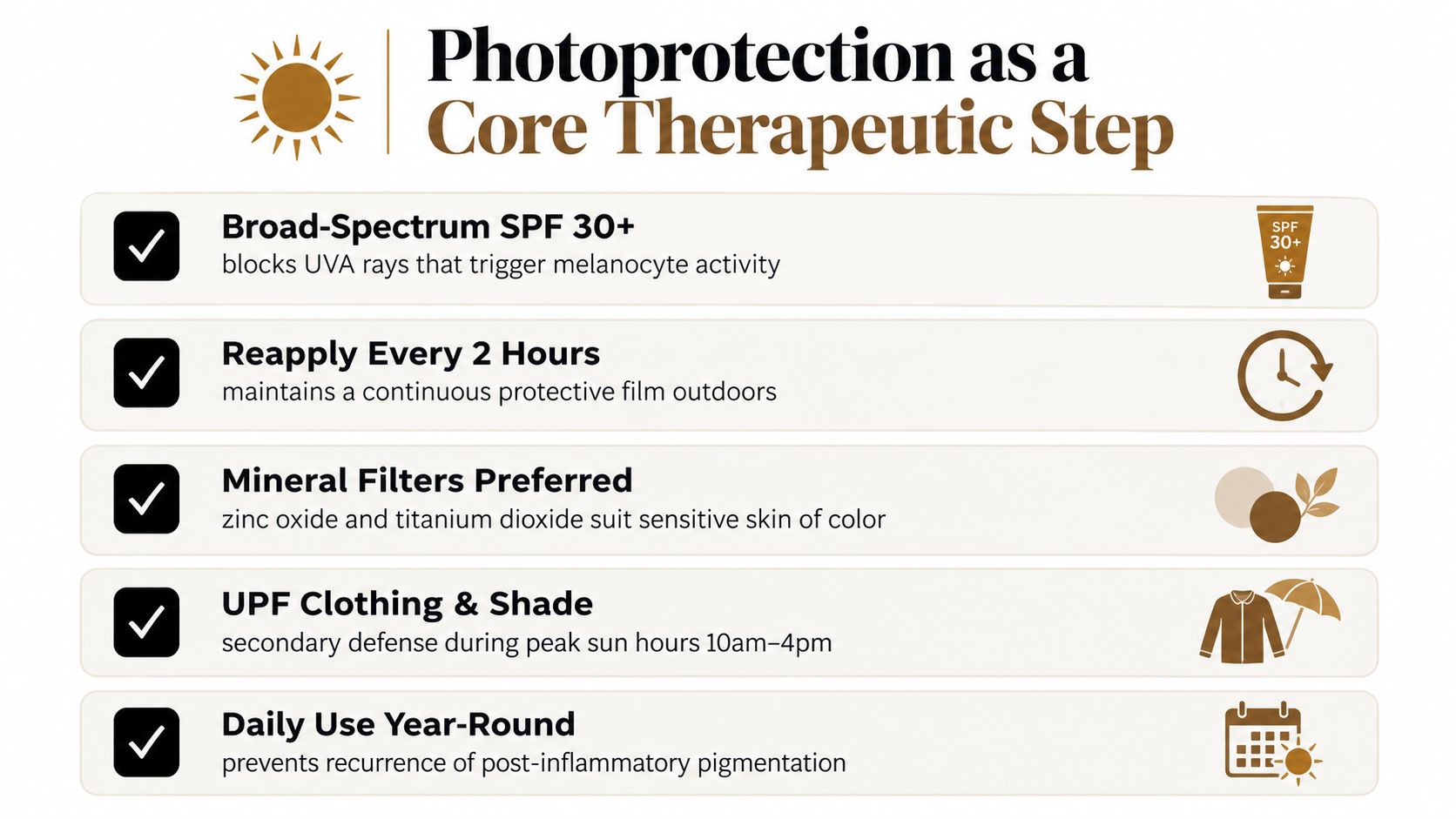
Pigment treatment can stall even when the evening routine is well chosen. Daily photoprotection is part of the treatment, because ultraviolet radiation maintains melanocyte activity and visible light can worsen melasma and post-inflammatory hyperpigmentation, particularly in intermediate and dark skin. Reducing the inflammatory triggers that start pigment production is more effective than repeatedly escalating a bleaching active.
For skin of color, choose broad-spectrum SPF 30 or higher with meaningful UVA and UVB protection. Tinted products containing iron oxides or pigmentary titanium dioxide also address visible light. Blue and violet wavelengths can sustain melanogenesis in Fitzpatrick types IV to VI, making visible-light coverage relevant when discoloration is persistent (photoprotection guidance for skin of color).
Choose protection you can maintain
A sunscreen that pills, leaves a visible cast, or feels heavy will be difficult to use consistently. Tinted formulas can make application easier, but the shade must suit your complexion. If the tint does not provide enough cosmetic coverage, layer a compatible complexion product over it for added visible-light shielding rather than applying less sunscreen.
Outdoor behavior supports the product:
- Use shade strategically: Direct exposure adds to the daily pigment stimulus.
- Wear protective clothing: Hats, sunglasses, and covering garments reduce exposure sunscreen cannot fully block.
- Reapply during extended outdoor time: Sweat, wiping, and time gradually disrupt the protective film.
- Apply every day: Windows, commuting, and incidental exposure can reactivate pigment.
- Protect after procedures: Recently treated skin is more vulnerable to inflammation and recurrence.
In an 8-week study of 89 African and Hispanic women, regular sunscreen use produced chromameter-measured improvement in 81% of patients, fewer macules in 59%, and overall lightening in 85% (study summarized in the photoprotection review). These findings do not make sunscreen a complete treatment for every diagnosis. They show that consistent light control can produce measurable change and create better conditions for other therapies.
Don't confuse coverage with cure
Tinted sunscreen will not erase established PIH overnight. It reduces the continuing light stimulus, allowing existing pigment to clear gradually while limiting new discoloration. For melasma and recurrent PIH, inconsistent protection is a common reason progress plateaus.
Use two coordinated layers: a corrective treatment that addresses pigment biology and a daily shield that reduces reactivation. Removing either weakens the system. Guidance on formula selection is available in this resource on the best sunscreen for hyperpigmentation.
Navigating Professional Peels and Laser Therapies Safely
Procedures can help when topical treatment has reached a plateau, but controlled injury is still injury. In richly pigmented skin, the clinician must improve the lesion without creating enough inflammation to trigger a darker one. This is why the operator's experience with skin of color matters as much as the device or peel name.
A 2024 systematic review of 41 studies involving 877 patients reported complete response in 18.1% of laser or energy-device cases, 5.4% with topical monotherapy, and 2.4% with combination therapies (systematic review of procedural PIH treatment). The results don't make lasers a universal first choice. A separate review found laser was the only intervention to achieve complete resolution in a subgroup, while also documenting PIH exacerbation after treatment. Efficacy and risk must be considered together.
Compare the main procedural choices
Chemical peels can gradually remove superficial pigment, but the formulation, depth, contact time, and aftercare determine the risk. Superficial, conservative treatment is generally more defensible than a single aggressive session when the skin has a strong pigment response.
Microneedling creates controlled channels and may be considered when uneven tone overlaps with textural acne scarring. It still produces inflammation, so the clinician should assess active acne, eczema, sensitivity, and prior PIH before proceeding.
Laser and energy devices can target selected pigment patterns, but wavelength, fluence, pulse settings, cooling, and treatment intervals require careful selection. A laser that performs well in lighter skin isn't automatically appropriate for Fitzpatrick IV through VI.
Priming is a safety step
Expert consensus recommends pre-procedural priming for 2 to 4 weeks before chemical peels or laser procedures in skin of color. The approach generally combines broad-spectrum sunscreen with a topical depigmenting agent such as hydroquinone and/or a retinoid (consensus guidance on priming before procedures). The clinician may modify or extend that plan based on tolerance and diagnosis.
Ask direct questions before booking:
- How often do you treat Fitzpatrick IV through VI?
- What is your plan if PIH worsens after treatment?
- Will you prime the skin first?
- What settings and treatment intervals do you use for my complexion?
- What products should I stop before and after the procedure?
- Can you show results from comparable skin tones without implying that every patient will respond identically?
Don't schedule a procedure over active dermatitis, a fresh breakout, or an unexplained rash. The safest procedural plan begins with stable skin, a clear diagnosis, conservative parameters, and follow-up.
Building a Daily Brightening Routine
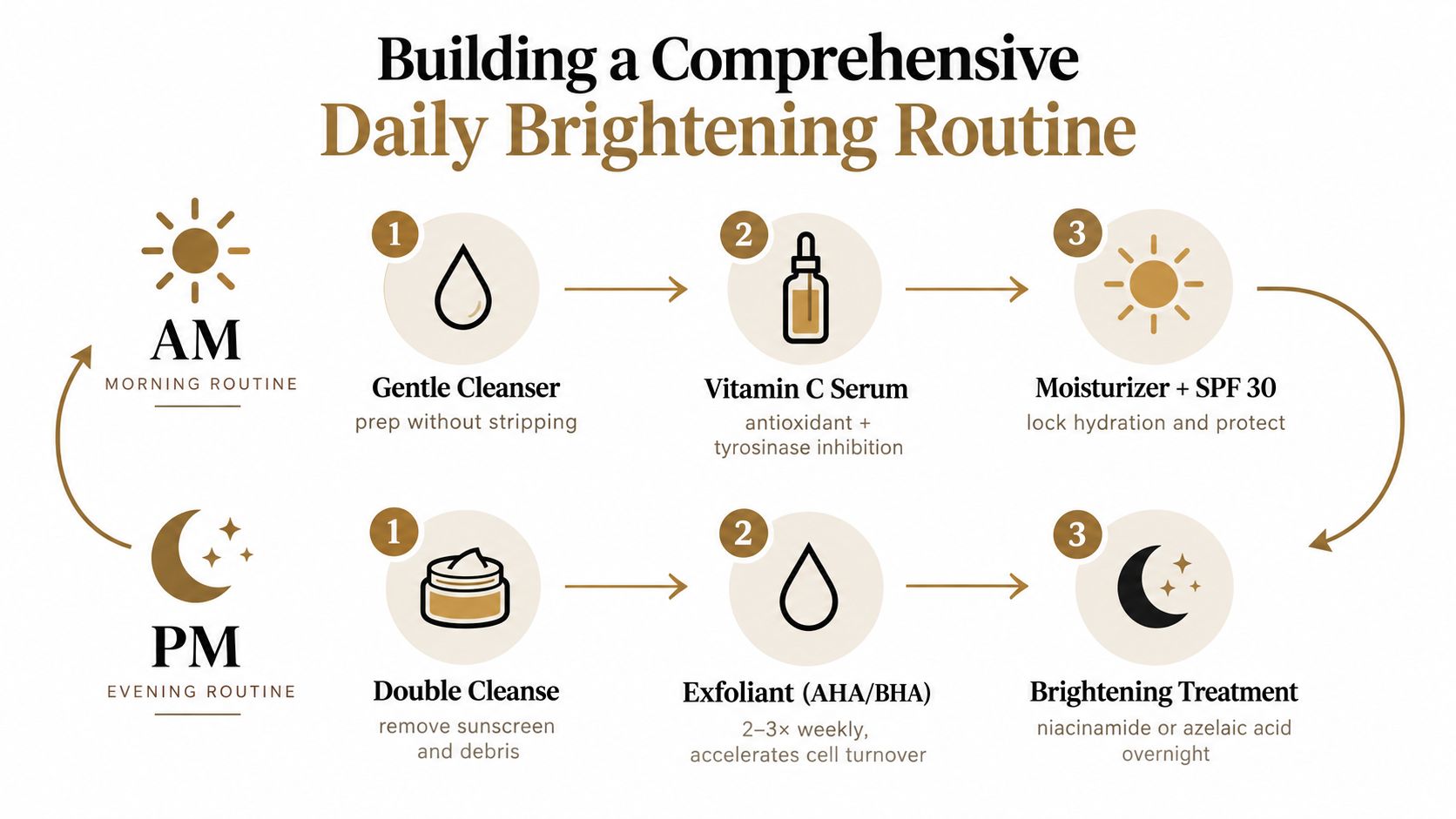
A brightening routine should control the causes of pigment, not just strip color from the surface. In Fitzpatrick IV through VI, friction, acne, eczema, and visible light can keep melanocytes active. Use layered steps that reduce inflammation, support the barrier, and protect against UVA, UVB, and visible light. A single aggressive active often creates irritation and more post-inflammatory hyperpigmentation.
Morning
- Cleanse gently: Remove residue without scrubbing or leaving the skin tight.
- Apply one brightening serum: Vitamin C, niacinamide, tranexamic acid, or another selected active may fit here, depending on your diagnosis and tolerance.
- Moisturize where needed: A stable barrier lowers the chance that treatment will trigger irritation.
- Finish with tinted broad-spectrum SPF 30 or higher: Choose protection against UVA, UVB, and visible light. Reapply during extended outdoor exposure.
For readers comparing vitamin C products, browse Enlighten Serum by Andalou, then review the complete ingredient list and patch-test if appropriate. Marketing claims do not replace a tolerance assessment.
Evening
- Remove sunscreen thoroughly: Use a gentle balm or cleanser, followed by a second cleanse if residue remains.
- Exfoliate sparingly: An AHA or BHA can be used 2 to 3 times weekly when the skin is calm. Avoid automatically combining it with a retinoid or another irritating treatment.
- Apply the corrective product: Niacinamide, azelaic acid, a retinoid, or hydroquinone under medical supervision should each have a defined role. Introduce one change at a time.
- Seal with moisturizer: Barrier support helps active treatment continue without unnecessary inflammation.
A clinician may reassess hydroquinone-based care after 8 to 12 weeks, as described in the earlier clinical review. Without hydroquinone, improvement still depends on consistent use and time for pigmented cells to move through the epidermis. Burning, scaling, or persistent redness means reduce frequency and seek professional guidance rather than pushing through.
Use this brightening skincare routine as a framework, not a reason to layer every active. The strongest plan controls inflammatory triggers, addresses the underlying cause, limits visible-light exposure, and remains tolerable long enough to improve uneven tone.
Mesoderm RX offers pigment-focused skincare and broad-spectrum sun protection for dark spots and uneven tone. Visit Mesoderm RX to review options for a structured routine.