


Brightening Skincare Routine That Actually Fades Dark Spots
Hyperpigmentation affects 10.6% of people worldwide, according to a 2025 systematic analysis of global prevalence. The figure varies across regions, with higher reported prevalence in Africa, Asia, and the Middle East than in Europe and Australia. These findings place brightening skincare in a biological context. Dark spots are not a surface issue that one aggressive serum can erase. They reflect ongoing melanin production, inflammation, pigment transfer, and exposure to ultraviolet and visible light.
A useful routine manages this pigment system in stages. Morning care limits light-driven signals and supports prevention. Evening care targets pigment pathways while allowing the skin barrier to recover. Each product has a defined role, like adjusting several controls rather than turning one switch to maximum.
The routine must also fit your tolerance. Consistent use of well-sequenced products, combined with reliable light protection, helps reduce the triggers that keep uneven tone active without creating irritation that can produce more discoloration.
Why Brightening Is About Biology Not Just Glow
A global survey summarized in a 2026 consensus paper on pigmentary disorders found that 50% of respondents reported at least one pigmentary disorder. Solar lentigo affected 27.5% of respondents, axillary hyperpigmentation 17.2%, post-inflammatory hyperpigmentation 14.8%, periorbital hyperpigmentation 14.7%, melasma 10.9%, and vitiligo 7.1%. The same consensus found that 28% scored above 10 on the Dermatology Life Quality Index, showing that uneven tone can affect confidence and daily life, not only appearance.
Melanin starts the process
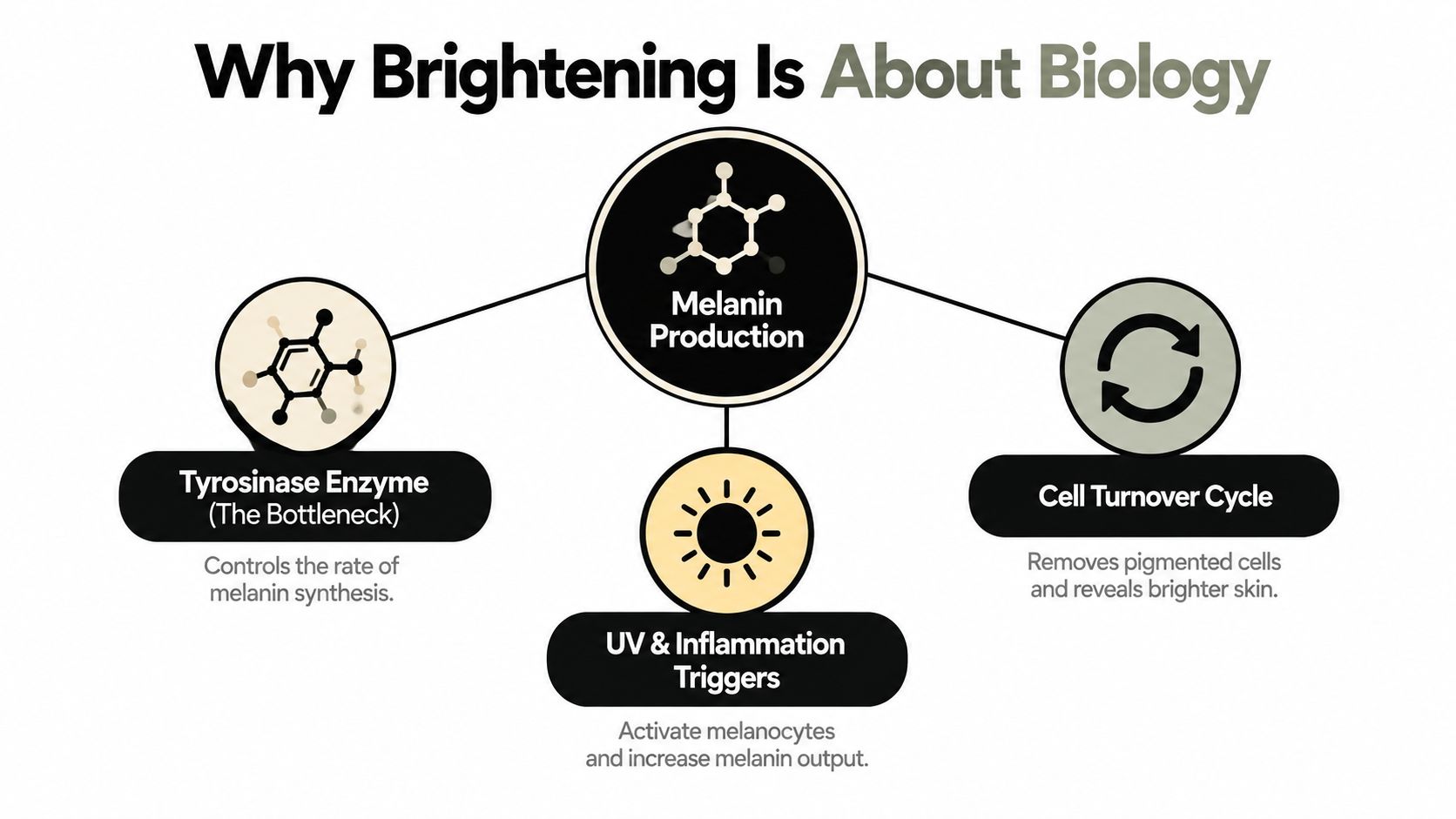
Melanin gives skin, hair, and eyes their color and absorbs some incoming light. Ultraviolet exposure, visible light, and inflammation can signal melanocytes to produce more melanin and transfer pigment-filled melanosomes into nearby keratinocytes. Brightening therefore works best as pigment-system management, with light control, inflammation control, and measured treatment working together.
Tyrosinase is one control point in melanin production. It helps begin the chemical reactions that create melanin, so many brightening ingredients influence its activity. Vitamin C can interfere with copper-dependent tyrosinase function, while niacinamide helps reduce pigment transfer between melanocytes and keratinocytes. Retinoids encourage cell turnover and may reduce melanosome deposition over time, as described in this clinical review of topical treatments for hyperpigmentation.
Inflammation can keep that pigment signal active. Inflammatory mediators may increase tyrosinase activity and prolong melanin production, meaning harsh treatment can undermine the goal of a brighter, more even complexion. Research on inflammatory control of melanogenesis examines pathways involving IL-18, prostaglandins, and leukotrienes.
Three dark-spot patterns need different strategies
Post-inflammatory hyperpigmentation, or PIH, follows injury or inflammation. Acne, eczema, trauma, and procedures can trigger cytokines, prostaglandins, and reactive oxygen species. Pigment may remain in the epidermis or settle deeper in the dermis, according to the NCBI clinical overview of PIH. A PIH routine must address active breakouts or dermatitis while gradually treating the remaining discoloration.
Melasma is chronic and responsive to light. UVB can increase melanogenesis-related gene expression, while keratinocytes release signals such as α-MSH, endothelin-1, and stem cell factor. Visible blue light also matters. A review of melasma biology discusses 415 nm light, opsin-3, calcium and MAPK signaling, MITF, and tyrosinase activity in worsening pigmentation.
Sun spots, also called solar lentigines, develop after cumulative light exposure and are more localized than melasma. Their triggers differ from PIH, so spot treatment without dependable photoprotection often gives temporary results.
For background on how shedding fits into routine planning, see this guide to skin cell turnover. The practical conclusion is clear. Brightening means managing melanin production, tyrosinase activity, inflammation, and light exposure together.
Why Most Brightening Routines Fail to Fade Dark Spots
Most routines fail for predictable biological reasons. A person applies vitamin C to a dark spot, skips sunscreen, adds a harsh scrub when results seem slow, then blames the ingredient. The serum may not be the main problem. The routine never controlled the light exposure, inflammation, and barrier stress that keep pigment active.
The common mistakes
Lemon juice and baking soda are poor choices. Lemon juice can irritate skin and increase photosensitivity. Baking soda can disrupt the skin's normal acidic environment and add barrier stress. Neither provides controlled delivery, a predictable concentration, or a reliable way to limit inflammation.
Over-exfoliation creates another problem. Strong acids, scrubs, retinoids, and multiple brightening serums used together can cause stinging, redness, dryness, and peeling. In pigment-prone skin, that irritation acts like a fresh alarm signal, encouraging inflammatory pathways that can stimulate melanocytes.
Skipping sunscreen has an even larger effect. Clinical guidance treats photoprotection as part of hyperpigmentation management, rather than an optional final layer. A clinical review of hyperpigmentation treatment describes hydroquinone as a tyrosinase inhibitor used with photoprotection because light exposure sustains melanocytic activity and can contribute to repigmentation. Protection should also account for visible light when discoloration is light-sensitive.
Practical rule: If a routine repeatedly makes your skin burn, crack, or peel, it is not working faster. It is adding another pigment trigger.
Why one spot product rarely solves the problem
A single brightening product may influence one part of the pigment pathway, while discoloration continues through other routes. Light can reactivate melanin production. Acne or eczema can maintain inflammation. Shaving, clothing, or repeated rubbing can create new injury. A brightening skincare routine must address the trigger, pigment biology, and barrier together, with stronger steps added only as the skin tolerates them.
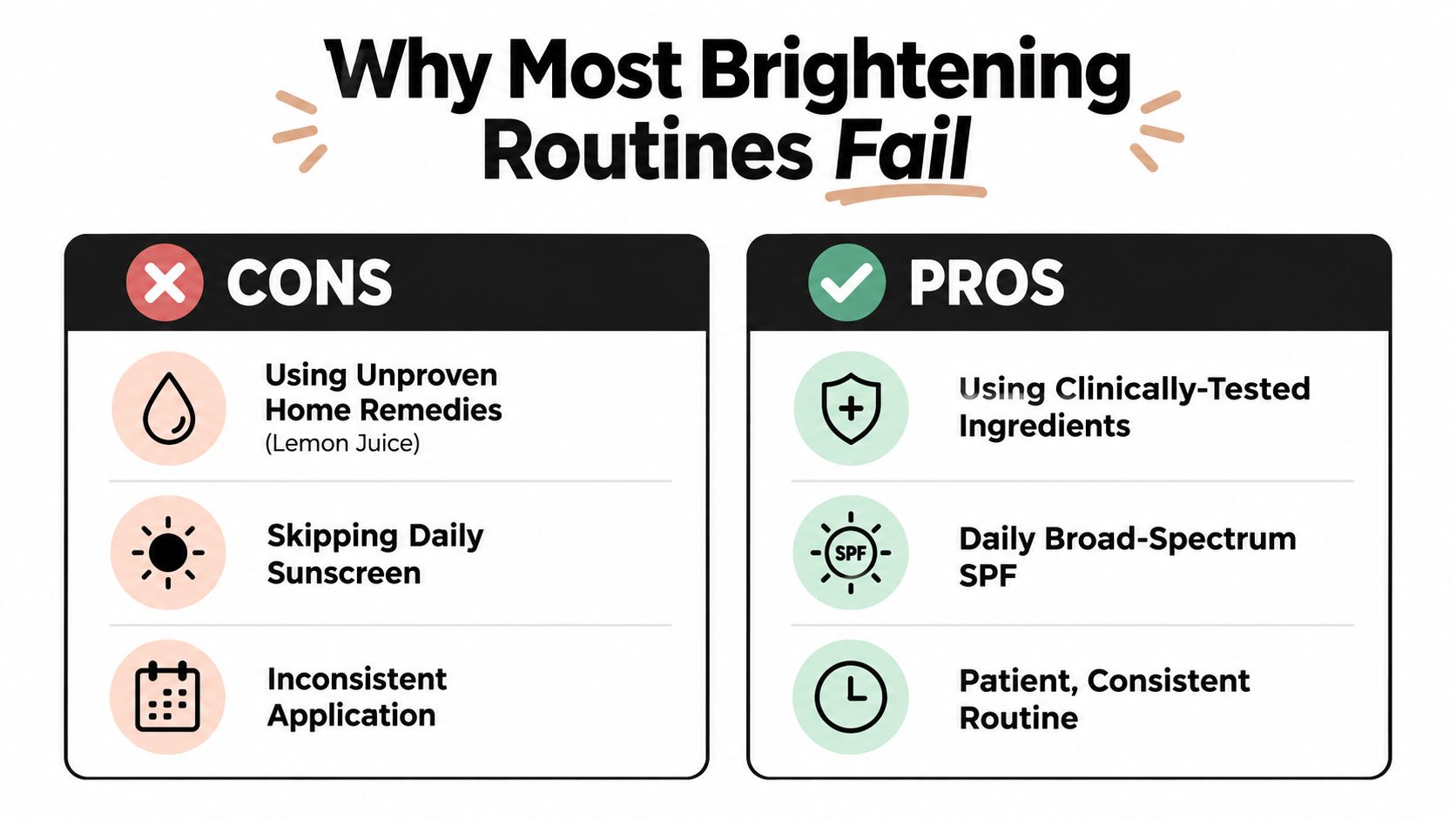
Stronger is not automatically better. A PubMed-indexed study of niacinamide reported significant pigmentation reduction after three months. It also found similar efficacy between a five-month niacinamide regimen and hydroquinone 4% used for three months, with better local tolerance and patient acceptability. The practical lesson is direct: the best active is often the one you can use consistently without provoking irritation.

Featured Product
Advanced Triple Action Age-Defying Serum
Defy the signs of aging and restore your youthful glow with a serum that works to smooth, firm, and brighten your skin.
Shop Now →For mature skin that also needs barrier and firmness support, the Anti-Aging Powerhouse is described as a rich serum containing peptides, DMAE, collagen, vitamin C, and alpha lipoic acid. Its stated use is three to five drops on clean skin, followed by moisturizer, on the face, neck, or backs of the hands.
Your Morning Brightening Routine for Protection and Prevention
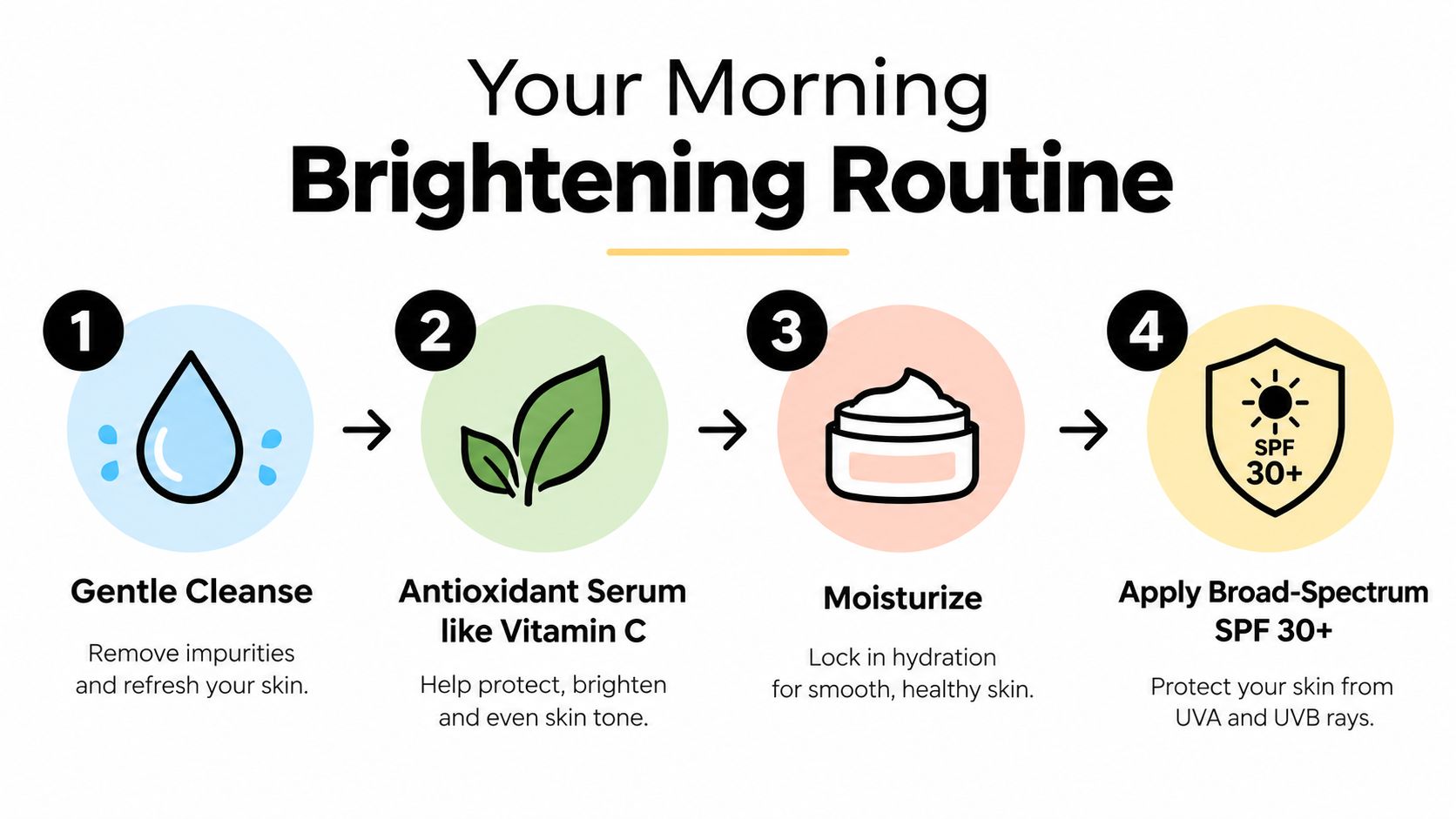
Morning care controls the conditions that keep pigment active: light exposure, irritation, and an unstable barrier. Follow the steps in order, but adjust the number of layers to your skin's tolerance.
Start clean, not stripped
Use a gentle cleanser to remove overnight oil and residue without leaving the skin tight. A squeaky, hot, or dry feeling suggests the cleanser is taking more from the barrier than necessary. Rinse thoroughly and pat dry rather than rubbing.
Treat with one antioxidant layer
Apply one antioxidant serum after cleansing. Vitamin C can interfere with copper-dependent tyrosinase activity, a key enzyme in melanin production. Niacinamide is another suitable option, particularly if acidic vitamin C causes stinging or redness.
Apply a thin layer to dry or slightly damp skin according to the product directions. Let a wet or tacky formula settle briefly before adding the next product, especially if pilling is a problem. More serum does not mean stronger pigment control. It mainly adds residue and may increase irritation.
Moisturize according to barrier need
Follow with moisturizer. A light lotion may feel more comfortable beneath sunscreen if your skin becomes greasy, while a richer cream can help when treatment has caused dryness. Glycerin, panthenol, ceramides, and hyaluronic acid support hydration without replacing the pigment-focused step.
Moisturizer also protects the routine's consistency. A calm barrier makes repeated treatment easier to tolerate. If your skin is irritated, apply moisturizer before the antioxidant to buffer contact, or pause the active until discomfort settles.
Finish with broad-spectrum and visible-light-aware protection
Sunscreen is the morning anchor. Protection should address UV and, when discoloration is persistent, visible light as well. In the clinical guidance on UV and visible-light protection, an iron-oxide UV-visible sunscreen improved pigmentation outcomes more than mineral SPF 50+ controls over eight weeks, with reductions in colorimetric values and MASI scores of 28% and 15%, respectively.
Apply broad-spectrum sunscreen every morning to exposed facial skin, ears, neck, and other uncovered areas. Reapply during outdoor activity, sweating, swimming, or extended time in direct light. Tinted formulas containing iron oxides can provide useful visible-light coverage, especially for melasma and deeper skin tones.
For help comparing formulas, read this guide to the best sunscreen for hyperpigmentation. The Pigment Restraint Ultra High Sun Protection is described as a fast-absorbing, non-greasy formula with a protection complex covering UVA, UVB, IR, and HEV combination rays, including light from phones and computers.
Avoid adding exfoliating acids or a retinoid in the morning unless a clinician has given you a specific reason. Keep the surface calm, make sunscreen the final skincare step, and apply makeup after the sunscreen has settled.
Your Evening Brightening Routine for Repair and Even Tone
Evening care gives you room to address pigment without immediately exposing freshly treated skin to outdoor light. The goal is to manage the pigment system, not to stack every brightening product at once. A useful routine reduces signals that encourage melanin, supports a calm barrier, and introduces treatment at a pace your skin can maintain.
If you wore makeup or water-resistant sunscreen, start with an oil or balm cleanser, micellar product, or another suitable first cleanse. Follow with a gentle water-based cleanser if residue remains. On makeup-free evenings, one gentle cleanse may be enough when your skin feels clean and comfortable.
Choose one main treatment focus
Use an exfoliant on selected nights rather than automatically every night. AHA, BHA, and PHA products can smooth surface texture and loosen accumulated cells, but they do not replace sun protection or control inflammation. If post-inflammatory hyperpigmentation follows acne, manage the acne as well. Fading an existing mark while new lesions continue to trigger pigment leaves the source active.
On other nights, choose one pigment-focused serum with an ingredient your skin tolerates. Vitamin C, niacinamide, azelaic acid, and retinoids act through different pathways, including effects on pigment formation, cell turnover, and inflammation. Controlled data summarized in the clinical review of topical brightening strategies support several combination approaches, including formulas involving niacinamide, potassium azeloyl diglycinate, and trans-4-(aminomethyl) cyclohexanecarboxylic acid. These findings support a measured, formulation-based approach, not a reason to combine every active in one evening.
Introduce one active at a time. Test it on a small area, then use it on limited nights. If your skin remains comfortable, increase use gradually according to the product directions. Avoid pairing a retinoid, exfoliating acid, and strong acidic vitamin C product when you are still establishing tolerance.
Seal with barrier support
Finish with moisturizer. Dryness, tightness, persistent stinging, or visible peeling indicates that the schedule is too demanding. Reduce treatment frequency and use a bland moisturizer. Stop any product that causes swelling, blistering, or significant burning.
| Active Combination | Best For | Frequency | Layering Note |
|---|---|---|---|
| Niacinamide with moisturizer | Sensitive skin and uneven tone | Begin gradually, then follow product directions | Use before moisturizer; prioritize tolerance |
| Azelaic acid with moisturizer | Pigment with acne-prone or reactive skin | Introduce on separate treatment nights | Apply a thin layer and avoid stacking with multiple irritants |
| Retinoid with moisturizer | Pigment, texture, and signs of aging | Start on alternating nights | Use at night and buffer with moisturizer if needed |
| AHA, BHA, or PHA with moisturizer | Surface texture and dullness | Use selectively rather than nightly | Keep separate from retinoids during introduction |
| Vitamin C with a simple moisturizer | Morning antioxidant support | Use according to formula tolerance | Place before moisturizer and sunscreen in the morning |
Combination treatment can be useful when the barrier and schedule support it. Azelaic acid plus glycolic acid showed a greater MASI reduction than azelaic acid alone in controlled data summarized by the same clinical review. Start with separate treatment nights rather than assuming a stronger combination will suit every skin type.
A workable rotation might use a pigment serum one night, moisturizer-only recovery the next, and an exfoliant or retinoid on a separate night. The exact calendar matters less than limiting irritation, protecting the barrier, and repeating the routine consistently.
Adapting Your Routine for Sensitive and Aging Skin
The brightening system stays recognizable across skin types. What changes is the strength of each signal, the formula texture, and the time between treatments. Skin responds to pigment control, inflammation management, barrier support, and light protection as a connected system.
Sensitive skin needs a slower signal
Sensitive skin usually handles fewer simultaneous changes better. Begin with a gentle cleanser, niacinamide, a barrier-supporting moisturizer, and sunscreen that addresses UV and visible light. Niacinamide can support a more even-looking tone with less sting than some acidic formulas, making it a practical first active for reactive skin.
Introduce one new treatment at a time and patch test first. If direct application feels uncomfortable, place moisturizer underneath the treatment to soften the signal. Keep fragrance-heavy products out of the routine, and pause exfoliation during eczema, dermatitis, or unexplained redness flares. Persistent irritation can stimulate inflammation, which may leave more discoloration behind.
For targeted product considerations, see this guide to a brightening serum for sensitive skin. Sensitive skin can brighten. The routine must lower pigment activity without repeatedly provoking the skin.
Aging skin needs pigment control plus structural support
Mature skin often needs hydration and firmness support alongside tone correction. Hyaluronic acid can improve the feel of dehydration, while peptides can complement a regimen focused on smoother-looking skin. These ingredients support comfort and texture, but they do not replace pigment-focused treatment.
Apply a treatment serum to clean skin, then follow with a nourishing moisturizer. If a retinoid is part of the plan, introduce it cautiously because irritation may take longer to settle. Dryness, peeling, or burning do not prove that a product is working. A calmer routine is often easier to maintain and gives the pigment system fewer inflammatory triggers.
Deeper skin tones need trigger control
Deeper skin tones may carry a greater burden of hyperpigmentation. The reviewed global evidence found higher prevalence among darker-skinned populations, as noted earlier in the article. Prevention therefore deserves the same attention as fading existing marks. Use UV and visible-light protection, manage acne and eczema, reduce friction, and introduce pigment actives gradually rather than relying on harsh bleaching practices.
Body discoloration follows the same biology. Friction, shaving, sweat, and repeated rubbing can sustain uneven tone around the neck, underarms, thighs, or hands. Use each formula only on areas allowed by its directions. A body lotion is not automatically suitable for the face or neck, and intimate areas require products formulated for those sites.
| Skin need | First adjustment | What to avoid |
|---|---|---|
| Easily irritated skin | Niacinamide, moisturizer buffering, slower introduction | Stacking acids and retinoids |
| Dehydrated mature skin | Humectant hydration and peptide support | Treating tightness as a sign to increase strength |
| Deeper skin tone with PIH | Trigger control and diligent light protection | Harsh scrubbing or unmonitored bleaching |
| Body discoloration | Reduce friction and use body-specific products | Applying facial or body formulas to unapproved areas |
Staying Consistent and Seeing Real Results
Brightening responds to repetition, not daily experimentation. Give a stable routine enough time to show a pattern. Clinical evidence summarized in the ingredient review includes measurable changes at different points, including week four, week six, and week twelve, while the niacinamide study reported pigmentation improvement after three months. Those timelines reinforce a practical expectation: visible change usually develops over weeks, not overnight.
Use a simple adherence plan:
- Weeks one and two: Establish gentle cleansing, moisturizer, and daily sunscreen. Add only one treatment active.
- Weeks three and four: Maintain the same products and adjust frequency only if your skin remains comfortable.
- Weeks five and six: Compare standardized photos in the same lighting. Look for reduced contrast between spots and surrounding skin, not perfect clearance.
- Weeks seven and eight: Decide whether the routine is tolerable and whether new spots are still appearing. If progress has stalled, review sunscreen coverage, reapplication, irritation, acne, eczema, and friction before adding another active.
Take photos from the same angle and under similar light. You can also use a simple MASI-style self-check by observing the distribution, darkness, and area of pigmentation, but a home assessment isn't a diagnosis.
Reduce treatment frequency if you develop persistent burning, swelling, cracking, or worsening redness. Seek dermatology input when pigmentation changes suddenly, affects the eyes or mucosal areas, follows a medication change, or doesn't respond despite consistent care. Melasma, PIH, and solar lentigines may need different clinical plans, so uncertainty about the diagnosis is itself a reason to ask for professional evaluation.
Travel, seasonal sun exposure, and outdoor work can expose weaknesses in a routine. Pack cleanser, moisturizer, treatment, and sunscreen together, and don't abandon protection when the weather feels cool. The system works when it controls pigment production, inflammation, and light exposure at the same time.
Mesoderm RX offers targeted options for dark spots, uneven tone, barrier support, body care, and high-level light protection, including treatment serums and Pigment Restraint Ultra High Sun Protection. Visit Mesoderm RX to explore a routine that fits your skin's tolerance and your brightening goals.