


Exfoliant for Mature Skin That Smooths Without Irritation
You used the same scrub in your thirties for years. It gave you an immediate polished feeling, so you tried it again when your skin began to look dull. This time, your cheeks sting, your skin feels tight, and the brown areas seem darker instead of clearer.
That reaction doesn't mean mature skin can't benefit from exfoliation. It means the decision has changed. The right exfoliant for mature skin isn't defined by the strongest peel or the fastest visible shedding. It's defined by dose, acid family, barrier support, frequency, and pigment control working together.
Why Mature Skin Needs a Different Approach to Exfoliation
At 30, your skin may have tolerated frequent scrubbing, strong acids, or several active products layered in the same routine. Later, the same approach can expose a weaker moisture barrier to more stress than it can comfortably manage. Surface shedding slows, dryness becomes more common, and the skin may respond to irritation with redness, tightness, or uneven pigmentation.
That creates a familiar conflict. You want to remove the dull surface, soften rough texture, and make fine lines look less noticeable. At the same time, you can't treat mature skin as if every visible change is caused by dead cells waiting to be scrubbed away.
Featured Product
Skin Perfection Liquid Exfoliant Peel AHA BHA PHA
Reveal your smoothest, clearest skin yet with our best-selling 2% BHA (Beta Hydroxy Acid) exfoliant. This lightweight, leave-on formula works deep within pores to unclog congestion, minimize blackheads, and boost skin clarity — without irritation.
Shop Now →
What exfoliation can and can't do
A carefully selected exfoliant can help improve:
- Surface texture, by supporting the shedding of accumulated corneocytes.
- Dullness and uneven tone, by making the skin surface more uniform.
- The appearance of fine lines, when smoother hydration and resurfacing make them less visually pronounced.
- Pore congestion, particularly when a pore-compatible acid is included.
- The appearance of some pigment irregularity, provided irritation stays controlled.
It won't replace daily sun protection, correct every pigment disorder, rebuild lost facial volume, or produce the same result as a professional treatment. Firmness is also a broader biological concern than surface exfoliation. It involves dermal structure, hydration, inflammation, and time, so an exfoliant should support a wider routine rather than carry the entire anti-aging plan.
Practical rule: Mature skin usually responds better to a repeatable maintenance dose than to occasional aggressive resurfacing.
The most common mistake is choosing by sensation. A strong sting or dramatic peeling can feel like proof that a product is working, but discomfort isn't a reliable measure of useful renewal. A system that combines controlled exfoliation with hydration and protection gives you more information than a single intense application.
That system-first approach also makes troubleshooting easier. If your skin becomes tight, you can reduce frequency. If pores remain congested, you can reconsider the acid family. If dark marks deepen, you can investigate inflammation instead of automatically increasing strength. For a clearer explanation of how shedding fits into the broader renewal process, see this guide to skin cell turnover.
How Exfoliation Works on Aging Skin Biology
Skin renewal begins at the outermost layer, the stratum corneum. Its flattened cells normally separate through desquamation, the ongoing process that clears older surface material. With age, this release can become less efficient. Cells may remain on the surface longer, making texture feel rougher and light reflect less evenly.
The barrier works like a brick wall. Surface cells are the bricks, and the lipids between them are the mortar that helps retain water and block irritants. Exfoliation should remove excess material while leaving that mortar intact. A carefully designed formula loosens buildup. Too much acid, too often, can disturb the structure it is meant to support.
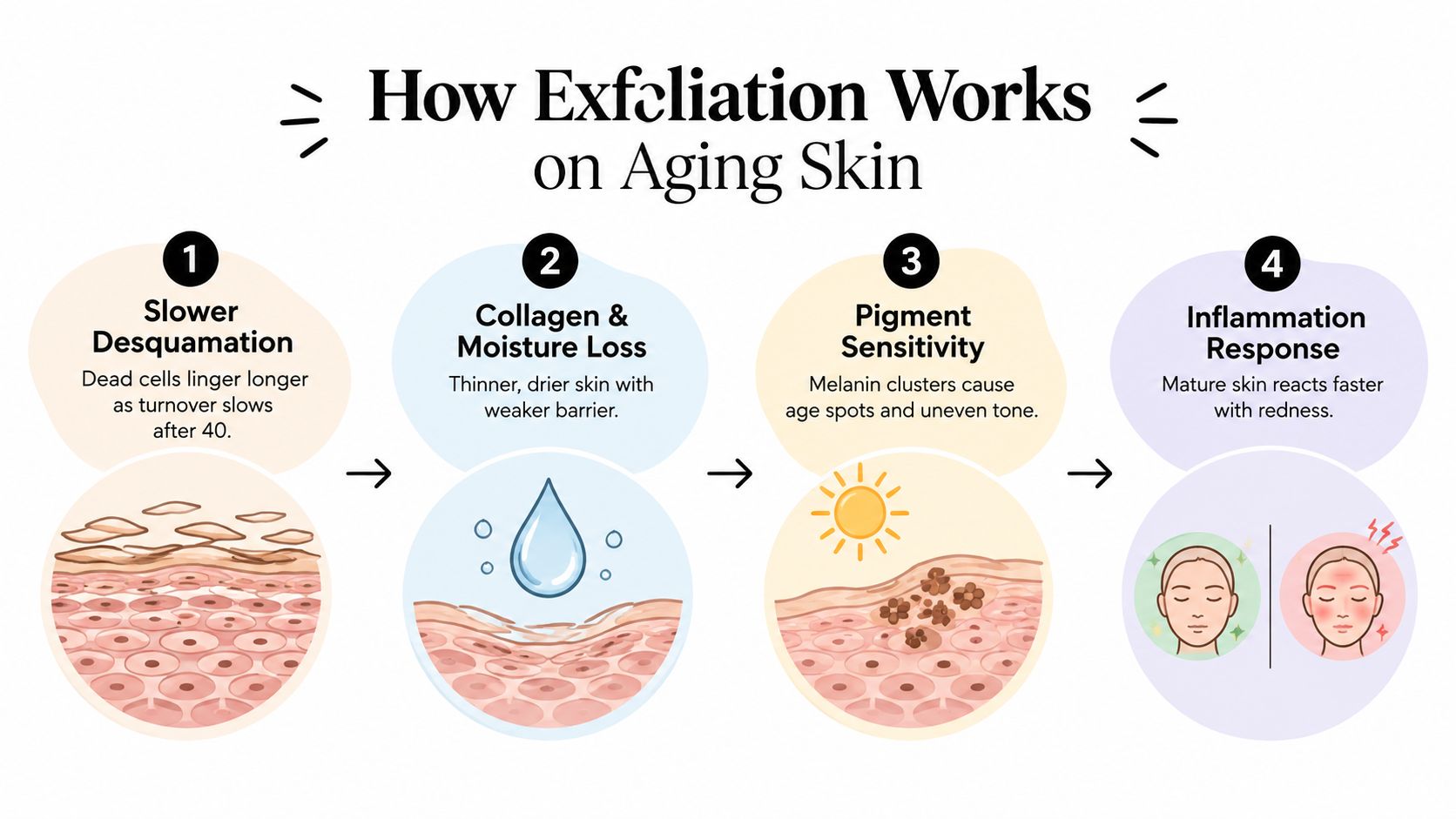
The four biological problems behind the visible changes
Slower desquamation can make mature skin look dull or feel uneven. Chemical exfoliants loosen some connections between surface cells, helping shedding occur more uniformly. The goal is controlled release, not maximum peeling.
Collagen and moisture loss reduce the margin for aggressive treatment. A drier barrier is less tolerant of repeated stress. If an exfoliant removes surface material without supporting water and lipid balance, skin may feel tighter and more fragile.
Pigment sensitivity matters when dark spots are the primary concern. Ultraviolet exposure and inflammation can signal melanocytes to produce more melanin. Exfoliation may improve the look of uneven tone, but irritation can trigger the opposite result.
Inflammation response determines whether resurfacing supports a more even appearance or leaves redness and darkening behind. The useful target is more controlled turnover with less inflammatory stress. This is why dose and routine design matter more than choosing the strongest product.
A 2024 clinical study followed five Lithuanian women aged 65–80 through five acid-based procedures over seven weeks. It reported elasticity improving from 7% to 78%, a pigmentation index declining from 46% to 42%, and a wrinkle index declining from 60% to 56%. The study also reported better hydration, lower transepidermal water loss, improved texture, and improved complexion tone. Its small sample and combined use of succinic, mandelic, and lactic acids make it a clinical signal, not a universal forecast (2024 mature-skin clinical study).
Dark spots aren't one condition
Post-inflammatory hyperpigmentation, or PIH, follows injury or inflammation. It can affect any skin type and is more common in Fitzpatrick IV–VI, because melanocytes may produce and redistribute melanin unevenly after an insult.
Melasma follows a different pattern. Its management can involve reducing pigment production, addressing deposited pigment, supporting turnover, and limiting inflammation. Irritant-only treatment may worsen darkening, so a harsh peel does not provide a complete melasma strategy (melasma and PIH treatment review).
Sun spots are another category, generally linked with cumulative ultraviolet exposure. Their appearance does not mean the same routine suits melasma or PIH. Correct identification helps determine how much irritation the skin can tolerate. For the broader renewal process, see this guide to skin cell turnover.
Chemical vs Physical vs Enzyme Exfoliants for Mature Skin
The category you choose determines how much control you have over the treatment. Mature skin usually benefits from a method that distributes exfoliation evenly and allows you to adjust frequency without adding friction.
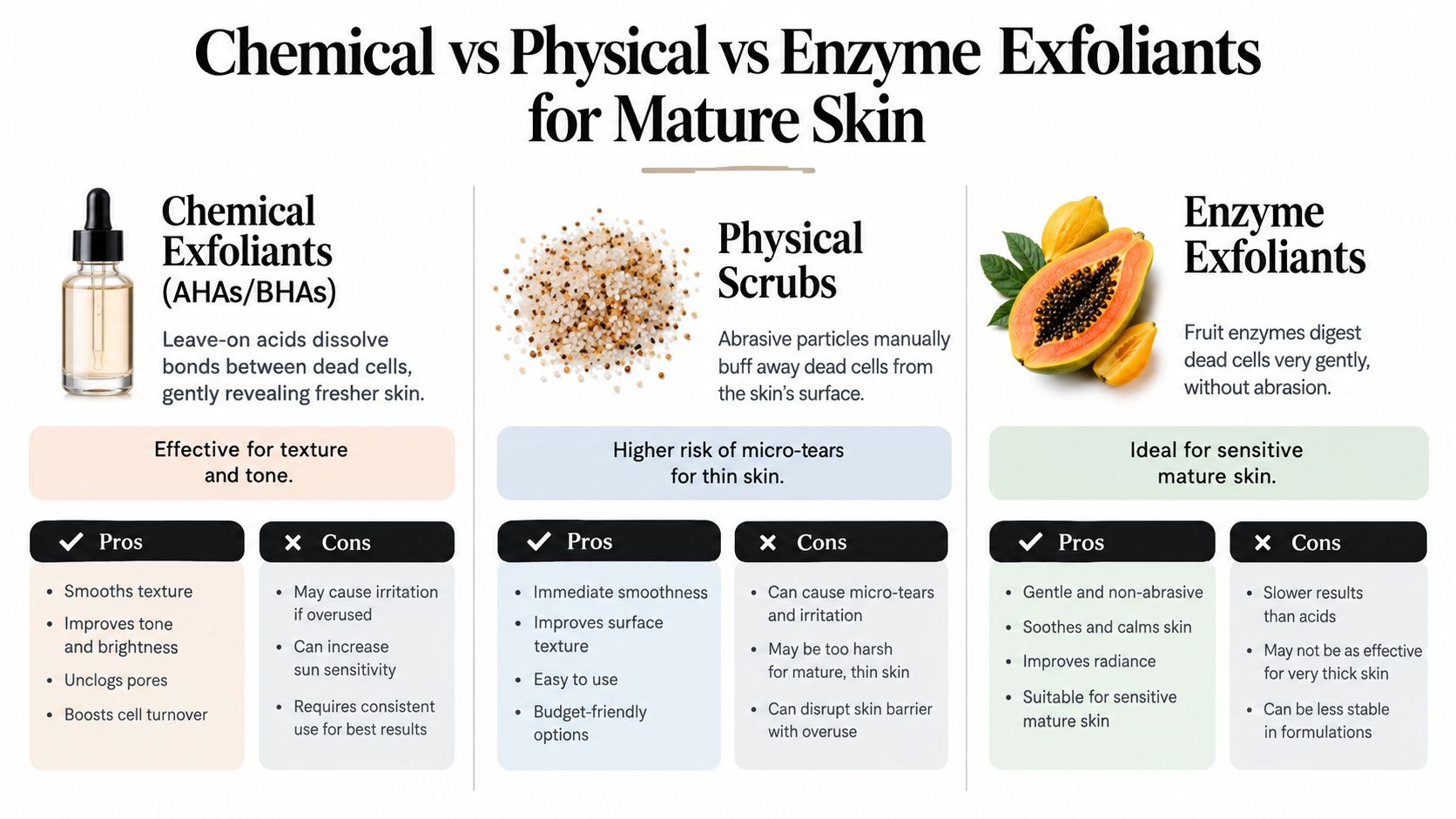
Chemical exfoliants
Leave-on acids dissolve some of the bonds between surface cells. That makes them easier to dose than a scrub, where pressure, particle shape, and repeated passes change the intensity from one use to the next.
AHAs such as lactic and glycolic acid primarily address surface dullness and texture. BHAs such as salicylic acid are useful when pores are visibly congested because they interact well with oil within the pore. PHAs, including gluconolactone and lactobionic acid, offer a larger-molecule approach that can feel more gradual and hydrating.
Chemical doesn't automatically mean gentle. A high-strength acid, a low-pH formula, frequent use, or poor layering can still overwhelm mature skin. The benefit is adjustability, not immunity from irritation.
Physical exfoliants
Scrubs, brushes, textured cloths, and abrasive tools rely on friction. That friction may provide an immediate smooth feeling, but it can also create uneven pressure across the face and aggravate a thin or reactive barrier. Repeated mechanical irritation is a poor match for someone whose main problem is pigment, because inflammation can stimulate melanin activity.
AAFP explains that inflammatory mediators including prostaglandins, leukotrienes, and thromboxane can stimulate epidermal melanocyte hypertrophy and increased melanin synthesis. That biological link explains why aggressive procedures or over-exfoliation can worsen pigmentation rather than improve it (AAFP discussion of inflammation and hyperpigmentation).
If you're considering a professional mechanical service, review how a trained provider approaches ProMD Health Bel Air dermaplaning rather than assuming a home scrub and a controlled procedure are equivalent.
Enzyme exfoliants
Fruit enzymes digest some surface proteins without relying on the same acid mechanism. They can suit days when your skin feels reactive, although their resurfacing effect is usually more limited than a well-tolerated acid routine.
A triple-acid leave-on option such as Skin Perfection Liquid Exfoliant Peel AHA BHA PHA uses AHAs, BHA, and PHA in a non-abrasive format. Its listed formula includes 2% salicylic acid, glycolic and lactic acids, lactobionic acid, kojic acid, hyaluronic acid, and hexapeptides. That ingredient architecture illustrates the maintenance principle: multiple functions can be distributed across an exfoliating system instead of relying on one highly aggressive acid.
AHA BHA PHA and Enzymes Explained With Ideal Strengths
Choosing an acid starts with the concern, not the trend. Glycolic acid can be effective for surface roughness and dullness, but its smaller molecule can feel more intense. Lactic acid is often a more comfortable starting point for dry mature skin because it combines surface exfoliation with a humectant profile. Mandelic acid is another gradual option when sensitivity and uneven tone matter.
Salicylic acid is oil-soluble and makes the most sense when enlarged-looking pores, congestion, or occasional blemishes are part of the picture. It doesn't need to be the centre of every mature-skin routine, particularly when the skin is already dry.
PHAs such as gluconolactone and lactobionic acid have larger molecular structures and can provide a slower resurfacing experience. That makes them useful when hydration and tolerance are more important than an immediate peeling sensation. In a 12-week controlled study of photoaged facial skin, a PHA regimen produced anti-aging benefits broadly comparable to a glycolic-acid AHA regimen, with significant improvements in clinical grading, silicone-replica appearance, and pinch-recoil firmness in both groups (controlled PHA and glycolic-acid study). The regimens differed on two reported endpoints, with the AHA regimen improving week-12 sallowness slightly more, 17.1% versus 12.4%, and pinch recoil 13.5% versus 10.2%, respectively. Those results support a practical conclusion: mature skin doesn't always need the most aggressive acid to obtain meaningful resurfacing.
Enzymes belong in the lowest-intensity part of the decision tree. They can help maintain a smoother surface when acids are poorly tolerated, but they aren't necessarily the best tool for persistent pore congestion or established pigment.
Choosing Your Acid Family by Mature Skin Concern
| Acid Family | Best For | Typical Effective Range | Mature Skin Advantage |
|---|---|---|---|
| AHA | Dullness, surface texture, uneven-looking tone | Product-specific low-to-moderate leave-on dosing | Supports visible smoothing and brightness |
| BHA | Pore congestion and oil-related buildup | Product-specific salicylic-acid dosing | Addresses pore contents without relying on scrubbing |
| PHA | Dryness, sensitivity, gradual resurfacing | Product-specific low-irritation dosing | Combines gentle renewal with a more comfortable maintenance profile |
| Enzymes | Reactive days and light surface maintenance | Product-specific enzyme activity | Offers non-abrasive exfoliation when acids feel excessive |
There isn't one universal “ideal percentage” for mature skin. A useful concentration depends on pH, free-acid availability, the complete formula, contact time, skin condition, and how often you apply it. The clinical peeling literature illustrates why professional strengths shouldn't be copied casually. A review lists superficial options for PIH and melasma including glycolic acid 20–70%, salicylic acid 20–30%, trichloroacetic acid 10–25%, and Jessner's solution, while warning that stronger or deeper peels increase inflammation and pigmentation risk (review of chemical peels for hyperpigmentation).
For ingredient context beyond exfoliation, AHA and BHA products can help you compare how these families fit into a broader routine. A barrier-supporting product such as Advanced Triple Action Age-Defying Serum is described as a rich, creamy moisturizer with peptides, DMAE, collagen, vitamin C, and alpha lipoic acid, intended to support the appearance of firmness, hydration, and fine lines. It should complement, not compete with, your exfoliant.
How Often to Exfoliate and How to Use It Safely
Frequency is where many mature-skin routines fail. A dermatologist-quoted rule of thumb in recent coverage places normal or combination skin at 2–3 exfoliation sessions weekly, while mature, dry, or sensitive skin may need only weekly use (frequency guidance and dermatologist survey coverage). The same source reports 63.2% of surveyed dermatologists endorsing daily gentle exfoliation for sensitive skin only when formulas are micro-dosed and barrier-supportive. That isn't a reason to exfoliate daily by default. It distinguishes a low-dose maintenance formula from an aggressive peel.
A conservative starting routine
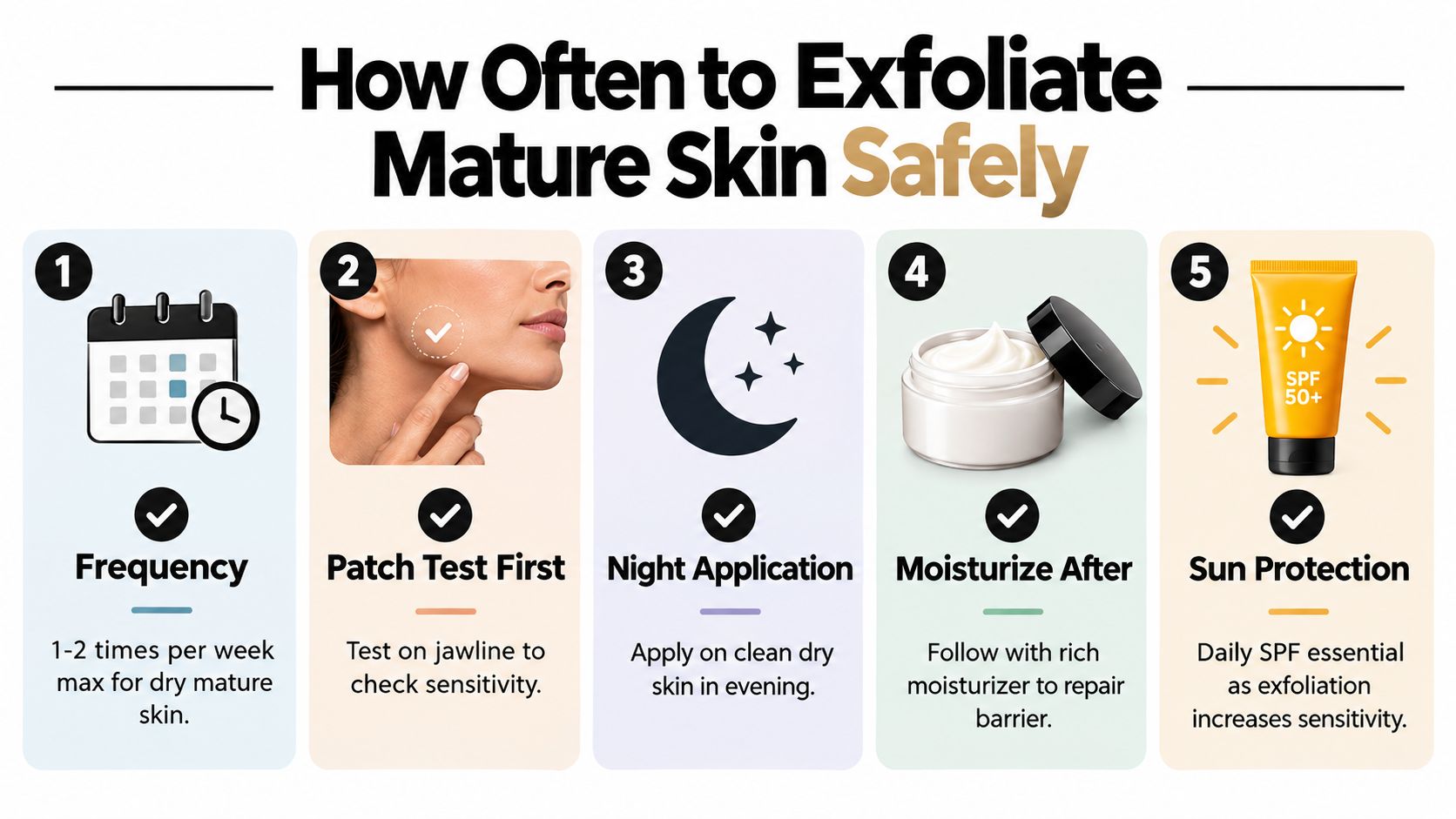
For dry, thin, or sensitive mature skin, begin with one evening per week. If your skin stays comfortable between applications, you can consider moving to two weekly sessions. Normal or combination skin may tolerate more frequent use, but tolerance should be earned through observation, not assumed from the label.
Use this sequence:
- Cleanse gently. Remove makeup, sunscreen, and surface residue without adding friction.
- Dry the skin fully. Damp skin can change how quickly some acids spread and feel.
- Apply a thin layer. Keep the product away from the eyelids, nostril creases, and corners of the mouth.
- Moisturize afterward. Choose a bland, barrier-supportive moisturizer instead of adding another active.
- Protect the next morning. Exfoliation makes consistent broad-spectrum sun protection essential, especially when uneven tone is a concern.
A product such as Pigment Restraint Ultra High Sun Protection is described in its product information as a fast-absorbing formula with protection against UVA, UVB, IR, and HEV-combination rays. It belongs in the daytime protection step, not as a substitute for cautious exfoliation.
Layering without creating an irritation stack
Don't introduce an exfoliant on the same evening as a retinoid when you're still establishing tolerance. Alternate nights instead. Vitamin C can fit in the morning for some people, but sensitive skin should avoid treating every active as mandatory.
A simple pattern is:
- Morning: gentle cleanse or rinse, hydrating product, moisturizer as needed, broad-spectrum sun protection.
- Exfoliation evening: cleanse, exfoliant, moisturizer.
- Retinoid evening: cleanse, retinoid as directed, moisturizer.
- Recovery evening: cleanse, hydration, moisturizer only.
Patch test first, especially if you've recently experienced stinging or redness. If the skin burns during application, remains tight after moisturizing, or becomes more reactive the following day, reduce frequency before changing to a stronger formula.
Signs You Are Over Exfoliating and How to Recover
You apply an exfoliant for a brighter look, then familiar moisturizer suddenly stings. Tightness returns within minutes, flakes appear, and the skin feels rough or papery despite added hydration. These changes signal that the dose is exceeding what your barrier can manage, not that the product is working better.
Watch for tightness that returns quickly, stinging from products you previously tolerated, persistent redness, flaking, unusual sensitivity, and a rough or thin-feeling surface. Darkening after irritation deserves attention, especially where you rubbed, peeled, or repeatedly applied an active. Reduce exposure before reaching for a stronger formula.
Why pigment can rebound
Post-inflammatory hyperpigmentation develops after injury or inflammation, rather than from having surface cells present. It can affect every skin type and tends to occur more often in Fitzpatrick IV–VI, whose melanocytes may respond strongly to inflammatory signals, as described in this review defining post-inflammatory hyperpigmentation. Scrubbing harder for a faster glow therefore creates a poor trade-off for pigment-prone skin.
Melasma needs a separate decision process. Its pattern can involve several pigment and inflammatory pathways, while irritation from a single treatment may worsen uneven tone. If discoloration is symmetrical, recurrent, or difficult to classify, a dermatologist can help distinguish melasma, post-inflammatory hyperpigmentation, and sun-related spots before you increase treatment intensity.
The recovery protocol
Stop acids, scrubs, enzyme masks, and other potentially irritating actives while the skin feels inflamed. Retinoids and vitamin C may also need a pause if they sting. Continuing several actives at once hides the trigger and prolongs recovery.
Cleanse gently, apply a simple moisturizer, and use sun protection each day. Avoid picking, rubbing, hot water, and manually removing flakes. This skin barrier repair guide provides a practical framework for restoring comfort before you reintroduce exfoliation at a lower dose.
A barrier-focused option such as Anti-Aging Powerhouse includes a rich serum described as containing skin-perfecting peptides and ingredients intended to support hydration, resiliency, and the moisture barrier. Its accompanying body essence is described for body use and says to avoid the face and neck, so follow the product boundary. Reintroduce one active at a time only after cleansing and moisturizing feel comfortable again. Low-dose maintenance is usually easier to control than aggressive peeling.
Choosing Your Exfoliant and Building a Simple System That Works
A practical product screen is more useful than a “strongest acid” ranking. Look for a formula with a clear acid family, a reasonable delivery system, hydrating support, and instructions that let you control exposure. Fragrance-free design can be helpful for reactive users, while ingredients such as hyaluronic acid, niacinamide, and squalane can support a more comfortable routine.
Use this checklist:
- Choose the concern first: Lactic acid or PHA for dry dullness, salicylic acid for pore congestion, and a cautious multi-acid approach for mixed texture and tone concerns.
- Prefer balanced formulas: AHA, BHA, and PHA can divide responsibilities across surface texture, pores, and hydration rather than forcing one acid to do everything.
- Check the surrounding routine: Don't pair a new exfoliant with several other strong actives on the same night.
- Protect pigment-prone skin: Sun protection and inflammation control matter as much as surface shedding.
- Start below your maximum tolerance: The right maintenance dose is the highest frequency your barrier can handle without tightness or stinging.
A retrospective chemical-peeling study from January through December 2019 included 37 patients out of 415 skin-aging cases, so peeling represented 8.9% of that clinic's skin-aging patients. Within the peeling cohort, 75.7% received 8% glycolic acid as a priming agent, and 62.2% received 20% glycolic acid as the peeling agent (retrospective chemical-peeling study summary). Those concentrations belong to a clinical treatment context, not a recommendation to reproduce professional peeling at home.
Build the routine around consistency. In the morning, cleanse gently, hydrate, moisturize, and apply sun protection. In the evening, alternate exfoliation with recovery and other active nights. Mature skin usually gets more from controlled repetition than dramatic intensity.
Mesoderm RX offers targeted formulas for resurfacing, hydration, age-related texture, and daily pigment protection, including the Skin Perfection AHA BHA PHA approach discussed here. Visit Mesoderm RX to review the collection and choose a routine that supports gentle renewal without making barrier stress the price of visible results.