


Chemical Exfoliant AHA Guide to Smoother Brighter Skin
Your cleanser is fine. Your moisturizer is fine. You may even be using a brightening serum faithfully. Yet your skin still looks flat by midday, rough when you touch it, and marked by old acne spots that seem to sit in place for months.
That pattern usually isn't a scrubbing problem. It's a turnover problem.
When skin sheds too slowly, dead surface cells accumulate, light reflects poorly, texture feels uneven, and pigment hangs around longer than it should. Many people respond by exfoliating harder with grains, brushes, or washcloths. That often adds friction without fixing the biology underneath. A chemical exfoliant AHA works differently. It changes how tightly old cells hold onto each other, so the skin can release them in a more controlled way.
That distinction matters if you're dealing with dullness, roughness, post-acne marks, or visible sun damage. It also matters if you've tried acids before and either saw no change or irritated your skin. With AHAs, the formula isn't just about the ingredient name. Acid type, concentration, pH, frequency, and sun protection all determine whether you get smoother, brighter skin or a compromised barrier.
Introduction Why Your Glow Fades Even With Good Skincare
A familiar routine goes like this. You wash your face, apply hydrating products, maybe add vitamin C or niacinamide, and still wake up with skin that looks tired. Makeup catches on flakes. Dark spots look sharper instead of softer. Fine lines seem more obvious when the surface feels dry and uneven.
That isn't always because your products are weak. Often, the top layer of skin isn't shedding efficiently.
What dullness usually means
The outermost layer of skin, the stratum corneum, is meant to act like a smart barrier. It keeps water in and irritants out. But when old cells linger too long, that same barrier starts to look coarse and opaque. Skin loses that smooth reflective quality people describe as glow.
Pigment also gets visually trapped in that rough upper layer. So even if inflammation from a breakout has settled, the mark can look more stubborn because the skin isn't clearing itself cleanly.
Practical rule: If your skin feels rough and looks dull at the same time, scrubbing harder usually isn't the answer. You need more orderly shedding, not more friction.
Why so many routines stall out
Most failed exfoliation routines break down in one of three places:
- They use abrasion instead of chemistry. A scrub removes some loose cells, but it doesn't reliably loosen the bonds that keep compacted cells attached.
- They chase pigment with only brighteners. If skin turnover is sluggish, even a good brightening routine can look underwhelming.
- They ignore formulation details. An AHA can be present in a product and still underperform if the pH isn't in the effective range.
AHAs didn't stay niche. Over the past few decades they moved from a limited dermatology ingredient category into routine cosmetic use. A safety assessment reported glycolic acid in 42 formulations and lactic acid in 342 formulations in earlier data, rising to 337 and 1,042 formulations by 2013, alongside higher maximum reported use concentrations over time, including glycolic acid up to 50% in some face-and-neck products and skin preparations (CIR safety assessment on AHAs).
If you're deciding whether an AHA belongs in your routine, the useful question isn't "Do acids work?" It's "Which acid, in what kind of system, and under what conditions?"
By the end, you'll be able to judge that for yourself.
How Chemical Exfoliant AHA Works on Skin Biology
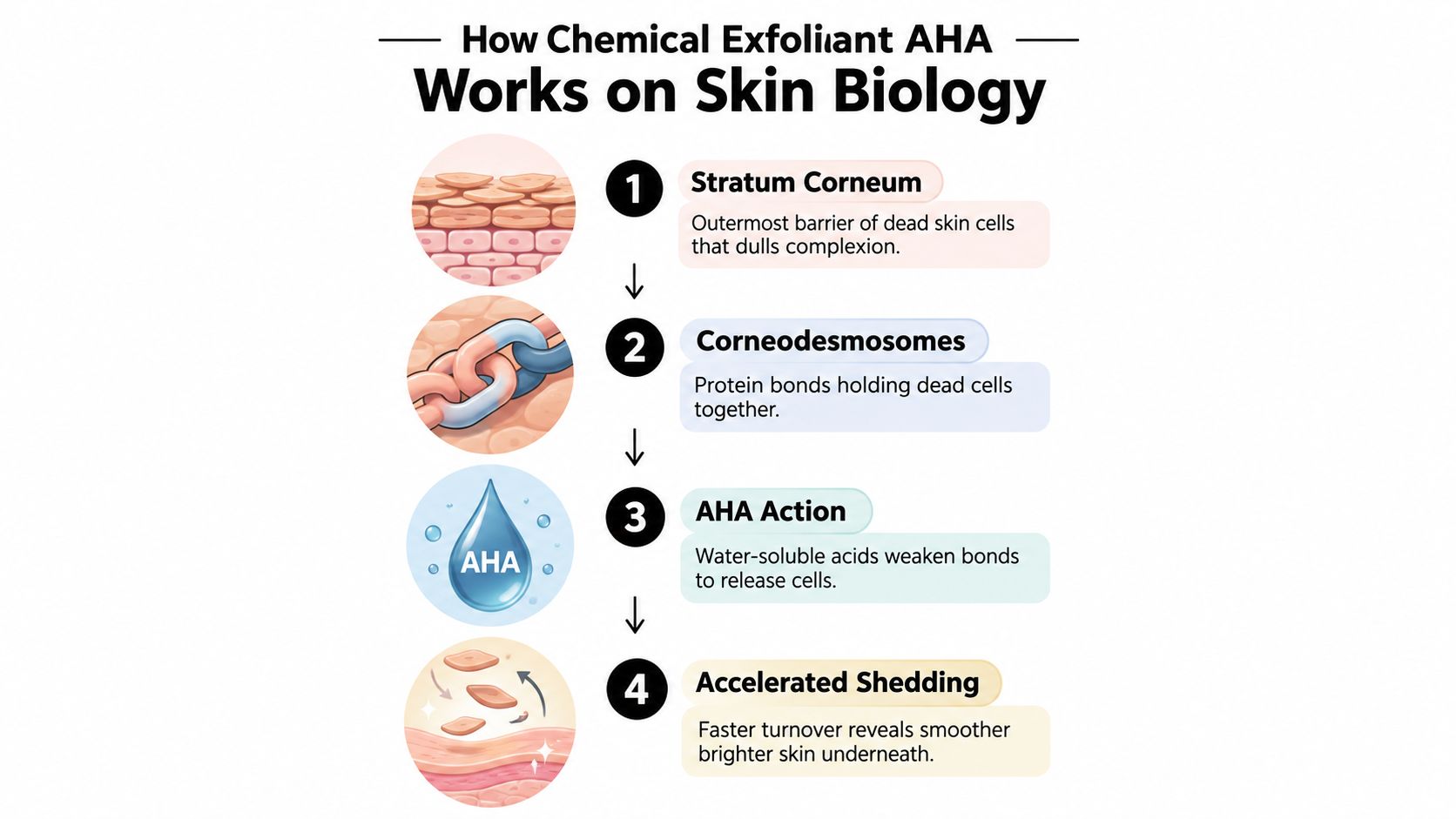
AHAs are water-soluble acids that work primarily on the skin's surface. Their main job is simple in concept and precise in practice. They loosen the connections between old surface cells so those cells release more evenly.
Start with the barrier, not the acid bottle
Think of the stratum corneum as a brick wall. The flattened dead cells are the bricks. The structures holding them together are part of the mortar. In skin biology, one important part of that attachment system is the corneodesmosome.
A chemical exfoliant AHA helps weaken that mortar. When those attachments loosen, compacted cells don't cling as long. The surface becomes smoother, and newer cells underneath become more visible.
This is why AHAs can improve rough texture without scrubbing. They don't sand the skin down. They alter cell shedding.
Why pH changes everything
Featured Product
Skin Perfection Liquid Exfoliant Peel AHA BHA PHA
Reveal your smoothest, clearest skin yet with our best-selling 2% BHA (Beta Hydroxy Acid) exfoliant. This lightweight, leave-on formula works deep within pores to unclog congestion, minimize blackheads, and boost skin clarity — without irritation.
Shop Now →
People often focus on percentage and ignore pH. That misses half the mechanism.
AHA activity is pH-dependent because the acid works best when enough of it remains in its free-acid form. Independent dermatology literature places the typical efficacy window around pH 3 to 5, where the acid stays sufficiently protonated to drive controlled desquamation. The same review notes that a 10% glycolic acid emulsion at pH 4.0 lowered skin-surface pH from about 5.2 to 4.0 within 10 minutes, and that shift persisted for hours (UBC dermatology review on AHA pH and skin effects).
In plain language, lower pH means more active acid is available to do exfoliating work. If a formula is heavily neutralized, the label may still say glycolic or lactic acid, but the resurfacing effect can be far weaker.
Lowering skin-surface pH isn't automatically better. It increases activity, but it also raises the chance of irritation if the formula is too strong or used too often.
AHAs can influence pigment beyond shedding
Exfoliation explains part of why skin looks brighter after AHAs. But it's not the whole story.
In vitro evidence summarized in dermatology literature shows glycolic acid and lactic acid at 300 to 500 μg/mL can suppress melanin formation by directly inhibiting tyrosinase in melanoma cells (dermatology review on AHAs and tyrosinase inhibition). Tyrosinase is a key enzyme in melanin production. That means AHAs may support pigment improvement through two separate paths. They help shed discolored cells and may also reduce new pigment formation upstream.
For people dealing with post-acne marks or uneven tone, that dual action is why AHAs can matter more than a simple polishing product.
A leave-on multi-acid formula such as Skin Perfection Liquid Exfoliant Peel AHA BHA PHA fits into this biology-first approach because it combines glycolic and lactic acid with salicylic acid and lactobionic acid in a non-abrasive format, rather than relying on scrub particles.
Types of AHAs and How to Choose Glycolic Lactic Mandelic
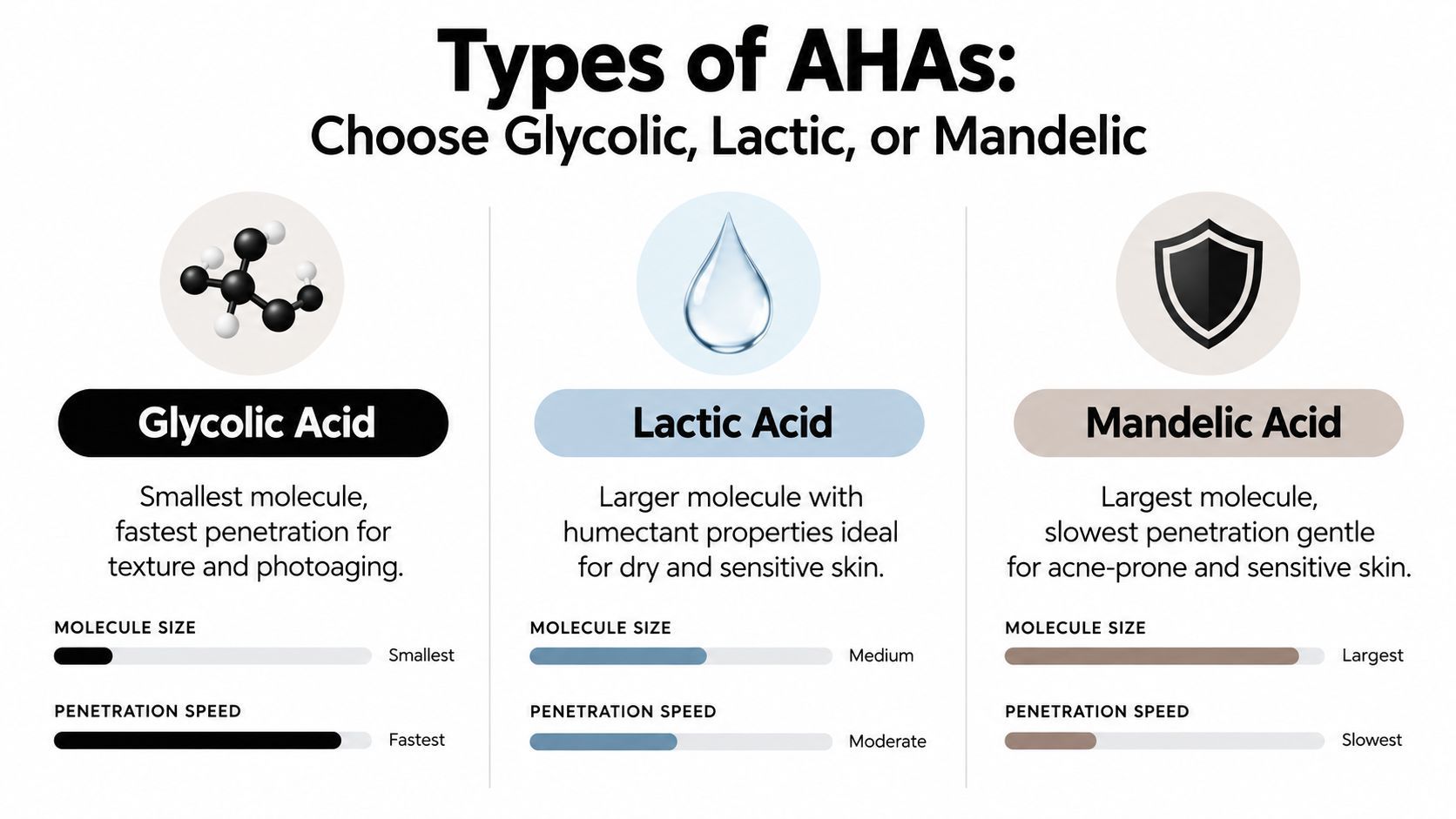
Not all AHAs behave the same way on skin. The family shares a mechanism, but the feel, speed, and tolerance profile differ. In practice, the easiest way to understand them is by molecular size, which influences how quickly they move into the upper skin layers.
Glycolic, lactic, and mandelic compared
Glycolic acid is the smallest commonly used AHA. It penetrates quickly, which is why formulators often choose it for rough texture, visible photoaging, and skin that needs more obvious resurfacing. That same fast penetration is also why glycolic can become irritating sooner when concentration or frequency outruns tolerance.
Lactic acid has a larger molecular size and tends to feel gentler. It's often a better fit when the skin is dry, reactive, or newly introduced to acids. If your barrier gets tight easily, lactic usually gives you a wider margin before irritation starts competing with results. If you want a deeper explanation of where lactic acid fits in a routine, this guide on what lactic acid does for skin is a useful companion.
Mandelic acid is larger still. It penetrates more slowly, which often makes it easier to tolerate for acne-prone or easily inflamed skin. It can also be a sensible choice when you're trying to brighten gradually without pushing the skin too hard.
A practical outside example is a brightening calendula lactic acid cream, where lactic acid is paired with a cream base rather than a sharp resurfacing format. That kind of product often appeals to people who want exfoliation to feel less clinical and more cushioned.
Match the acid to the problem
Use this logic when choosing:
- Rough texture and visible sun wear: Glycolic acid usually makes the most sense if your skin already tolerates actives well.
- Dry, dull, easily sensitized skin: Lactic acid is often the cleaner starting point.
- Acne-prone, reactive, or cautious beginners: Mandelic acid tends to offer a slower, more forgiving pace.
- Blend formulas: Citric and tartaric acids often play supporting roles rather than acting as the sole resurfacing driver.
When a blend makes more sense than a single acid
Single-acid products are easier to troubleshoot. Multi-acid products can be more balanced.
A blend may pair stronger resurfacing with more gradual exfoliation, or combine exfoliation with barrier support. That's often useful when someone wants smoother texture and better tone without choosing between the two. The same logic applies when pairing resurfacing with age-supportive skincare. Advanced Triple Action Age-Defying Serum is described as a rich, creamy moisturizer with peptides that helps fortify the moisture barrier and reduce the appearance of fine lines and wrinkles, which can complement an exfoliation routine focused on mature skin.
If you're choosing your first AHA, start with the gentler side of the category. Stronger isn't smarter when the barrier can't keep up.
Clinical Benefits for Pigmentation Texture and Visible Aging
You use a brightening product for weeks, your skin feels smoother, but the same marks still catch the light in the mirror. That gap between smoother skin and clearer skin is where many AHA routines get misunderstood.
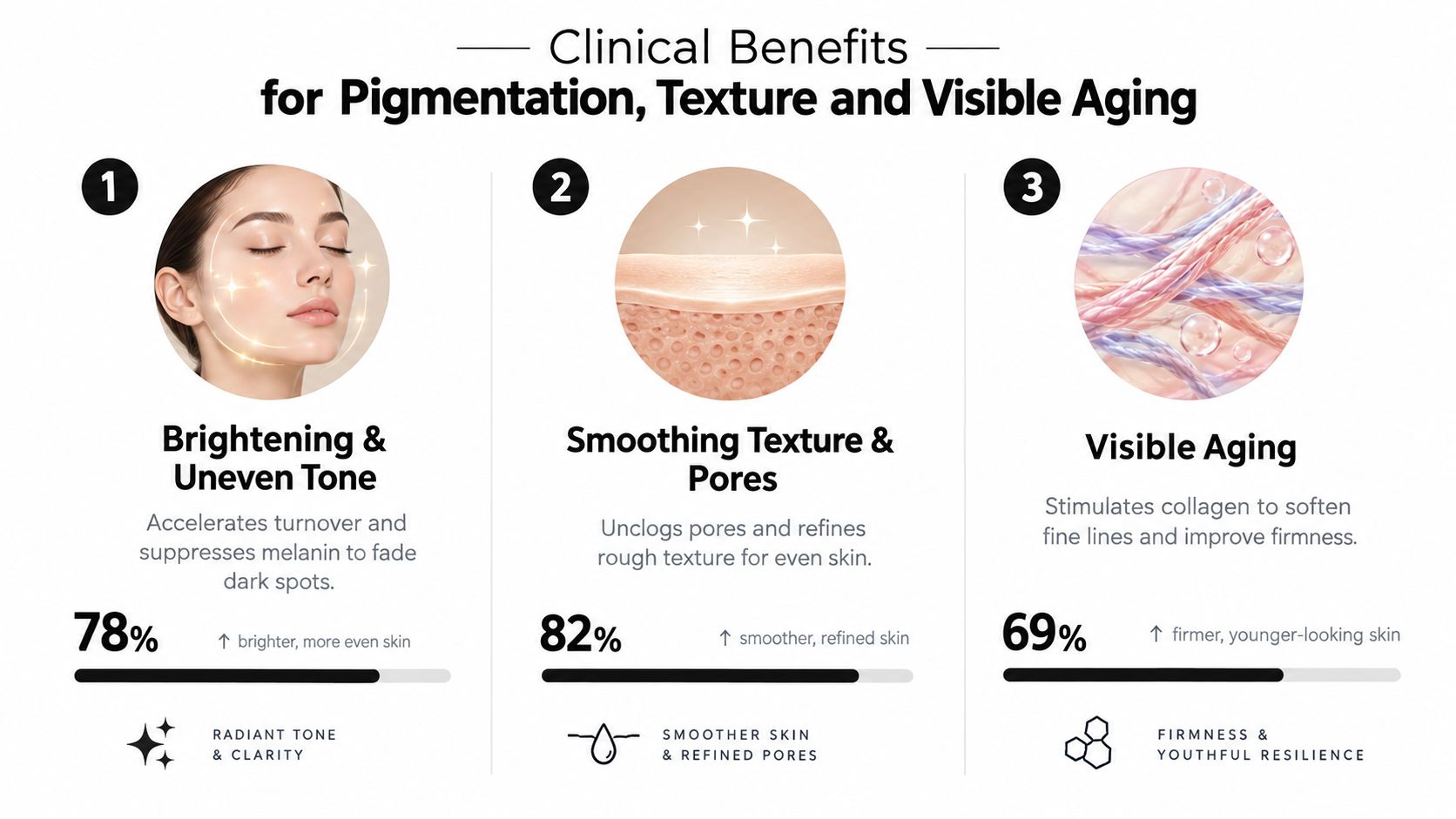
AHAs help in two visible ways at once. First, they loosen the bonds between older surface cells so dull, uneven layers shed more evenly. Second, some formulas can support a brighter-looking tone by reducing the conditions that keep discoloration looking obvious on the surface. In plain terms, desquamation improves the way damaged cells leave the skin, while pigment control depends on a different pathway. Tyrosinase activity, inflammation, UV exposure, and barrier disruption all matter. That is why a single exfoliating product often improves part of the problem, but not the whole picture.
What the data supports
A clinical review reported that an AHA regimen improved sallowness and pinch recoil over 12 weeks, with statistically significant change in visible color quality and skin responsiveness (clinical review of AHA outcomes). Those are useful measures because they describe changes people notice. Skin can look less gray-yellow, less tired, and a bit more refined before deeper discoloration fully fades.
Texture usually responds earlier than pigment.
That timing makes sense biologically. AHAs act first on the outermost layers, where compact, uneven cell buildup makes skin look rough and flat. Pigment problems are more variable. A post-acne mark near the surface may fade with steady exfoliation, while sun spots and melasma involve ongoing pigment signaling that exfoliation alone does not fully control. Research on topical agents that inhibit tyrosinase helps explain why discoloration treatment often needs more than resurfacing, because reducing pigment production and removing pigmented cells are related but separate jobs (review of topical treatment strategies for hyperpigmentation).
Why single-product fixes often disappoint
The pattern is predictable in clinic-style skin planning. Educate first. Diagnose the kind of discoloration second. Prescribe a system third.
People often run into trouble for three reasons:
- They treat all dark marks as the same problem. Post-inflammatory hyperpigmentation, sun spots, and melasma do not behave the same way.
- They judge progress only by speed. Smoother texture can improve in weeks, while pigment often needs a longer cycle of controlled shedding plus pigment suppression.
- They rely on exfoliation alone. AHAs help remove uneven surface cells, but they do not replace daily UV protection or other pigment-targeting steps.
A useful analogy is a stained tile floor. Exfoliation helps lift the film sitting on top. It does not stop a new stain from forming, and it does not remove every stain that has set deeper into the material.
So the clinical benefit of AHA is real, but specific. It can brighten dull surface tone, smooth rough texture, soften the look of fine lines, and help post-acne marks clear more evenly over time. If the trigger for discoloration is still active, results plateau. That is why stronger peeling is sometimes considered after a careful diagnosis. For readers weighing that option, this chemical peel for pigmentation guide helps clarify when at-home exfoliation is likely enough and when deeper treatment may make more sense.
AHA vs BHA vs PHA Which Exfoliant Fits Your Skin Type
You don't need every acid category. You need the category that matches the layer of skin where your problem lives.
AHAs are best when the issue is mostly on the surface. Dullness, uneven texture, visible sun damage, superficial discoloration. BHAs are more useful when congestion inside the pore is driving breakouts or blackheads. PHAs are the low-friction option when skin needs exfoliation but doesn't tolerate much aggression.
Choosing Between AHA BHA and PHA
| Exfoliant | Solubility and Target | Best For | Watch Out For |
|---|---|---|---|
| AHA | Water-soluble, works mainly on the skin surface | Dullness, rough texture, uneven tone, visible photodamage | Can irritate if concentration, pH, or frequency are poorly matched |
| BHA | Oil-soluble, reaches into pores | Blackheads, congestion, oily and acne-prone skin | Can feel drying if overused on already dry skin |
| PHA | Surface exfoliation with a gentler profile | Sensitive skin, beginners, barrier-compromised skin | May feel too mild if you want faster resurfacing |
How to decide without overcomplicating it
If your skin feels rough but not oily, start by looking at AHA.
If your main complaint is blackheads or clogged pores, BHA usually deserves first priority.
If nearly everything stings, PHA gives you a slower entry point. A useful primer on that category is this explanation of what PHA does in skin care.
When combination formulas help
Combination exfoliants can make sense when concerns overlap. That's common. Someone may have rough texture on the cheeks, congestion in the T-zone, and post-acne marks left behind from past breakouts.
In that situation, a formula that combines AHA, BHA, and PHA can address different layers at once. The tradeoff is that blended formulas require more discipline. You still have to control frequency, protect the barrier, and stop if stinging turns into persistent irritation.
Safe Use Guide for Concentration pH Frequency and Sun Protection
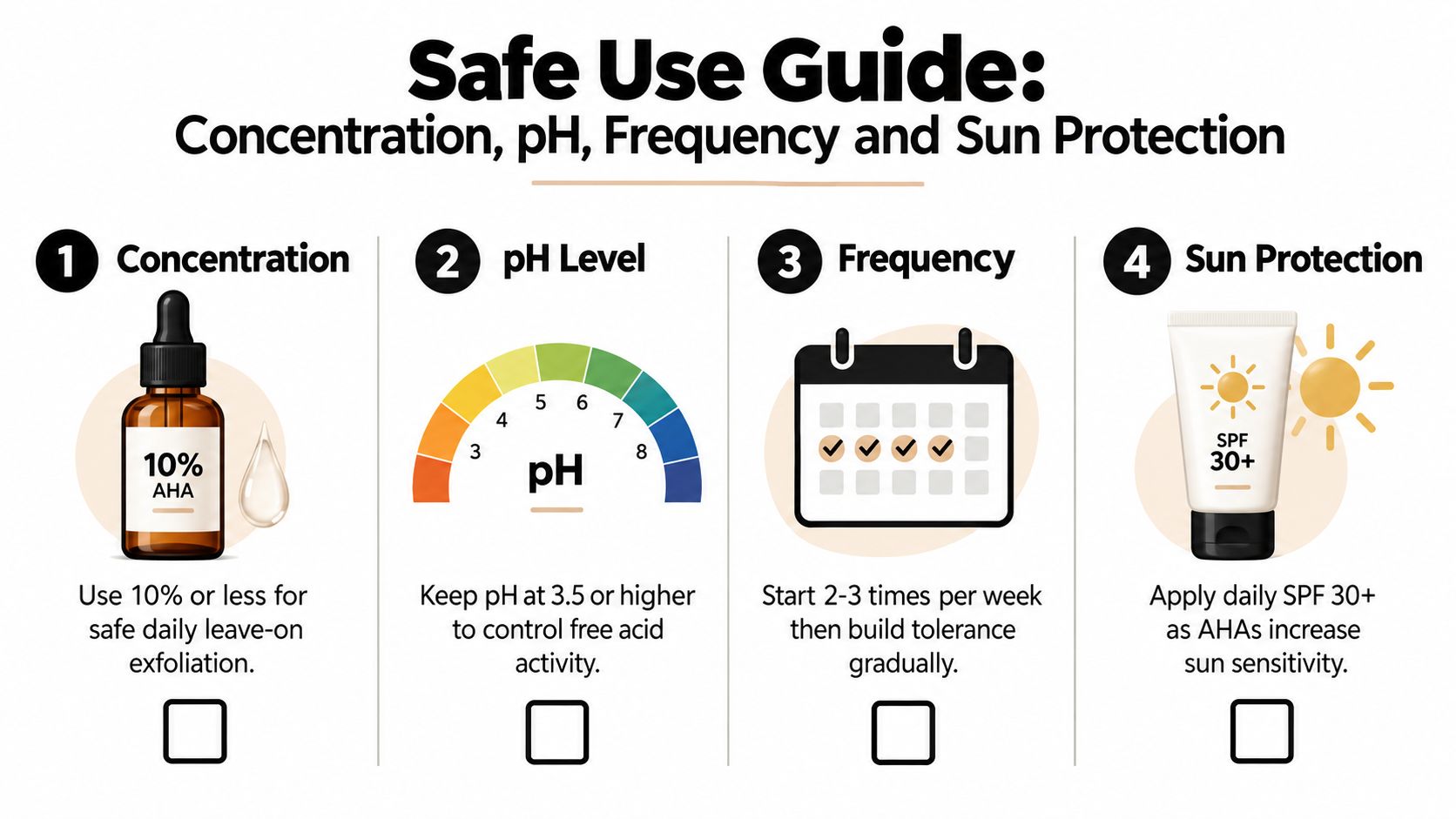
The safest way to use AHAs is to think like a formulator, not a trend cycle. You need four controls in place. Concentration, pH, frequency, and UV protection.
The leave-on benchmark
Regulatory and safety reviews align on a practical consumer standard. Leave-on products containing glycolic or lactic acid are generally considered safe when the AHA concentration is 10% or less and the final product pH is 3.5 or higher, with daily sun protection recommended because AHAs can increase UV sensitivity (FDA guidance on alpha hydroxy acids).
That benchmark exists for a reason. Lower pH increases the amount of active free acid. That's part of what makes a formula work, but it's also what raises sting, redness, and barrier disruption when the product is too aggressive for routine use.
If pH is confusing, this overview of skin pH balance and toning helps connect formulation language to what your skin feels.
Daily products are not office peels
People regularly compare a home exfoliant to a professional peel as if they differ only by branding. They don't.
A 2023 review classifies superficial AHA peels at roughly 30 to 50% glycolic acid, 10 to 30% lactic acid, or 50% mandelic acid, while OTC skincare is typically in the 4 to 10% range (2023 review of chemical peel concentrations).
That concentration gap is why a nightly exfoliant and an in-office peel are not interchangeable. Professional peels rely on brief contact, trained application, and rinse-off control. Leave-on skincare is designed for a completely different exposure pattern. If you want a broader clinical context on stronger procedures, this reference on chemical peels for anti-aging helps separate professional resurfacing from home care.
A simple use protocol
Use this progression instead of guessing:
- Patch test first: Apply to a small area before full-face use, especially if your skin is reactive.
- Start low-frequency: Use it 2 to 3 times per week at first, then build only if your skin stays calm.
- Keep the rest of the routine quiet: Pair with hydrating, non-irritating support rather than stacking multiple strong actives.
- Pause on warning signs: Lingering burn, marked redness, unusual tightness, or peeling that keeps worsening means the barrier needs a break.
- Protect every morning: This is not optional when using AHAs.
Skin that becomes shiny, tight, and stings from plain moisturizer isn't "purging." It's often over-exfoliated.
For UV defense in an exfoliation routine, Pigment Restraint Ultra High Sun Protection is described as a fast-absorbing, non-greasy formula with protection against UVA, UVB, IR, and HEV-combination rays, which is relevant when you're trying to prevent fresh darkening while using resurfacing acids.
Building Lasting Results With a Complete Brightening System
Exfoliation clears old damage. It doesn't prevent all new damage.
That's why single-product thinking keeps people stuck. A chemical exfoliant AHA can smooth the surface and help move discoloration along, but durable brightening requires a system. You need controlled exfoliation, pigment-management support, hydration that keeps the barrier functional, and daily UV defense so you don't recreate the problem you're trying to erase.
A simple structure works better than a crowded shelf:
- Morning: gentle cleanse, brightening support, moisturizer if needed, then high broad-spectrum sunscreen
- Evening on non-exfoliation nights: cleanse, treatment serum, moisturizer
- Evening on exfoliation nights: cleanse, AHA product at the frequency your skin tolerates, then barrier support
Watch the skin over 6 to 12 weeks, not over six to twelve hours. Texture often shifts before discoloration does. Once the skin is smoother and more even, maintain rather than constantly intensify. Most setbacks come from adding too much, too fast, after the first signs of progress.
The best routines usually look restrained. Fewer formulas competing. More attention to pH, tolerance, and consistency. That's how brightness becomes stable instead of temporary.
Start with the skin you have, not the one a label promises by next weekend.
Mesoderm RX builds routines around that exact principle: high-potency actives, minimal additives, and systems that target dark spots, uneven tone, rough texture, and sun-related discoloration without relying on harsh scrubs. If you want a more structured way to pair exfoliation, brightening, and protection, visit Mesoderm RX and look at the formulas designed specifically for resurfacing and pigment control.