


Sunscreen Cream vs Spray: Which Is Best for You?
The most common advice on sunscreen cream vs spray is too simple: use whichever one you like more. That works for casual sun care. It fails for pigment control.
If you're treating melasma, post-inflammatory hyperpigmentation (PIH), or uneven tone, the vehicle matters almost as much as the filter system. Melasma is hormonally and light-driven pigment dysregulation. PIH is pigment left behind after inflammation. Sun spots are cumulative UV injury. These are not the same condition, and they do not respond equally to sloppy sunscreen use. When UV exposure slips through thinly protected areas, melanocytes receive the signal to keep producing pigment. Tyrosinase activity stays stimulated. Inflammation stays relevant. Your brightening routine ends up working against inconsistent protection.
That is why generic sunscreen comparisons miss the core issue. The question isn't just which format feels better. The question is which format creates the most reliable protective film on skin that is already prone to darkening, flushing, irritation, or rebound pigmentation.
The Foundational Difference in Sunscreen Delivery
A sunscreen doesn't protect because the bottle says SPF 30 or SPF 50. It protects because the formula forms a continuous film over the skin surface. That film has to sit across ridges, pores, folds, follicles, and facial contours without leaving weak spots.
Here's the core distinction in sunscreen cream vs spray. Creams are emulsions. They are built to be spread by hand into a visible, tactile layer. Sprays are atomized droplets. They land as dispersed particles first, then depend on application technique to become a film.
| Format | How it reaches skin | What the user can control | Main limitation in practice |
|---|---|---|---|
| Sunscreen cream | Spread directly by hand as an emulsion | Coverage, thickness, missed zones, rubbing pressure | Can feel heavier, slower to apply |
| Sunscreen spray | Deposited as a mist from aerosol or pump | Speed and reach on large body areas | Film can be sparse or uneven unless applied heavily and rubbed in |
| Cream for pigment-prone facial skin | Builds a more predictable layer over high-risk areas | Precision around cheeks, temples, upper lip, nose | Requires deliberate application |
| Spray for body reapplication | Convenient on limbs and back | Quick top-ups outdoors | Easy to under-apply without noticing |

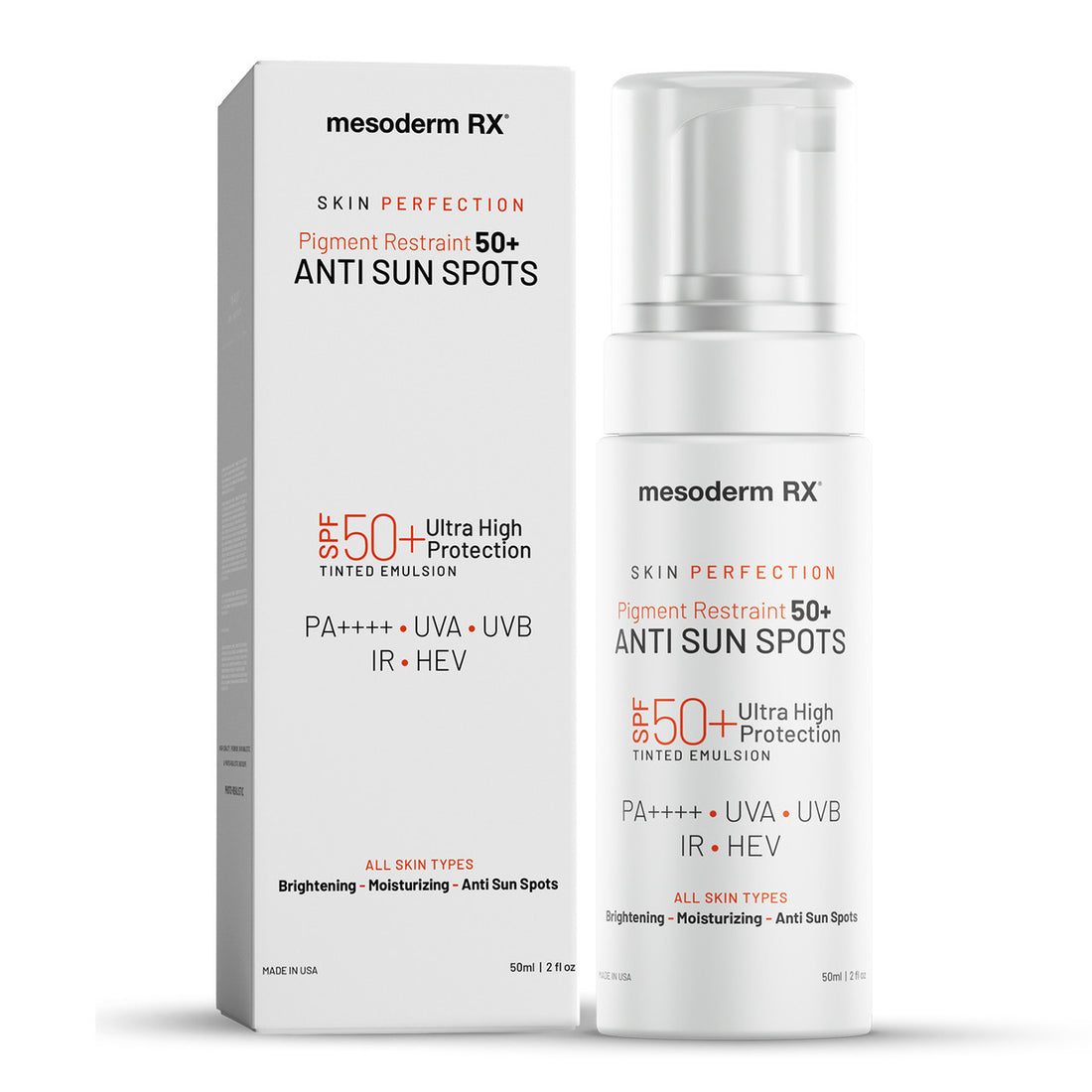
Featured Product
Pigment Restraint Ultra High Sun Protection
SHIELDS FROM UV DAMAGE AND SUN-INDUCED DARK SPOTS
Shop Now →Why creams usually create a stronger film
Creams have viscosity. That matters. A thicker emulsion doesn't just sit on top of skin. It gives you tactile feedback while you spread it. You can feel drag. You can see shine. You can tell when the cheeks got product but the hairline didn't.
Verified formulation guidance notes that creams and lotions produce more predictable film thickness at the standard 2 mg/cm² test dose and achieve more uniform UV coverage on uneven surfaces, while sprays form a thinner, more discontinuous film unless they are rubbed in thoroughly, with users typically applying only 25 to 50% of the recommended spray volume in consumer-use settings (Sun Bum overview of cream vs spray formulation behavior).
Why sprays fail more often on real skin
A mist doesn't arrive on skin as a complete shield. It arrives as droplets. Some overlap. Some don't. Some drift. Some collect more heavily on convex areas and less in recesses. Unless the user sprays long enough for the skin to glisten and then works the formula in, the result is patchy coverage.
Uneven sunscreen doesn't just lower protection globally. It creates local weak points where pigment can break through first.
This matters most on the face. The upper lip, cheekbones, temples, jawline, and sides of the nose are exactly where many people struggle with persistent discoloration. Those are also areas where a discontinuous spray film performs poorly if the application is rushed.
Why the vehicle matters for pigment control
Hyperpigmentation management is never only about fading existing marks. It is also about preventing daily microscopic re-stimulation of melanin production. If UV exposure reaches partially protected areas, melanocytes react. In pigment-prone skin, that repeated stimulation can keep dark patches active even while serums and exfoliants are trying to suppress them.
For that reason, the delivery system is part of the treatment plan. The SPF number tells you lab potential. The vehicle tells you how likely you are to achieve that protection on actual skin.
Efficacy and Coverage What the SPF Label Does Not Tell You
Most sunscreen failure isn't about choosing the wrong SPF on paper. It's about failing to reach the application density used in testing.
Clinical studies indicate that the typical application amount is only about 0.5 to 0.75 mg/cm², which is roughly 25 to 37% of the recommended dose. For sprays, the gap is worse. Engineering analyses show that only about 15 to 30% of the dispensed product lands on the target skin surface, and some real-world experiments suggest only about 7 to 20% of sprayed volume may reach the skin, which means users may need to spray 5 to 15 times more product to achieve equivalent protection (consumer application data and spray loss analysis).

The SPF label is a lab value, not a guarantee
SPF is measured under controlled conditions. The formula is applied evenly and thickly. Users almost never reproduce that at home, especially with sprays.
Market and behavioral data show that properly applied sprays can test comparably to lotions under identical protocols, typically within ±10 to 15% of the labeled SPF. But real-world observations also show spray users often apply only a few quick bursts, sometimes less than 1 to 2 seconds per area, and one analysis estimated that typical spray routines yield roughly SPF 8 to 15 even when products are labeled SPF 30 or higher, compared with SPF 20 to 25 for equally under-applied creams (real-world comparison of spray and cream use).
A high-SPF spray applied thinly can protect less effectively than a lower-SPF cream applied properly.
That is the point most shoppers miss. The bottle doesn't protect your skin. Application density does.
Why this matters more when you're correcting dark spots
If your goal is casual burn prevention, minor under-application is still a problem. If your goal is pigment suppression, it's a much bigger problem. Daily UV breakthrough keeps melanocytes active. It can also worsen tone irregularity because exposed zones don't darken evenly.
People often ask whether they can still tan while using sunscreen. The answer depends heavily on how much protection reaches the skin, not just the label. This is why practical guidance on whether you can tan with SPF 30 matters more than the number printed on the front panel.
A body-brightening routine makes this issue even more visible. For example, Whitening Advanced Body Essence Lotion is described by Mesoderm RX as a brightening body lotion formulated to reduce brown spots, support a more even-looking tone, and be used with at least SPF 50 during daytime exposure to maintain results. That instruction is clinically sensible. Pigment-correcting body care loses ground if daytime UV protection is inconsistent.
What works in practice
Use the SPF label as a ceiling, not a promise. Then choose the format that gives you the best chance of reaching that ceiling.
- For first application: cream usually wins because you can see and feel the layer.
- For body touch-ups: spray can help if convenience makes you reapply more often.
- For pigment-prone areas: precision beats speed.
A Clinical Analysis of Safety and Formulation
The better sunscreen for pigment control is often the one that causes the least irritation and the least user error, not the one that feels most elegant on first application. Vehicle choice affects more than comfort. It changes exposure route, barrier response, and how reliably the sunscreen sits on skin that is already reactive from a treatment routine.
Inhalation is a real formulation concern
Sprays introduce a safety question that creams do not. Part of the product can leave the skin route entirely and enter the air. That matters around the face, in enclosed spaces, and for children or anyone with asthma.
Regulators and clinicians have been consistent on this point. Avoid spraying directly onto the face, and use spray sunscreens in well-ventilated settings, as summarized in this Harvard Health review of spray sunscreen precautions.
This does not make every spray a bad product. It means the delivery system adds a variable that cream does not have.
If you're comparing mineral formats for outdoor use, especially around surf and prolonged UV exposure, reef-safe zinc sun protection is a useful reference point for how zinc-based formulas fit into a broader protection plan.
Why pigment-sensitive skin often does better with calmer vehicles
Pigment-prone skin has a lower margin for irritation. That includes melasma, post-inflammatory hyperpigmentation, acne marks, and skin recovering from acids, retinoids, shaving, or in-office procedures.
Many sprays rely on alcohols or other fast-drying solvents to spread quickly and dry down with less residue. That can improve feel on the body. It can also increase sting, tightness, or transient redness in skin that is already inflamed. In pigment disorders, that matters because inflammation is not a side issue. It is one of the signals that can keep melanocytes active and make discoloration harder to stabilize.
I see this problem often in practice. A patient uses brightening actives correctly, then applies a sunscreen they tolerate poorly because it feels lighter. The result is subtle daily irritation, skipped reapplication, or selective avoidance of sensitive zones like the upper lip or cheeks. That is enough to slow progress.
A sunscreen that stings, dries, or triggers redness is working against a hyperpigmentation regimen, even if the SPF number is high.
Creams and lotions are usually easier to formulate with more barrier-supportive bases. They can still be lightweight. They give formulators more room to build a uniform film without depending as heavily on volatile components.
Formulation details matter more than marketing language
"Non-greasy" is not a clinical benefit by itself. For pigment management, the useful questions are different. Does the formula spread evenly. Does it sit comfortably over treatment products. Does it trigger burning around the eyes, mouth, or post-acne marks. Will the patient apply enough of it every day.
Use these decision points:
- Compromised barrier: choose a cream or lotion that spreads evenly and stays comfortable over moisturizers, retinoids, and pigment serums.
- Facial redness or sensitivity: avoid direct facial spraying. Apply product into the hands first if using a spray at all.
- Acne-prone skin: separate breakout risk from irritation risk. A lighter texture is not automatically a better facial sunscreen. Mesoderm RX's guide to non-comedogenic face sunscreen is useful if acne and daily sunscreen adherence are both concerns.
- Outdoor body reapplication: spray can be practical if it is applied slowly, generously, and rubbed in where the product instructions allow.
For patients treating PIH or trying to keep melasma quiet, sunscreen is part of the treatment plan itself. Choose the vehicle that protects without provoking the skin, because preventable irritation can erase gains that brightening products are trying to make.
Application Strategies for Face Body and Hyperpigmentation
Pigment-prone skin does not fail because the SPF number was too low. It often fails because the product was put on unevenly, too lightly, or in the wrong format for the area being treated.
That matters most on the face. Melasma, post-inflammatory hyperpigmentation, and lingering acne marks tend to sit in repeat-exposure zones such as the cheeks, forehead, upper lip, temples, and jawline. If coverage is thin at the edges of those areas, the brightening routine becomes less consistent. In practice, that is how patients end up with patchy improvement instead of a steady fade.
Face needs controlled placement
For facial use, cream is usually the better first layer on pigment-sensitive skin. It is easier to place deliberately over the exact areas that darken first, and it works more predictably over serums, retinoids, azelaic acid, and other treatment steps that can leave skin reactive.
Use a methodical application pattern:
- Apply to dry skin. Residual water can change slip and make film formation less even.
- Divide the face into zones. Forehead, each cheek, nose, chin, jawline, ears, and neck.
- Build coverage over pigment-prone areas first. Cheekbones, upper lip, temples, and the perimeter of old acne marks often need closer attention.
- Press into curves and borders. Around the nostrils, along the hairline, and at the jaw are common skip areas.
- Use sprays for the face only with caution. If a spray is used at all, dispense into the hands first unless the product instructions direct otherwise.
Small misses matter here.
A patient treating hyperpigmentation does not need a sunscreen method that is merely convenient. The method needs to protect the exact skin that is under correction.
Body application is about reach and adherence
The body has a different problem. Surface area is larger, the back and shoulders are harder to cover well, and reapplication is more likely to be skipped if the product feels slow or messy. That is where sprays can help.
Use each format for the job it does best:
- Morning body application at home: cream or lotion gives better control when there is time to apply thoroughly.
- Midday reapplication on exposed limbs: spray is practical if it is applied generously enough to visibly coat the skin.
- Back, shoulders, and backs of legs: spray improves access, but coverage still needs to be checked rather than guessed.
- High-friction areas: rub in after spraying when the label allows, especially where clothing, towels, or seat contact can remove product unevenly.
Convenience has value if it prevents missed reapplication. It just should not dictate the first layer on treatment-focused areas.
Hyperpigmentation changes how technique should be judged
For pigment control, sunscreen success is not only about preventing a burn. It is about preventing repeated low-grade exposure that keeps melanocytes active in one part of a treated area while the rest begins to lighten. I see this often with upper-lip melasma, cheek PIH, and post-acne marks near the temples, where patients are diligent with serums but casual with sunscreen placement.
Cosmetic habits can also interfere. Powder and mist touch-ups over makeup can be useful, but they are maintenance tools, not the foundation of a pigment-control plan. Readers trying to protect treated skin without disturbing makeup can use Mesoderm RX's guide to applying sunscreen over makeup, but the base layer still needs full, even coverage underneath.
A practical split works well for many patients. Use cream on the face, neck, chest, and any area with active hyperpigmentation. Use spray on the body when it improves reach or makes reapplication realistic. That approach protects treatment results better than forcing one vehicle to handle every site.
The Definitive Protocol for Primary Sun Protection
If pigment control is the goal, cream is the default. Spray has a role, but it should not carry the treatment-critical parts of your routine.
That matters more than many readers realize. Melasma, post-inflammatory hyperpigmentation, and lingering acne marks do not need a dramatic burn to worsen. Repeated small gaps in UV protection are enough to keep melanocytes active, especially on the upper lip, cheeks, temples, neck, and chest. In practice, sunscreen vehicle choice affects whether brightening serums, retinoids, exfoliating acids, and pigment inhibitors get a chance to work.

The protocol that protects results
Use a cream sunscreen as the first full layer on the face, neck, chest, and any area with active or easily triggered pigmentation. Those sites need controlled placement, visible spread, and a uniform film. That is hard to verify with a spray, especially around the hairline, nostrils, eyelids, jawline, and sides of the neck.
For large body areas, the decision depends on whether you will apply enough product. Cream remains the stronger first-choice option for an intentional morning application. Spray becomes useful later, particularly for arms, legs, shoulders, back, and other broad areas where convenience makes reapplication more realistic.
A practical hierarchy works well:
- Face, neck, chest, and pigment-prone zones: cream as the primary sunscreen
- Full-body first application on high-exposure days: cream when you can apply it carefully
- Outdoor body reapplication: spray used generously, then rubbed in when the label allows
- Hard-to-reach areas: spray if it improves coverage enough to prevent missed spots
Mesoderm RX Pigment Restraint Ultra High Sun Protection fits this section because it is designed for daily use within a pigment-management routine. For readers treating melasma, dark spots, or uneven tone, the point is not the brand alone. The point is choosing a cream-first sunscreen that can be applied consistently and evenly over treatment zones.
If water activity or reef compatibility is part of the decision, the guide to the best reef-safe sunscreen for snorkeling can help narrow filter choices without losing sight of practical wear.
Sunscreen Format Decision Matrix
| Use Case | Recommended Format | Clinical Rationale |
|---|---|---|
| Daily facial protection | Cream | Allows precise placement on contour-heavy areas where uneven film often leads to persistent discoloration |
| Melasma or PIH routine | Cream | Better supports a consistent protective layer over skin already prone to UV-triggered pigment rebound |
| Neck and chest | Cream | Easier to spread deliberately across zones that are commonly missed and quick to show photoaging |
| Full-body morning application | Cream | Easier to meter and distribute as a true first layer |
| Midday body reapplication outdoors | Spray | Practical on larger areas if generous application improves follow-through |
| Back or hard-to-reach limbs | Spray | Useful when reach is the main barrier to adequate coverage |
What does not work
Several habits repeatedly undermine pigment treatment outcomes:
- Using spray as a casual first layer on the face
- Applying too little product because the skin looks covered before it is fully protected
- Relying on brightening products while treating sunscreen as optional daytime maintenance
- Assuming a higher SPF label corrects thin or patchy application
The stricter the pigment goal, the less room there is for sloppy sunscreen use. A good topical regimen can fade discoloration. Uneven UV protection can keep bringing it back.
Frequently Asked Clinical Questions
Can I use spray sunscreen on my face if I spray it into my hands first
Yes, that is safer than spraying directly onto the face. It gives you better control around the eyes, nose, and mouth. Even then, for daily pigment control, cream is still the more dependable option because it creates a more intentional first layer on the areas that darken most easily.
Is a mineral spray safer than a chemical spray
"Safer" is too broad to answer without context. The active filter type and the delivery system are separate issues. A mineral spray may still carry the same application and inhalation limitations as other sprays. For reef and ocean activity, practical guidance on the best reef-safe sunscreen for snorkeling can help you think through filter choice, especially if environmental compatibility matters alongside skin tolerance.
Does a very high SPF spray make up for uneven application
No. Higher label SPF does not erase thin coverage, skipped zones, or product loss during spraying. If the film is patchy, pigment can still break through in the weak areas. In real use, technique beats theory.
Which format is better if I use exfoliating acids or dark spot products
Cream is usually the better starting point. Skin being treated with resurfacing or brightening actives often has a lower irritation threshold. A more emollient, tactile vehicle is usually easier to apply evenly and more supportive of the barrier.
Can I use both in the same routine
Yes. This is often the most practical strategy. Use cream as the deliberate base layer in the morning. Use spray for body reapplication when you're outside and speed matters. That combination works because each format is assigned the job it performs best.
What is the main mistake people make
They judge sunscreen by feel instead of film quality. If a product feels light but goes on unevenly, it may be sabotaging the exact result you're trying to protect.
If you're working on dark spots, melasma, PIH, or uneven tone, sunscreen shouldn't be the weakest step in your routine. Explore Mesoderm RX for pigment-focused skincare designed to support brightening, barrier care, and daily UV protection as part of a results-driven regimen.