

Sun Protection Bandana: A Clinical Guide to UV Safety
A bandana around the neck feels protective. Clinically, that assumption is where many pigmentation plans fail.
It's a common belief that if skin is covered, it must be protected. That's not how ultraviolet injury works. Fabric type, weave density, moisture, stretch, and fit all change how much UV reaches the skin. If you're managing melasma, post-inflammatory hyperpigmentation, or early photoaging, “some coverage” isn't the same as meaningful photoprotection.
That matters because pigment cells don't care whether exposure was intentional. They respond to repeated stimulus. A little daily leakage through weak fabric can keep melanocytes active, deepen uneven tone, and make treatment feel ineffective even when the rest of your routine is well chosen.
A sun protection bandana can help. It just can't carry the full burden alone.
Rethinking Your Bandana's Role in Sun Protection
A standard bandana is often treated like a universal summer fix. Tie it on, cover the neck, move on. In practice, that advice is too loose for anyone serious about preventing darkening, rebound pigmentation, and texture changes from chronic UV exposure.
The first issue is false reassurance. Many people wear untreated cotton and assume they've solved the problem because the skin is no longer directly visible. But visible coverage and photoprotection are different standards. If the fabric allows substantial UV transmission, the skin is still receiving the signal that drives tanning, oxidative stress, inflammation, and pigment production.
A covering that leaks UV can reduce glare and still fail as a protective device.
That distinction becomes more important in patients with pigment instability. Melasma-prone skin can react to small triggers. Skin recovering from acne or irritation can convert inflammation into lingering discoloration. In both cases, incomplete protection delays improvement.
The market itself reflects how much consumer behavior has shifted toward technical apparel. The global sun protective clothing market was valued at US$ 703.4 million in 2022 and is forecast to reach US$ 1.2 billion by 2031, with a projected 6.1% CAGR from 2023 to 2031, according to Transparency Market Research's analysis of sun protective clothing demand. That growth tells you people are moving away from ordinary fabric and toward purpose-built UV barriers.
Coverage isn't the same as protection
If you're choosing headwear or neck coverage for teams, events, or outdoor staff, details like shape and exposure zones matter too. A practical comparison such as this Guide to bulk hat orders for businesses is useful because different formats protect different anatomical areas, and neck exposure is often where simple caps fall short.
A bandana belongs in the conversation. It just needs to be judged like protective gear, not like a fashion accessory.
The Cellular Cascade Triggered By UV Radiation
A bandana only changes outcomes if it blocks enough radiation to interrupt the biology of pigment formation. Once UV reaches skin, the process is already underway.

What UV does after it hits skin
UV exposure injures keratinocytes, increases reactive oxygen species, and activates inflammatory signals that stimulate melanocytes. Melanocytes then increase melanin synthesis and transfer pigment into surrounding keratinocytes. That is the visible tan or the darker patch a patient notices days later. Repeated exposure also accelerates collagen breakdown and other features of photoaging.
The enzyme tyrosinase is central to this response. Higher tyrosinase activity means higher melanin production. In skin that is already prone to dyschromia, even sub-erythemal exposure can keep that pathway active.
Patients often underestimate how much incomplete sunscreen application leaves behind. Mesoderm RX's explainer on whether you can tan with SPF 30 is useful here because the clinical issue is not just burning. It is residual UV exposure that continues to drive pigment signaling despite partial protection.
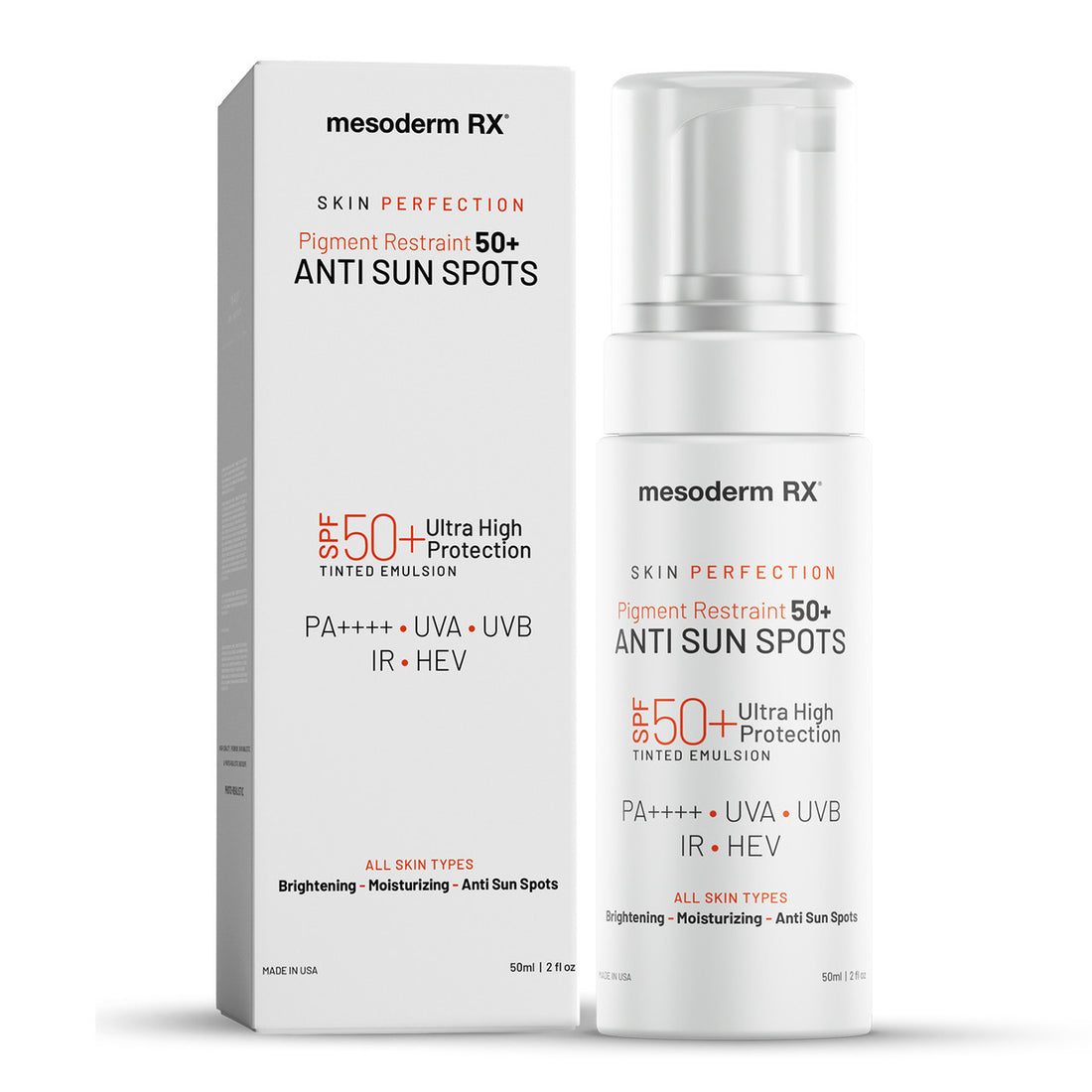
Featured Product
Pigment Restraint Ultra High Sun Protection
SHIELDS FROM UV DAMAGE AND SUN-INDUCED DARK SPOTS
Shop Now →Melasma, PIH, and sun spots follow different biology
Pigment disorders are often grouped together, but they do not behave the same way and should not be managed the same way.
| Condition | Primary driver | Clinical pattern |
|---|---|---|
| PIH | Inflammation in the skin | Marks after acne, irritation, injury, or procedures |
| Melasma | Hormonal and inflammatory factors, strongly worsened by light exposure | Symmetric patches, often on cheeks, forehead, upper lip |
| Sun spots | Cumulative UV damage | More discrete areas of pigmentation over time |
Post-inflammatory hyperpigmentation follows inflammation. Melasma is a chronic pigment disorder with hormonal, vascular, and inflammatory components, and light exposure can reactivate it with frustrating ease. Sun spots reflect cumulative photodamage over time and are usually more localized.
Melasma deserves special caution. Sun exposure is the most significant exacerbating factor for melasma, where even minimal ultraviolet radiation can activate oversensitized melanocytes to darken existing patches or cause new ones, which is why it behaves differently from ordinary sun spots in this melasma versus sun spots explanation.
If you mislabel melasma as simple sun damage, you will usually under-treat the condition and overestimate what fabric alone can do.
Where topicals fit into the biology
Physical barriers reduce the incoming trigger. They do not switch off pigment pathways that have already been activated.
That is where a topical regimen earns its place in a pigmentation plan. For patients addressing uneven tone, AHA + BHA + PHA Skin Brightening Serum 30ml contains kojic acid, glycolic acid, lactic acid, salicylic acid, lactobionic acid, hyaluronic acid, and hexapeptides. The stated goal is to improve the appearance of dark spots and uneven tone, and to continue reducing tyrosinase activity during nighttime use.
The distinction is important because pigmentation control requires both less incoming UV and less ongoing pigment production. A sun protection bandana can lower exposure over part of the face and neck. It cannot, by itself, correct melanocyte overactivity, post-inflammatory signaling, or existing uneven pigment.
Why Your Standard Cotton Bandana Is a Clinical Failure
The problem with the standard cotton bandana isn't that it does nothing. The problem is that it doesn't do enough, and it convinces people otherwise.

The numbers that matter
Traditional cotton bandanas provide only minimal sun protection, with a UPF of 5 to 9 when dry, blocking about 80% to 87% of UV radiation. When wet, protection can fall to UPF 3 or lower, according to this comparison of fishing neck gaiters and bandanas.
That's not a minor technicality. Sweat, humidity, and water exposure are normal in outdoor conditions. If the fabric's protective performance collapses once it gets wet, the bandana stops functioning as reliable sun gear precisely when you need it most.
Why cotton underperforms in real use
Cotton has several structural weaknesses in this context:
- Loose fiber arrangement: Ordinary cotton weave allows more UV transmission than tightly engineered technical fabric.
- Moisture sensitivity: Sweat and water reduce protective performance.
- Stretch distortion: Tight tying can pull fibers apart and increase permeability.
- False confidence: People keep exposed routines because they believe the neck is already protected.
A standard white cotton fabric commonly used in regular bandanas has a UPF range of 5 to 8, while UPF 50+ textiles block over 98% of UV rays, and stretch can reduce protection further by pulling fibers apart, as described in this discussion of UV protection in regular bandana fabric.
Practical rule: If the product doesn't state a UPF rating, treat it as an accessory, not as clinical sun protection.
Why this sabotages pigment control
Pigmentation management fails in small, repeated exposures. A patient may use active brightening products, avoid obvious sunburn, and still wonder why the neck, jawline, and lower face keep darkening. The answer is often chronic under-protection.
Untreated cotton can be acceptable for sweat control or dust. It's a weak choice for anyone trying to suppress melanocyte stimulation day after day. In dermatologic terms, that makes the standard cotton bandana a poor frontline device.
How to Select a Clinically Effective Sun Protection Bandana
A clinically useful sun protection bandana isn't defined by style. It's defined by fabric engineering, verified performance, and coverage.

Start with the rating, not the color
The first filter is simple. Look for UPF 50+.
UPF 50+ certified sun bandanas are benchmarked to block over 98% of UV radiation, and The Skin Cancer Foundation emphasizes that high-tech, lightweight, breathable fabrics engineered for UPF performance offer excellent sun protection while maintaining comfort, as noted on this UPF 50+ sun bandana product page.
If you're comparing formats, Mesoderm RX also has a practical review of the sun protection balaclava, which helps clarify when broader facial and neck coverage may be more useful than a standard bandana shape.
What to look for in the fabric and cut
Use these selection criteria:
- Certified UPF label: This is an essential first check.
- Synthetic technical fibers: Polyester and nylon usually perform better than untreated cotton because the weave is denser and the fibers can be engineered for UV defense.
- Breathability without transparency: Lightweight is good. Sheer is not.
- Coverage geometry: The fabric should protect the neck consistently without slipping open during movement.
- A fit that isn't overstretched: Compression can widen the spaces between fibers and reduce protection.
- Moisture management: Quick-drying materials are easier to wear for extended outdoor use.
A good sun protection bandana should feel like equipment. If it functions only when perfectly dry and loosely draped, it's not durable enough for active use.
Here's a visual demonstration of how performance-oriented bandanas are used in outdoor conditions:
A quick clinical checklist
Before you buy, ask:
| Question | Why it matters |
|---|---|
| Is the UPF rating stated clearly? | Unrated fabric leaves too much uncertainty |
| Is the material technical rather than ordinary cotton? | Fiber choice affects UV transmission |
| Will it stay stable during sweating and movement? | Real-world wear determines actual protection |
| Does it cover the neck fully without constant adjustment? | Gaps create repeat exposure |
A good result comes from repeatable protection, not from a product that looks protective on a hanger.
Building Your Complete Pigmentation Control System
Even a well-designed UPF bandana leaves gaps. It won't cover the eyelids, ears, upper cheeks, much of the face, or the hairline consistently. It also doesn't create a sealed environment. Light reflects off pavement, water, and surrounding surfaces. Motion shifts fabric. Coverage changes when you talk, turn your head, or sweat.
That's why clothing alone doesn't fully control hyperpigmentation risk.

Where physical barriers stop
Even with UPF 50 clothing, exposed areas like ears, eyelids, and hairline require sunscreen, and the Photobiology Committee recommends SPF 50+ sunscreen on all uncovered skin during extended outdoor activity, emphasizing that bandanas alone cannot block 100% of UV rays, according to these expert answers on sun protection.
That single point changes the whole strategy. A bandana is a targeted barrier. Pigment control requires a system.
You don't control melasma or recurrent dark spots by protecting one strip of skin well and the surrounding skin inconsistently.
The system that works better
The structure is straightforward:
- Use a high-UPF physical barrier over the neck and lower face exposure zones.
- Apply broad topical protection to every uncovered area before outdoor exposure.
- Support pigment regulation with a routine that doesn't keep provoking inflammation.
For patients trying to reverse visible fallout from chronic sun exposure, resources on achieving clearer skin from sun damage can help frame the long game. The visible issue is rarely just one tan line. It's often a mix of dyschromia, texture change, and persistent inflammatory signaling.
Where one topical option fits
One option in that system is Mesoderm RX, specifically its Pigment Restraint Ultra High Sun Protection, used as the topical layer for uncovered skin. In practical terms, a bandana and a sunscreen stop competing and start doing different jobs. The fabric shields a fixed zone. The topical fills the uncovered gaps around it.
For patients focused on discoloration, this additional reading on the best sunscreen for hyperpigmentation is worth reviewing because sunscreen selection affects both prevention and maintenance.
A good pigmentation plan doesn't ask one product category to solve every problem. It assigns each tool a defined role.
Your Clinical Protocol for Integrated Sun Defense
Hyperpigmentation control fails at the margins. The obvious exposed areas matter, but so do the small untreated borders where UV reaches melanocytes often enough to keep pigment pathways active. A bandana helps. It does not close the system on its own.
Step 1 starts with a reliable physical barrier
Choose a sun protection bandana with a verified UPF rating and a fabric designed for sun exposure, not just comfort. Use it for the neck and lower face zones it can cover consistently. Keep the fit stable without stretching the weave too far, because tension and shifting create weak points.
Casual cotton is a comfort accessory. It is not a dependable pigmentation-control tool.
Step 2 protects every exposed edge
Apply sunscreen evenly to all uncovered skin before outdoor exposure. Cover the ears, eyelids, hairline, jawline, upper chest, and the transition zones around the bandana itself. Those border areas are where uneven protection commonly shows up later as patchy darkening.
This step is critical if you are already treating discoloration. PIH and melasma do not need a dramatic burn to stay active. Repeated low-grade UV exposure and ongoing inflammation are enough to keep melanogenesis going, which means brightening products are forced to compete with the trigger you keep reintroducing.
A practical system assigns different jobs to different tools. Fabric blocks a fixed area. Topical protection covers the skin fabric misses.
Step 3 reduces the triggers that keep pigment active
Daily behavior determines whether treatment has a fair chance to work:
- Limit high-exposure hours: Midday sun raises the chance of ongoing pigment stimulation, particularly in melasma-prone skin.
- Care for the garment correctly: Wash and dry technical fabrics according to instructions so their performance does not degrade prematurely.
- Do not mistake comfort for UV protection: Breathability and softness improve wear time, but they do not confirm meaningful UV blocking.
- Treat the inflammatory driver: Acne, dermatitis, friction, and heat can all prolong discoloration if they remain active.
Consistency beats intensity. A routine that prevents small daily UV hits usually performs better than aggressive pigment treatment layered onto inconsistent protection.
If you are building a routine for dark spots, uneven tone, or melasma-prone skin, use complete photoprotection rather than relying on a single accessory. Explore Mesoderm RX for minimalist, high-potency skincare designed to support brightening, resurfacing, and daily UV defense as part of a broader pigmentation-control system.