


Sun Damage Skin Repair: A Clinician-Minded Plan That Works
You look in the mirror after summer and notice more than a tan. The cheeks look patchier, the forehead carries a stubborn brown cast, and the skin feels rougher despite using a brightening serum. You may have added vitamin C, exfoliated more often, and applied sunscreen when you remembered, yet the result has stalled.
That pattern is common because sun damage isn't one condition. Melasma, post-inflammatory hyperpigmentation, solar lentigines, redness, rough texture, and collagen loss have different biological drivers. Effective sun damage skin repair starts by identifying the dominant problem, removing the triggers that keep it active, and then introducing correction at a pace your barrier can tolerate.
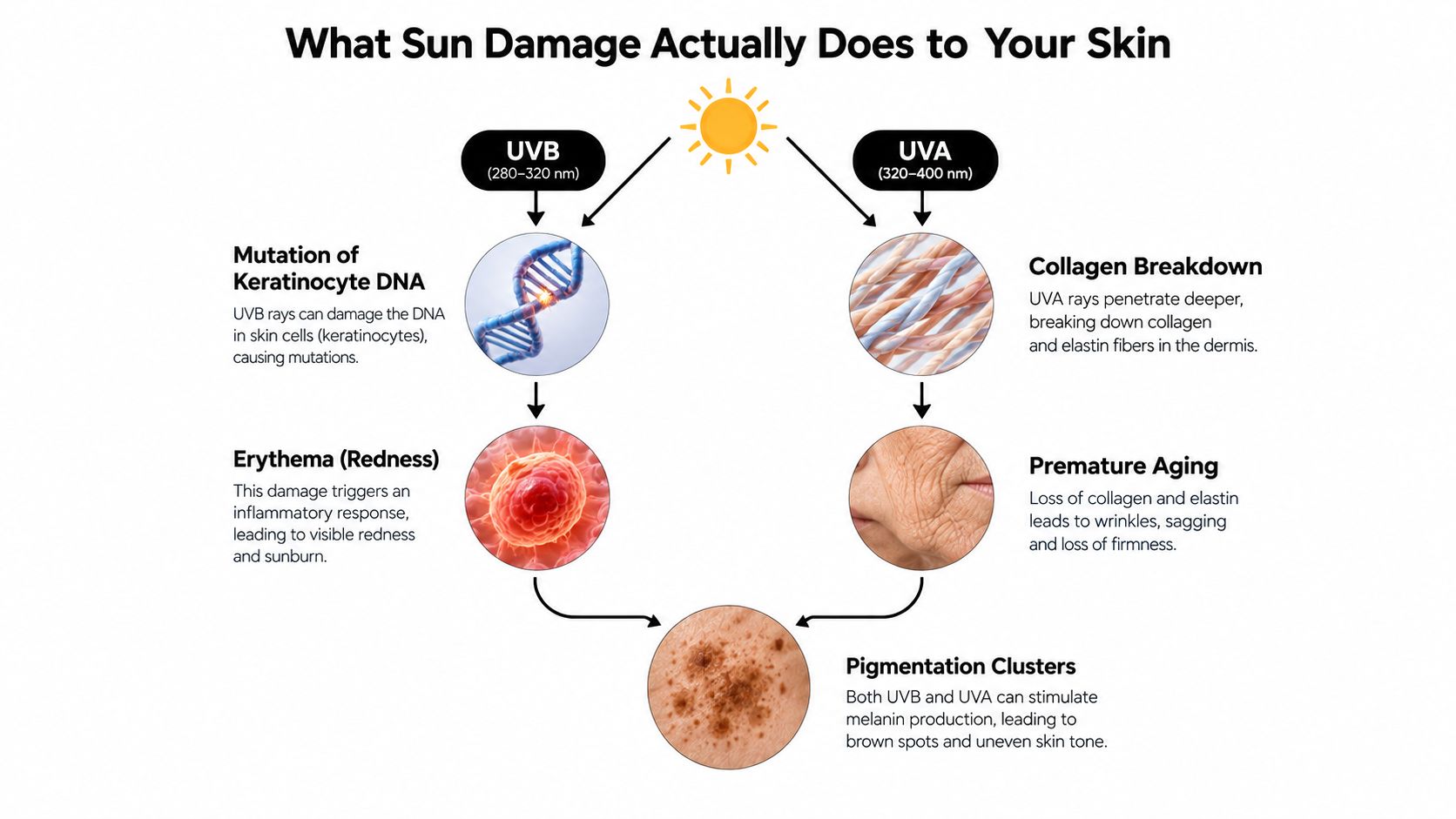
What Sun Damage Actually Does to Your Skin
Sun exposure creates both immediate injury and cumulative structural change. UVB is the stronger driver of sunburn and direct DNA damage, while UVA penetrates deeper and promotes oxidative stress, pigmentation, collagen degradation, and elastin breakdown. The distinction matters because a sunscreen that mainly protects against redness may still leave deeper photoaging pathways insufficiently controlled. A practical overview of UVA and UVB biology is available in this SPF and sun protection guide.
A single day in the sun can create about 100,000 DNA defects in each exposed skin cell. The half-life of those defects is approximately 20 to 30 hours, and one clinical summary found that nearly 25% of the damage still detected at 24 hours remained at 72 hours (RACGP clinical summary). Your repair systems work continuously, but once UV radiation changes cellular DNA, the injury can't be fully erased. That is why prevention has a higher clinical value than trying to compensate later.
The cascade beneath the visible symptoms
UVB injures keratinocyte DNA and activates inflammatory signaling, producing erythema, or visible redness. UVA reaches the dermis, where reactive oxygen species stimulate enzymes that break down collagen and disrupt elastin. Repeated exposure leaves the dermal framework less organized, so fine lines, laxity, and coarse texture become progressively more apparent.
Melanocytes respond to UV and inflammation by increasing melanin production and transfer. When that activity becomes uneven, pigment clusters appear as patches or discrete spots. The outer skin can also thicken irregularly, creating a rough surface that reflects light unevenly and makes discoloration look more pronounced.
High-energy visible light and heat add another layer, particularly for pigment-prone skin. Consumer routines often address only UVB and surface brightness, while visible light can deepen stubborn pigmentation and heat can sustain inflammatory activity. That is why clinical guidance on treating pigmentation for clinics treats trigger control as part of correction, not as an optional finishing step.
Before adding a tanning habit back into your routine, review what SPF 30 can and can't do in this guide to tanning with SPF 30. The key principle is simple. Every active you apply is working against ongoing exposure if the upstream trigger remains uncontrolled.
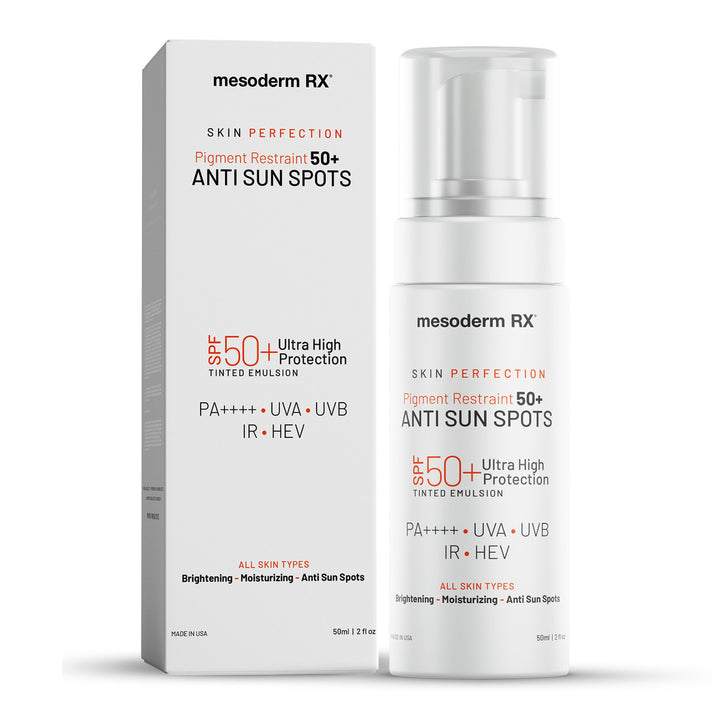
Featured Product
Pigment Restraint Ultra High Sun Protection
Its advanced formula defends against UV damage, helps protect againstsun-induced dark spots, and promotes a radiant, even-looking complexion—all while maintaining optimal hydration.
Shop Now →Diagnosing the Damage Before You Treat It
A brown area isn't a diagnosis. Melasma, post-inflammatory hyperpigmentation, and solar lentigines may all look brown, but their distribution, trigger, depth, and response to treatment differ. Choosing an aggressive brightener before identifying the pattern is one reason people create irritation without creating lasting improvement.
A practical visual triage
Melasma usually appears as bilateral, relatively symmetrical patches on areas such as the cheeks, forehead, upper lip, or jaw. UV, visible light, hormonal influences, and family history can all contribute. Pigment may sit in both the epidermis and dermis, which helps explain why melasma tends to recur and why superficial brightening alone often disappoints.
PIH follows an inflammatory event. Acne, shaving injury, a peel, trauma, or dermatitis can leave excess melanin and, in deeper skin types, deeper pigment components such as hemosiderin. The border often follows the original irritation rather than forming a clean, isolated macule.
Solar lentigines are discrete, flat macules that develop on chronically sun-exposed areas such as the face, hands, chest, and shoulders. They reflect focal sun-related changes and are usually more sharply outlined than melasma.
| Feature | Melasma | Post-Inflammatory Hyperpigmentation | Solar Lentigines |
|---|---|---|---|
| Typical pattern | Bilateral and patch-like | Follows acne, trauma, shaving, or inflammation | Discrete, focal macules |
| Main triggers | UV, visible light, hormones, heat | A prior inflammatory event | Cumulative sun exposure |
| Depth | Epidermal, dermal, or mixed | Epidermal and sometimes deeper | Predominantly focal surface-associated change |
| Clinical challenge | Recurrence and trigger sensitivity | Ongoing inflammation can prolong it | Lesion must be distinguished from actinic disease |
| Best first question | Is the pattern symmetrical? | What irritated the skin first? | Is the spot isolated and sun-exposed? |
Visible light can increase darkening, especially in pigment-prone and darker skin tones. Shorter visible wavelengths around 415 nm produced greater pigmentation than longer wavelengths around 630 nm in melasma research, so a conventional untinted sunscreen may not address every trigger (American Academy of Dermatology sunscreen information). For friction-related discoloration outside the face, the Bikini Line & Inner Thigh Brightening Cream, Beach-Ready Skin in 30 Days combines tranexamic acid, kojic acid, arbutin, niacinamide, vitamin C, AHA, azelaic acid, and hexylresorcinol in a dermatologist-tested, vegan formula.
Diagnostic rule: A spot that bleeds, crusts, fails to heal, changes rapidly, becomes asymmetric, or looks unlike the others needs a dermatologist's assessment, not a stronger serum.
Why Most Repair Routines Stall
Most stalled routines don't fail because the ingredients are naturally useless. They fail because the user creates a new inflammatory problem while trying to solve the old one.
Layering a retinoid, multiple acids, vitamin C, a scrub, and several pigment inhibitors can damage the barrier. Barrier disruption increases reactivity and can activate inflammatory pathways, including NF-kB signaling. Cytokines such as interleukin-1α, tumor necrosis factor-α, and prostaglandin E2 can promote tyrosinase activity and melanosome transfer, allowing inflammation to keep pigment visible (clinical review of inflammation and pigmentation).
The habits that interrupt repair
- Treating irritation as proof of potency: Stinging, peeling, and persistent tightness aren't evidence that pigment is leaving. They often indicate that the barrier is losing its ability to regulate water and inflammatory exposure.
- Using vitamin C without serious UVA control: Antioxidants can support a routine, but daylight continues to generate oxidative stress and melanocyte stimulation when UVA protection is weak.
- Scrubbing dark areas: Physical exfoliation can disturb the lipid matrix and create microscopic irritation. In PIH-prone skin, that extra inflammation can prolong the very discoloration you're trying to remove.
- Skipping tinted protection: In melasma, visible light can sustain melanogenesis. Untinted SPF may be appropriate for some users, but pigment-prone skin often needs iron oxides as part of the protection strategy.
- Protecting only the face: The neck, chest, hands, and arms continue receiving exposure while facial skin is being treated. That undermines consistency across the areas most likely to show cumulative photodamage.
A useful routine should be judged by its ability to maintain comfort while delivering steady exposure control. If your skin is constantly inflamed, adding another active usually lowers the quality of the plan.
The At-Home Repair Protocol Step by Step
The most reliable home plan is phased. Start by making the barrier comfortable, then introduce pigment and collagen-supporting actives one at a time. The correct sequence is less about owning every ingredient and more about preventing incompatible or excessive stimulation.
Morning
- Cleanse gently. Use a low-pH cleanser that removes residue without leaving the skin tight. If your skin is dry or reactive, a brief cleanse or a water rinse may be enough.
- Apply vitamin C. L-ascorbic acid at 10% to 20% or a stable derivative such as THD ascorbate can provide antioxidant support. Allow it to settle before the next layer rather than rubbing repeatedly.
- Add niacinamide. A 4% to 5% formula can support barrier function and tone. If you have melasma or marked sensitivity, don't add several brighteners on the same morning at first.
- Use azelaic acid selectively. A topical strength of 15% to 20% may fit acne-associated PIH or inflammatory discoloration, but introduce it only after the basic routine feels comfortable.
- Moisturize, then protect. Choose a barrier-supportive moisturizer containing ceramides, cholesterol, and fatty acids. Finish with broad-spectrum sunscreen, applying it after the moisturizer has settled.
Evening
Double cleanse if you wore water-resistant sunscreen or makeup. Use an oil cleanser first, followed by a gentle water-based cleanser, then apply the evening active to completely dry skin.
Rotate treatments rather than stacking them:
- Retinoid night: Begin with retinal 0.05% or retinol 0.3% to 0.5%. A clinician may later titrate treatment toward tretinoin 0.025% when appropriate.
- Exfoliation night: Choose glycolic acid 7% to 10%, mandelic acid 10% for sensitive or melasma-prone skin, or salicylic acid 2% when comedones and acne-related PIH dominate.
- Brightening support: Arbutin, topical tranexamic acid 2% to 5%, or cysteamine 5% can be used according to tolerance and the diagnosis.
- Recovery night: Use a rich moisturizer or occlusive layer when the skin feels dry, tight, or reactive.
Don't combine a retinoid and AHA on the same night when you're starting. Keep benzoyl peroxide and vitamin C approximately 12 hours apart to reduce compatibility and irritation concerns. Encapsulated retinoids can be useful when irritation control is a priority, and retinoids should go on dry skin rather than damp skin, which can increase penetration and stinging.
A structured routine can complement broader skin rejuvenation guidance, especially when home care and procedures need to be coordinated. The practical test is not whether the routine feels intense. It's whether you can follow it consistently without triggering fresh inflammation.
SPF and After-Sun Strategy That Actually Reverses Damage
Daily photoprotection has the highest return in a sun damage skin repair plan because it removes the stimulus that keeps producing DNA injury, oxidative stress, collagen breakdown, and pigment signaling. Cleveland Clinic guidance summarized by WebMD states that photodamage can't be completely reversed, though its appearance can improve with retinoids, lightening agents, peels, laser resurfacing, dermabrasion, and fillers (medical overview of sun-damage treatment).
Use broad-spectrum SPF 50 with strong UVA performance. In the European Union, look for the UVA circle logo. In the United States, look for broad-spectrum labeling and a critical wavelength of at least 370 nm. Reapply every two hours while outdoors and after sweating, swimming, or towel drying.
For melasma and pigment-prone skin, select a tinted formula containing iron oxides. Visible light can deepen pigmentation, and tinted protection is more relevant than untinted UV protection alone when melasma or PIH is the main concern.
| Diagnosis | Recommended SPF Type | Key UVA Metric | Tinted/Iron Oxide Needed |
|---|---|---|---|
| Melasma | Broad-spectrum SPF 50, preferably tinted | UVA circle logo or critical wavelength at least 370 nm | Strongly consider it |
| PIH | Broad-spectrum SPF 50 with high UVA protection | High photostability and meaningful UVA coverage | Consider it, especially in darker skin tones |
| Solar lentigines | Broad-spectrum SPF 50 for exposed areas | Consistent UVA and UVB protection | Helpful when uneven pigmentation coexists |
If you've had acute sun exposure, use a cool rinse, apply a humectant such as hyaluronic acid or polyglutamic acid, and follow with a ceramide moisturizer. An occlusive balm can protect peeling areas. Avoid retinoids and acids for 48 to 72 hours after significant sun exposure, and don't exfoliate peeling or sunburned skin.
A guide to sunscreen for hyperpigmentation can help you compare formulas, but product selection isn't enough. Use UPF clothing, a wide-brim hat, shade, and sensible timing outdoors. Heat and visible light can matter even when you haven't developed obvious redness, so your protection strategy should cover more than UVB.
Professional Procedures Worth Considering
Procedures work best when the clinician chooses them for the lesion, not for a vague promise of “rejuvenation.” A peel can clear superficial pigment, but it won't rebuild severely damaged dermal collagen. Microneedling can improve crepey texture, but it isn't the most efficient treatment for a sharply defined lentigo. Lasers can be powerful, but inappropriate settings can turn a cosmetic concern into PIH.
| Procedure | Mechanism | Best For | Downtime | PIH Risk in Skin of Color |
|---|---|---|---|---|
| Glycolic, TCA, Jessner's, or mandelic peel | Controlled resurfacing and accelerated pigment clearance | Superficial pigment and texture | Varies by depth | Meaningful, especially with deeper peels |
| Q-switched or picosecond laser | Targets focal pigment | Discrete solar lentigines | Usually localized recovery | Requires careful selection and settings |
| IPL | Targets diffuse pigment and vascular change | Broad photoaging and redness | Generally limited | Requires caution |
| Non-ablative fractional laser | Creates controlled dermal heating for collagen remodeling | Texture and dermal collagen | Shorter than ablative resurfacing | Moderate, depending on skin type and settings |
| Ablative CO2 or Er:YAG | Removes damaged layers and resurfaces deeper tissue | Severe rhytides and advanced photoaging | Approximately 7 to 14 days | Higher |
| Microneedling or RF microneedling | Controlled wound healing and neocollagenesis | Atrophic scars and crepey texture | Modest, procedure-dependent | Often lower than aggressive resurfacing, but not risk-free |
Superficial chemical peels may use glycolic acid 30% to 50%, TCA 10% to 20%, Jessner's solution, or mandelic acid for melasma-prone and darker skin. A treatment series may involve 4 to 6 sessions, but the appropriate interval and depth depend on diagnosis and skin response. A peel accelerates surface clearance. It doesn't make DNA injury disappear.
Lasers should be matched to target. Q-switched and picosecond devices suit discrete lentigines, IPL suits diffuse photoaging with a vascular component, and non-ablative fractional devices address texture and dermal collagen. Ablative resurfacing offers deeper correction with longer recovery and greater pigment risk.
Microneedling at 0.5 to 2.5 mm and RF microneedling devices such as Morpheus8 or Scarlet stimulate controlled repair. They're useful for laxity, scars, and crepey texture, but weaker for pigment alone. For a deeper explanation of RF treatment choices, review this radiofrequency for the face resource.
Prepare the skin with retinoids and pigment inhibitors for 4 to 6 weeks when your clinician recommends it. Pause retinoids 5 to 7 days before and after a laser or deep peel, then resume brighteners only after the surface has healed and your provider approves.
Realistic Timelines, Safety, and When to See a Dermatologist
Repair follows biology, not marketing calendars. A consistent plan can improve the appearance of photodamage, but no topical routine can guarantee full reversal once UV has altered cellular DNA. A one-year prospective study of daily facial broad-spectrum SPF 30 found improvement in photoaging parameters by week 12, continuing through week 52. By the end, skin texture, clarity, and mottled or discrete pigmentation improved 40% to 52%, and 100% of participants showed improvement in clarity and texture (daily sunscreen study).
A separate 12-month solar-protection and nighttime-repair regimen reported improved texture and luminosity, reduced redness and pigmentation, and volumetric improvement on 3D facial analysis. Patient approval was 89% at six months and 94% at twelve months (12-month solar-protection and repair regimen).
A clinician's timeline
- By week 2: Barrier comfort should improve if cleansing is gentle, actives are limited, and moisturizer use is consistent. Persistent burning means the plan is too aggressive.
- Around week 6: Mild texture and tone changes may become noticeable. Don't escalate every product because pigment remains.
- From month 3 onward: Melasma and PIH may begin fading more visibly when trigger control and treatment remain consistent. Recurrence remains possible, especially with visible-light and hormonal triggers.
- From month 6 to month 12: Collagen remodeling and deeper textural improvement require patience. Procedures may accelerate visible change, but maturation continues after the initial recovery period.
Book a dermatologist appointment for a changing mole, a lesion that bleeds or doesn't heal, suspected actinic keratosis, sudden darkening, treatment-resistant hyperpigmentation beyond 12 weeks, or any mark that looks different from the surrounding lesions. Use the ABCDE framework for pigmented lesions: asymmetry, border irregularity, color variation, diameter change, and evolution.
Pause exfoliation during sunburn and active dermatitis. Don't start retinoids during pregnancy without medical guidance, and discuss retinoids with a clinician if you're taking isotretinoin or have a compromised barrier. Hydroquinone use should follow clinician direction and appropriate limits, particularly when treatment extends beyond a short corrective course.
Safety threshold: Persistent irritation isn't a sign to push harder. It is a reason to simplify, restore the barrier, and reassess the diagnosis.
Mesoderm RX offers targeted, vegan skincare for concerns including dark spots, uneven tone, dryness, and visible signs of aging, with options that support a structured brightening and protection routine. Review the collection at Mesoderm RX and choose products based on your diagnosis, tolerance, and daily photoprotection plan.