


How to Treat Facial Hyperpigmentation: 5 Proven Methods
Most advice on facial hyperpigmentation starts in the wrong place. It starts with a hero cream, a trendy acid, or a promise that one active will fade every dark mark the same way.
That's not how pigment works.
If you want to know how to treat facial hyperpigmentation, you need to separate three different jobs. First, understand the biology driving the pigment. Second, identify why your current routine keeps failing. Third, use a protocol that prevents new pigment while gradually clearing existing discoloration. People skip that sequence and then wonder why the spots lighten, stall, or come back.
Hyperpigmentation isn't one diagnosis. Melasma, post-inflammatory hyperpigmentation, and sun-induced spots are not the same problem, and they don't respond the same way. Some pigment sits more superficially and responds better to topicals. Some is deeper, more persistent, and easier to worsen with irritation. Some is tightly linked to ultraviolet exposure, visible light, hormones, or ongoing inflammation.
That's why random product stacking fails. If skin is still inflamed, melanocytes stay stimulated. If tyrosinase activity stays high, melanin production continues. If sunscreen use is inconsistent, treatment works against a daily trigger.
Why Most Facial Hyperpigmentation Plans Fail Before They Start
Facial hyperpigmentation usually does not fail because the active was too weak. It fails because the plan never addressed the biology driving the pigment in the first place.
In practice, I see the same mistake over and over. Someone buys a brightening serum, adds an acid, gets a week or two of cosmetic improvement, then stalls. The spot is still being fed by ultraviolet exposure, visible light, acne inflammation, friction, heat, hormones, or barrier damage, so treatment is working against an active trigger instead of shutting it down.
The real problem is misdiagnosis plus irritation
Pigment is not just leftover color sitting on the surface. Inflammatory signals can keep melanocytes switched on after acne, eczema, picking, procedures, or aggressive exfoliation, which is why irritation-prone routines often prolong discoloration instead of clearing it (review on inflammation and melanogenesis).
That changes how treatment should be built.
A useful plan has three layers:
- Biology: reduce melanocyte stimulation and slow excess melanin production.
- Diagnosis: identify whether the pattern is more consistent with melasma, post-inflammatory hyperpigmentation, lentigines, or a mixed picture.
- Protocol: use a routine that fades existing pigment without creating enough irritation to trigger more of it.
Many routines skip the middle step. That is why they look logical on paper and still fail on real skin.
Stronger routines often make pigment more stubborn
Over-exfoliation is a common reason for rebound, especially in reactive skin and deeper skin tones. Repeated stinging, visible peeling, or a chronically tight barrier often means the routine is creating low-grade inflammation every day. That can keep pigment pathways active even while brightening agents are being applied.
This is the trade-off people miss. A fast-looking routine can be a slow-healing routine.
Featured Product
Skin Perfection Liquid Exfoliant Peel AHA BHA PHA
Reveal your smoothest, clearest skin yet with our best-selling 2% BHA (Beta Hydroxy Acid) exfoliant. This lightweight, leave-on formula works deep within pores to unclog congestion, minimize blackheads, and boost skin clarity — without irritation.
Shop Now →
Scrubs, frequent acid layering, high-strength retinoids introduced too quickly, and repeated spot treating on compromised skin all raise the risk of post-inflammatory darkening. The result is familiar. Skin looks brighter for a short period, then turns patchy, sensitive, or persistently discolored.
Treatment works best as a system
The first-line logic is not glamorous, but it is what works consistently:
- Remove ongoing triggers. Daily light protection and control of acne, irritation, rubbing, and heat exposure come first.
- Treat the right pigment problem. Melasma behaves differently from acne marks and sun spots.
- Escalate carefully. Richly pigmented, sensitive, or inflammation-prone skin often improves more with steady, tolerable treatment than with aggressive cycling.
Expert guidance on pigment disorders consistently places photoprotection at the center of treatment because sunscreen improves outcomes and lowers the chance that discoloration returns (expert review on photoprotection and pigment treatment).
Real progress is slower than marketing suggests
Hydroquinone-free pathways can work well, but they still require sequencing, consistency, and enough time for skin turnover. One clinical study of a serum containing tranexamic acid, kojic acid, and niacinamide reported visible improvement early in treatment and continued gains over 12 weeks, which matches what clinicians often see with non-hydroquinone protocols. Improvement can begin within the first couple of months, but recurrence remains possible if the trigger is still present or treatment is stopped too soon (review on hydroquinone-free approaches).
That is the part many consumers and even some product-led routines get wrong. Hyperpigmentation responds to a controlled system, not a hero product.
What Type of Facial Hyperpigmentation You Actually Have
Before choosing actives, identify the pigment pattern. A useful primer is Solawave's guide on what to know about hyperpigmentation, but the key point is this: treatment only works well when it matches depth, trigger, and recurrence risk.
Post-inflammatory hyperpigmentation is not one thing
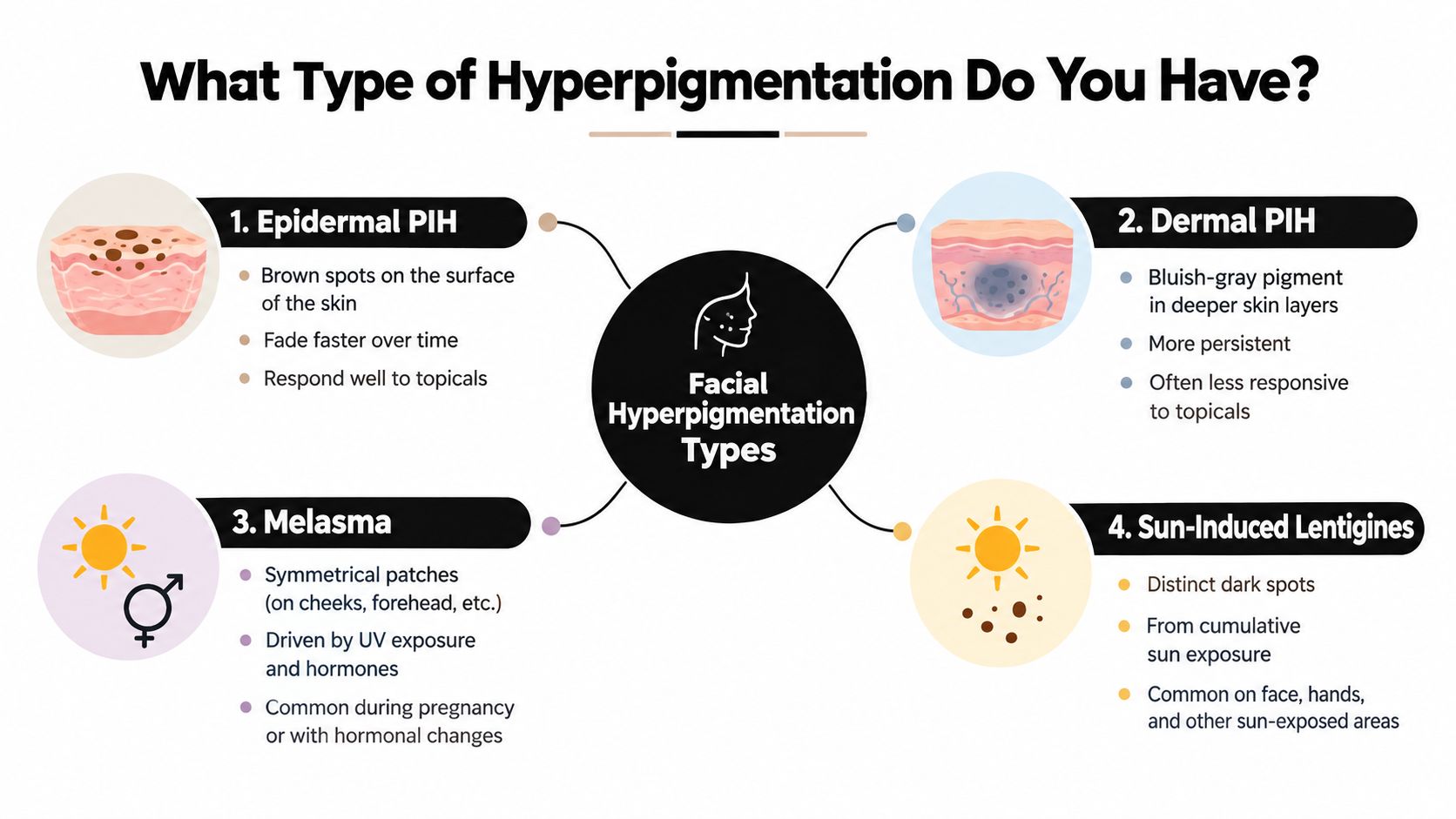
Post-inflammatory hyperpigmentation (PIH) is an acquired hypermelanosis caused by skin inflammation or injury, and it can involve the epidermis, dermis, or both. In epidermal PIH, inflammatory mediators stimulate melanocytes to make more melanin. In dermal PIH, damage at the basal layer allows melanin to drop into the dermis, where it can create a blue-gray discoloration that may be permanent (NCBI Bookshelf overview of PIH).
That distinction changes expectations.
- Epidermal PIH often looks brown and tends to respond better to topical treatment.
- Dermal PIH often looks blue-gray, persists longer, and is easier to worsen with overly aggressive procedures.
- Mixed PIH behaves exactly like it sounds. Some spots improve, some barely move.
If you're unsure which pattern you have, it helps to review examples of types of dark spots on face before building a routine.
Melasma behaves differently
Melasma isn't just “sun damage with bigger patches.” It has a stronger relationship to ultraviolet-triggered melanocyte activation and often hormonal influence. One reviewed pathway shows UVB activating keratinocyte signaling that increases nitric oxide production, which then activates tyrosinase in melanocytes. Tyrosinase is the rate-limiting enzyme in melanin synthesis, which is why so many useful actives focus on suppressing that enzyme rather than exfoliating pigment away (mechanistic review on melasma and tyrosinase).
Look for clues such as:
- Symmetry: Melasma often appears on both cheeks, forehead, upper lip, or jawline.
- Recurrence: It may improve and then return quickly with light exposure or heat.
- Diffuse borders: Patches often blend rather than sitting as sharply defined dots.
Sun-induced lentigines need a different lens
Sun-induced lentigines are the classic distinct brown spots from cumulative sun exposure. They're usually more defined than melasma and aren't driven by the same inflammatory history as PIH. They can still coexist with melasma or acne marks, which is why many people misread their own skin.
When someone says, “I have dark spots,” they may be describing three separate diagnoses on one face.
That's also why a single exfoliating product can disappoint. A formula like Skin Perfection Liquid Exfoliant Peel AHA BHA PHA may help with surface roughness, uneven tone, pores, and some superficial post-acne marks because it combines salicylic acid, glycolic and lactic acids, lactobionic acid, and kojic acid. But if the discoloration is deeper, hormonally reactive, or driven by ongoing irritation, exfoliation alone won't solve the case.
Daily Prevention That Makes Treatment Work
Daily prevention decides whether treatment fades pigment or keeps chasing new pigment.
The mistake is treating prevention like a side task instead of one of the three working layers of a pigment plan. Biology creates the tendency. Diagnosis tells you what kind of discoloration you are dealing with. Daily prevention controls the triggers that keep melanocytes active. If that third layer is weak, even good topicals underperform.
What daily protection actually includes
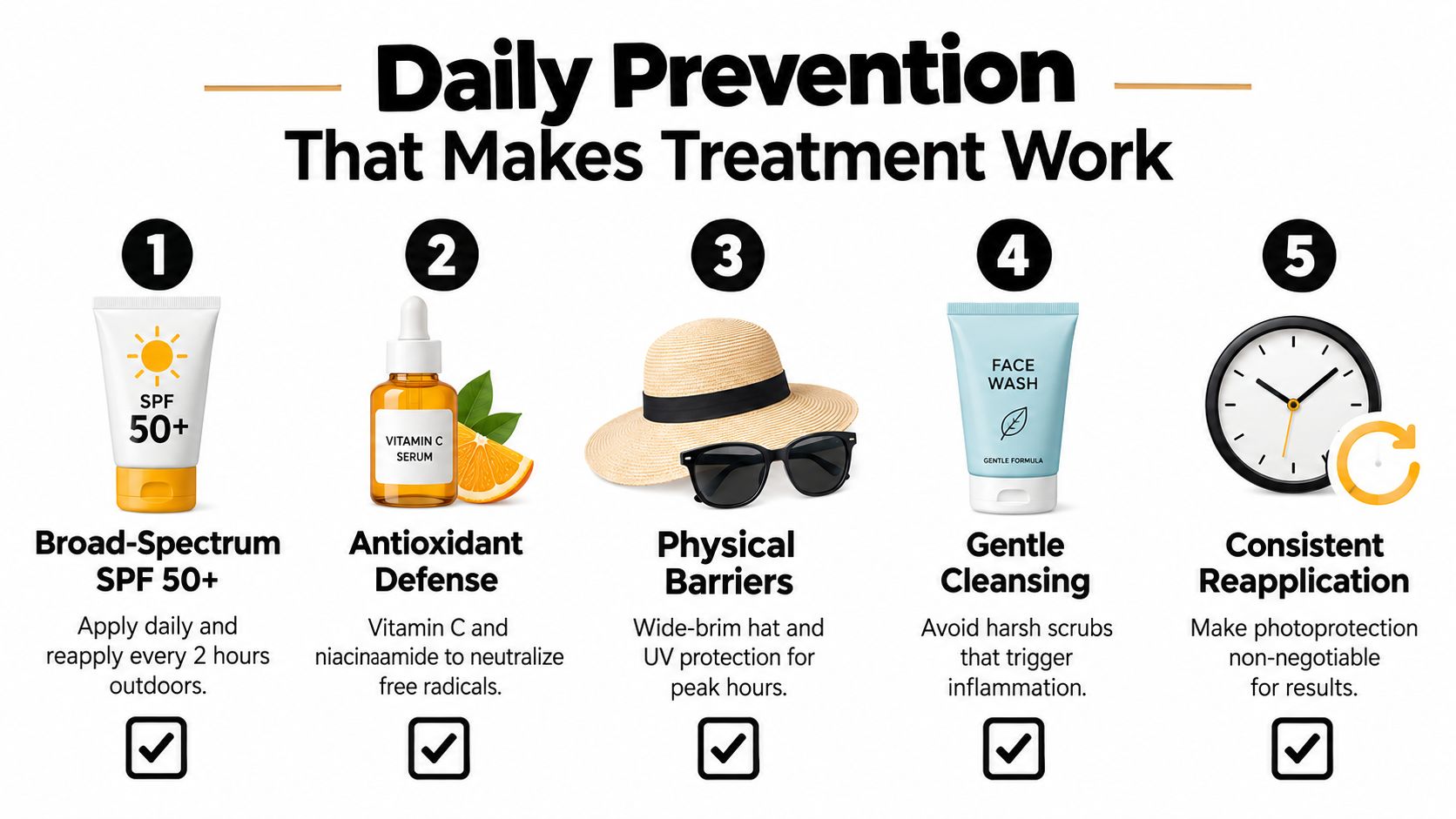
A workable prevention routine has five jobs.
- Cover UV every day. Use a broad-spectrum sunscreen every morning, including on cloudy days and indoor-heavy days if you sit near windows or drive regularly.
- Reduce visible-light exposure if you are melasma-prone or deeper skinned. This is a common miss. Standard SPF habits are often not enough for easily reactivated pigment.
- Reapply when exposure is real. Outdoor time, sweating, and long days out change the math. Morning-only application rarely holds up.
- Use physical barriers. Hats, sunglasses, and shade lower total trigger load without irritating the skin.
- Cleanse without stripping at night. Sunscreen, sweat, and pollution should come off. A tight, squeaky-clean finish usually means the cleanser is too aggressive for pigment-prone skin.
For people who want product-specific support in this category, Pigment Restraint Ultra High Sun Protection is described as a fast-absorbing formula designed to protect against UVA, UVB, IR, and HEV-combination rays while helping reduce the look of visible sun damage. That matters because pigment control is partly exposure control.
A more practical walkthrough of habits, reapplication, and trigger reduction is covered in this guide on how to prevent dark spots on face.
Antioxidants and irritation control matter too
Light is not the only problem. Heat, friction, over-exfoliation, and low-grade inflammation keep pigment pathways switched on. That is why routines fail even when the person owns a good serum.
I see this pattern often. Someone uses an acid cleanser in the morning, skips reapplication, adds a retinoid at night, then wonders why the marks look darker after a few weeks. The answer is usually not that the skin needs stronger treatment. The answer is that the routine keeps creating new inflammation.
Antioxidant support can help, but only inside a low-irritation system. Vitamin C, niacinamide, and other defensive ingredients make more sense when the barrier is stable and daily exposure is controlled. On reactive skin, fewer well-chosen steps beat a crowded routine.
Here's a simple visual checklist to keep the basics tight:
Common prevention mistakes
You cannot out-treat daily UV, visible light, and irritation with a nighttime brightening serum.
Three mistakes account for a large share of stubborn cases:
-
Inconsistent sunscreen use
Applying it only for beach days or obvious sun exposure leaves too many routine triggers unchecked. -
Starting peels or lasers before prevention is stable
Procedures can help, but results are less predictable when the skin is still getting repeated daily stimulation. -
Running too many brightening products at once
More actives often means more irritation, more barrier damage, and more rebound pigmentation.
Skin type changes the prevention plan. Oily or acne-prone skin usually does better with lighter textures they will reapply. Dry or sensitive skin often needs a more moisturizing sunscreen and a gentler cleanse to avoid treatment dropout. Melasma-prone skin benefits from stricter visible-light protection habits. Hydroquinone-free routines especially depend on this consistency, because slower brightening pathways only work if you stop feeding the trigger cycle.
Topical Actives That Fade Dark Spots and How to Choose Them
Hyperpigmentation treatment usually fails at the ingredient stage, not because there are too few options, but because the routine has no job assignment. Four brightening products stacked together often hit the same pathway, irritate the barrier, and keep melanocytes active. A better plan uses a small set of actives with different roles: one to slow pigment production, one to improve turnover or pigment dispersal, and one that the skin can tolerate long enough to matter.
That is the practical shift from product shopping to system design.
A 2026 systematic review and meta-analysis of PIH treatment found that topical medical skincare products improved outcomes versus controls, supporting a structured topical plan plus photoprotection as a foundation for facial hyperpigmentation (systematic review and meta-analysis). The useful takeaway is simple. Topicals work when they are chosen by mechanism and tolerated consistently. Random rotation rarely does.
Ingredient-by-ingredient logic
| Active | Primary Mechanism | Best For | Sensitivity Note |
|---|---|---|---|
| Retinoids | Increase cell turnover and improve pigment dispersal | PIH, uneven tone, mixed texture concerns | Start low and space application. Irritation can deepen marks on reactive skin |
| Azelaic acid | Reduces visible discoloration and helps calm acne-related inflammation | PIH, acne-prone skin, rosacea-leaning or reactive skin | Often easier to keep using than stronger acid combinations |
| Vitamin C | Antioxidant support with a brightening role | Dull tone, maintenance, daytime routines | Can sting a compromised barrier, especially at low pH |
| Kojic acid | Tyrosinase inhibition | Sun spots, PIH, combination formulas | Usually performs better in balanced formulas than in aggressive layering plans |
| Niacinamide | Helps with barrier support and tone evenness | Sensitive skin, maintenance, mixed routines | Versatile and usually easy to pair with other actives |
| Tranexamic acid | Pigment regulation with a useful hydroquinone-free role | Melasma, PIH, relapse-prone discoloration | Results depend on steady use over months, not spot treating |
| AHA BHA PHA blends | Surface exfoliation and renewal | Superficial discoloration, rough texture, post-acne marks | Overuse is a common cause of rebound irritation |
Hydroquinone and the hydroquinone-free decision
Hydroquinone still has a clear place, especially for melasma and stubborn PIH. It also has limits. In practice, the question is not whether hydroquinone is effective. The question is whether the patient can use it safely, whether the diagnosis fits, and what the maintenance plan will be once it is stopped.
For relapse-prone pigment, hydroquinone-free pathways often make more sense as a long game. A review of hydroquinone alternatives and combination care describes growing support for options such as tranexamic acid, cysteamine, azelaic acid, kojic acid, arbutin, niacinamide, and retinoids, while also reinforcing a point that matters in clinic: combination treatment usually outperforms a one-product plan (review on hydroquinone alternatives and combination care).
Tranexamic acid is one of the more practical non-hydroquinone choices, particularly for melasma-prone or easily irritated skin. As noted earlier, published reviews describe topical tranexamic acid in the 2% to 5% range as a credible option with a better tolerance profile than many stronger brightening stacks. The trade-off is speed. Hydroquinone-free plans usually ask for more patience and tighter routine discipline.
How to choose by pattern, not hype
Use the diagnosis to choose the lane.
- Post-acne marks, rough texture, active breakouts: start with azelaic acid or a retinoid
- Melasma, recurrent patchy pigment, heat or irritation triggers: build around tranexamic acid, niacinamide, and low-irritation suppressors
- Mild superficial discoloration with congestion: use controlled exfoliation as support, not the whole treatment plan
- Sensitive or barrier-impaired skin: choose fewer actives, lower frequency, and longer evaluation windows
A useful rule in clinic is one primary pigment suppressor, one supporting active, and one tolerance check. If stinging, flushing, or flaking keep showing up, the formula may be effective on paper and wrong for that patient.
If you want one example of a multi-acid brightening option, Mesoderm RX Skin Perfection Dark Spot Brightening Serum AHA BHA PHA uses kojic acid, glycolic acid, lactic acid, salicylic acid, and lactobionic acid in a daily-use format intended to reduce the appearance of dark spots and improve uneven tone. The advantage of that type of formula is pathway overlap inside one product. It can be more practical than layering several separate exfoliants and brighteners, especially for users who tend to overbuild routines.
Sensitive Skin Safe Routines and Layering That Prevents Rebound
The fastest way to stall pigment treatment is to irritate the skin while trying to brighten it. Sensitive skin doesn't need a weaker plan. It needs a cleaner one.
When barrier function is unstable, melanocytes stay reactive. That's why the most effective routines for sensitive, melasma-prone, or acne-prone skin are built around calm consistency, not daily aggression.
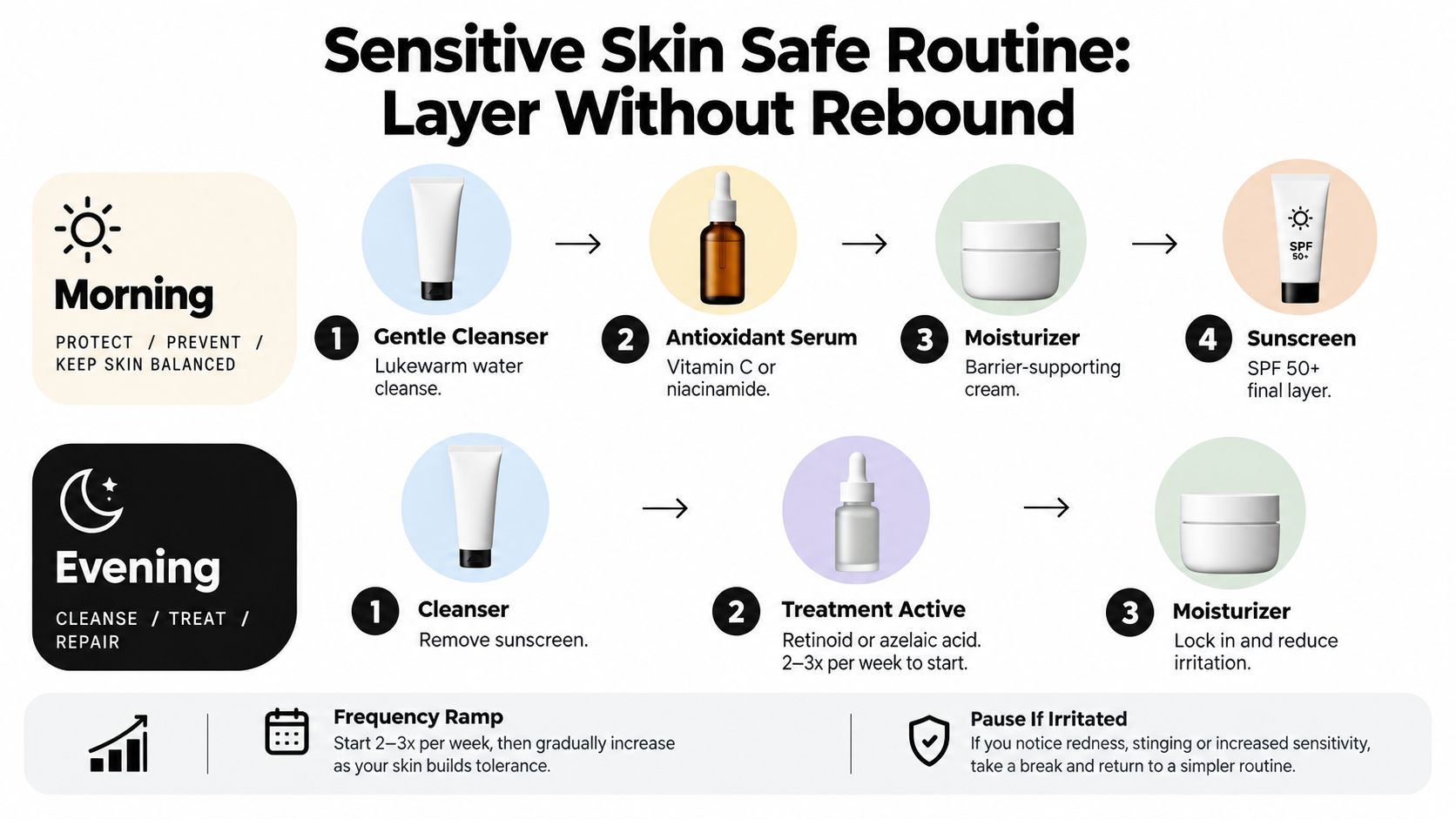
Morning routine that protects progress
A morning routine should defend skin, not challenge it.
-
Gentle cleanse or rinse
If skin is dry or easily irritated, a full cleanser every morning may be unnecessary. -
Antioxidant or tone-support serum
Vitamin C can work well for some. Niacinamide is often easier for reactive skin. -
Moisturizer if needed
Use a barrier-supportive layer when skin feels tight, hot, or flaky. -
High-protection sunscreen
This is the final step.
If your skin burns after application, your routine is too strong for your current barrier state, even if the ingredients are technically “good for pigmentation.”
Evening routine that fades spots without overdoing it
Night is where people create rebound.
- Cleanse thoroughly but gently. Remove sunscreen and debris without scrubbing.
- Pick one treatment lane. Use a retinoid or azelaic acid to start, not both on night one.
- Start with limited frequency. Sensitive skin usually handles a gradual ramp better than daily application.
- Seal with moisturizer. A stable barrier helps keep treatment on track.
For ongoing tone-evening support, Pigment Restraint Cream 1 is positioned as a lightweight daily cream designed to help reduce the appearance of dark spots, discoloration, and uneven tone while keeping skin hydrated and balanced. In a routine, that kind of product fits best as a maintenance-oriented layer rather than a substitute for sunscreen or diagnosis.
Routine adjustments by skin behavior
Different skin patterns need different restraint.
-
Acne-prone skin
Prioritize anti-inflammatory acne control first. New breakouts create new PIH. -
Melasma-prone skin
Keep heat, light exposure, and irritation low. Avoid frequent experimentation. -
Reactive or eczema-prone skin
Strip the routine down. Fewer formulas, fewer fragrance exposures, slower active rotation.
A 2023 systematic review of PIH found complete response in only 5.4% of patients treated with topical therapies, compared with 18.1% for laser and energy-based devices and 2.4% for combination therapies in the included studies, which is a useful reminder that topicals often improve pigment gradually rather than dramatically (systematic review on PIH treatments).
That doesn't mean topicals don't work. It means your routine has to be sustainable enough to keep working long enough.
Timelines In Office Options and When to See a Dermatologist
Visible change doesn't arrive on demand. It arrives when treatment matches diagnosis, inflammation is controlled, and light exposure is managed consistently.
If you're seeing slow but steady lightening, keep going. If pigment stops moving, keeps recurring, or worsens with each new product, that's the point to reassess the diagnosis, not just intensify the routine. Mesoderm RX has a useful overview on how long does it take for hyperpigmentation to fade if you need a practical frame for expected progress.
When in-office care makes sense
A 2024 systematic review of PIH treatment in skin of color found 41 studies covering 877 patients, with topical retinoids and laser therapy the most frequently reported interventions. In that review, partial improvement occurred in 85% of patients treated with retinoids and 66% with laser, while complete resolution was reported in 26% of a laser subgroup. Laser also carried risk, with PIH worsening in 2.6% (8/309) of laser-treated patients, and there was no complete resolution among 346 untreated participants (systematic review in skin of color).
That trade-off matters. Procedures can help stubborn pigment, but they can also create new PIH when skin type, energy settings, or timing are poorly chosen.
Who should escalate carefully
People with richly pigmented or highly reactive skin need more caution, not less treatment. A 2026 systematic review found that intradermal tranexamic acid, topical corticosteroids, topical vasoconstrictors, oral tranexamic acid, and epidermal cooling all reduced procedure-induced PIH incidence more than sunscreen monotherapy after procedures, with intradermal tranexamic acid showing the strongest effect (RR 0.02, 95% CI 0.00–0.53) (review on PIH prevention after procedures).
If you're comparing procedural directions, this overview of IPL vs chemical peels for pigmentation is a helpful starting point for understanding why treatment selection depends heavily on pigment type.
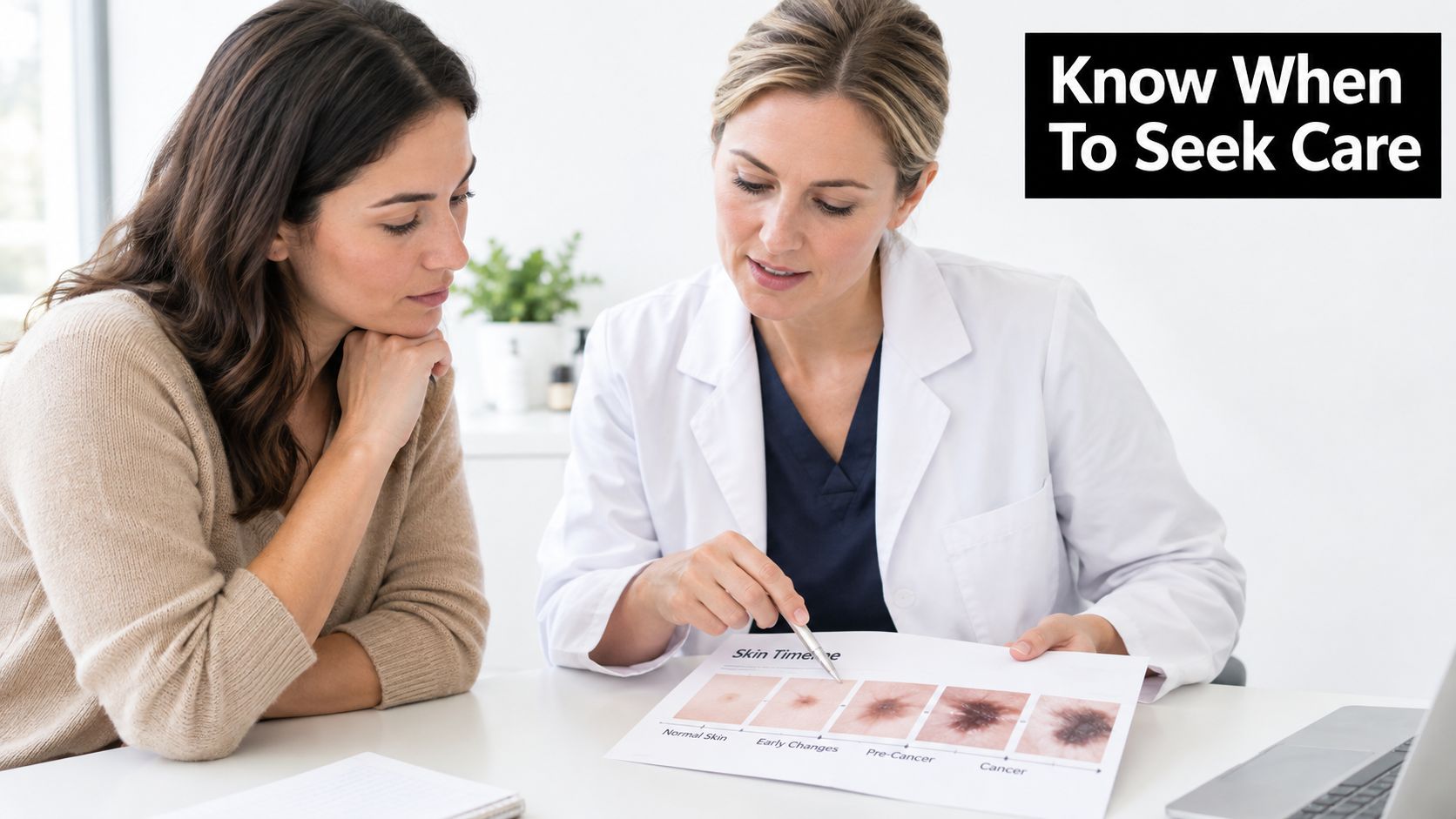
See a dermatologist if a spot is changing, asymmetric, unusually dark, resistant despite disciplined home care, or if you suspect melasma but keep treating it like a sun spot. The right escalation plan is individualized and usually multimodal.
Mesoderm RX builds this category the way it should be built. Around high-potency, minimal-additive brightening, resurfacing, and protection that can fit into a real pigment-control system. If you're ready to move from random spot treatments to a more structured routine, visit Mesoderm RX.