


Fragrance Free Skincare: A Clinical Guide for Sensitive Skin
Fragrance-free skincare is often reduced to one instruction, avoid the word “parfum.” That advice is useful, but incomplete. A product can omit an obvious fragrance declaration and still contain essential oils, aromatic botanicals, masking materials, or fragrance-related allergens that aggravate reactive skin. For anyone managing redness, dark spots, or premature-looking texture, label literacy matters because repeated low-grade inflammation can undermine every brightening or anti-aging step that follows.
The clinical reason for taking fragrance seriously is clear. Dermatology reviews place fragrance contact allergy at about 1% to 3% of the general population, with higher rates among people evaluated for suspected allergic contact dermatitis, as documented in this dermatology review on fragrance allergy. Fragrance-free skincare isn't a cure for pigmentation, but it can remove a meaningful source of avoidable exposure.
Why Just Avoid Fragrance Is Not the Full Answer
The popular advice fails because it treats fragrance as a single ingredient rather than a group of scent-producing materials. Scanning for parfum, fragrance, or aroma is the first filter, not the whole assessment. Essential oils, fragrant plant extracts, and masking systems can create similar problems while presenting themselves as natural, clean, or unscented.
Skin reacts to molecules, not marketing language. A volatile component may evaporate quickly, but repeated exposure can still irritate the surface or contribute to sensitization. Oxidized fragrance compounds are particularly relevant for people who already have eczema, a compromised barrier, or a history of contact dermatitis. The 2024 clinical review of fragrance allergy emphasizes that allergy becomes clinically meaningful when patch-test findings correspond with real exposure on the skin.
Biology comes first
Inflammation activates immune signals around the epidermis. In melanin-rich skin, that inflammatory environment can stimulate melanocytes and make discoloration linger after a blemish, rash, or irritating product has disappeared. Fragrance therefore belongs in a pigmentation conversation, not only a comfort conversation.
Diagnosis prevents random product swapping
Two people can use the same cream and experience different outcomes. One may tolerate an aromatic botanical, while another reacts to a specific allergen, preservative, surfactant, or active ingredient. If every new product changes several variables at once, you can't identify the trigger.
Prescription means simplifying the system
A useful routine removes scent variables, supports the barrier, introduces pigment-targeting actives gradually, and protects the skin from ultraviolet exposure. That sequence works better than collecting several “gentle” products and hoping the label tells the whole story.
Practical rule: Fragrance-free is a starting control. It isn't proof that a formula is non-irritating.
What Fragrance-Free, Unscented, and Hypoallergenic Actually Mean
These labels aren't interchangeable, and treating them as synonyms causes predictable shopping mistakes. Fragrance-free generally signals that fragrance materials weren't intentionally added, but the product may still have a mild odor from its raw ingredients. That natural odor doesn't automatically make the formula unsafe, but it does mean “no smell” isn't the definition.
Unscented describes the sensory result, not necessarily the ingredient strategy. A manufacturer may add a masking material to neutralize the odor of the base formula. In the United States, fragrance and masking ingredients can be declared as “fragrance” or “flavor,” so the label may not reveal every component of the mixture, as explained in the FDA cosmetics labeling guide.
Hypoallergenic is a marketing descriptor rather than a guarantee that a product contains no recognized allergens. It shouldn't replace reading the complete ingredient list or testing the product cautiously.
Fragrance Label Claims Compared
| Claim | Definition | Regulated? | Risk for Reactive Skin |
|---|---|---|---|
| Fragrance-free | No intentionally added fragrance materials, although raw ingredients may have a natural odor | Meaning varies by market and brand usage | Lower exposure to added scent, but not a guarantee against irritation |
| Unscented | The formula has little or no detectable odor | Not a reliable safety standard | May include masking materials that sensitive skin doesn't tolerate |
| Hypoallergenic | A marketing claim suggesting reduced allergy potential | No universal cosmetic guarantee | Must be verified against the full ingredient list |
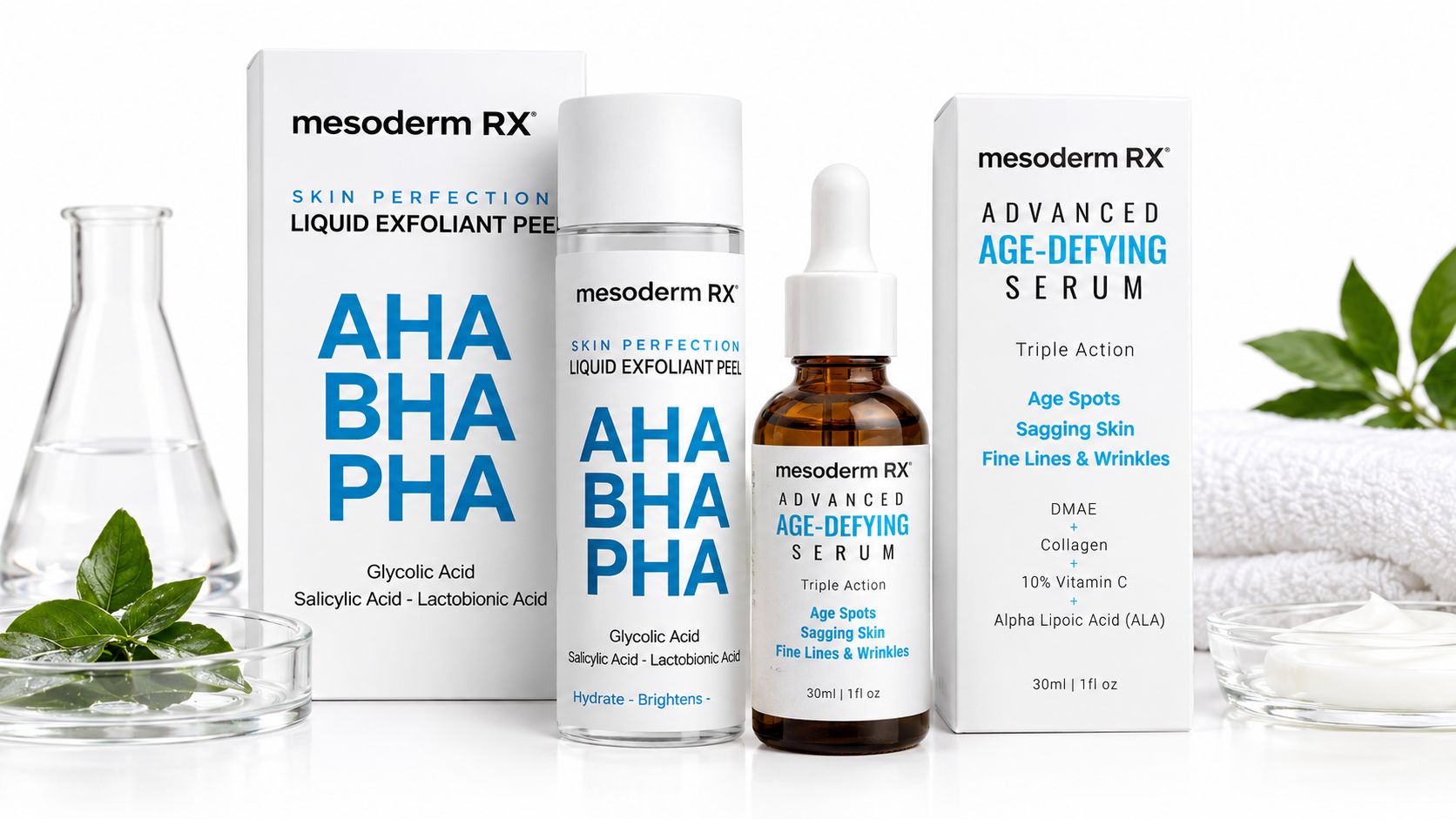
A rich peptide serum such as Anti-Aging Powerhouse is positioned around barrier support, hydration, antioxidant protection, and the appearance of fine lines. That type of product can fit an anti-aging routine, but the same label discipline still applies: check the current ingredient list rather than assuming a product claim answers every sensitivity question.
For a broader ingredient-first approach to reactive skin, the clean skincare guide for sensitive skin is a useful companion to the label analysis above.
How Fragrance Triggers Dark Spots, Aging, and Reactive Skin
Fragrance doesn't create every case of pigmentation, and removing it won't erase an established dark spot by itself. The concern is indirect but important. When a product repeatedly irritates the skin, it can create the inflammatory conditions that make discoloration harder to control.
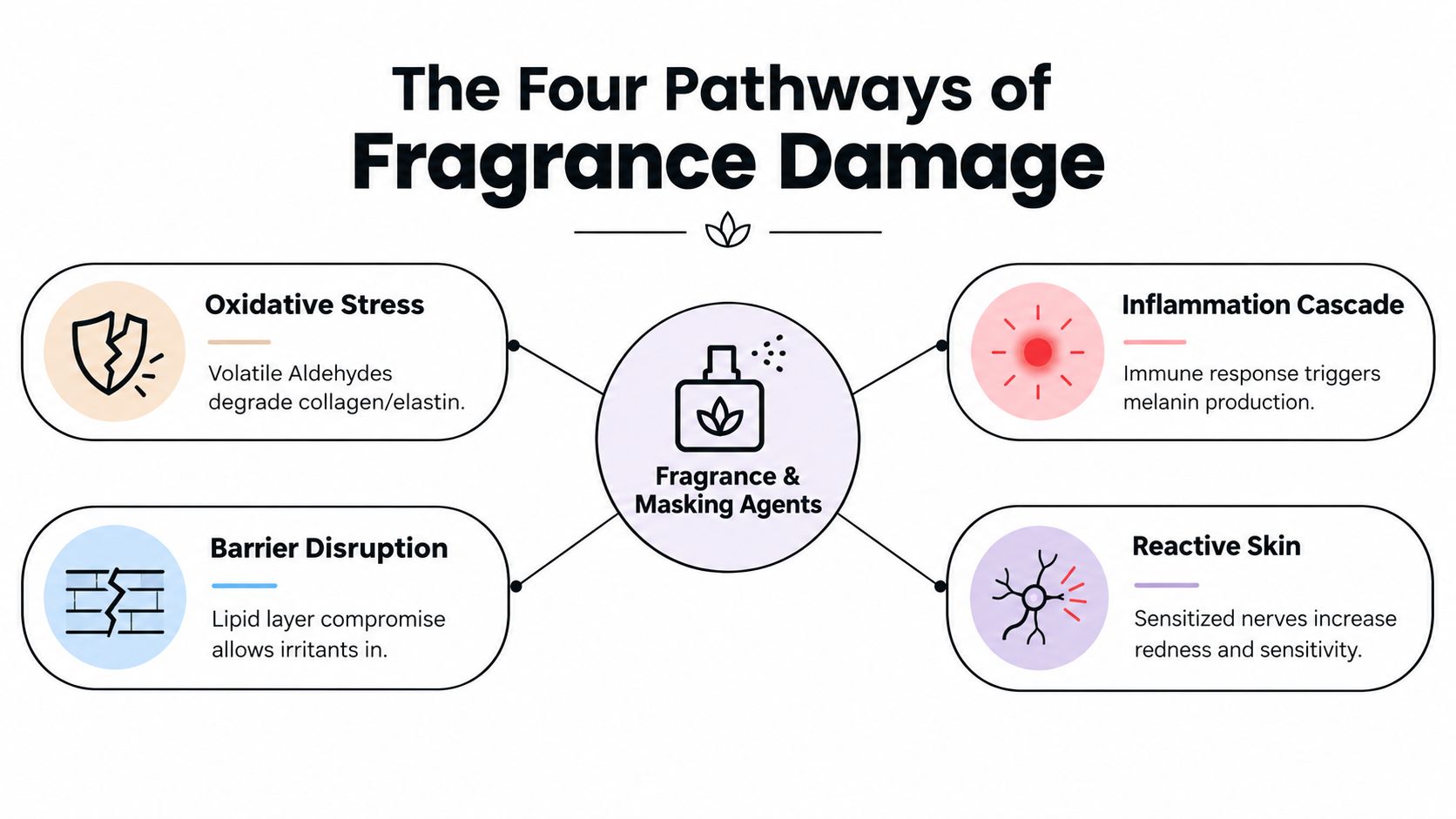
The first pathway is oxidative stress. Some volatile fragrance materials can oxidize over time, and oxidized compounds may become more reactive than the original ingredients. That matters for skin already exposed to ultraviolet radiation, pollution, exfoliating acids, or retinoids. The visible consequence may be persistent roughness or discomfort rather than an immediate rash.
The second pathway is inflammation. Immune activity around an irritated follicle or patch of skin can stimulate melanocytes, the pigment-producing cells responsible for melanin. That mechanism helps explain why a small eruption can leave a disproportionately persistent mark on deeper skin tones.
Barrier damage changes the whole routine
A weakened barrier loses water more easily and allows other ingredients to penetrate a compromised surface. A cleanser that was previously comfortable may begin to sting. An exfoliant that once produced smoothness may suddenly cause redness. This is why a brightening routine can appear to “stop working” when the actual problem is accumulated irritation.
The third pathway is sensitization. Fragrance allergy is an immune response, not merely a preference against smell. The FDA's guidance on fragrances in cosmetics notes that fragrance ingredients must meet cosmetic safety requirements, while also acknowledging that some components can trigger allergic reactions or sensitivities.
For a pigment-focused routine, the practical response is to reduce unnecessary variables before adding stronger actives. A product such as AHA + BHA + PHA Skin Brightening Serum 30ml combines exfoliating acids with ingredients intended to support tone, texture, and hydration. That kind of formula should be introduced only when the barrier is stable, because even a fragrance-free active can irritate skin when used too aggressively.
The relationship between fragrance and dermatitis is clinically significant. Cosmetics account for 30% to 45% of allergic reactions in this category, according to DermNet's fragrance allergy overview. The goal isn't fear. It's controlling an avoidable source of inflammation while you address melanin production, barrier function, and sun exposure.
Fragrance Ingredients and Masking Agents to Scan For
A clean-looking label can still contain scent-related materials. Start with declared fragrance, then check for volatile fragrance allergens and aromatic botanicals. “Natural” describes origin, not tolerance.
Three label groups deserve attention
Declared fragrance includes terms such as parfum, fragrance, aroma, and fragrance blends. If one of these appears, a fragrance-sensitive person should treat the formula as unsuitable unless a healthcare professional has advised otherwise.
Fragrance-related allergens can appear separately or as components of essential oils. Common terms include linalool, limonene, geraniol, citronellol, eugenol, citral, coumarin, and farnesol. The dermatology guidance on fragrance markers and patch testing explains why these materials deserve attention, especially when they occur in leave-on products.
Aromatic botanicals include lavender, sweet orange, tea tree, peppermint, rose, ylang-ylang, frankincense, cinnamon, vanilla, and citrus peel oils. Plant-derived waters and glycol-based botanical extracts may also carry residual volatile compounds. A product can use a botanical for sensory appeal rather than a clear skin function.
Fragrance Ingredients and Masking Agents to Flag
| Category | INCI / Common Terms | Why It Matters |
|---|---|---|
| Declared fragrance | Parfum, fragrance, aroma, fragrance blend | Signals an added scent system |
| Fragrance allergens | Linalool, limonene, geraniol, citral, eugenol, coumarin | May contribute to sensitization, especially after oxidation |
| Essential oils | Lavender, citrus peel, tea tree, peppermint, rose, cinnamon | “Natural” doesn't remove allergen potential |
| Aromatic botanicals | Lavandula angustifolia, Citrus aurantium dulcis, Melaleuca alternifolia, Rosa damascena | May add volatile scent compounds despite fragrance-free positioning |
| Masking language | Masking fragrance, fragrance neutralizer, odor neutralizer | May cover the base odor rather than remove scent materials |
A quick scan can flag terms ending in -ol or -one, but that rule is only a screening shortcut, not a diagnosis. Also check Latin botanical names, especially plants from aromatic families such as Asteraceae, Rutaceae, or Lamiaceae. If the label is unclear, contact the manufacturer and ask what creates the product's scent.
The same logic applies outside skincare. People who are reducing household scent exposure may find a guide to certified pet-safe cleaning solutions useful because cleaning products can introduce another layer of fragrance exposure in the home.
How to Read a Skincare Label for Hidden Scent
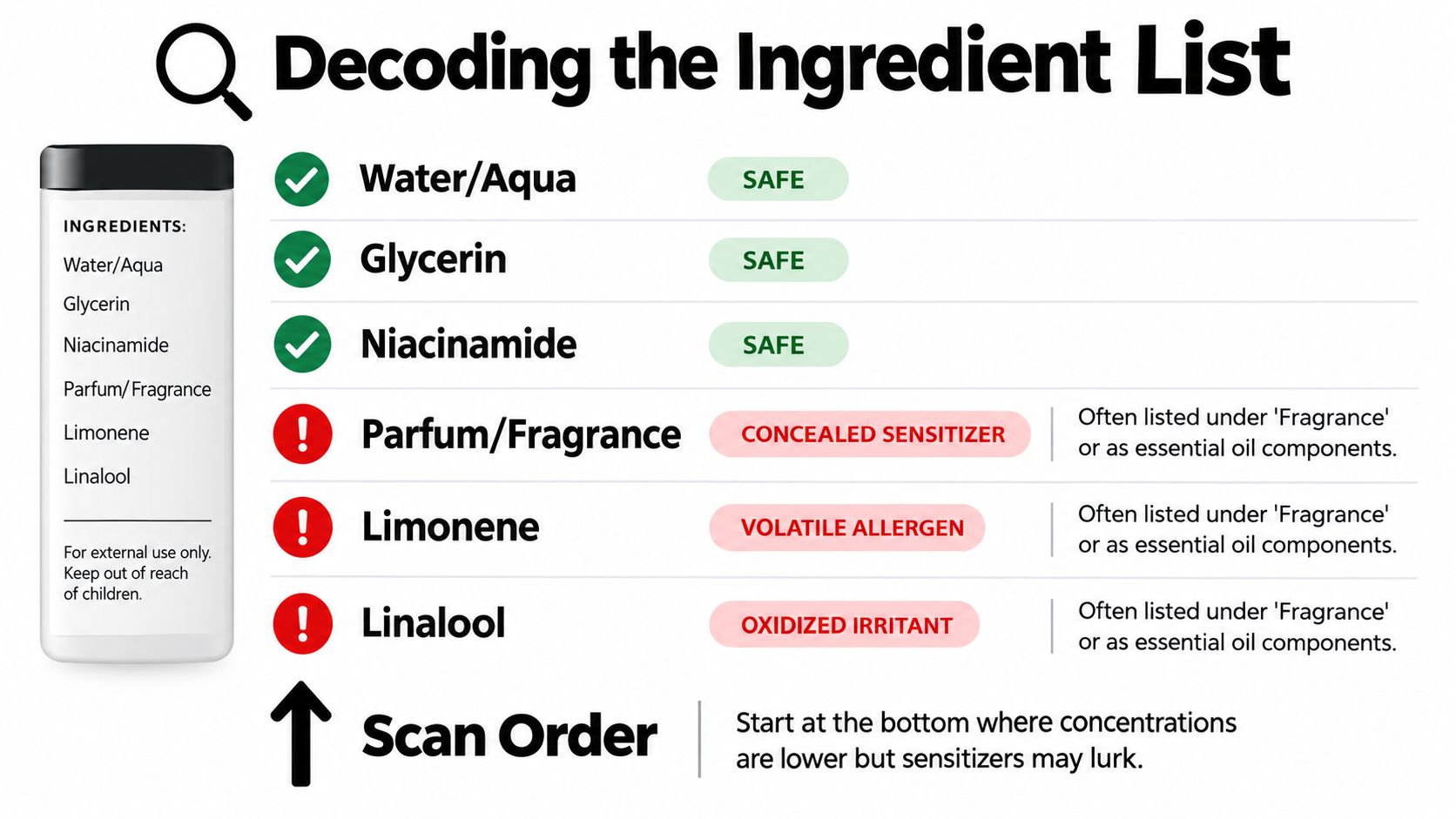
Read the label in two directions. The first pass starts at the beginning, where the formula's primary base and functional ingredients usually appear. The second pass starts at the end, where fragrance declarations, preservatives, colorants, and smaller-quantity ingredients may be listed.
Take a cleanser marketed as fragrance-free. The front label may look reassuring, while the INCI list includes Citrus aurantium dulcis peel oil, Lavandula oil, or linalool. Those ingredients don't need to be called “parfum” to contribute aromatic compounds or create a problem for an already reactive user.
A practical label workflow
- Scan the first five ingredients. Confirm that the base looks appropriate for your skin and that the formula isn't dominated by a component you've previously reacted to.
- Scan the last five ingredients. Look for fragrance, essential oils, aromatic extracts, and unfamiliar odor-control terms.
- Search for -ol and -one endings. Treat them as prompts for verification, not automatic proof of an allergy.
- Verify every Latin botanical. Find out whether the plant is included for a functional skin benefit or just to provide a sensory experience.
U.S. labeling rules allow fragrance mixtures to be listed under a general term, so a consumer may not see every individual component. That doesn't mean every undisclosed mixture contains an allergen, but it does mean an ingredient list can't always provide complete detail about a fragrance blend.
Third-party seals and phrases such as dermatologist-tested can offer secondary context. They shouldn't outrank a transparent INCI list, a clear manufacturer response, or your own reaction history. “Clean” is not a biological category, and “natural” isn't a patch-test result.
Building a Fragrance-Free Routine for Dark Spots and Aging
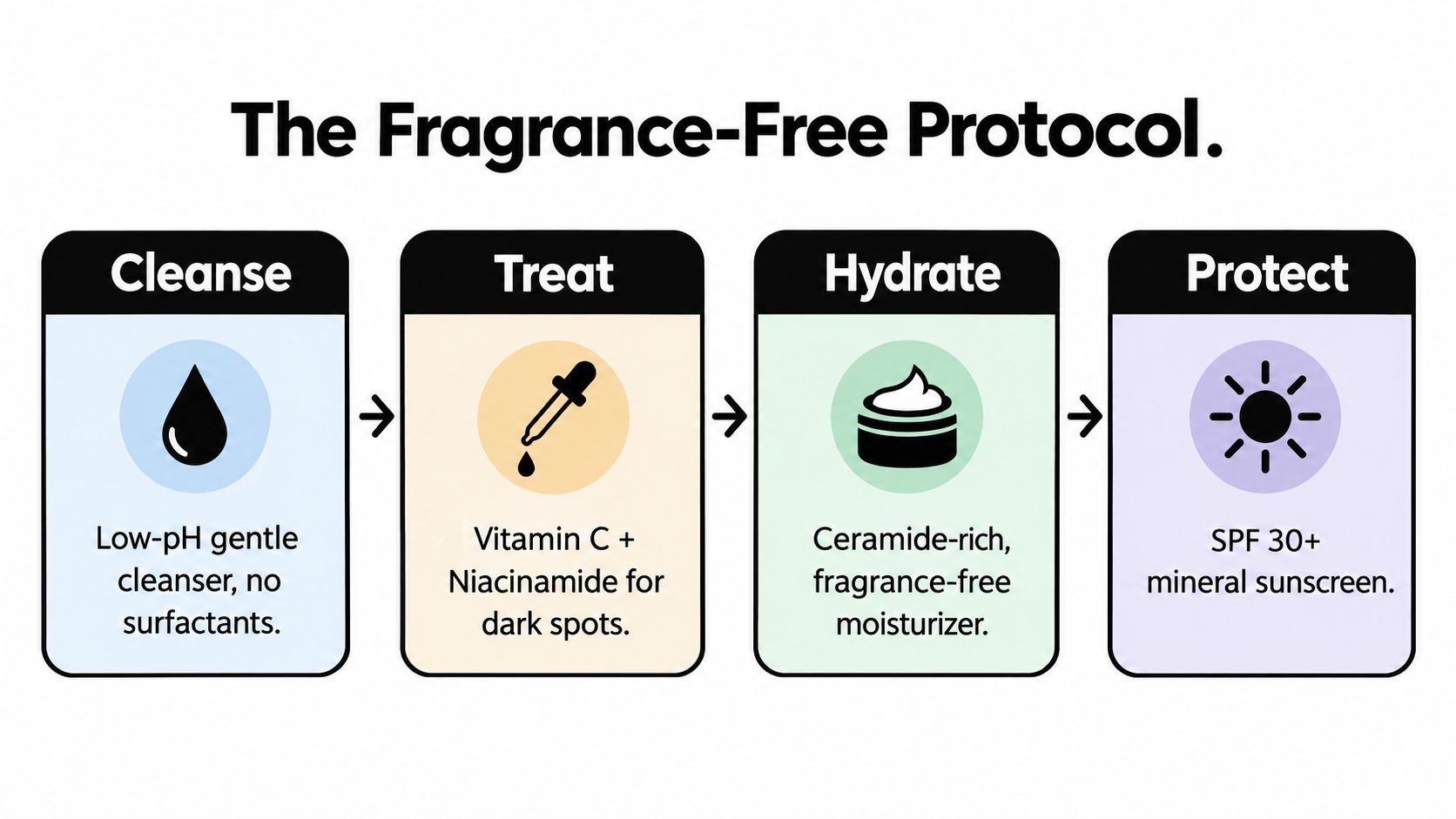
A useful routine has four jobs: cleanse without stripping, treat the visible concern, restore water and lipids, and protect the skin from ultraviolet exposure. The order matters less than consistency and tolerance, but introducing several active products at once makes troubleshooting almost impossible.
Morning
Use a low-foaming, gentle cleanser, or rinse with water if cleansing leaves the skin tight. Avoid formulas that sting immediately or leave a squeaky finish. Follow with one brightening serum, such as a stable vitamin C derivative or niacinamide, rather than layering several pigment regulators on the first morning.
Apply a fragrance-free moisturizer with barrier-supporting ingredients. Peptides can be useful in an anti-aging routine, but they won't compensate for a formula that repeatedly irritates the surface. Finish with a broad-spectrum mineral sunscreen containing zinc oxide or titanium dioxide when those filters suit your skin.
Evening
Remove sunscreen with a fragrance-free cleansing oil, balm, or gentle cleanser, then cleanse again only if residue remains. Apply one treatment on selected nights and leave the remaining nights for recovery. Azelaic acid can address uneven tone and inflammatory discoloration, while a low-irritation retinoid can support smoother-looking texture, but use them on separate evenings when your skin is reactive.
Ceramides, cholesterol, humectants, and a bland moisturizer have a practical role on recovery nights. Leave enough time between layers for each product to settle, and don't add an exfoliating acid to a routine that is already producing burning or persistent redness.
Before adopting any new product, patch-test it on the jawline or inner arm for several days. A small test doesn't guarantee facial tolerance, but it gives you more information than applying a full new routine overnight.
For readers comparing brightening options, a dark spot cream for face can be evaluated using the same criteria, fragrance disclosure, active ingredients, barrier compatibility, and a realistic introduction schedule. Sunscreen selection also deserves separate attention, particularly for people who find many formulas sting around the eyes; this fragrance-free sunscreen guide provides another way to assess the category.
Sample Routines for Beginners and Stubborn Pigmentation
The beginner routine should feel almost boring. That is a strength, not a weakness. Start with a cream cleanser, a hydrating serum containing hyaluronic acid or polyglutamic acid, a ceramide moisturizer, and a mineral sunscreen. Keep the same products long enough to identify whether your skin is calmer, tighter, drier, or more comfortable.
For stubborn pigmentation, add one active at a time. A stable vitamin C derivative can sit in the morning routine, while azelaic acid, tranexamic acid, or a low-irritation retinoid can be introduced on separate evenings. Don't combine every brightening ingredient just because each one has a plausible mechanism. Melanin regulation works better when the skin can tolerate the routine consistently.
Beginner vs Results-Driven Routine Timeline
| Routine Step | Beginner, Barrier-First | Results-Driven, Stubborn Pigmentation |
|---|---|---|
| Morning cleanse | Cream or low-foaming cleanser | Gentle cleanser selected for comfort |
| Morning treatment | Hydrating serum only | Stable vitamin C derivative, then moisturizer |
| Evening treatment | Hydration and barrier repair | Alternate azelaic acid, tranexamic acid, or retinoid |
| Moisturizer | Ceramide-focused formula | Barrier moisturizer adjusted to active nights |
| Sun protection | Mineral sunscreen every morning | Broad-spectrum sunscreen every morning and reapplication when needed |
| Introduction pace | Change one product at a time | Add one active only after the previous step is tolerated |
During the first phase, judge the routine by reduced tightness and less stinging rather than immediate spot removal. Early brightening can be subtle, and pigmentation often appears unchanged before the baseline tone starts to look more even. A plateau doesn't always mean failure. It can signal inconsistent sunscreen use, too much inflammation, or a pigment diagnosis that needs professional review.
Melasma, sun spots, and post-inflammatory hyperpigmentation aren't the same condition. Melasma is influenced by hormonal and ultraviolet triggers and often appears in symmetric facial patterns. Sun spots are localized areas of excess pigment associated with cumulative exposure. Post-inflammatory hyperpigmentation follows inflammation or injury. The active strategy should reflect the diagnosis, not just the shade of the mark.
Smarter Buying Questions and What Real Progress Looks Like
Fragrance-free skincare reduces exposure to a common trigger, but it doesn't treat hyperpigmentation on its own. You still need to manage ultraviolet exposure, inflammation, melanin production, and barrier function. The fragrance-free cosmetics guide can help you compare product positioning, but every formula still deserves an ingredient-level review.
Ask these questions before buying:
- Who made the formula? Look for a named manufacturer or brand contact that can answer ingredient questions.
- What creates the scent? A fragrance-free product may retain a raw-material odor, but the company should explain whether masking materials or essential oils are present.
- Why are botanicals included? A functional extract and a sensory botanical aren't equivalent from a reactive-skin perspective.
- How is the formula preserved? Preservatives are necessary in many water-based products, and a “natural” label doesn't explain preservation quality.
- Can the brand provide the complete INCI list? If the answer is vague, choose a more transparent option.
Real progress looks gradual. You may notice less redness, fewer episodes of stinging, and quicker recovery when introducing a retinoid or acid. Dark spots usually fade incrementally, while overall tone becomes more even before a single stubborn mark disappears. If a formula burns, causes persistent redness, or produces a rash, stop using it rather than interpreting irritation as proof that the product is working.
A large daily-life study found that people with clinically relevant fragrance allergy reported dry skin and sensitive skin more often than the overall patch-tested population, with dry skin reported at 59.6% versus 52.1% and sensitive skin at 47.9% versus 41.0% in the compared groups, as reported in this open-access study of scented products. Those findings support a practical conclusion: control the trigger load first, then build treatment around what the skin can tolerate.
The winning system has three layers. Biology explains how inflammation affects the barrier and melanocytes. Diagnosis separates melasma, sun spots, and post-inflammatory marks while identifying personal triggers. Prescription turns that information into a short, repeatable routine. Product count isn't the deciding variable. Tolerability and consistency are.
Mesoderm RX offers fragrance-free, vegan, cruelty-free skincare made in the USA for concerns including dark spots, uneven tone, dryness, and visible signs of aging. Visit Mesoderm RX to review its brightening, anti-aging, body-care, and sun-protection options, then compare each formula against the label and tolerance standards in this guide.