


Fragrance Free Beauty Products: A Clinical Guide
The most popular advice about fragrance free beauty products is also the least complete: choose anything marked “fragrance-free” and assume your reactive skin is protected. In the United States, that badge has no federal standard, while labels may disclose fragrance compounds collectively as “fragrance” or “perfume,” making the front of the package an incomplete decision tool. The safer approach is a personal fragrance-allergen audit, paired with a minimal-additive routine and a clear understanding of your pigmentation problem.
That distinction matters because fragrance sensitivity is a genuine clinical concern, not a preference invented by sensitive-skin marketing. A European Commission review estimated fragrance contact allergy in approximately 1% to 3% of the general population, while about 16% of patch-tested patients with suspected allergic contact dermatitis showed fragrance contact allergy. A broader European analysis found 4.5% prevalence when several fragrance markers were tested, with the differences reflecting the population, allergens, and diagnostic method used. The European Commission's explanation of fragrance-related skin problems makes the practical point clear: the issue is broader than a small group of unusually delicate consumers.
You'll leave with a method, not a product list. You'll learn how to separate fragrance-free from unscented and hypoallergenic, identify aromatic ingredients that survive a quick label scan, connect irritation with melanin biology, and build a high-performance routine that removes one controllable trigger without stripping away effective actives.
The Label Promise Most People Misread
In the U.S., “fragrance-free” is not a federally standardized cosmetic claim. The FDA states that terms including “fragrance-free,” “hypoallergenic,” and “for sensitive skin” have no federal standard or legal definition, and cosmetic fragrance formulas may be declared collectively as “fragrance” or “flavor.” That means a front-of-pack promise can sound precise while leaving the actual composition unclear. FDA guidance on cosmetic allergens and labeling is more useful than the badge itself because it directs fragrance-sensitive consumers to inspect the complete ingredient list.
Two moisturizers can both present themselves as suitable for sensitive skin and still create very different experiences. One may contain no intentionally added fragrance but include botanical extracts with naturally aromatic constituents. Another may be labeled unscented because masking materials suppress the base odor. Neither claim tells you whether the formula contains an ingredient your own skin has already learned to reject.
The practical rule: Treat “fragrance-free” as a screening signal, not a diagnosis.
That doesn't make the claim meaningless. Removing added parfum, fragrance, or aromatic essential oils where feasible can reduce one avoidable exposure category, especially in leave-on products that remain against the skin for extended periods. It means the label must be tested against the formula and your reaction history.
A reliable decision process has three parts:
- Interpret the wording. Learn what fragrance-free, unscented, no added fragrance, and hypoallergenic can each permit.
- Audit the ingredients. Search for collective fragrance terms, essential oils, aromatic botanicals, and known personal triggers.
- Build around tolerance and results. Use a small number of transparent formulas so irritation doesn't obscure whether brightening, exfoliating, or anti-aging actives are working.
For a deeper look at the formulation issue, fragrance-free skincare is a useful reference, but the same principle applies across brands. Your skin responds to the ingredients it receives, not the confidence of the marketing copy.
Fragrance-Free vs Unscented vs Hypoallergenic
These terms answer different questions, and none should replace an ingredient audit.
Fragrance-free
A genuinely fragrance-free formula should contain no intentionally added fragrance materials. Look for the absence of “fragrance,” “parfum,” “perfume,” and “aroma,” then check for aromatic essential oils and botanicals. A formula can still have a mild natural scent from its raw materials. That doesn't automatically make it fragranced, but it does mean the label needs closer reading.
Unscented
Unscented describes the sensory result, not necessarily the formulation. A moisturizer can smell neutral because the manufacturer has used masking materials to suppress the odor of other ingredients. If you react to fragrance constituents, “unscented” may provide less information than “fragrance-free.” A product with no obvious scent can still contain ingredients that matter to your skin.
No added fragrance
This is often the most honest formulation language. It indicates that the manufacturer hasn't intentionally added fragrance for scent, while acknowledging that plant extracts, oils, or other raw materials may have their own aromatic components. Ask whether the brand discloses those materials individually and whether it controls them from batch to batch.
Hypoallergenic
In the U.S., hypoallergenic isn't a regulated guarantee. It may communicate that a brand believes its formula is less likely to cause a reaction, but it doesn't identify which ingredients were excluded, what testing was performed, or whether the formula suits your specific allergy history.
European labeling requirements provide a sharper contrast. Fragrance allergens must be listed individually above 0.001% in leave-on products and 0.01% in rinse-off products, and Regulation (EU) 2023/1545 expanded the framework by adding 56 fragrance allergens. The European Commission's fragrance-allergen labeling guidance explains why leave-on thresholds are lower. Longer contact creates a stronger reason for detailed disclosure.
That regulatory difference matters when you're comparing products sold across markets. It's also why a person trying to reduce dust mite triggers may apply the same broader principle to skincare: identify the exposure rather than trusting a general comfort claim.
For mature skin, a peptide-rich formula such as Anti-Aging Powerhouse is described as supporting the moisture barrier, hydration, firmness, and the appearance of fine lines. Apply the product according to its directions, and still review the complete ingredient list if you've reacted to cosmetic products before.
Why Fragrance Triggers Sensitive Skin
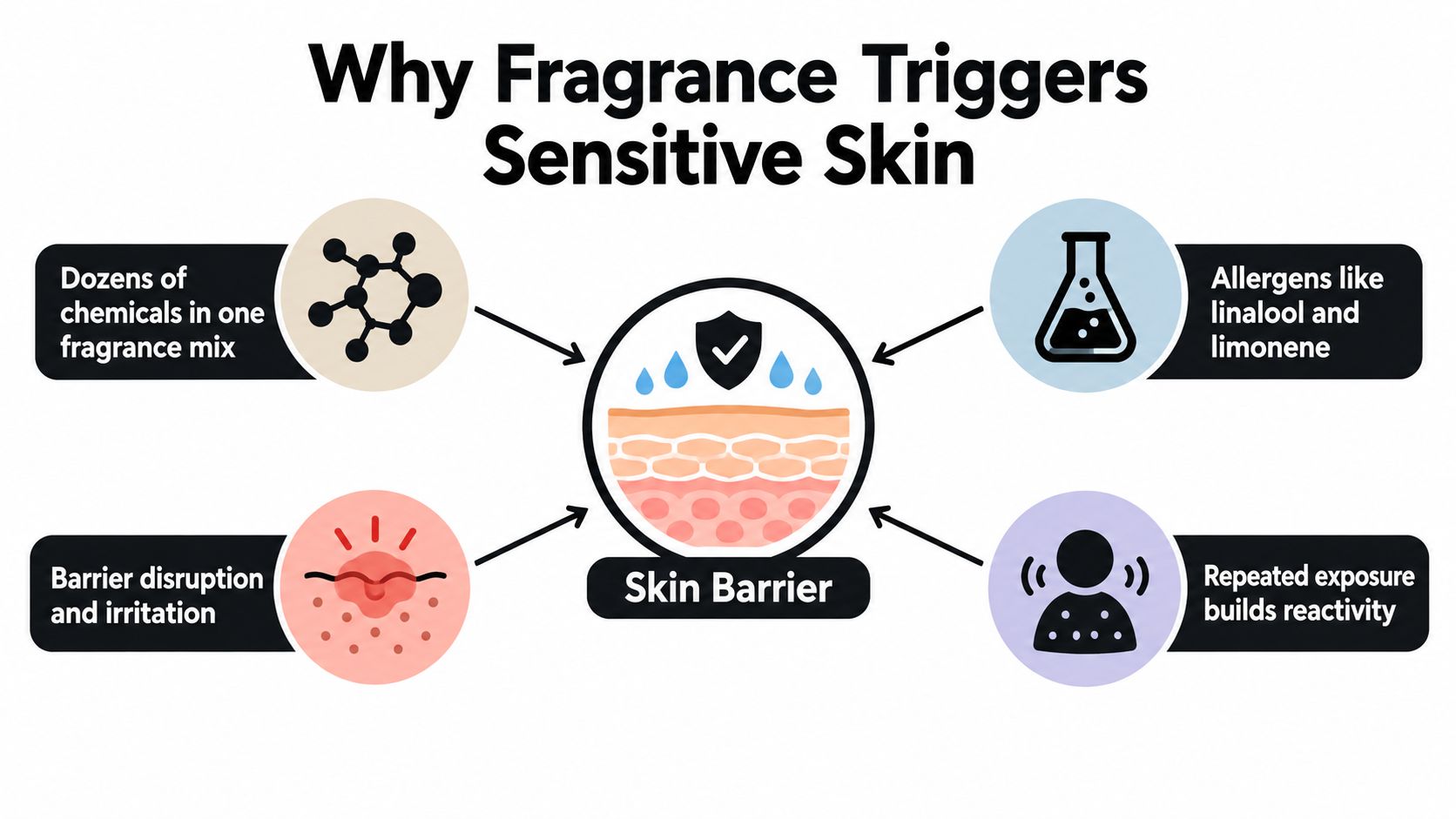
Fragrance is a weak point in sensitive-skin routines because it is rarely a single material. A fragrance blend can contain dozens of chemically distinct compounds, and some are capable of sensitizing the skin over time. Early use may seem fine. Later, the same product can trigger allergic contact dermatitis because the immune system has already learned to recognize part of that blend as a threat.
That is different from irritation, although patients often experience both in the same routine. Irritation can come from acids used too often, over-cleansing, shaving, low barrier function, or just too much product turnover at once. Allergy involves immune recognition. Without patch testing or clinical evaluation, many people cannot reliably tell which one they are dealing with.
Exposure time matters.
A 2024 review identified leave-on products as the most significant reported source of fragrance sensitization, accounting for 79% in the cited analysis. That fits what shows up in practice. A serum, moisturizer, sunscreen, or body lotion sits on the skin for hours, while a cleanser is diluted, massaged briefly, and rinsed away. Front-of-pack claims matter less than that exposure pattern, especially in the U.S. market, where a “fragrance-free” badge does not replace checking what your own skin repeatedly reacts to.
The impaired barrier changes the equation
Once the barrier is compromised, fragrance becomes a higher-risk variable. Eczema, dermatitis, over-exfoliation, retinoid misuse, shaving, and in-office procedures can all increase water loss and make stinging more likely. In that state, even a product that looked acceptable on paper can become harder to tolerate. Adding fragrance to a stressed barrier gives reactive skin one more thing to process, with very little functional benefit.

Featured Product
Hydrating Skin Booster
Hydrate your skin with Hydrating Skin Booster. Its advanced formula defends against UV damage, prevents dark spots, and promotes a radiant, even complexion—all while maintaining optimal hydration.
Shop Now →Clinical data support that caution in dermatitis populations. In a systematic review of European dermatitis patients, patch-test sensitization was 6.81% for fragrance mix I and 3.64% for fragrance mix II. Among pediatric dermatitis patients, the corresponding figures were 4.09% and 2.17%. These are clinically selected dermatitis groups, not prevalence estimates for everyone buying skincare. Still, The systematic review of fragrance sensitization in dermatitis patients supports a practical takeaway. Removing added fragrance can reduce one avoidable exposure category, but it will not solve every reaction if acids, preservatives, dyes, or botanicals are also in play.
This matters even more in routines built for dark spots, uneven tone, or visible aging, where vitamin C, exfoliating acids, peptides, and pigment-focused actives already push the skin harder. If inflammation keeps showing up, you cannot judge whether the active is underperforming or the formula is too busy. Start by reducing avoidable exposures and choosing a low-stripping cleanser. If you need a practical comparison, this guide can help you find a barrier-friendly face wash.
Here's a short visual explanation of how repeated exposure and ingredient complexity can affect reactive skin:
Reading an Ingredient List for Hidden Fragrance
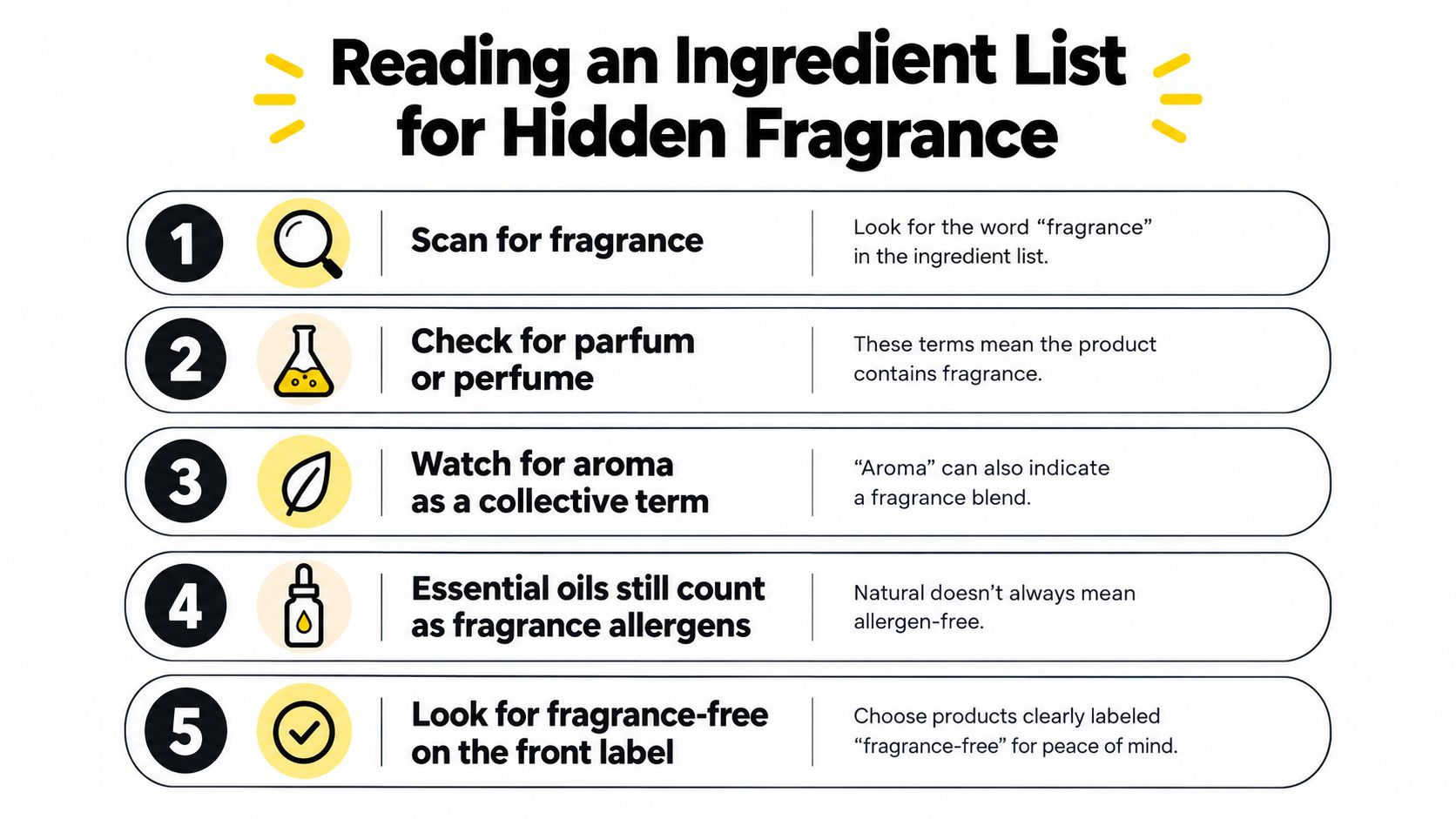
Start at the declaration that can hide the most information. Fragrance, parfum, perfume, and aroma may function as collective terms rather than a complete list of every component. In the U.S., the FDA permits fragrance compounds to appear under a collective “fragrance” or “flavor” declaration, so you may not be able to identify each constituent from the label alone.
Then inspect the plant-derived ingredients. Lavender oil, citrus peel oils, ylang-ylang, rose oil, and similar aromatic materials may look gentle because they come from plants. Natural origin doesn't prevent sensitization. Essential oils can contain fragrance-related constituents, and botanical extracts can add both active compounds and aromatic complexity.
A workable audit order
Use the same sequence every time you review a new product:
- Search the collective terms first. Find “fragrance,” “parfum,” “perfume,” “aroma,” and “natural fragrance.” Don't assume “natural” means low-risk.
- Circle aromatic oils. Look for lavender, lemon, orange, bergamot, peppermint, eucalyptus, ylang-ylang, jasmine, rose, and similar materials.
- Check the product's purpose. A leave-on serum or lotion deserves stricter scrutiny than a rinse-off cleanser because contact lasts longer.
- Compare the full list with your history. Preservatives, dyes, exfoliating acids, and botanical actives can also cause irritation or allergy.
- Record the result. Keep a note on your phone with every ingredient that has caused a reaction or suspicious flare.
The last step turns general caution into a personal tool. Copy the five to fifteen ingredients you suspect, then search each one across every product in your routine. You're looking for repetition, not a universal blacklist. If the same aromatic oil appears in your cleanser, toner, moisturizer, and body lotion, removing only one product may not reveal the trigger.
A short ingredient list can still contain a problematic material, while a longer list can be well tolerated. The relevant question is whether the formula is transparent, purposeful, and compatible with your skin. Readers who want more context on choosing well-formulated natural skin care should apply the same standard to botanical products: evaluate the actual ingredients, not the word “natural.”
The same audit helps when comparing moisturizers. Best fragrance-free moisturizer should mean more than a pleasant front-label claim. Check whether the base supports the barrier, whether aromatic ingredients appear under botanical names, and whether the formula contains actives that fit the rest of your routine.
Why Pigmentation-Prone Skin Has the Most to Gain
Pigmentation is not one diagnosis. Post-inflammatory hyperpigmentation, melasma, and sun-induced spots have different triggers and need different management.
Post-inflammatory hyperpigmentation, or PIH, appears after skin injury or inflammation. DermNet describes it as pigmentation that follows conditions such as dermatitis, infection, or thermal burns, with color remaining where the original disease occurred. It can range from light brown to black and is particularly common in darker skin types. DermNet's overview of pigmentation disorders explains why daily broad-spectrum SPF 50+ matters on exposed sites, because ultraviolet exposure can intensify residual pigment.
Melasma is a chronic pigmentary disorder, not just a collection of sun spots. It requires sustained photoprotection, including broad-spectrum SPF 50+ and sunscreen containing iron oxides, according to DermNet's melasma guidance. Tyrosinase inhibitors such as hydroquinone may be used as pretreatment options, while procedures require caution because peels and lasers can worsen melasma or provoke PIH.
Educate, diagnose, prescribe
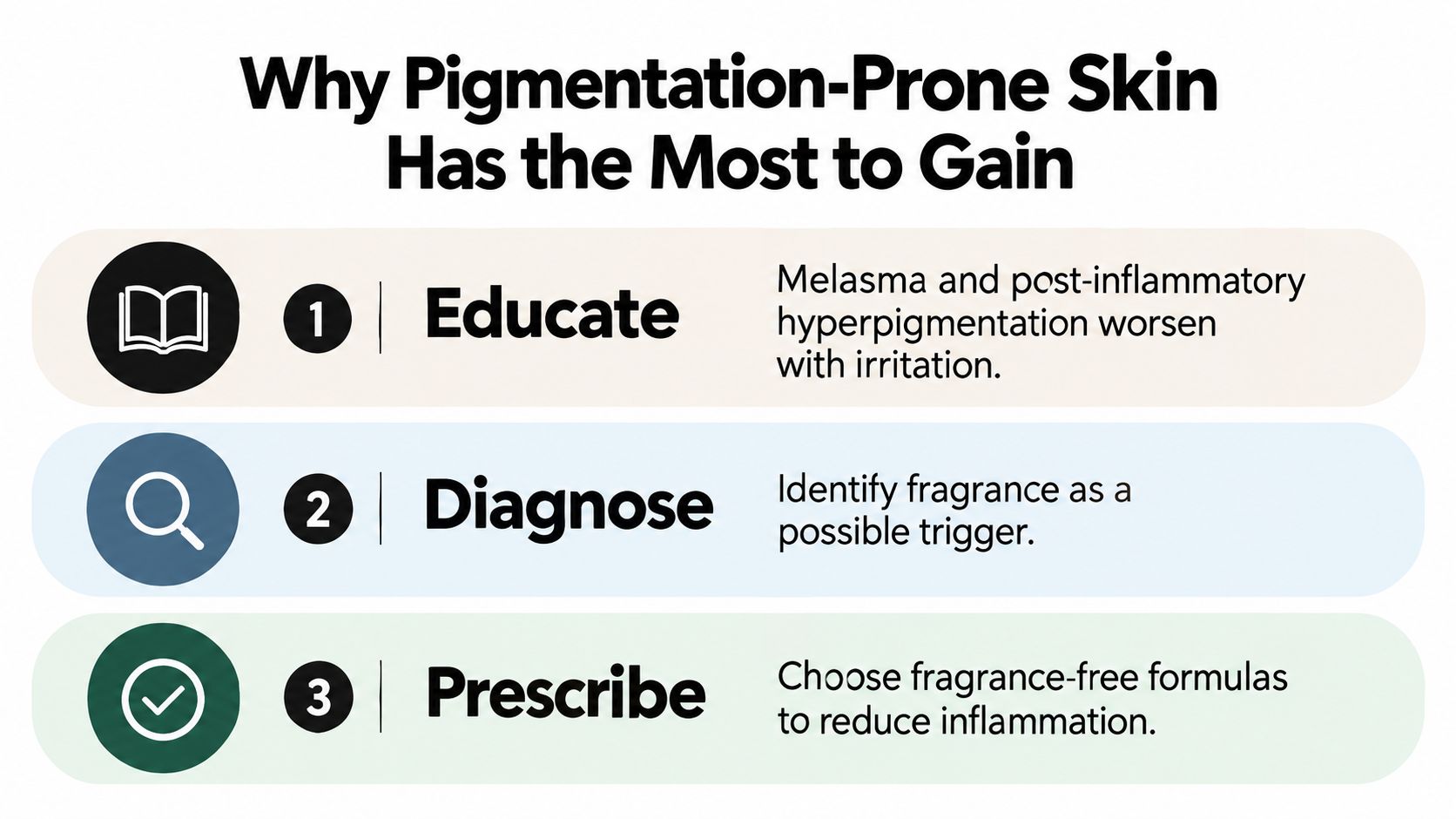
Educate. Melanocytes produce melanin, and tyrosinase helps regulate melanin production. Inflammation can stimulate pigment formation or leave pigment behind after the original irritation resolves. A scented product doesn't cause every dark spot, but repeated irritation can become part of the inflammatory cycle.
Diagnose the trigger. Review the timing of your flare. Did burning, redness, scaling, or itching begin after adding a fragranced serum, essential-oil blend, or masking product? Did darkening appear where the irritation occurred? These observations don't replace a dermatologist's diagnosis, but they can identify a controllable exposure.
Prescribe a lower-noise routine. Remove added fragrance, keep the carrier simple, introduce pigment-targeting actives gradually, and protect the skin from light every day. Aggressive peels, lasers, and intense pulsed light aren't automatically better. DermNet notes that epidermal injury can aggravate PIH, while procedures can also worsen melasma.
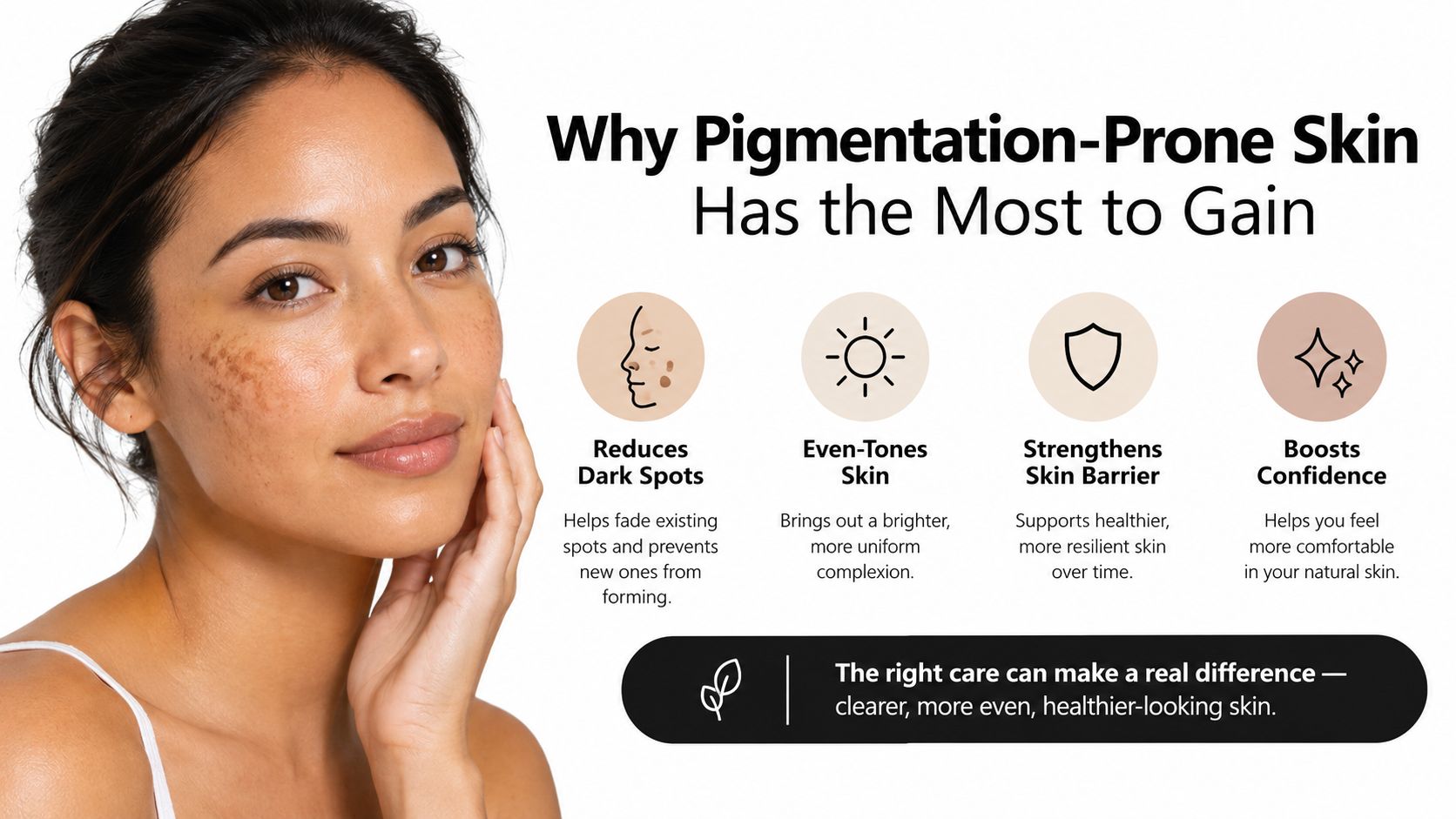
The strategic advantage of fragrance minimization is simple. It lowers one potential inflammatory input so that niacinamide, vitamin C, alpha arbutin, kojic acid, exfoliating acids, or peptides can be evaluated without an avoidable source of noise. It won't cure melasma, and it won't make every formula suitable for every person. It can make a results-driven routine easier to tolerate and easier to interpret.
Building a Fragrance-Free Routine That Still Performs
A fragrance-free routine shouldn't mean an inactive routine. The aim is more useful actives in a lower-noise base, with sequencing that respects the barrier.
Morning structure
Begin with a gentle, low-pH cleanser or rinse with water if cleansing leaves you tight. The first step should remove residue without creating the irritation you're trying to prevent.
Follow with a vitamin C or antioxidant serum if your skin tolerates it. Antioxidants support a routine built around environmental defense, but introduce them slowly when your barrier is reactive. A targeted brightening serum containing niacinamide and alpha arbutin can follow, provided the formula doesn't duplicate irritating ingredients elsewhere.
Use a peptide and hyaluronic acid serum when firmness, hydration, and fine lines are priorities. A lightweight moisturizer can seal the layers, and broad-spectrum SPF 50+ remains the daily anchor for pigmentation-prone skin. For more detail on selecting a daily product, see this guide to fragrance-free sunscreen.
Evening structure
Cleanse gently, then choose your active rather than applying everything at once. An AHA, BHA, or PHA exfoliating serum can address texture and congestion, but a sensitized face doesn't benefit from forcing an exfoliant into every night.
Use a hydrating layer next, followed by a pigment-targeting treatment on nights when the skin feels calm. Peptides can fit on recovery nights, while a moisturizer supports the barrier. If you experience persistent burning, swelling, scaling, or itching, stop the suspected product instead of adding another soothing product to cover the reaction.
A useful sequencing rule: Introduce one new active at a time, and don't treat stinging as proof that a formula is working.
Keep body and face formulas separate
Face skin, body skin, and intimate-area skin don't have identical tolerance or formulation needs. A body brightening lotion can be appropriate for affected body areas but not necessarily for the face or neck. Follow the product's stated directions rather than extending a body formula into a facial routine.
The same applies to exfoliation. A formula that feels manageable on the elbows may be excessive around the eyes or on a compromised cheek. Minimal-additive skincare isn't about using one product everywhere. It's about giving each area the narrowest effective treatment and removing unnecessary fragrance exposure from every leave-on step.
Patch Testing, Shopping, and Spotting Greenwashing
Patch testing is a screening process, not a guarantee. Apply a small amount to the inner forearm or behind the ear, then observe the area for 48 to 96 hours. If the product contains potent actives, extend the observation period gradually to seven days before applying it broadly. A delayed reaction can matter as much as an immediate sting.
Redness, itching, swelling, blistering, or persistent burning suggests that the product isn't earning a place in your routine. A brief, mild sensation from a known active isn't automatically an allergy, but worsening discomfort is not a result to chase. Stop the product and seek dermatology input for recurring reactions, suspected allergic contact dermatitis, eczema flares, or symptoms involving the eyes and lips.
Shop the formula, not the slogan
Open the ingredient list before reading the sales copy. Search for parfum, perfume, fragrance, aroma, essential oils, and “natural fragrance.” If the retailer doesn't display the complete list, ask the brand for it. A product filter labeled “sensitive skin” can narrow choices, but it cannot verify the formula.
| Label Claim | What It Typically Means | What It Still Allows |
|---|---|---|
| Fragrance-free | No intentionally added fragrance materials | Naturally aromatic botanicals, other irritants, or allergens |
| Unscented | The finished product has little or no noticeable scent | Masking materials and fragrance-related ingredients |
| No added fragrance | Fragrance wasn't intentionally added for scent | Aromatic raw materials and botanical constituents |
| Hypoallergenic | The brand suggests lower allergy potential | No U.S. federal definition or guaranteed tolerance |
| Natural fragrance | Fragrance materials derived from natural sources | Essential oils and fragrance allergens |
Three greenwashing signals deserve immediate skepticism:
- “Clean” without disclosure. A broad safety promise is weak when the complete INCI list is missing.
- “Hypoallergenic” without a test explanation. Ask what was excluded and how tolerability was assessed.
- A badge contradicted by the list. If the front says fragrance-free but the ingredients include parfum, aroma, or aromatic oils, trust the list and contact the brand.
Fragrance-free still fails reactive skin when the formula contains another trigger. Preservatives, dyes, botanical extracts, acids, and active ingredients can all cause trouble independently. The audit is valuable because it prevents you from blaming every reaction on fragrance while overlooking the actual ingredient.
More Actives and Less Additives in Practice
Fragrance-free shouldn't be a defensive identity. It's a formulation strategy that removes one unnecessary variable while preserving ingredients with a clear job.
The practical decision rule is straightforward: choose the product that delivers a purposeful active in a transparent, well-tolerated base, then verify it against your own history. Read the full list, audit repeated ingredients, patch test, introduce actives gradually, and protect pigment-prone skin from light. A front-of-pack badge can start the review, but it can't finish it.
Your working checklist
- Identify the condition. Separate melasma, PIH, and sun-induced pigmentation before choosing treatment.
- Audit the formula. Search collective fragrance terms, aromatic oils, masking language, and personal triggers.
- Reduce inflammatory noise. Remove unnecessary fragrance from leave-on products when possible.
- Keep active therapy structured. Use brightening agents, exfoliants, antioxidants, peptides, and hydrators according to tolerance.
- Protect the result. Daily broad-spectrum SPF 50+ is central to pigment management.
- Test before committing. Use a small-area trial, then escalate slowly.
- Escalate clinically. Persistent or recurrent reactions need professional assessment, not another product swap.
This is the logic behind more actives, less additives. You're not buying a label. You're choosing a delivery system that gives effective ingredients a better chance to work without adding a controllable source of irritation. Fragrance-free beauty products become genuinely useful when the claim is verified, the routine is disciplined, and the formula matches the biology of your skin.
Mesoderm RX offers minimal-additive, fragrance-free options designed around brightening, exfoliating, hydration, anti-aging, and daily protection. Review the formulas against your personal allergen audit, then visit Mesoderm RX to choose a routine that matches your skin concern and tolerance.