


Exfoliant for Dry Skin That Smooths Without Stripping
You apply a rich moisturizer to your dry skin, wait a few minutes, and still feel tightness. Then the flakes return, makeup catches on rough patches, and the instinct is to scrub harder. That cycle usually means the surface needs better shedding support, not more friction.
The right exfoliant for dry skin is a barrier-first decision. Ingredient type matters, but so do concentration, pH, vehicle, layering, and frequency. A gentle formula used sparingly can smooth retained flakes, while an aggressive scrub or poorly paired acid can increase irritation, dryness, and discoloration.
This guide follows three clinical questions. First, what is happening biologically when dry skin holds onto flakes? Second, why do common approaches fail? Third, how can you choose and use an exfoliating system that improves texture without sacrificing barrier recovery?
Introduction Why Dry Skin Still Needs Gentle Exfoliation
Your skin may feel tight even after a rich moisturizer. Flakes can return, makeup may catch on rough patches, and scrubbing harder can seem like the obvious solution. Often, the issue is retained surface buildup rather than a need for more friction. Moisturizer can soften that layer temporarily, but it does not always help attached cells shed evenly.
Dry skin benefits from controlled desquamation, the natural separation and shedding of surface cells, alongside enough water and lipids to support the barrier. The goal is not maximum peeling. A suitable exfoliant for dry skin should loosen excess buildup while limiting disruption to the protective lipid structure.
That makes exfoliation a barrier-first decision. Format, pH, concentration, and frequency can matter as much as the acid itself. A leave-on lotion with a compatible vehicle may distribute an exfoliant more evenly than a rough scrub, while a lower-strength product used too often can still cause irritation.
A 14-day controlled study of 56 women over age 50 with dry, rough shin skin examined a lotion containing 15% lactic acid and ceramides. Moisturization and desquamation improved by Day 2 and Day 14, with D-SQUAME® scores changing by -2.51 and -3.07 from baseline, respectively, and p<0.0001. No adverse events were reported in the study of controlled study in dry, rough skin.
Those findings do not make 15% lactic acid a starting instruction for every dry complexion. They show how much the surrounding formula matters. Ceramides, the delivery vehicle, and the way a product is scheduled can influence comfort alongside exfoliating strength.
The useful target: smoother shedding with preserved comfort, not the strongest possible peeling effect.
Retinoids, acne treatments, and pigment-correcting actives also change how much exfoliation your skin can tolerate. Choose a gentle system, introduce it gradually, and judge success by smoother texture without persistent stinging or tightness.
How Exfoliation Works on Dry Skin and the Barrier
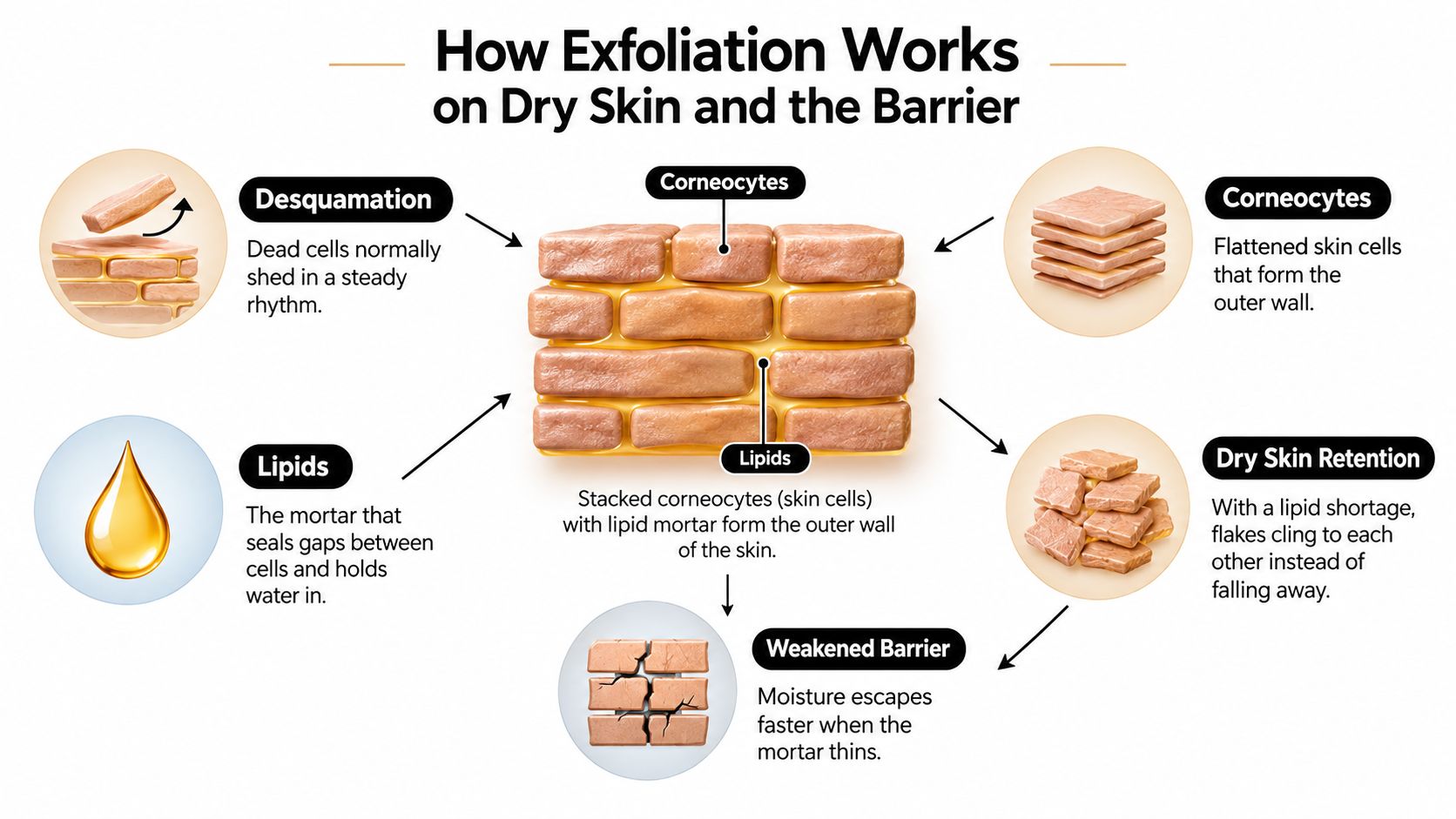
Your outer skin layer works like a brick wall. Corneocytes, the flattened cells at the surface, act as the bricks. Ceramides and other lipids sit between them like mortar, helping reduce gaps and limit water loss.
In healthy skin, surface cells detach through desquamation at a steady pace. Dry skin can retain flakes because reduced lipid support affects how those cells separate. The result is a rough, uneven layer that may look flaky but remains attached.
The difference between loosening and abrading
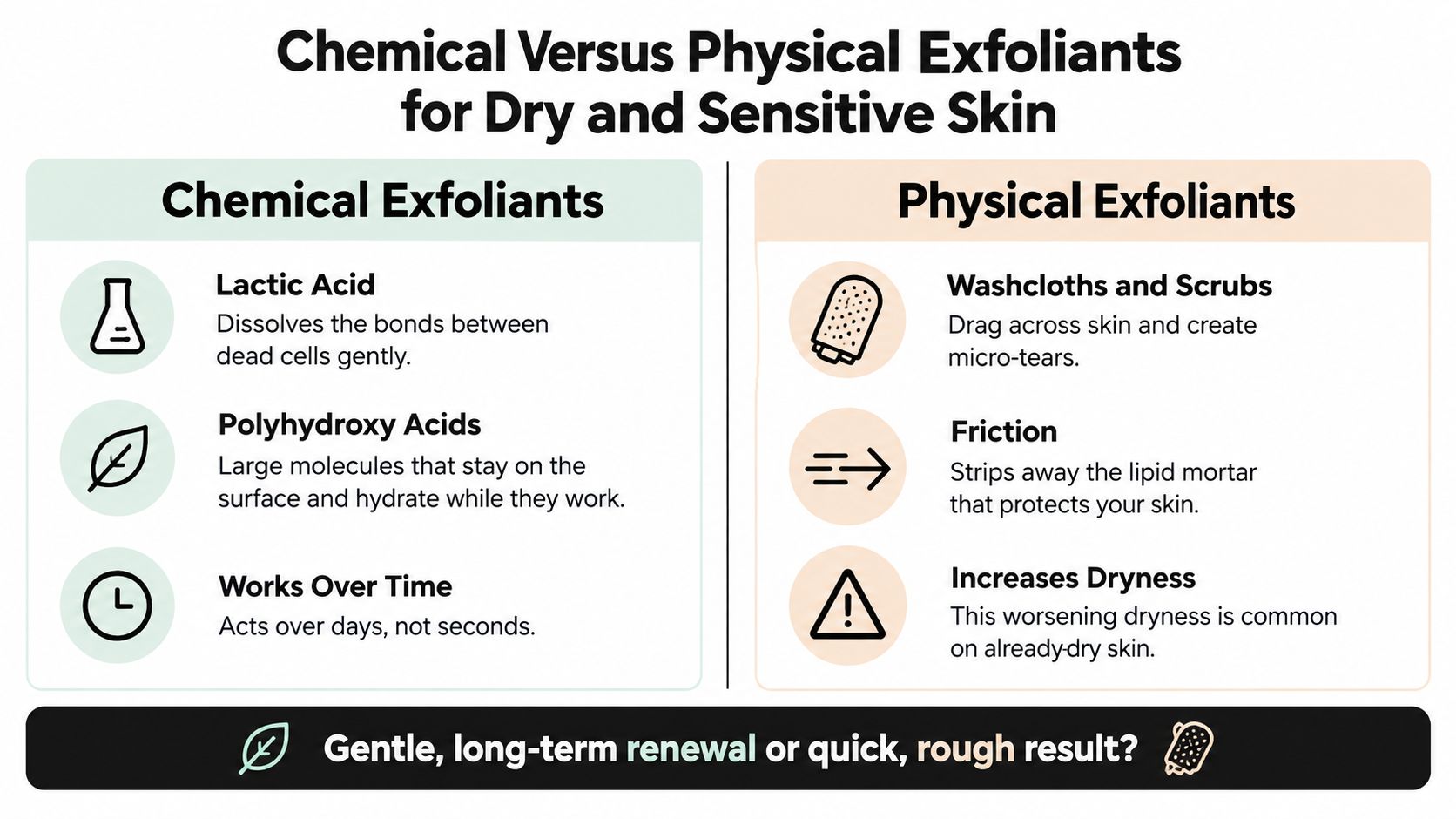
Chemical exfoliants work mainly by helping loosen the connections between retained surface cells. Physical exfoliants use friction to move or remove material from the surface. Both approaches can change texture, but they create different demands on a fragile barrier.
A scrub doesn't know which flakes are ready to detach and which areas still need protection. Pressure, rough particles, and repeated passes can disturb the lipid mortar along with the unwanted surface buildup. Once that barrier is compromised, water escapes more easily and products can sting.
A chemical formula can be more uniform because the ingredient spreads across the treated area rather than depending on how hard you rub. That doesn't make every acid gentle. Penetration depends on molecular size, concentration, pH, and vehicle, which is why labels alone don't tell the whole story.
Moisture retention determines tolerance

Featured Product
Skin Perfection Liquid Exfoliant Peel AHA BHA PHA
Reveal your smoothest, clearest skin yet with our best-selling 2% BHA (Beta Hydroxy Acid) exfoliant. This lightweight, leave-on formula works deep within pores to unclog congestion, minimize blackheads, and boost skin clarity — without irritation.
Shop Now →Humectants attract water, while emollients and barrier lipids help reduce its escape. Urea has both humectant and barrier-supporting emollient relevance in dermatology literature. A review describes a formula containing 5% urea, ceramide NP, and lactate as hydrating skin better and longer than a moisturizer without skin-moisturizing factors (review of urea and barrier support).
That principle explains why a dry-skin exfoliant should rarely stand alone. If the formula loosens surface cells but the routine doesn't replenish water and lipids, the skin may feel smoother briefly and then become tighter.
For mature skin, the Anti-Aging Powerhouse is described as a rich serum with peptides that helps fortify the moisture barrier, support hydration, and improve the appearance of fine lines and wrinkles. Its catalog instructions specify applying three to five drops to clean skin, avoiding the eyes, and following with moisturizer.
Chemical Versus Physical Exfoliants for Dry and Sensitive Skin
A dry, reactive face may feel instantly smoother after scrubbing, yet that immediate feedback can hide the cost of friction. Chemical exfoliation works more gradually, loosening retained surface cells without making pressure the main control. Read this overview of what chemical exfoliation means to distinguish the category from the strength of any one product.
Physical exfoliation is not automatically inappropriate. A soft washcloth used lightly can be reasonable, while a rough mitt, facial scrub, or vigorous circular motion can aggravate skin with limited lipid support. The American Academy of Dermatology advises people with dry or sensitive skin to consider a washcloth with a mild chemical exfoliator, apply it gently for about 30 seconds, and moisturize afterward to limit added dryness and irritation. The guidance link is retained elsewhere in the article.
A practical comparison
| Approach | Main action | Dry-skin trade-off |
|---|---|---|
| Chemical exfoliant | Loosens connections between retained surface cells | Can sting when concentration, pH, or frequency is too aggressive |
| Soft washcloth | Provides light mechanical removal | Tolerance depends on pressure and repetition |
| Facial scrub | Uses particles and friction | May disturb the lipid barrier and increase roughness |
| Combination system | Pairs exfoliation with hydrators or barrier-supporting ingredients | Still requires controlled frequency and active-ingredient spacing |
For dry skin, the better choice usually depends on the whole system, not the word “acid” or “scrub” on the label. A chemical product gives more control because its effect is less dependent on rubbing. Its behavior still depends on format, pH, concentration, and frequency. A buffered cream may feel different from an acidic toner, even when both feature a similar exfoliating ingredient.
Lactic acid can smooth the surface while supporting a more hydrated feel. PHAs generally remain closer to the surface because their larger molecules slow penetration. A soft cloth may suit a small area of resilient body skin, but repeated physical exfoliation is a poor default for a tight, reactive face.
Ingredient function also includes formulation choices and environmental considerations. Fillaree's low-waste skin care insight offers context on citric acid in skin care without reducing the decision to scrub versus acid.
Choose according to skin behavior
- Very sensitive or actively irritated: Pause exfoliation until stinging and redness settle. Barrier recovery comes first.
- Dry with attached flakes: Choose a mild leave-on chemical format rather than repeated scrubbing.
- Dry with clogged pores: A low-strength BHA may suit targeted areas, while broad application can increase dryness.
- Using retinoids or acne medication: Avoid layering exfoliation with those actives until your skin's tolerance is clear.
Chemical does not automatically mean harsh, and physical does not automatically mean gentle. For dry and sensitive skin, a low-friction format, suitable pH, and modest frequency usually matter more than pursuing a stronger sensation.
Best Exfoliant Types and Concentrations for Dry Skin
A dry face may feel rough and flaky, yet a stronger scrub can leave it tighter and more reactive. Choosing an exfoliant therefore starts with the whole system: the acid family, concentration, pH, vehicle, and application frequency. A buffered lotion or cream may behave very differently from an acidic water-based toner, even when both name the same exfoliating ingredient.
Lactic acid and other AHAs
Lactic acid is often a sensible starting point for rough, dry texture. It loosens retained surface cells and can support a more hydrated feel. A controlled study of 15% lactic acid with ceramides found improvements in moisturization and desquamation in dry, rough skin, but that concentration is not a universal starting point (lactic acid and ceramides study).
Smaller AHAs can penetrate more readily, so they may sting more when the barrier is compromised. For dry skin, choose a lower concentration, carefully controlled pH, and infrequent use instead of selecting the strongest formula available. The ingredient name is only one part of the product's behavior.
For a plain-language explanation of how this ingredient works, see lactic acid for skin. The practical question is whether the finished formula delivers gradual surface smoothing without making the skin feel stripped.
PHAs for surface smoothing
PHAs, including lactobionic acid, have larger molecules than many AHAs. They mainly exfoliate at the surface while also acting as humectants. Their slower penetration may reduce stinging and burning compared with smaller-acid exfoliants (PHA formulation overview).
This format can suit skin that flakes easily and reacts to stronger products. PHAs may produce less immediate sensation than a strong acid, but dry skin usually benefits from steady, low-disruption improvement. A quiet response is often a better sign than intense tingling.
BHA, enzymes, and support ingredients
Salicylic acid is oil-soluble, which can make it useful when dryness occurs alongside localized pore congestion. A Canadian cohort evaluated 35 adults with mild-to-moderate dry skin using a ceramide cleanser and cream containing salicylic acid. 34 completed the study, and daily use for 28 days significantly improved dry-skin scores for physicians and subjects (Canadian dry-skin cohort). The useful lesson is the pairing with ceramides, not applying BHA broadly to every dry routine.
Enzyme exfoliants act on surface proteins through a different mechanism, but the full formula still determines tolerance. Urea, ceramides, glycerin, and hyaluronic acid do not replace exfoliation. They support water retention and the barrier, helping the routine remain comfortable.
| Exfoliant Type | How It Works | Best For Dry Skin When |
|---|---|---|
| Lactic acid | Loosens retained surface cells and can support hydration | Roughness is the main concern and the formula is used sparingly |
| PHA | Exfoliates mostly at the surface while acting as a humectant | Sensitivity and tightness make deeper penetration undesirable |
| Salicylic acid | Helps loosen buildup in oil-rich pores | Dryness is paired with localized congestion |
| Enzymes | Break down surface proteins in a controlled topical formula | You want surface smoothing without relying on physical friction |
| Urea and ceramides | Hydrate and reinforce the barrier rather than exfoliate alone | You need recovery support alongside an exfoliant |
For a broader consumer-friendly discussion, ALODERMA's exfoliation guide offers additional context on choosing an exfoliator for dry skin.
A formulation study reported a 4.19-fold increase in epidermal delivery and a 45.52% improvement in the clinical desquamation index at pH 3.9, without compromising barrier integrity or causing irritation (formulation and desquamation study). The broader point is that pH and vehicle can be as important as acid identity. The study also described aqueous exfoliant formats as temporarily disruptive to barrier function, while ointment-based formats better suited dry skin by maintaining transepidermal water loss more effectively.
How to Use Exfoliant Safely Frequency Layering and Sun Protection
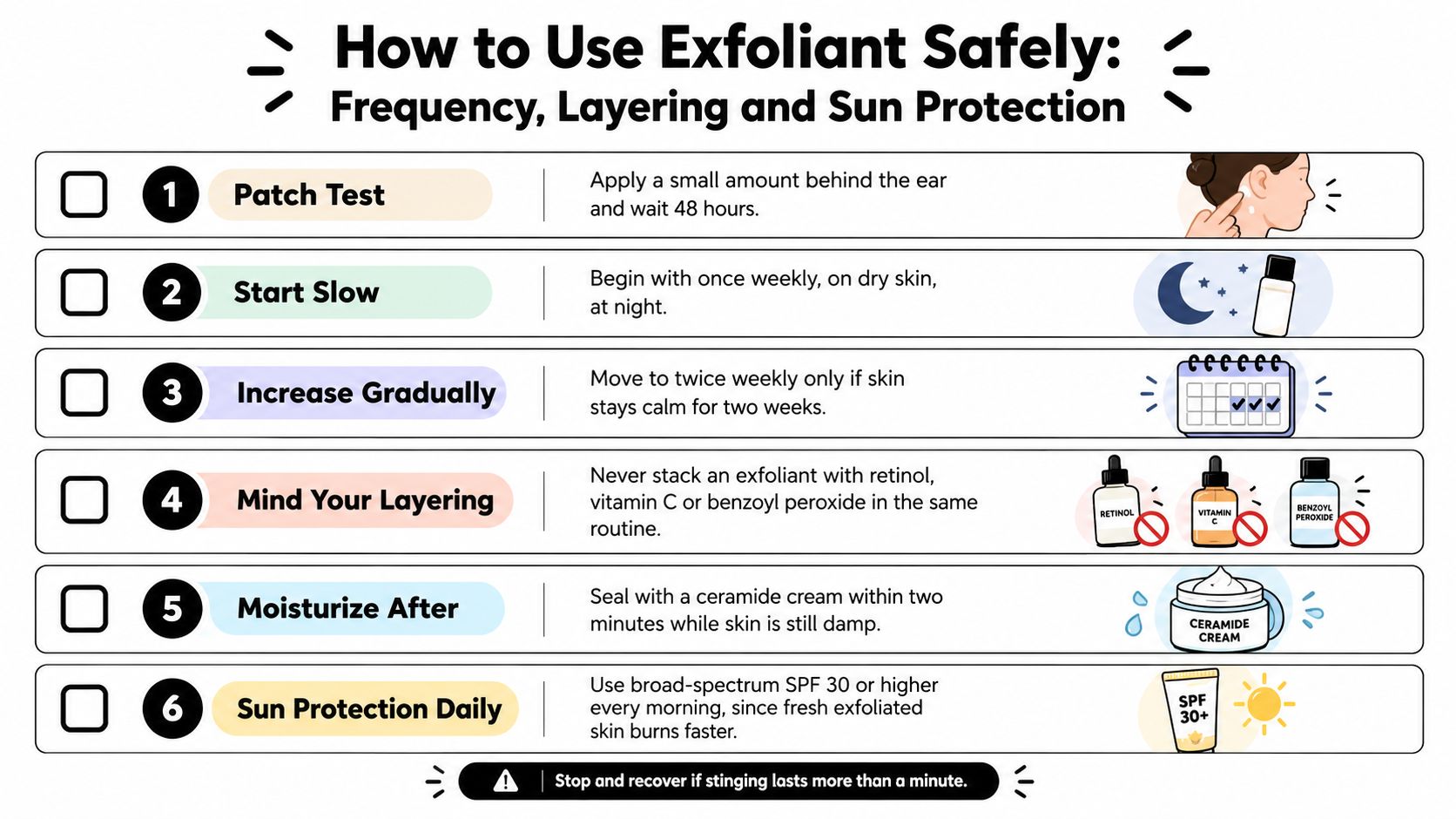
A dry-skin routine can seem fine at first, then sting after repeated exfoliation. Start with a controlled trial rather than a strong first application. Patch test a small amount behind the ear and wait 48 hours before using it more broadly. This cannot predict every reaction, but it can reveal an obvious intolerance before the formula reaches your face.
A simple weekly routine
- Start slow: Apply the exfoliant once weekly, at night, to clean, dry skin.
- Use a light hand: Spread it gently without rubbing, limiting application to about 30 seconds. Friction adds stress to a barrier that is already short on lipids and water.
- Increase only after stability: Consider twice-weekly use only if your skin stays calm for two weeks. Dry skin usually benefits more from a compatible formula and steady spacing than from a stronger schedule.
- Separate competing actives: Do not pair the exfoliant with retinoids, vitamin C, or benzoyl peroxide in the same routine. Combining several active ingredients can raise irritation and dryness, especially when acne or pigmentation is also being treated.
- Moisturize promptly: Follow with a ceramide cream and hydrating ingredients such as glycerin or hyaluronic acid. Apply moisturizer while the skin still feels slightly damp, helping reduce water loss.
- Protect the result: Use broad-spectrum SPF 30 or higher every morning. Exfoliation can leave skin more vulnerable to sun-related irritation and discoloration.
Layer by skin priority
On exfoliation nights, keep the order simple: gentle cleanser, exfoliant, then a barrier-supporting moisturizer. On recovery nights, leave out the exfoliant and focus on hydration and lipid replenishment. This separation works like a small clinical trial, making it easier to identify which product causes a reaction.
People with dark spots need extra restraint. Inflammation can activate melanocytes, the pigment-producing cells in the epidermis, through signals that increase melanin production. Tyrosinase, an enzyme involved in melanin synthesis, participates in that pathway. Repeated irritation may therefore produce post-inflammatory pigmentation and undermine the goal of a more even tone.
Signs You Are Over Exfoliating and How to Recover
More peeling doesn't prove that an exfoliant is working better. Tightness, persistent stinging, redness, increased flaking, sensitivity to products, and a shiny thin-looking surface can signal that the barrier is under stress rather than that the skin is successfully resurfacing.
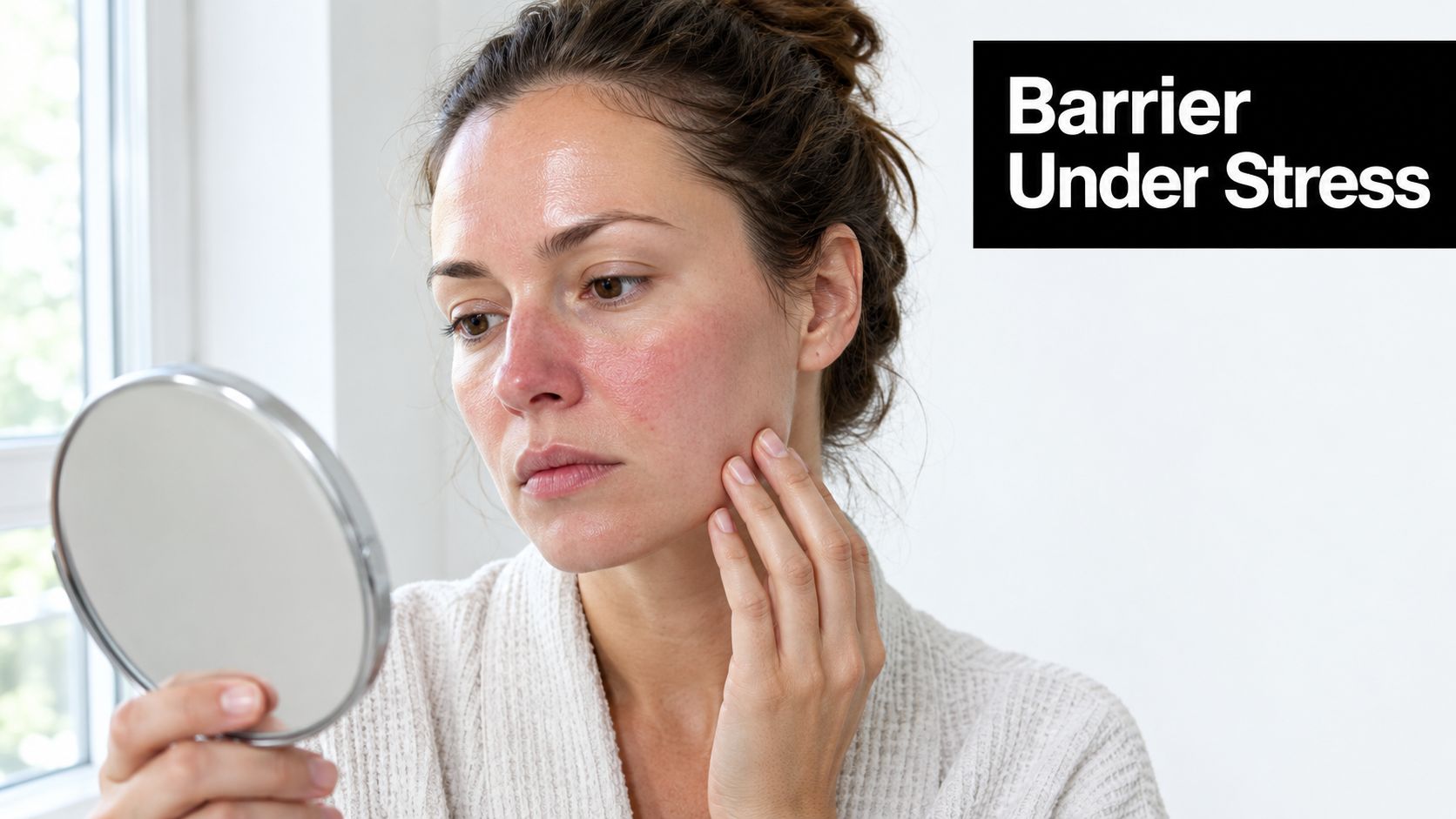
A common mistake is to respond to new flakes with another exfoliating application. That removes more surface material from a barrier that already needs recovery, so the skin becomes more reactive and loses water more readily. Stop the exfoliant instead of trying to neutralize the discomfort with additional actives.
Recovery means reducing variables
Use a gentle cleanser, a plain moisturizer, and daytime sun protection while the skin settles. Add barrier-supporting lipids and humectants if they feel comfortable, but avoid introducing several new products at the same time.
The recovery period should end when everyday products no longer sting and the skin no longer feels persistently tight. Then reintroduce the exfoliant at a lower frequency than before, preferably in a formula with a supportive cream, lotion, or ointment vehicle rather than a highly active watery format.
A calmer routine is a treatment decision, not a failure to make progress.
For a more detailed barrier-repair framework, consult Mesoderm RX's guide to repairing a damaged skin barrier. A short visual explanation can also help you recognize why irritation should change your routine rather than trigger more exfoliation.
If eczema, cracking, severe flaking, swelling, or persistent burning continues, don't keep experimenting with acids. A dermatologist can determine whether the problem is ordinary dryness, irritant contact dermatitis, eczema, or another condition requiring targeted care.
Choosing Your Exfoliant and When to Consult a Dermatologist
Evaluate an exfoliant as a complete system, not as an isolated acid name. Start with the lowest effective intensity for your concern, then examine whether the product offers a dry-skin-compatible vehicle, a sensible pH, hydration support, and a clear use schedule. Fragrance-free formulas may also be preferable when your skin reacts easily, although fragrance status doesn't replace proper frequency control.
For uneven tone, separate the biology from the marketing. Melasma is commonly associated with patterned, hormonally influenced pigmentation. Sun spots are localized areas of accumulated photodamage, while post-inflammatory hyperpigmentation follows inflammation or injury, including acne or over-exfoliation. All involve melanin, but their triggers and management aren't identical. Tyrosinase is involved in melanin production, yet removing surface cells won't correct every source of excess pigment.
A multi-acid product can be reasonable when the formula balances AHA, BHA, and PHA activity with hydration and a conservative schedule. Mesoderm RX Skin Perfection Liquid Exfoliant Peel AHA BHA PHA is one example of a leave-on multi-acid system to evaluate by its full ingredient list, vehicle, instructions, and compatibility with the rest of your routine. Don't combine it automatically with retinoids, acne treatments, or other exfoliating products.
Consult a dermatologist for persistent irritation, suspected eczema, severe or widespread flaking, painful skin, or pigmentation that worsens after treatment. Professional assessment matters especially when dark patches don't behave like ordinary surface dullness or when your routine includes prescription actives.
Mesoderm RX offers targeted skincare systems for concerns including dryness, uneven tone, dark spots, and signs of aging, including exfoliating and barrier-supportive options. Visit Mesoderm RX to review the formulas and build a measured routine around gentle resurfacing, recovery, and daily sun protection.