


Dry Skin Care Routine: A Clinician's Guide to Hydration
Dry skin is often made worse by trying to moisturize it harder. The more useful question isn't how many products you can layer, but how effectively you can reduce water loss, limit irritation, and choose ingredients your skin can tolerate consistently.
A practical dry skin care routine starts with the barrier, not the shopping list. Cleansing technique, water temperature, product texture, treatment frequency, and photoprotection all matter. The right approach also changes when ordinary xerosis becomes sensitized skin or eczema-prone skin.
Why Dry Skin Is a Barrier Problem First
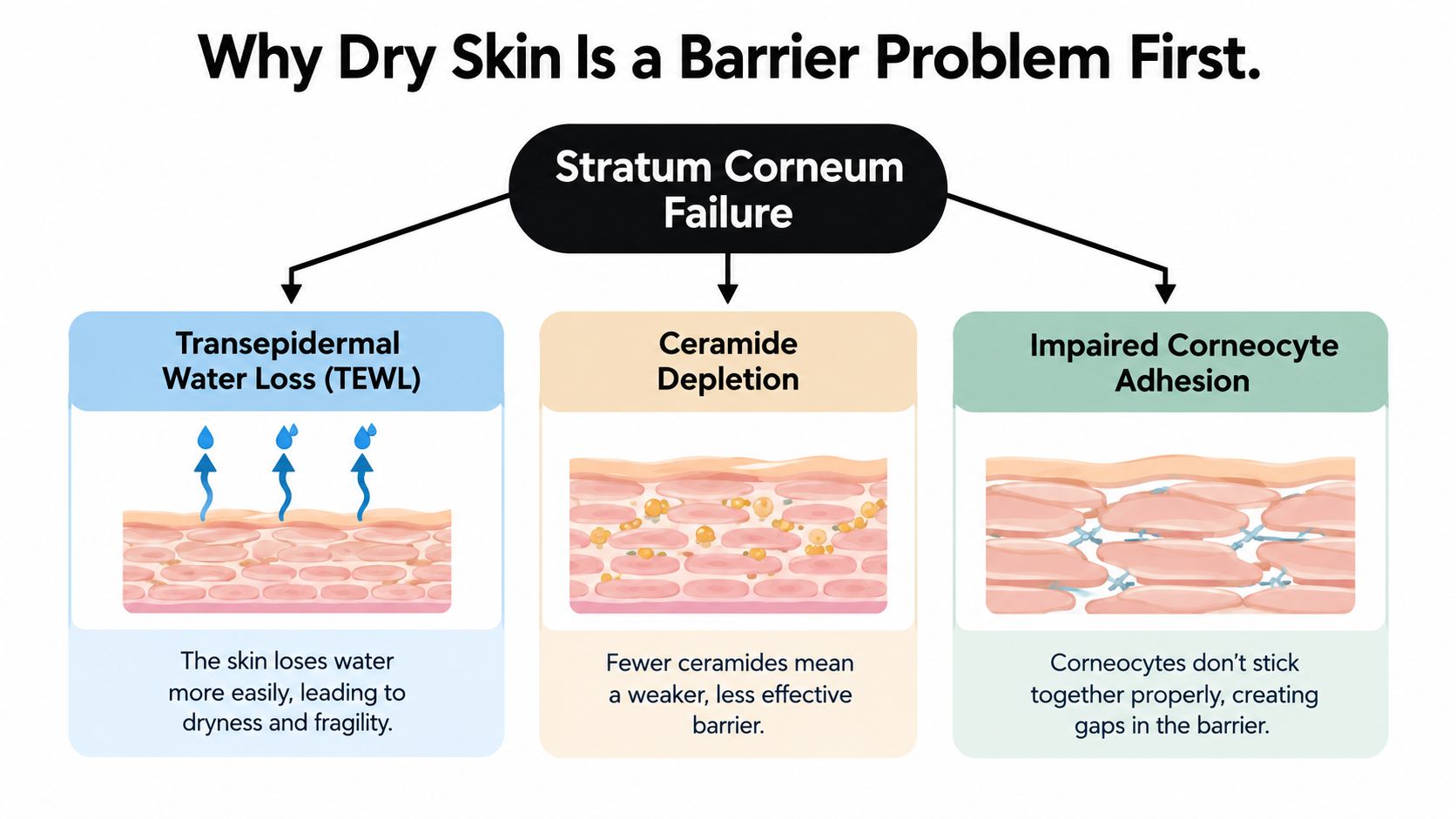
Dryness is not just a shortage of oil on the surface. The outermost layer of skin, the stratum corneum, acts as a physical and biochemical barrier. When that structure is disrupted, water escapes through the skin more readily. This process is called transepidermal water loss, or TEWL, and it explains why skin can feel tight again shortly after cleansing.
The barrier depends on organized lipids, including ceramides, cholesterol, and fatty acids, together with well-connected corneocytes, the cells that make up much of the stratum corneum. Ceramide depletion creates weaker lipid organization, while impaired corneocyte adhesion contributes to roughness and scaling. Once the barrier is compromised, irritants can penetrate more easily, so a product that previously felt comfortable may begin to sting.
Three patterns that need different handling
Uncomplicated xerosis usually presents as tightness, rough texture, fine flaking, or dullness without a persistent inflamed rash. It commonly worsens after hot water, harsh cleansers, low humidity, or repeated handwashing. This pattern generally responds to gentler cleansing and consistent emollient use.
Sensitized dry skin reacts to otherwise ordinary products. Burning, redness, itching, or discomfort after applying a bland moisturizer suggests that reducing product complexity may be more useful than adding another serum. Fragrance-free formulas are a sensible starting point, but tolerance still has to be judged on the individual skin.
Eczema-prone skin may develop recurrent inflammation, fissures, marked itch, or flares. Moisturizer can support treatment, but it isn't a substitute for diagnosis when the skin is persistently inflamed. A skin barrier guide from ProMD Health Easton offers a useful visual explanation of barrier disruption, while this barrier repair resource from Mesoderm RX can help organize the practical steps.
Clinical rule: If the skin is inflamed, burning, or cracking, don't treat it like ordinary dryness simply by increasing the amount of moisturizer.
The American Academy of Dermatology recommends brief bathing, warm rather than hot water, gentle patting instead of rubbing, and prompt application of a fragrance-free moisturizer while skin remains damp (AAD guidance on relieving dry skin). That sequence addresses the barrier before any active treatment is considered.
Morning Routine From Cleanser to SPF
Morning care should protect the barrier from the next several hours of cleansing, weather, friction, and ultraviolet exposure. Keep the sequence simple enough that you can repeat it without irritation or pilling.
Start with a non-stripping cleanse
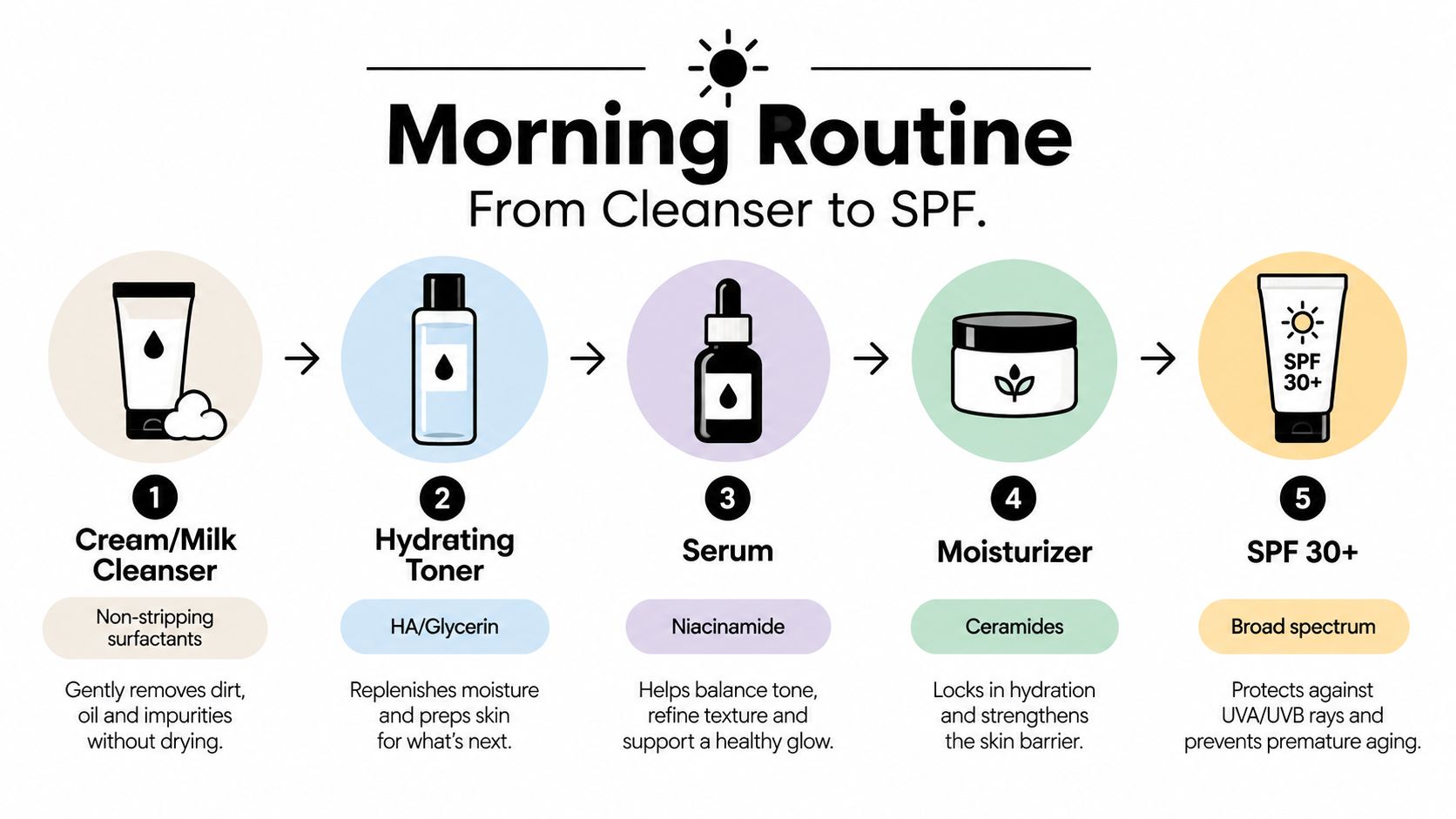
Use a cream or milk cleanser with mild surfactants. If your face isn't oily or sweaty when you wake, rinsing with lukewarm water may be enough. A foaming cleanser that leaves the skin squeaky isn't proof of cleanliness. It may just be removing more surface lipid than your barrier can replace comfortably.
Add water support
Apply a hydrating toner or essence containing humectants such as glycerin or hyaluronic acid. Humectants attract water into the outer skin, but they shouldn't be treated as the entire moisturizing step. Follow them with an emollient or occlusive layer so the added water isn't lost quickly.
Use one focused serum
A serum containing niacinamide can support barrier function and help with uneven tone. Vitamin C is another option for people whose skin tolerates it, particularly when environmental exposure and visible discoloration are concerns. Don't introduce several active serums at once. If the skin becomes warm, itchy, or persistently flushed, the formula isn't earning its place in the routine.
Apply a ceramide-rich moisturizer next. A cream is generally more protective than a thin lotion when dryness is pronounced. Give each layer enough time to settle, but don't turn waiting into a rigid ritual. Thin application, moderate product amounts, and compatible textures matter more than a precisely timed pause.
Finish with broad-spectrum protection
Use a broad-spectrum sunscreen with SPF 30 or higher and meaningful UVA coverage. Mineral filters such as zinc oxide may suit some reactive users, although the finish can feel dry or leave visible cast. Organic filters often create a more cosmetically elegant film, but the best choice is the one you can apply consistently without burning or irritation.
Pilling usually comes from too much of one layer, incompatible film-formers, or rubbing rather than pressing products into the skin. Reduce the amount of toner or serum, allow the moisturizer to settle, and apply sunscreen in gentle sections. For reapplication over makeup, a thin sunscreen layer or a compatible sunscreen product is more reliable than repeatedly rubbing a thick cream across the face. For skin recovering from a procedure, these post-laser care tips from Luxe Aesthetic Surgery & Medical Spa provide useful context about minimizing irritation and protecting treated skin.
For a more detailed explanation of choosing a hydrating sunscreen, see this guide to hydrating sunscreen for dry skin. Brightening products used on other sensitive exterior areas should still be treated as targeted treatments, not as substitutes for facial barrier care. For example, Intimate Skin Lightening Cream for Under Arms, Inner Thighs & Private Area is described as containing tranexamic acid, niacinamide, and arbutin for exterior areas such as the underarms, inner thighs, bikini zone, and other delicate skin.
Evening Routine for Repair and Deep Hydration
Night is the appropriate time for a more protective routine because you aren't applying makeup or sunscreen over the top. It is also the time to decide whether your skin needs treatment or needs to stop being challenged.
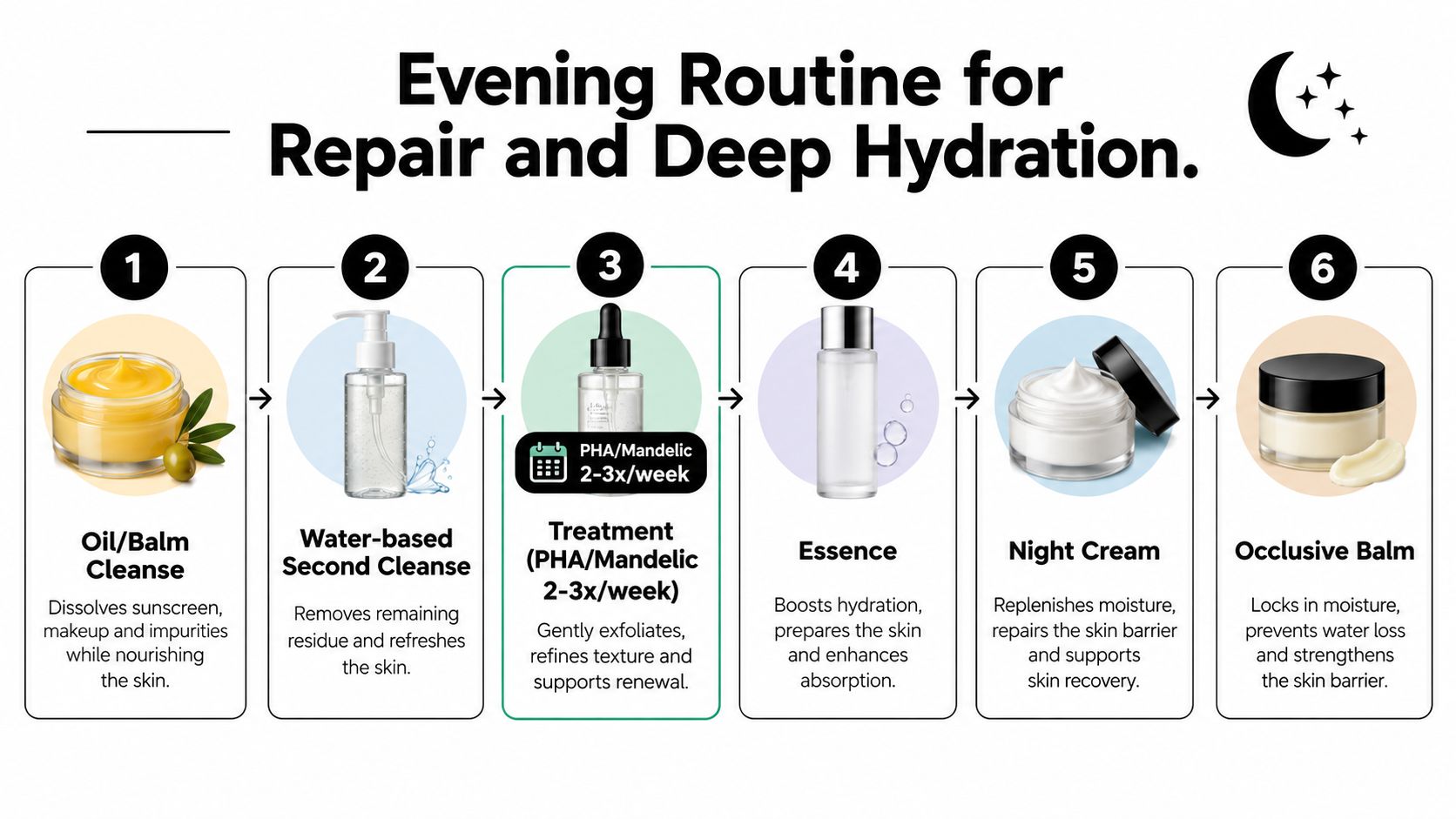
Begin with an oil or balm cleanser if you wear sunscreen or makeup. Massage it gently onto dry skin, emulsify with lukewarm water, and rinse without scrubbing. Follow with a water-based second cleanser only when residue remains or the first cleanse isn't sufficient. Double cleansing isn't a requirement for everyone, and unnecessary cleansing can prolong dryness.
Place treatments carefully
Exfoliation belongs in a controlled slot, not in every evening. A mild PHA or low-strength mandelic acid may be suitable for some people a few nights per week, but dry or reactive skin often needs less. Don't combine exfoliation with a high-strength retinoid, abrasive scrub, or another strong acid while the barrier is unstable.
On non-exfoliation nights, apply a hydrating serum to slightly damp skin. A cream containing ceramides, cholesterol, and fatty acids can then provide the main barrier-supporting layer. The evening moisturizer should feel protective, not painfully heavy.
Seal only where sealing helps
An occlusive such as petrolatum, squalane, dimethicone, or a silicone-based sleeping mask can reduce evaporation over a moisturizer. Use it selectively on cheeks, around the mouth, hands, or other persistently dry areas. Full-face occlusion every night may feel comforting initially but can become excessive for people prone to clogged pores, follicular bumps, or perioral irritation.
The correct evening routine is therefore not automatically the heaviest one. A person with uncomplicated xerosis may benefit from a richer final layer. A person with burning dermatitis may do better with a single bland moisturizer after cleansing. If a product causes redness, itching, or worsening rash, stop it rather than trying to cover the reaction with another layer.
Ingredients That Actually Change the Skin
A useful ingredient list begins with function. Humectants attract water, emollients smooth and fill spaces, and occlusives slow evaporation. A well-built formula often uses all three, but not every skin type needs the same ratio or texture.
| Category | Key Ingredients | Evidence Level | Best For |
|---|---|---|---|
| Humectants | Glycerin, hyaluronic acid, sodium PCA, panthenol | Strong practical support, with product tolerance still important | Tightness and surface dehydration |
| Emollients | Squalane, fatty alcohols, ceramides, cholesterol, fatty acids, colloidal oatmeal | Strong barrier rationale and clinical support for regular moisturization | Roughness, scaling, and impaired comfort |
| Occlusives | Petrolatum, dimethicone, lanolin, beeswax | Strong water-loss reduction, with texture and sensitivity trade-offs | Fissures, very dry patches, and overnight protection |
The mechanism matters more than the marketing label. Glycerin can improve water content, but it won't replace the lipid layer. Ceramides can support barrier-lipid replacement, but a ceramide product that burns isn't automatically appropriate. Petrolatum is highly effective at reducing evaporation, but some people dislike its feel or develop congestion when they apply it too broadly.
Match the formula to the patient
Sensitive skin generally does better with fragrance-free products and fewer essential oils, denatured alcohol, and high-strength retinoids until comfort returns. For aging, dry skin, niacinamide, retinaldehyde, and peptides may have a place, but frequency should be reduced when flaking or stinging appears.
Eczema-prone skin needs an even stricter distinction between maintenance and treatment. A Cochrane review of 77 randomized controlled trials involving 6,603 participants found that moisturizer users had fewer flares, with a reported risk ratio of 0.40 and a 95% confidence interval of 0.23 to 0.70 (Cochrane review of emollients and moisturizers). The same review found lower topical corticosteroid use over 6 to 8 weeks, with a mean difference of approximately 9.30 grams, although product formulations varied and evidence quality ranged from low to moderate.
That evidence supports regular emollient use, not the claim that one moisturizer is universally superior. Urea, glycerol, and glycyrrhetinic acid performed better than controls in some comparisons, while most products produced some benefit across the evidence base. If you have fissures, oozing, infection, or recurrent inflammation, professional assessment is more appropriate than endlessly changing ingredients.
Dryness and discoloration also require diagnostic discipline. Melasma is usually symmetrical facial hyperpigmentation involving abnormal melanocyte activity and increased melanin production. Post-inflammatory hyperpigmentation, or PIH, follows inflammation or injury such as acne, eczema, burns, or procedures. Solar lentigines, often called sun spots or age spots, are discrete lesions associated primarily with cumulative ultraviolet exposure. These conditions may look similar, but they don't carry the same treatment risks, as explained in this clinical overview of melasma and its differential diagnosis.
When More Moisturizer Makes Things Worse
“Just moisturize more” is incomplete advice. Moisturizers can be valuable maintenance tools, but more product can create problems when the formula, schedule, or diagnosis is wrong.
Repeatedly stacking rich creams and occlusive balms may contribute to milia, periorbital dermatitis, clogged pores, or follicular eruptions. Occlusion can trap sweat, sebum, and residue against the skin. The problem isn't that moisturization is harmful by nature. The problem is that a compromised routine can turn barrier support into an uncontrolled accumulation of films.
A 2025 review described a more nuanced pattern for eczema-prone skin. Applying moisturizer after bathing may slow drying and improve atopic dermatitis, but repeated applications at other times were associated with more severe disease in one cited study. The authors suggested that people who can't tolerate moisturizers may do better with a simpler schedule, such as once daily after bathing (review of moisturizer use and atopic dermatitis).
Signs your routine is overshooting
- Immediate tightness: The skin feels tight within minutes of washing, suggesting the cleanser or water exposure is still disruptive.
- Bland-product stinging: A simple moisturizer burns instead of soothing, which may indicate sensitization or active inflammation.
- New bumps: Small bumps along the hairline, jaw, or eye area can signal excessive layering or an unsuitable formula.
- Migrating redness: Redness that spreads or changes location shouldn't be managed by adding more active products.
- Persistent itch: Ongoing itch, especially with fissures or recurrent patches, deserves evaluation for dermatitis or eczema.
Aggressive exfoliation creates a separate failure loop. High-strength AHA or BHA products, scrubs, and frequent peels can worsen inflammation in already dry skin. That matters for pigmentation because PIH is pigment left behind after inflammatory signaling activates melanocytes. Melasma can also worsen after procedures that provoke inflammation, so evidence on moisturizers, barrier integrity, and pigment-prone skin supports restraint rather than aggressive resurfacing.
Reset the routine to a gentle non-foaming cleanser, one barrier-repair moisturizer, and daily sunscreen. Keep the simplified routine for two to four weeks, then reintroduce one active at a time, leaving three days between additions so you can identify the cause of a reaction. If stinging, cracking, or redness continues, seek clinical assessment.
Body, Seasons, and Sample Weekly Schedules
Body skin needs the same barrier logic, but limbs often feel drier because they have less surface oil than the central face. After bathing, apply a ceramide-rich or petrolatum-based body cream while the skin is still slightly damp. The fastest way to lose the benefit is to towel off aggressively and wait until the skin feels tight.
You don't need to use soap over every square inch of the body. Reserve cleanser for areas that collect sweat, odor, or friction, such as the axillae, groin, and feet. A brief warm shower is usually more barrier-friendly than a long hot one. Products such as shower steamers for cold days may make a cold-weather shower more comfortable, but they shouldn't justify hotter water or a longer exposure.
Seasonal adjustments
Winter usually calls for richer creams, fewer active treatments, and protection from cold wind. A humidifier can help when indoor air is dry, but keep it clean and use it as an environmental support rather than a replacement for moisturizer. Summer may allow a lighter lotion on the body, but sweating, swimming, and sun exposure still increase the need for cleansing that isn't harsh and consistent SPF use.
For body-specific hydration, a urea body lotion guide can help you evaluate where a keratolytic humectant may fit. Urea can be useful for rough, thickened areas, but cracked or actively inflamed skin may sting with it.
Two workable schedules
Standard dry skin
- Monday: Gentle morning routine, rich evening moisturizer.
- Tuesday: Same core routine, with a mild exfoliant at night if skin is comfortable.
- Wednesday: Barrier-focused morning and evening routine.
- Thursday: Hydrating serum and moisturizer only.
- Friday: Repeat the mild exfoliation slot if there is no stinging or flaking.
- Saturday: Use a hydrating mask or richer cream instead of another active.
- Sunday: Keep both routines simple and review whether tightness, scaling, and itch have improved.
Sensitive or reactive skin
- Every morning: Gentle cleanse or rinse, bland moisturizer, sunscreen.
- Every evening: One gentle cleanse followed by one moisturizer.
- During a flare: Stop exfoliation, retinoids, fragrance, and nonessential serums.
- For a reset: Maintain the simplified routine for 14 days before considering an active.
- After recovery: Add only one treatment, then monitor comfort before changing anything else.
The schedule is a template, not a religion. Travel, illness, retinization, a procedure, or a sudden weather change can justify fewer steps. Skin comfort is the clinical endpoint, not the number of products completed each night.
A Single Rule to Build Any Routine From
Use one sequencing principle: apply products from thinnest to thickest, moving from water-based layers toward oil-based layers. Place the most active or highest-pH treatment early only when the barrier can tolerate it. If a new serum makes the skin sting, its position in the sequence won't solve the underlying problem.
This rule lets you add products without dismantling the routine that already works. A hydrating serum usually belongs before moisturizer. A cream belongs before an occlusive balm. Sunscreen remains the final morning layer. If two products pill when used together, reduce the amount, allow the first layer to settle, or remove the less essential product.
Practical rule: Keep the core stable and test variables one at a time.
The essential foundation is modest: gentle cleansing, a tolerated moisturizer with barrier-supporting ingredients, and daily photoprotection. Everything else is conditional. Exfoliants, retinoids, brightening agents, masks, and occlusive layers should earn their place by improving comfort or a clearly defined concern without creating new irritation.
Seek clinical care for persistent cracking, bleeding, eczema flares, sudden stinging with bland products, or dryness that doesn't respond to four weeks of consistent barrier care. Don't keep swapping products when the pattern suggests dermatitis, infection, allergy, or another condition that requires diagnosis.
Pigment treatment also demands a system rather than a single exfoliant. Melanin production is influenced by ultraviolet and visible light, inflammation, and signaling pathways such as tyrosinase activity. In a clinical review, a 12-week randomized trial found significant MASI reductions with both 2% hydroquinone and 5% tranexamic acid, while another analysis reported a 55% mMASI reduction after three months when oral tranexamic acid was added to topical 4% hydroquinone and sunscreen, compared with a 10.9% reduction for hydroquinone, sunscreen, and placebo alone (clinical review of melasma treatments). Oral tranexamic acid requires medical screening because contraindications and thrombotic risk matter.
A dry skin care routine should therefore function as a repeatable diagnostic skill. First reduce disruption, then restore comfort, then introduce targeted treatment only when the barrier is stable.
Mesoderm RX offers focused skincare options for dryness, uneven tone, visible discoloration, and barrier-conscious routines, including its Hydrating Skin Booster with hyaluronic acid, peptides, and antioxidant-rich botanical extracts. Visit Mesoderm RX to review the collection and choose a simple, consistent starting point for your skin's actual needs.