


Urea Body Lotion: How It Works and How to Use It Right
You step out of the shower, towel off, apply a body cream, and your shins still feel tight an hour later. By midday, the flaky look is back. If that sounds familiar, the problem usually isn't that you forgot moisturizer. It's that you picked the wrong kind for the job.
Most body lotions are built to sit on top of skin and reduce surface water loss. That helps, but it doesn't fully solve the deeper problem in chronically dry skin. Inside the stratum corneum, the outermost layer of skin, the water-binding system is often depleted. That's where urea earns its place. It doesn't just coat. It helps the skin hold water where dryness starts.
Why Your Skin Still Feels Dry No Matter What You Try
If your legs feel smooth for ten minutes and rough again before lunch, you're not failing at skincare. You're dealing with a mismatch between product behavior and skin biology.
Surface sealing is not the same as hydration
A lot of people rotate through body butters, oils, and thick creams thinking heavier automatically means better. Those products can reduce evaporation, but many of them don't do enough to replenish the water-binding capacity inside dry skin itself. Dry shins, flaky calves, and that sandpaper drag on the towel usually point to a stratum corneum that isn't holding water well.
That's why generic advice about managing dry skin naturally can be useful for lifestyle habits, but it often needs a more targeted topical strategy when the skin barrier is already chronically dry.
The real deficit sits inside the outer skin layer
Think of the stratum corneum as a brick wall. The corneocytes are the bricks, and the lipids between them are the mortar. When the bricks are dehydrated, the wall feels stiff, rough, and less flexible. Urea matters because it's part of the skin's own natural moisturizing system, not just an extra layer added from the outside.
If you've been trying rich creams and still getting that midday ashiness, it helps to look at products made for dehydration rather than only occlusion. Mesoderm RX has a useful overview of skincare products for dehydrated skin that frames this difference clearly.
Clinical reality: Dry skin often needs water-binding support first, then sealing support second.
Why urea deserves a closer look
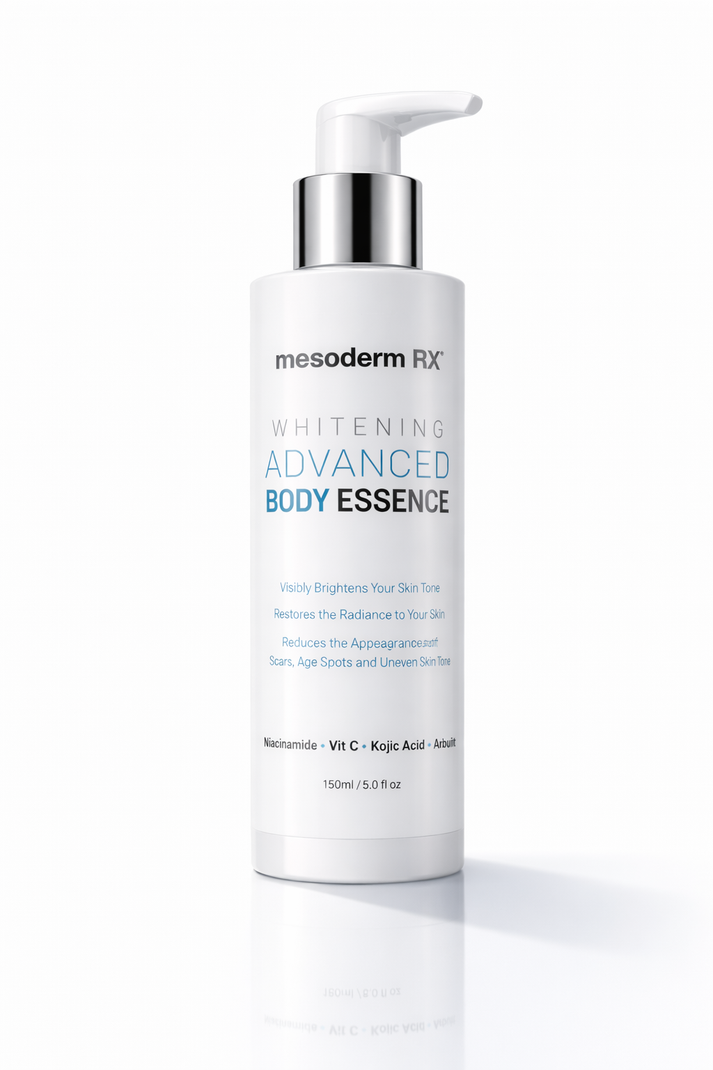
Featured Product
Brightening Advanced Body Essence Lotion
Reveal Radiant Skin with Mesoderm RX Whitening Advanced Body Essence This advanced cosmeceutical brightening essence targets hyperpigmentation, sun damage, and age spots on the hands, arms, legs, feet, and back.
Shop Now →Urea isn't just “a moisturizer.” Its behavior changes with concentration. At lower levels, it acts mainly as a humectant. At higher levels, it starts loosening compacted dead skin. That dual mode is why one urea body lotion can be perfect for winter dryness, while another is better for rough elbows, KP, or callused heels.
That concentration question is where many people waste time. They buy too weak for thick roughness, or too strong for reactive skin, then assume urea doesn't work.
What Urea Actually Does Inside the Stratum Corneum
Urea has been in dermatology for a long time. It was first discovered in urine in 1773 by Hilaire Rouelle and artificially synthesized in 1828 by Friedrich Wöhler, a milestone described as the first credited laboratory synthesis of a naturally occurring organic compound. In skin care, it has been used in hand creams since the 1940s, and by the second half of the twentieth century it had become one of the most common moisturizers and keratolytic agents for xerosis, atopic dermatitis, ichthyosis, and psoriasis, as summarized in the dermatology history review at the International Journal of Clinical Practice article on urea in dermatology.

Urea is part of the skin's own water system
Inside healthy skin, natural moisturizing factor, or NMF, helps keep the outer layer flexible. Urea sits in that mix alongside other water-binding components. When skin is dry, one useful way to picture it is a sponge inside a wall. The corneocytes need water like a sponge needs moisture to stay soft. If the sponge dries out, the whole wall feels brittle.
At lower concentrations, urea helps refill that sponge. It binds water and improves flexibility in the stratum corneum.
The same ingredient can also loosen built-up scale
Urea has two jobs, and the concentration decides which one dominates. Readers often get confused by this.
A dermatology review notes that concentrations at or below 10% act primarily as humectants, increasing water binding and improving corneocyte flexibility, while higher concentrations shift toward keratolysis or exfoliation, with 20% to 30% used more for thicker, hyperkeratotic skin in practice, according to the review on topical urea in skincare.
That means the same molecule can either cushion or loosen, depending on dose.
Urea is not a scrub. It changes how the outer skin layer handles water and how tightly dead cells cling to each other.
It also helps with the feel of dry, itchy skin
Dry skin doesn't just look flaky. It often stings, catches on clothing, or itches after bathing. Urea is useful here because when you improve hydration and soften compacted scale, itch often settles too. In practice, that's one reason dermatologists keep returning to it for body dryness rather than treating it like a trend ingredient.
The Concentration Ladder and Why Percentage Matters
Percentage isn't trivia. It tells you what the lotion is trying to do.
Read the number as a job description
A dermatology position paper reports that 5% urea is specifically recommended for sensitive skin, fragile aging skin, facial skin, or mild xerosis, while 10% urea was used in most clinical studies of generalized or senile xerosis, atopic dermatitis, psoriasis, ichthyosis, palmoplantar hyperkeratosis, and severe pruritus, according to the German dermatology position paper on urea.
That already gives you a practical ladder. Lower is usually for comfort and maintenance. Higher is for thicker buildup.
Urea concentration ladder at a glance
| Urea % | Primary Action | Best For | Trade-off |
|---|---|---|---|
| 2 to 5% | Gentle humectant | Mild dryness, sensitive or maintenance use | Minimal texture correction |
| 5 to 10% | Daily hydration support | Generalized dry body skin, winter tightness, routine maintenance | Limited effect on thick bumps or scale |
| 10 to 20% | Hydration plus clear keratolytic activity | Rough elbows, knees, KP-type texture, thicker dry patches | More sting risk on compromised skin |
| 20 to 40% | Stronger keratolytic use | Thickened heels, callused areas, pronounced scale | Not ideal for large reactive areas |
Stronger isn't smarter
People often jump straight to a high-strength formula because rough skin feels like it needs something aggressive. That's the wrong reflex. A lotion that's too weak won't shift compacted keratin, but a lotion that's too strong can sting, especially if the barrier is cracked.
If you're also using exfoliating body products, it helps to understand how lactic acid fits into the picture because that changes how much keratolysis you need from urea. Mesoderm RX has a practical guide on lactic acid products that's useful for that decision.
A body lotion doesn't have to be a urea formula to matter in this conversation. For example, Whitening Advanced Body Essence Lotion is a brightening body lotion described by Mesoderm RX as paraben- and fragrance-free, developed to help brighten body discoloration and support softer-looking skin. That's a different job than a urea-first xerosis lotion, which is exactly why matching product type to skin problem matters.
Matching Urea to the Skin Condition You Actually Have
Not all rough body skin is the same. The texture tells you what the keratin layer is doing.
Generalized xerosis
This is the classic “my legs are dry everywhere” pattern. The skin looks dull, feels tight after washing, and flakes without obvious bumps. Here, a 5% to 10% urea body lotion usually makes the most sense because the main problem is poor water retention rather than heavy buildup.
Expect a normal lotion or light cream texture. Apply once or twice daily, especially after bathing. The visible change you're watching for is less flaking, less tightness, and skin that bends instead of looking chalky.
Keratosis pilaris on arms or thighs
KP feels different. The skin is rough, dotted, and plugged rather than dry. A low-strength lotion may soften the area, but it often won't move the compacted keratin enough. 10% to 20% makes more sense because you need both hydration and loosening of the retained plugs.
For KP, the goal isn't “more moisture” alone. The goal is moisture plus release of compacted surface buildup.
Ichthyosis vulgaris and other scaling patterns
When scaling is more fixed and plate-like, you're dealing with a stronger retention problem in the outer keratin layer. In those cases, the need usually shifts upward toward the keratolytic range rather than a comfort-only lotion. Texture matters here. A richer cream base often works better than a thin body milk because contact time and occlusion help.
Thick heels and callused elbows
These areas are a different category because the stratum corneum is naturally thicker. That's why a lotion that feels powerful on the arms may do very little on the heel. For localized thickening, higher-strength urea is often more rational than spreading a mid-strength formula over the whole body.
| Condition | Urea % | Texture | Frequency | Expected Change |
|---|---|---|---|---|
| Generalized xerosis | 5 to 10% | Lotion or light cream | Daily | Less tightness, fewer visible flakes |
| Keratosis pilaris | 10 to 20% | Lotion or cream | Consistent routine use | Smoother feel, less bumpiness |
| Ichthyosis vulgaris | 10 to 20% or higher if clinician-guided | Rich cream | Regular ongoing use | Softened scale, improved flexibility |
| Thickened heels or callused elbows | Higher-strength targeted use | Dense cream or balm-like vehicle | Targeted application | Softening of compacted roughness |
If the skin is red, cracked, oozing, painful, or looks infected, don't treat it like a simple dryness problem. Urea may sting badly on inflamed skin, and the first move should be diagnosis. Also, don't confuse urea in skincare with Ureaplasma, which is an unrelated genital microorganism. If that term has caused confusion, Momotaro Apotheca has a clear explainer on what Ureaplasma is and why it can recur.
For friction-darkened inner thighs or bikini-line texture, a targeted brightening product may be more relevant than urea alone. Bikini Line & Inner Thigh Brightening Cream, Beach-Ready Skin in 30 Days is described by Mesoderm RX as a dermatologist-tested vegan formula with Tranexamic Acid, Kojic Acid, Arbutin, Niacinamide, Vitamin C, AHA, Azelaic Acid, and Hexylresorcinol for friction-darkened skin and texture smoothing.
The Mistakes That Make Urea Body Lotion Backfire
Most urea failures come from one of three errors. The ingredient usually isn't the problem. The match is.
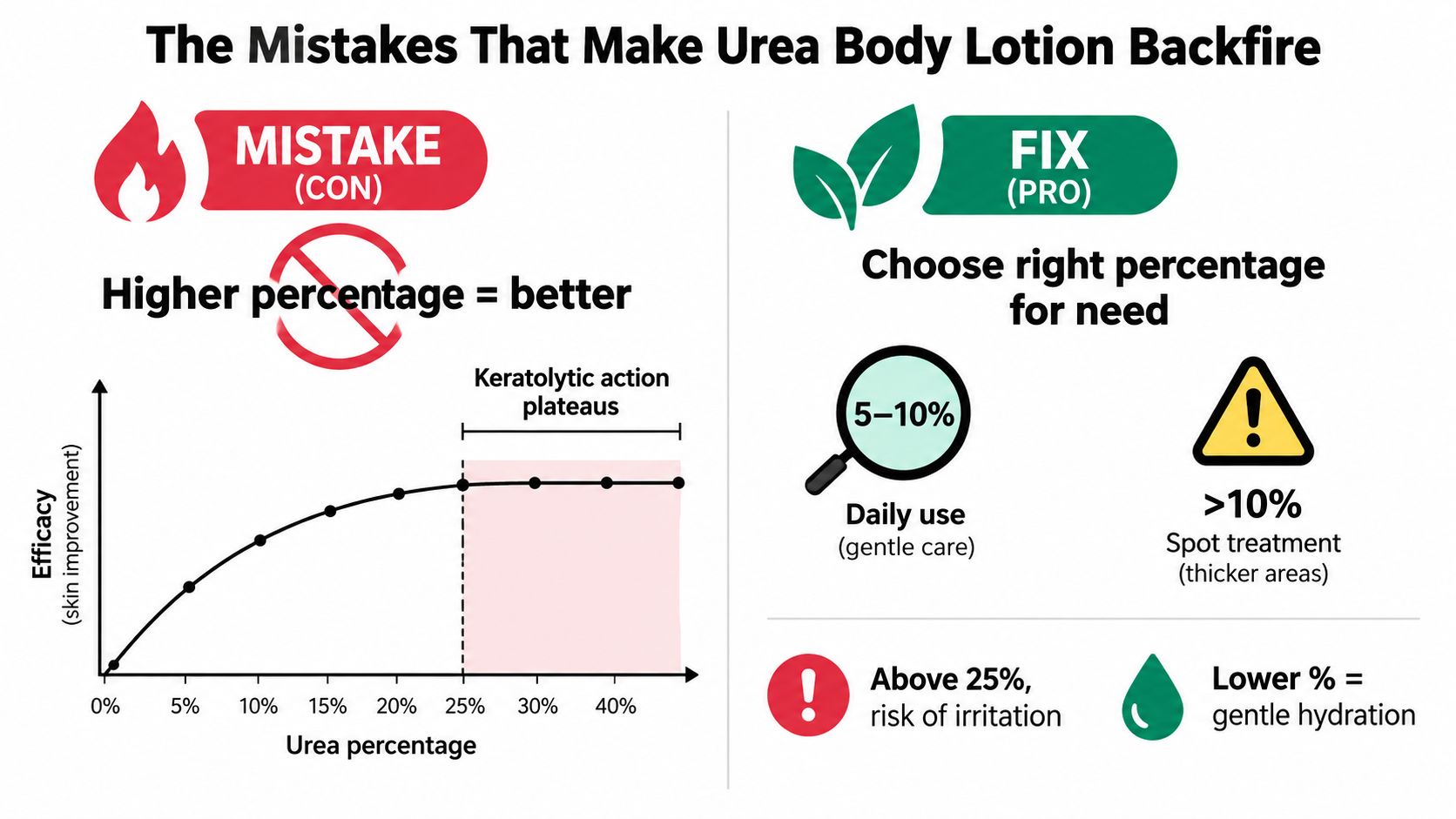
Mistake one is treating percentage like a score
A lotion with more urea isn't automatically more effective for your skin. If your issue is everyday dryness, jumping into a high-strength keratolytic formula can create sting without adding much benefit. The skin doesn't reward force. It rewards fit.
Mistake two is believing sting proves efficacy
It doesn't. Early stinging usually tells you the barrier is compromised, especially after shaving, over-exfoliating, or applying to fissured skin. Therapeutic action and irritation are not the same thing.
Barrier check: If a urea body lotion burns on contact, step down in strength or pause other exfoliants before you decide the product is “working.”
Mistake three is thinking urea dries skin out
People make that assumption because keratolytic products can feel active. But the core biology goes the other direction. Clinical data in xerosis and healthy skin support its hydrating role. In a 2026 evaluation of a 10% urea lotion for xerosis, dryness improved from 2.18 ± 0.75 at baseline to 2.87 ± 1.00, and hydration increased from 3.31 ± 0.79 to 3.84 ± 0.79, both with p < 0.001, as reported in the clinical review and evaluation of topical urea.
The review also summarized earlier evidence that a 20% urea lotion improved skin hydration in 50.8% of cases and produced marked improvement in 12% of cases in a 49-patient open-label study, with added support from a placebo-controlled study in 21 participants showing reduced transepidermal water loss over 4 weeks in healthy skin at 10% to 20%.
The last miss is skipping a seal when you need one
Humectants work best when the environment around them makes sense. If the air is dry and your barrier is leaky, urea may need help from a creamier top layer to keep the water in place. That doesn't mean urea failed. It means you stopped at step one.
How to Layer Urea With Acids Retinoids and SPF
Layering decides whether urea behaves like a steady repair tool or an irritation trigger.
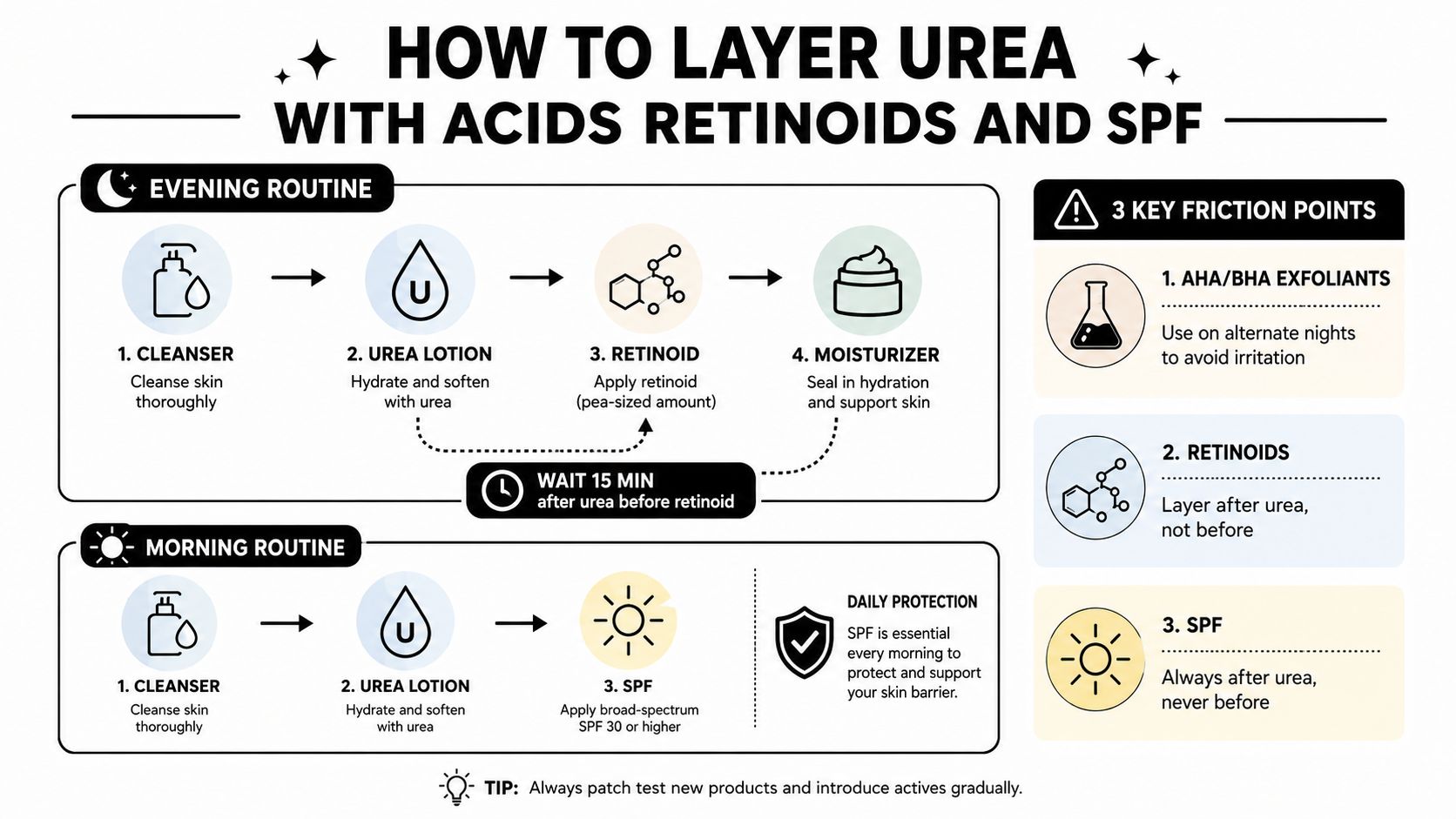
Where urea goes in the routine
For hydration-focused use, apply urea body lotion to slightly damp skin after cleansing and pat-drying. The skin surface should not be dripping, but it also shouldn't be fully dry and chalky. Urea needs available water to do its humectant job well.
Then decide what comes next based on your actives.
If you use acids
AHA and BHA products already push the skin toward exfoliation. High-percentage urea on the same night can turn a smart routine into cumulative irritation. If your skin is reactive, alternate nights instead of stacking.
That's especially true on chest, shoulders, thighs, and upper arms where people often treat both roughness and discoloration at once.
If you use retinoids
Retinoids such as tretinoin or adapalene can leave body skin tight and flaky. In the right routine, urea often helps by reducing that dry, brittle feel. The safer pattern is to use your urea layer first on slightly damp skin, let it settle, then apply the retinoid if your skin tolerates that sequence. If not, alternate nights.
Mesoderm RX has a practical guide to layering skin care that helps when your routine includes several active products.
Don't combine every active on the same evening just because each one works alone.
If the area is exposed to daylight
On exposed body areas, sunscreen goes last in the morning. Urea itself isn't your UV defense. If you're using a keratolytic-strength formula and you're trying to smooth roughness while preventing dark marks, protecting that freshened outer layer matters.
The order is simple in practice:
- Morning: cleanse, urea on slightly damp skin, then moisturizer if needed, then SPF on exposed areas.
- Evening with no strong actives: cleanse, urea, then a richer cream if your barrier needs a seal.
- Evening with acids or retinoids: don't stack aggressively. Alternate if your skin starts to sting, flush, or peel.
How to Choose a Urea Body Lotion That Will Not Irritate You
Picking a urea body lotion gets easier when you stop shopping by marketing language and start shopping by four filters.
Match the concentration first
Don't begin with fragrance claims or packaging. Begin with the number. For simple body dryness, stay under the keratolytic range. For rough texture, you need more than a comfort lotion. For thickened heels or dense plaques, body-wide daily use isn't the goal. Targeted treatment is.
Audit the supporting ingredients
Urea works better in a good formula than in a harsh one. Helpful companions include glycerin, niacinamide, panthenol, and ceramide-supportive ingredients because they reduce the chance that an “active” body lotion feels raw or sharp on use.
If you want a good example of how to think through topical safety and formula choices, even outside the urea category, this guide on how to choose a safe CBD topical is useful because it teaches the same habit of reading the whole formula, not just the hero ingredient.
Vehicle matters more than people think
A lotion is easier to spread over arms, torso, and large body areas. A cream or balm base usually performs better on shins, ankles, knees, and heels where the skin loses water faster and benefits from more occlusion.
| Criterion | What to Look For | Red Flag to Avoid |
|---|---|---|
| Concentration | Strength that matches the actual skin problem | Buying the highest percentage by default |
| Supporting ingredients | Glycerin, niacinamide, panthenol, barrier-supportive formula | Strong fragrance, menthol, essential oils on reactive skin |
| Vehicle | Lotion for larger areas, cream for drier zones | One texture for every body site |
| Personal tolerance | Fragrance-free if reactive, patch-test if eczema-prone | Ignoring known allergens |
Patch test before full-body use
Use the product on a small test zone first, especially if your barrier is fragile or you already use acids or retinoids. Watch for delayed sting, redness, or itching rather than judging only the first minute after application.
That one small test saves a lot of unnecessary inflammation.
The One Habit That Decides Whether Urea Works for You
If I had to reduce this entire topic to one action, it would be this. Apply your urea body lotion to slightly damp skin within a few minutes after bathing, then add a sealing layer if that area still runs dry.
Timing changes the result
Urea is a water-binding ingredient. When there's a little surface water available, it has something to grab and help hold inside the stratum corneum. When you wait until your legs are fully dry hours later, you're asking it to soften flakes without enough available water to work with.
That's why the same formula can feel mediocre in one routine and excellent in another.
The practical rule is short
Use this decision rule:
- Match the strength to the problem
- Apply on slightly damp skin
- Seal with a richer layer if the area still dries out
- Back off if your barrier is inflamed, cracked, or burning
One body zone is enough for your own test. Pick a shin, elbow, or upper arm and treat only that area consistently for a week. Compare it with the untreated side. You're looking for less drag, less visible flaking, and skin that feels more flexible by touch.
A good urea routine should make skin feel calmer and more pliable. If it only makes it stingier, the routine needs adjusting.
That's the payoff of understanding urea. You stop guessing. You stop buying random “intensive” creams. And you start matching the molecule's behavior to the skin problem in front of you.
Mesoderm RX formulates body and treatment products for people dealing with dryness, uneven tone, texture, and barrier stress, with a focus on active-led routines that don't rely on fluff. If you want a body-care lineup that fits alongside smarter ingredient use, visit Mesoderm RX and build a routine that matches what your skin is doing.