


Best Hyperpigmentation Cream: A Clinical Buying Guide
You've probably done this already: bought a brightening cream after seeing a convincing before-and-after, used it for a few weeks, noticed dryness or no visible change, then replaced it with another jar. The dark marks remain, and the routine becomes more complicated without becoming more effective.
The problem usually isn't a lack of effort. It's a mismatch between pigment pattern, active ingredient, concentration, skin tolerance, and formulation quality. The best hyperpigmentation cream isn't the one with the loudest claim. It's the product that interrupts the right biological pathway, fits your skin's inflammatory threshold, and can be used consistently while sunscreen prevents new pigment from overriding the treatment.
This guide uses a clinician's decision process. First identify what you're treating, then evaluate the active, then audit the formula and application plan. By the end, you should be able to read an ingredient list before trusting its marketing.
Why Most Hyperpigmentation Searches End in Disappointment
A typical pigment case arrives with a familiar history. Someone has spent years rotating through popular brightening creams, exfoliating serums, and spot treatments, yet the marks look unchanged or appear darker after irritation. They often remember the product names but not the active concentrations, the diagnosis, or whether they used reliable sun protection.
That pattern is predictable because “dark spot” describes an appearance, not a diagnosis. A flat mark left after acne is not managed in exactly the same way as symmetrical facial melasma or a sharply defined sun-induced spot. If the treatment creates inflammation, especially in skin that readily develops post-inflammatory hyperpigmentation, the cream can work against its intended purpose.
The clinical buying decision
I assess pigment through three filters:
- Pattern: Is the discoloration symmetrical and patch-like, linked to previous inflammation, or isolated and sun-exposed?
- Biology: Does the active inhibit tyrosinase, reduce inflammation, increase epidermal turnover, limit pigment transfer, or exfoliate pigmented cells?
- Usability: Can the formula be applied at an effective concentration without fragrance, excessive alcohol, unstable packaging, or a barrier reaction?
Hydroquinone, azelaic acid, retinoids, acids, vitamin C derivatives, and tranexamic acid don't perform the same job. A lower-irritation ingredient used steadily can be more useful than a stronger treatment that causes burning, peeling, and treatment abandonment.
Practical rule: If a product doesn't disclose its meaningful actives or gives you no way to judge irritation risk, its packaging is doing more work than its formulation.
Why “brightening” isn't enough
A cream may make skin look temporarily more luminous through hydration or surface exfoliation without materially changing the process that creates excess pigment. That doesn't make it useless, but it means glow and pigment control are different outcomes.
A useful primer on choosing a treatment for discoloration is this guide to skin discoloration cream. The same principle applies whether you're treating a single post-acne mark or recurrent facial patches: identify the trigger, control inflammation, inhibit excess melanin production, and protect the result.
What Hyperpigmentation Is and How Melanin Drives It
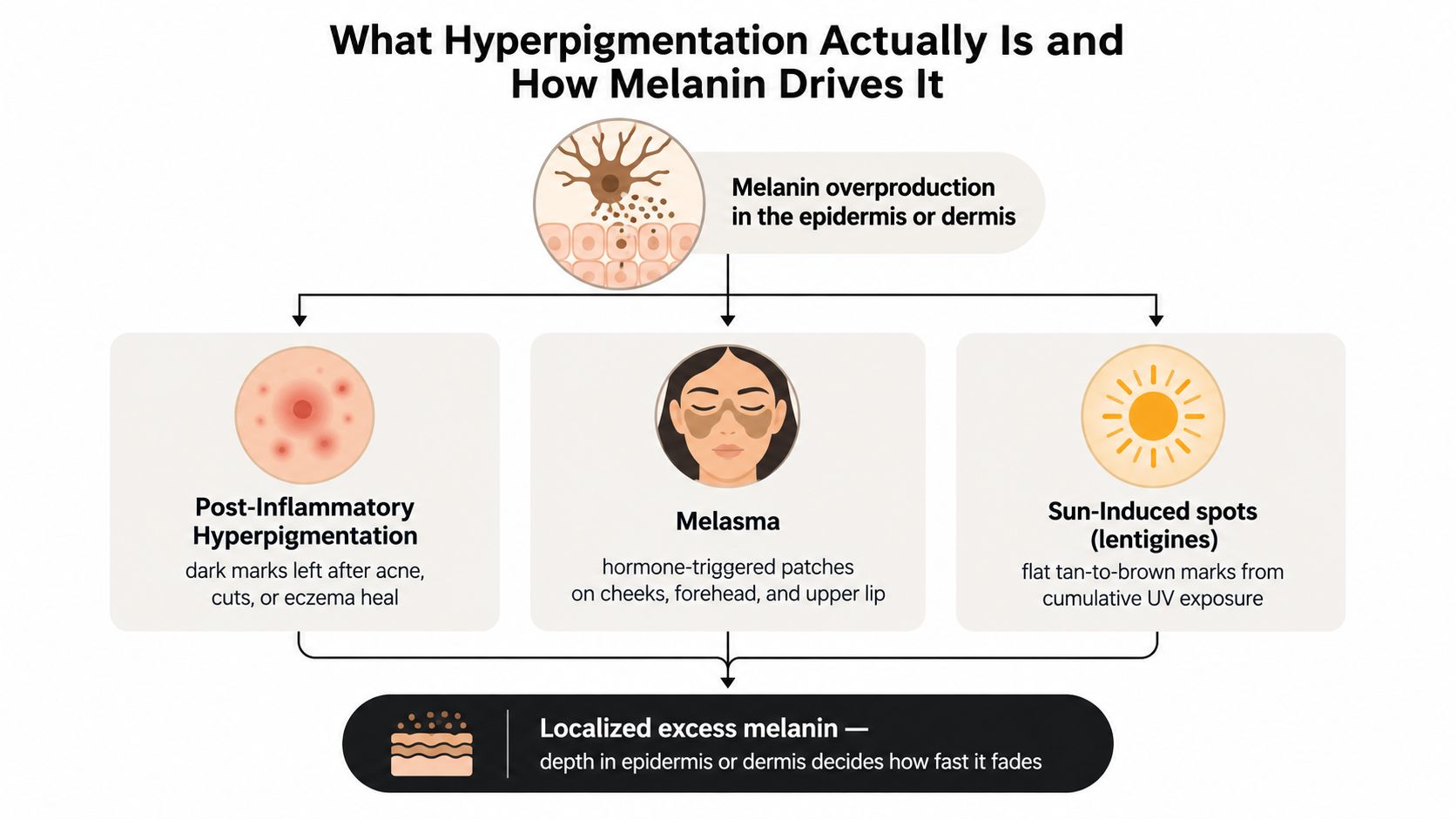
A brown mark left after acne, a symmetrical facial patch, and a sun-exposed spot may look similar in a mirror, but they do not arise from the same pigment pattern. Hyperpigmentation is localized excess melanin in the epidermis or dermis. Melanocytes produce melanin, package it into melanosomes, and transfer those structures to nearby keratinocytes. UV exposure, hormonal signals, and inflammation can stimulate the process, darkening selected areas relative to surrounding skin.
The distribution and history narrow the possibilities. Post-inflammatory hyperpigmentation, or PIH, follows acne, eczema, cuts, burns, or other inflammation. Melasma produces recurring brown or gray facial patches, commonly in symmetrical areas such as the cheeks, forehead, and upper lip, and may occur during pregnancy. Solar lentigines are flat tan-to-brown spots associated with accumulated sun exposure. These patterns can overlap, yet their triggers and tendency to recur differ.
The pathway a cream needs to influence
Melanogenesis starts as L-tyrosine moves through tyrosinase-dependent reactions that produce eumelanin and pheomelanin. Tyrosinase regulates a key rate-limiting step in melanin synthesis, so it is a central target for pigment treatments. Hydroquinone reversibly inhibits tyrosinase and may also affect melanosome formation, structure, degradation, and melanocyte activity, according to this review of tyrosinase inhibition and hyperpigmentation treatment.
Active ingredients act at different points. Kojic acid, arbutin, licorice-derived compounds, thiamidol, and hydroquinone primarily modify melanogenesis. Retinoids increase epidermal turnover and may improve delivery of other treatments. Azelaic acid offers pigment-modulating and anti-inflammatory activity, while niacinamide is commonly used to reduce pigment transfer and support the barrier.
The same mechanism matters after procedures. Inflammation can create new pigment even when the original treatment worked, which is why guidance on treating dark spots from tattoo removal can be relevant. A concise overview of causes, patterns, and treatment options is available in this guide to what hyperpigmentation is and how to treat it effectively.
The Three Mistakes That Keep Dark Spots Coming Back
A patient may choose a potent cream, use it diligently, and still see new dark marks each month. The usual problem is a mismatch between the pigment pattern, the routine, and the light exposure that keeps stimulating pigment. Misdiagnosis, inconsistency, and unprotected light exposure commonly undermine treatment.
Mistake one is treating without diagnosis
A routine built around aggressive exfoliation can aggravate melasma by adding inflammation. A melasma-focused routine will not control the acne or eczema that continues to create new PIH. If fresh lesions keep appearing, fading older marks cannot solve the underlying cycle.
Start with distribution and history. A mark left after a pimple points toward PIH. Symmetrical patches across the face suggest melasma. A single, stable spot on sun-exposed skin needs a different assessment, especially if it changes in shape, color, texture, or symptoms. A clinician should review uncertain or changing lesions before you apply a pigment cream.
Mistake two is under-dosing, then over-hopping
Switching products before the skin has had time to respond makes treatment impossible to evaluate. A stable routine gives the active time to work as pigmented cells move through epidermal turnover, while controlled use limits irritation. Adding acids, retinoids, scrubs, and several spot correctors at once can inflame skin and hide which ingredient helped.
Clinical rule: Change one meaningful variable at a time. Burning signals irritation, not proof that an active is working.
Choose concentration and frequency according to tolerance, pigment pattern, and barrier condition. A lower-strength formula used consistently can outperform a stronger product that causes peeling and repeated pauses.
Mistake three is treating sunscreen as optional
Daily broad-spectrum protection is part of pigment treatment, not a final cosmetic step. A clinical study summarized in this dermatology review of sunscreen and hyperpigmentation found lighter macules, fewer macules, and overall lightening among African and Hispanic women using daily SPF 30 or SPF 60 over 8 weeks. The review also describes benefits from protection against UV and visible light.
Featured Product
Pigment Restraint Ultra High Sun Protection
Its advanced formula defends against UV damage, helps protect againstsun-induced dark spots, and promotes a radiant, even-looking complexion—all while maintaining optimal hydration.
Shop Now →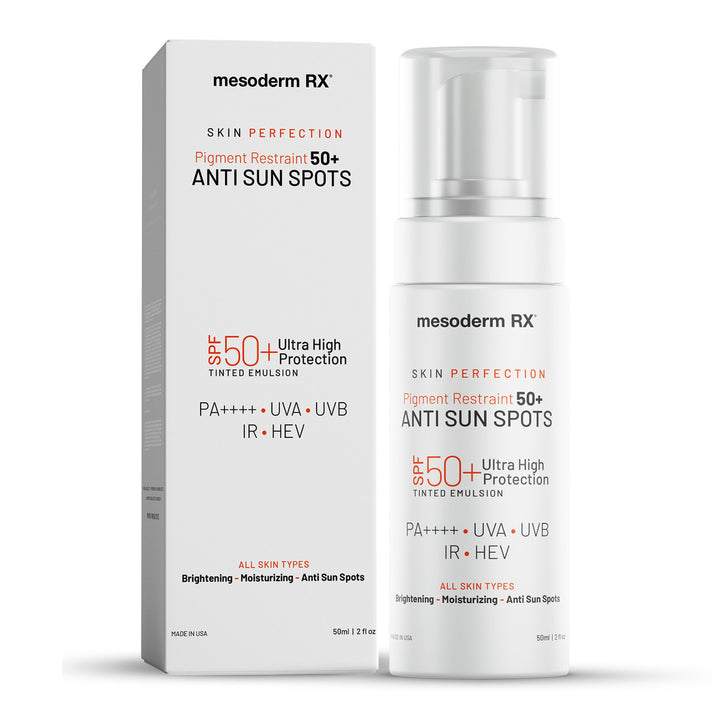
A fast-absorbing option such as Pigment Restraint Ultra High Sun Protection is described as a non-greasy formula covering UVA, UVB, infrared, and high-energy visible combination rays. Apply broad-spectrum sunscreen every morning, reapply as exposure requires, and treat outdoor light as an active trigger for recurrent pigment.
Comparing the Strongest Evidence-Based Actives
A dark spot cream earns its place through mechanism, concentration, stability, and tolerability. No active suits every pigment pattern. The right choice depends on whether the formula can address the pigment pathway without causing the inflammation that keeps discoloration visible.
Hydroquinone remains a strong clinical benchmark. Comparative melasma trials describe azelaic acid 20% as performing roughly on par with hydroquinone 4%. One review reported good-to-excellent outcomes in 65% of azelaic-acid users versus 73% of hydroquinone users. The comparative review of melasma treatments supports azelaic acid as a serious treatment option, rather than a weak substitute.
| Active Ingredient | Typical Concentration | Mechanism | Evidence Strength | Irritation Risk |
|---|---|---|---|---|
| Hydroquinone | 2% to 4% | Reversible tyrosinase inhibition and effects on melanosomes | Strong clinical history, especially for melasma | Moderate to high, requires supervision |
| Azelaic acid | 15% to 20% | Melanogenesis modulation, anti-inflammatory activity, and keratinization support | Comparative melasma and PIH evidence | Low to moderate |
| Kojic acid | Disclosed cosmetic concentration | Tyrosinase inhibition | Supportive clinical and formulation evidence | Moderate, especially in reactive skin |
| Arbutin | Disclosed cosmetic concentration | Tyrosinase pathway modulation | Supportive, generally gentler evidence | Low to moderate |
| Retinoids | Product-specific | Increased epidermal turnover and treatment support | Strong category evidence for PIH and acne-linked pigment | Moderate to high |
| Vitamin C derivatives | Product-specific | Antioxidant support and pigment pathway modulation | Form-dependent clinical support | Low to moderate, higher with acidic L-ascorbic acid |
| Tranexamic acid | Product-specific topical use | Supports pigment control through inflammatory and plasmin-related pathways | Growing evidence, particularly for melasma | Usually low topically |
| Hydroxy acids and PHAs | Product-specific | Exfoliation and surface renewal | Strong category support for PIH combinations | Moderate if overused |
How I rank the options
Hydroquinone at 2% to 4% is potent, but it is not an indefinite daily moisturizer. Medical guidance matters, particularly for melasma or prolonged use. Retinoids, including tretinoin, adapalene, and retinol, support epidermal turnover and can improve acne-linked pigment. Peeling and irritation can worsen PIH when use escalates too quickly. The clinical rationale is outlined in this resource on tretinoin cream and Obagi.
Azelaic acid at 15% to 20% often fits acne-prone, sensitive, or inflammation-linked pigmentation. Kojic acid, alpha arbutin, licorice-derived glabridin, liquiritin, isoliquiritin, cysteamine, and thiamidol work through different non-hydroquinone pathways. Their practical performance depends on the disclosed concentration, stability, packaging, and vehicle, not the ingredient name alone.
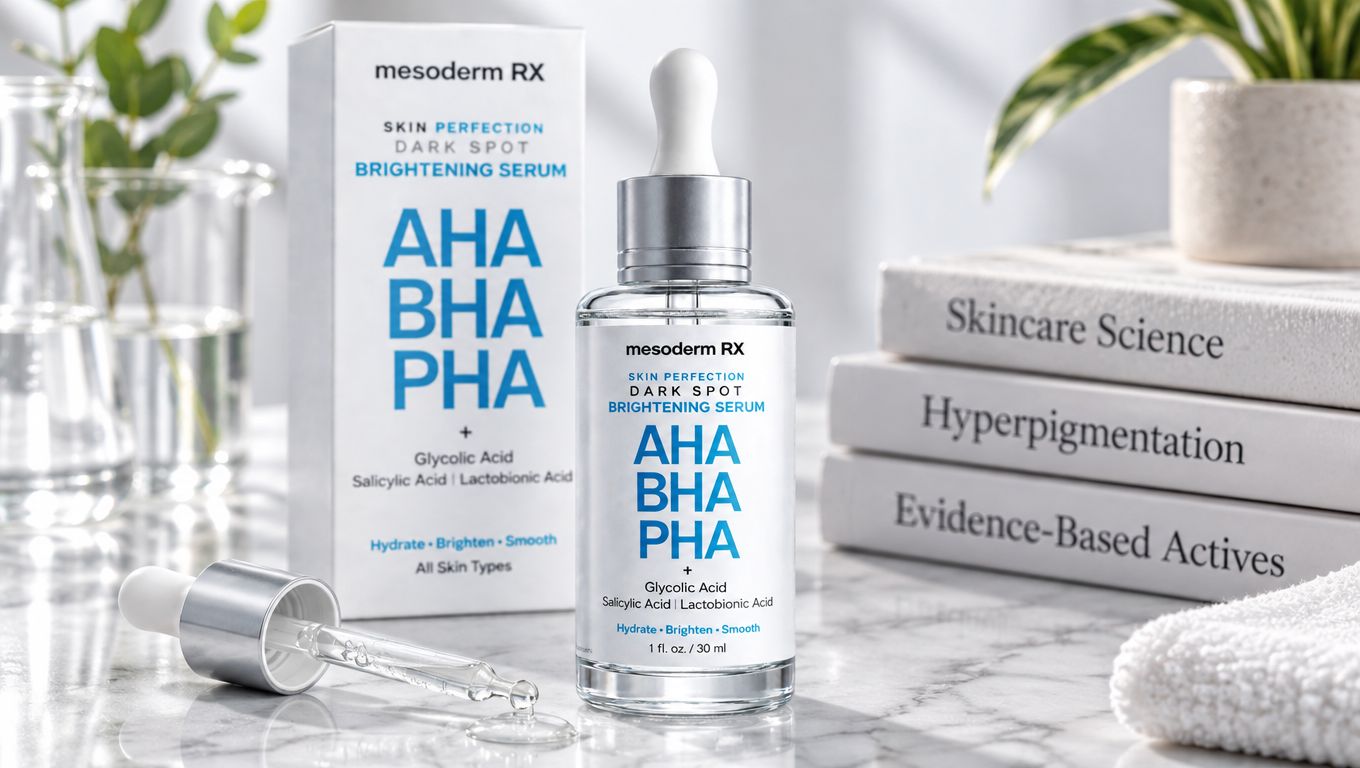
A multi-acid product such as AHA + BHA + PHA Skin Brightening Serum 30ml lists kojic, glycolic, lactic, salicylic, lactobionic, hyaluronic acid, and hexapeptides. The stated directions allow daytime and nighttime use, yet a formula containing several acids deserves cautious introduction, especially on reactive or pigment-prone skin.
Vitamin C may provide antioxidant support. L-ascorbic acid is acidic and can sting more readily, while THD ascorbate is a lipid-soluble alternative. Topical tranexamic acid offers another option for pigment control. Oral tranexamic acid requires clinician assessment because medical history and risk factors affect suitability.
Some patients also ask about an antioxidant and immune support IV. Intravenous services do not replace diagnosis, a well-formulated topical, or consistent photoprotection.
Matching Actives to Skin Type and Pigment Pattern
Skin tone affects the margin for irritation. Deeper Fitzpatrick skin types may develop more visible post-inflammatory hyperpigmentation after dermatitis, so an aggressive product can worsen the problem it targets. Lighter skin can also develop persistent pigment, especially with melasma, although the rebound may look different.
| Pigment Pattern | First-Line Direction | Use Caution With |
|---|---|---|
| Melasma | Azelaic acid, cysteamine, thiamidol, gentle retinoid support, and visible-light protection | Aggressive peels and unsupervised hydroquinone use |
| PIH after acne or eczema | Control the inflammation, then consider azelaic acid, a retinoid, a hydroxy acid, or niacinamide | Picking, harsh exfoliation, and stacked irritants |
| Solar lentigines | Photoprotection and a targeted pigment inhibitor after assessment | Treating a changing or uncertain lesion at home |
| Sensitive or barrier-compromised skin | Azelaic acid, niacinamide, licorice-derived ingredients, and barrier lipids | High-strength acids, fragrance, and rapid escalation |
A practical skin-type framework
Fitzpatrick I to III skin with epidermal sun-induced spots may tolerate a retinoid or acid more readily, but tolerance still sets the schedule. Fitzpatrick IV to VI skin with PIH usually calls for a slower regimen centered on azelaic acid, niacinamide, antioxidants, and reliable sunscreen. Stronger hydroquinone or retinoid protocols belong under appropriate clinical supervision, particularly when irritation could create more pigment.
Melasma requires maintenance rather than a single correction cycle. Hormonal triggers and visible light can reactivate pigment, making a fragrance-free, low-irritation routine more useful than repeated aggressive treatment. A simple daily cream with disclosed non-hydroquinone brighteners and barrier support may suit sensitive cases. Mesoderm RX Bright Cream is a hydroquinone-free, fragrance-free option that fits this maintenance profile.
Acne-prone, oily skin often feels better with a light gel-cream or serum containing azelaic acid, niacinamide, or carefully dosed salicylic acid. Dry or barrier-compromised skin needs a cream vehicle, humectants, and emollients before adding another exfoliant. The ingredient list should therefore be read alongside the vehicle, concentration, fragrance content, and intended frequency. A familiar active in an irritating formula is a poor match for pigment-prone skin.
How to Apply a Hyperpigmentation Cream for Real Results
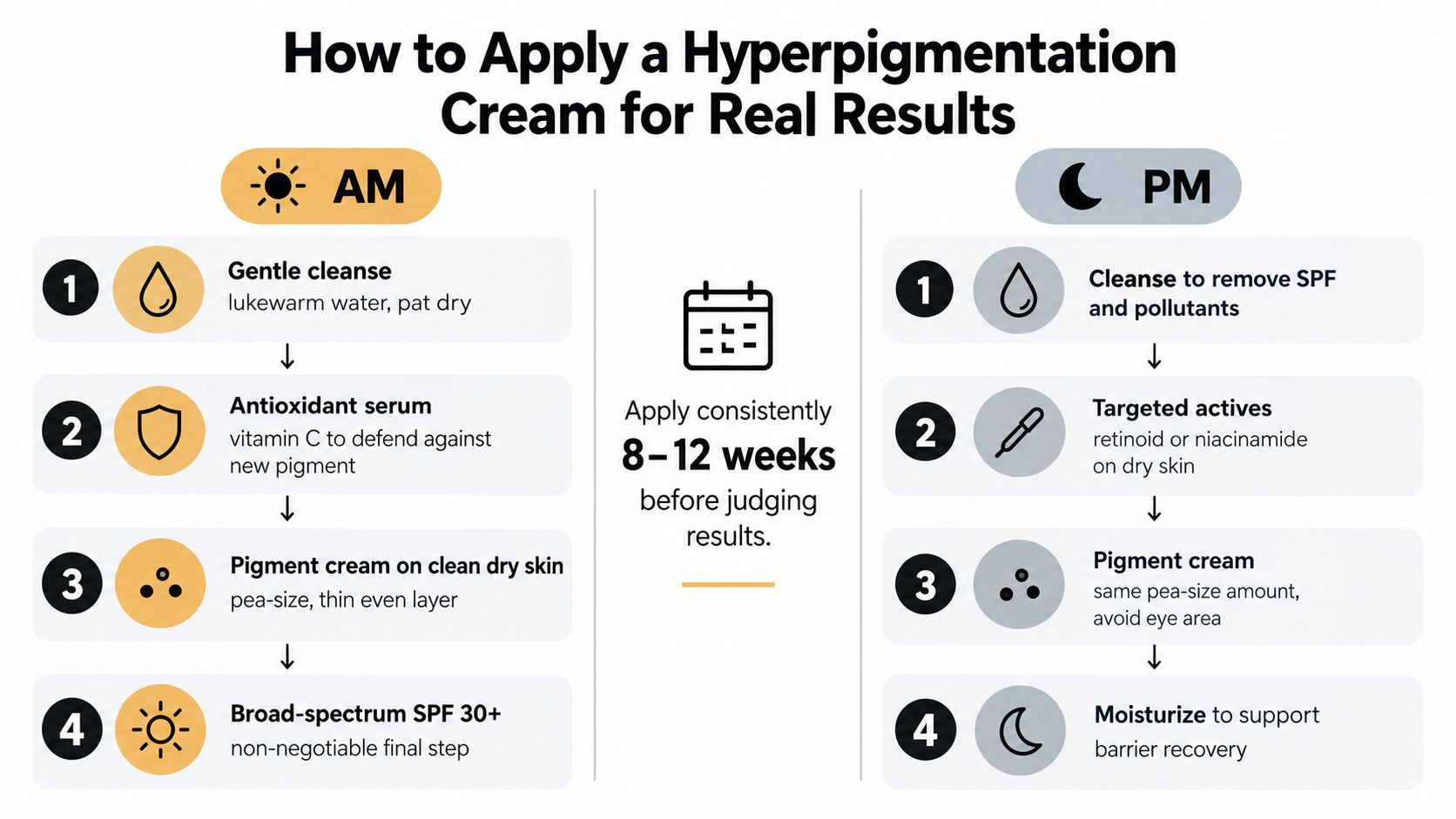
A well-chosen active can still fail if the application causes irritation. Set up the routine so the pigment treatment contacts clean skin, receives consistent photoprotection, and does not overload the barrier.
Morning protocol
Wash with lukewarm water and a gentle cleanser, then pat dry. If tolerated, apply an antioxidant serum. Follow with a thin layer of the pigment cream on clean, dry skin, and finish with broad-spectrum sunscreen. Use enough sunscreen to cover exposed skin, then reapply according to exposure and the product directions.
Photoprotection affects whether treatment holds. Clinical evidence indicates that sunscreen addressing both ultraviolet and visible light can improve pigmentation even without a separate depigmenting cream. The cited review reported significant improvement by 8 weeks, including a 28% reduction in colorimetric values and a 15% reduction in Melasma Area and Severity Index scores compared with UV-only sunscreen. See the review of sunscreen for hyperpigmentation for the reported comparison.
Evening protocol
Remove sunscreen and pollutants with a gentle cleanser. Apply one targeted active to dry skin, then moisturize. A retinoid should begin on alternate nights rather than being introduced alongside an acid or strong pigment inhibitor. This schedule gives you a clearer way to identify the source of stinging, dryness, or peeling.
Reactive skin may benefit from short-contact treatment. Apply the product for the period specified by its instructions or clinician, rinse when directed, and moisturize. A mandatory waiting period does not improve every formula. Focus on compatibility, dry skin when irritation is a concern, and keeping multiple low-pH or exfoliating actives out of the same application.
Evidence for PIH supports regimens that combine retinoids, hydroxy acids, and broad-spectrum sunscreen. A systematic review found these categories among those with the greatest number of high-quality studies. It also documented a clinical review in which 4% hydroquinone used for 8 weeks produced about a 25% mean melanin-index reduction from baseline in a Nigerian acne-PIH cohort. The details appear in this systematic review of PIH treatments.
Assess change after a consistent course, not after a few applications. A practical evaluation window is 8 to 12 weeks when the routine is tolerated and sunscreen use is reliable. Burning, swelling, persistent redness, or marked peeling means the active should be stopped while you use cleanser, moisturizer, and sunscreen until the barrier settles. Spreading pigment or a changing spot requires dermatological assessment rather than a stronger product.
Reading the Label Like a Clinician
A pigment product should be judged by its ingredient list, not by the word “brightening” on the front panel. I favor hydroquinone-free, fragrance-free, minimal-additive formulas for long-term cosmetic maintenance because avoidable irritation can create the very inflammation that sustains PIH.
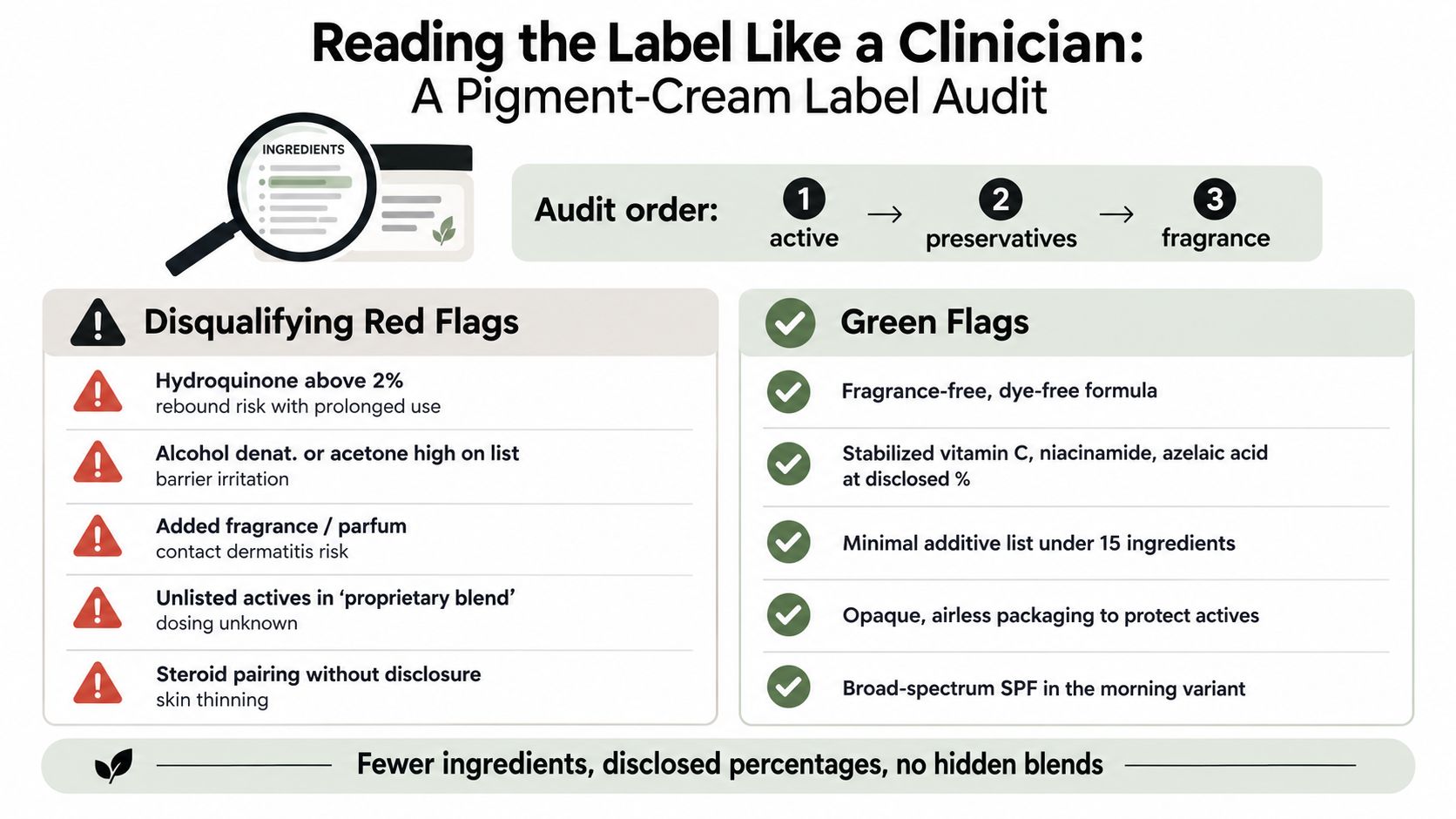
Red flags on the ingredient deck
Look for parfum or fragrance anywhere in a leave-on treatment, especially if your skin has reacted to products before. Essential oils such as lavender, citrus, peppermint, and rose can add sensitization risk without improving the core pigment mechanism. Bergamot and grapefruit extracts deserve caution because some extracts can be photosensitizing.
Denatured alcohol high on the list may increase dryness and stinging, particularly alongside retinoids or acids. Drying sulfates are a poor fit for a leave-on cream, and an undisclosed proprietary blend prevents you from judging dose. A steroid pairing without clear disclosure is a serious reason to stop and seek professional advice.
The infographic's warning about hydroquinone above 2% reflects a conservative audit position for non-prescription shopping, not a claim that every higher-strength medical formula is inappropriate. Hydroquinone can be effective, but higher-strength use belongs within medical guidance because duration, diagnosis, and monitoring matter.
Green flags that improve the odds
Opaque or airless packaging helps protect light- and air-sensitive ingredients. A short ingredient deck dominated by functional ingredients is easier to evaluate than a crowded formula built around fragrance, color, and vague botanical language. Niacinamide and panthenol can support the barrier, while EDTA can help stabilize formulas that contain oxidation-sensitive components such as vitamin C.
Ingredient order matters, but it isn't a concentration report for every ingredient. Ingredients present below 1% may be listed in any order, so a long list of impressive actives doesn't prove that each is present at a meaningful level.
Run this shelf audit:
- Identify the active: Is the pigment-relevant ingredient named clearly?
- Check disclosure: Is the concentration stated when it matters?
- Scan for irritants: Are fragrance, essential oils, or high-position alcohol present?
- Assess the package: Is the container opaque or airless when the active needs protection?
- Reject vague claims: “Natural,” “clean,” and “brightening” aren't clinical evidence.
- Check the routine role: Does the product complement sunscreen and barrier care?
Which Hyperpigmentation Cream Profile Fits You
A melasma routine needs different decisions from one treating post-acne marks or friction-related discoloration. Match the active mechanism, irritation risk, vehicle, and maintenance burden to the pigment pattern before comparing brands.
| Skin Type & Pattern | Recommended Active Class | Vehicle & Formulation Must-Haves | Routine Cadence |
|---|---|---|---|
| Fitzpatrick I to III with melasma | Azelaic acid, cysteamine, thiamidol, gentle antioxidants | Fragrance-free cream or gel-cream, disclosed actives, barrier support | Daily maintenance, with gradual active introduction |
| Fitzpatrick III to V with PIH | Retinoid support, alpha arbutin, azelaic acid, niacinamide | Lightweight cream or serum, low-irritation vehicle, no unnecessary fragrance | Alternate-night retinoid, steady pigment treatment |
| Fitzpatrick V to VI with deeper PIH | Niacinamide, tranexamic acid, azelaic acid, gentle antioxidants | Hydrating, fragrance-free cream, strict light protection | Slow escalation, daily sunscreen, barrier-first adjustments |
| Sensitive or compromised barrier | Mild brighteners, panthenol, niacinamide, licorice derivatives | Cream vehicle, humectants, emollients, minimal additives | Repair first, then introduce one active gradually |
Four practical matches
For melasma, choose a fragrance-free formula intended for continued use rather than a harsh short-term peel. Maintenance also requires consistent photoprotection, because ultraviolet and visible light can sustain melanogenesis even after the pigment appears lighter. Introduce the active gradually and keep barrier irritation low.
Post-inflammatory hyperpigmentation after acne needs an acne plan as well as a pigment product. Control active lesions, avoid picking, and add a measured retinoid or alpha-arbutin layer only if the barrier tolerates it. A lightweight vehicle may suit oily skin, but insufficient hydration can increase irritation and prolong discoloration.
Deeper skin tones with recurrent marks require careful anti-inflammatory pigment control. Strong peels, frequent scrubs, and rapid retinoid escalation can trigger more inflammation than they resolve. Niacinamide and tranexamic acid suit a maintenance-focused approach. Persistent, spreading, or diagnostically unclear discoloration warrants professional assessment rather than stronger self-treatment.
Friction-related discoloration often follows shaving, waxing, tight clothing, or chafing, so treating the trigger matters as much as selecting the cream. A product such as Bikini Line & Inner Thigh Brightening Cream lists tranexamic acid, kojic acid, arbutin, niacinamide, vitamin C, AHA, azelaic acid, and hexylresorcinol. Apply it only to intact external skin as directed, and reduce friction alongside topical treatment.
Use the comparison table in Comparing the Strongest Evidence-Based Actives to select the profile whose mechanism and irritation risk fit your skin. The practical choice is the formula you can use consistently without creating new inflammation.
Mesoderm RX offers hydroquinone-free, fragrance-free skincare options for pigment control, exfoliation, hydration, and broad-spectrum protection. Its range includes the AHA BHA PHA dark spot serum and Pigment Restraint sun protection. Visit Mesoderm RX to compare formulas against your pigment pattern and routine needs.