


Anti Aging Skin Serum: Unlock Youth
The most popular advice about anti aging skin serum is also the least useful: pick one hero ingredient, use it everywhere, and wait for your face to change.
That's not how skin ages, and it's not how good formulations work.
Visible aging isn't a single problem. It's a layered process involving slower epidermal renewal, collagen breakdown, oxidative stress, dehydration, barrier disruption, and uneven pigment behavior. A serum can help, but only when it's built as a targeted delivery system for those pathways, not as a marketing vehicle for one fashionable active.
Consumers clearly want that kind of targeted treatment. The global skincare serum market is projected at USD 5.5 billion in 2026 and USD 11.5 billion by 2036, and anti-aging serums are expected to represent nearly 42% of the market share according to Fact.MR's skincare serum market analysis. That scale tells you something important. Serum isn't a niche format anymore. It's where people expect concentrated, problem-specific treatment.
A clinically useful anti aging skin serum should answer a simple question: what biological job is this formula doing, and what else must the routine do to support it?
Beyond the Hype What an Anti Aging Serum Does
A serum is not a miracle. It is a delivery format.
Serums are usually designed to carry higher concentrations of treatment ingredients in textures that spread thinly, absorb efficiently, and sit early in a routine before heavier creams. That matters because anti-aging work depends on contact with skin pathways that regulate turnover, pigment transfer, inflammation, and extracellular support.
Why single-ingredient thinking fails
Most disappointing serums fail for one of three reasons:
- They target only one pathway: A formula may brighten but do little for texture or firmness.
- They ignore tolerability: An active that irritates the barrier often gets used inconsistently, which ruins outcomes.
- They rely on label appeal: A trendy ingredient can look impressive on the carton and still be poorly chosen for the actual skin problem.
Fine lines, roughness, dull tone, and laxity don't come from the same mechanism. If a serum only chases exfoliation, you may get smoother skin without stronger barrier function. If it only hydrates, skin can feel better while collagen decline continues underneath. If it only leans on antioxidants, you may reduce some environmental stress without meaningfully changing turnover.
Clinical rule: Match the formula to the pathway, then build the routine to protect the skin while that pathway changes.
What a good serum actually does
A strong anti aging skin serum usually fits into one or more of these jobs:
- Regulate renewal: Improve how quickly surface cells shed and are replaced.
- Support structure: Encourage processes tied to firmer-looking skin and reduced visible wrinkling.
- Defend against oxidation: Limit ongoing damage from environmental exposure.
- Correct uneven tone: Interrupt the signals that keep pigment looking blotchy or tired.
- Reinforce hydration: Reduce the dry, creased look that exaggerates age.
This is why experienced clinicians rarely think in terms of one miracle bottle. We think in systems. One serum may do the heavy lifting for renewal. Another formula, or the moisturizer layered over it, may handle barrier support and inflammation control. Sunscreen then protects every gain you make.
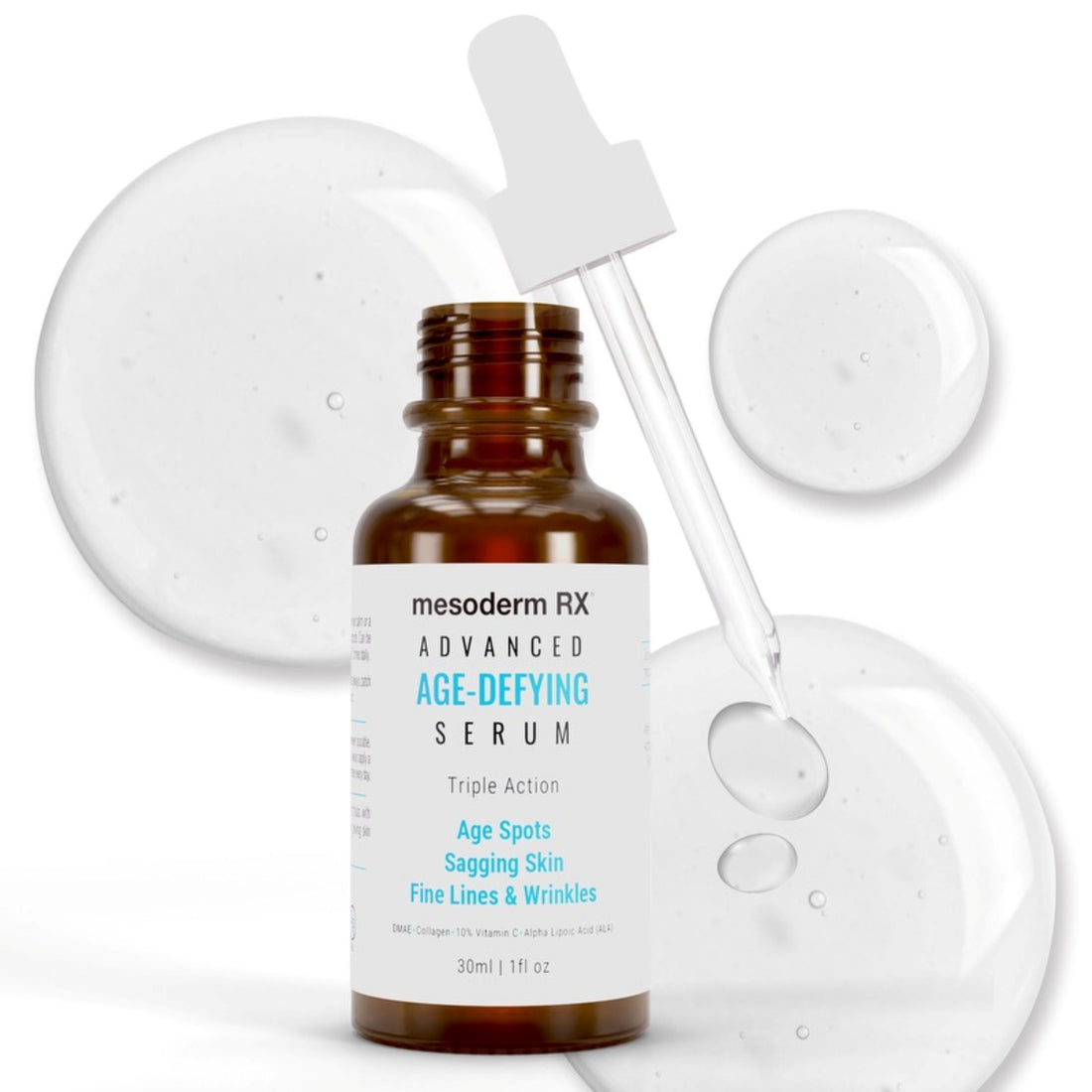
Featured Product
Advanced Triple Action Age-Defying Serum
TURN BACK TIME WITH A SERUM THAT RESTORES, REPAIRS, AND REJUVENATES
Shop Now →Understanding Your Skin's Aging Blueprint
Skin doesn't age in one straight line. Different layers change at different speeds, and those changes show up as texture, laxity, crepiness, discoloration, and loss of radiance.

Structural aging weakens the scaffold
Collagen and elastin act like the skin's internal support mesh. Over time, that scaffold becomes less organized and less resilient. Skin doesn't snap back the same way. Fine lines deepen into folds because the tissue under the surface isn't holding shape as efficiently.
This is why “moisturized” and “firm” are not the same thing. Hydration can temporarily plump the surface. It can't replace a weakened structural network by itself.
Cell turnover slows and texture gets heavier
Young skin sheds and renews more efficiently. Aging skin often behaves like a sluggish factory. Dead cells stay on the surface longer, which makes skin look dull, rough, and less reflective. Pores can appear more obvious. Pigment can look patchier because older cells aren't moving off the surface cleanly.
When patients tell me their skin looks “tired” even when it's hydrated, this is often part of the reason.
Oxidative stress keeps feeding damage
Free radicals act like cellular rust. They form from UV exposure and daily environmental stress, then interfere with normal skin function. Over time, they contribute to collagen damage, uneven tone, and a worn, less resilient appearance.
Oxidative stress is one reason anti-aging treatment can't be reduced to exfoliation alone. You also need defense.
Aging skin often looks older not because of one dramatic flaw, but because several low-grade processes keep running at the same time.
Pigment becomes less even
Hyperpigmentation isn't just “dark spots.” Melanin production can become irregular from UV exposure, inflammation, and cumulative cellular stress. The result is a more mottled surface, with areas that reflect light unevenly and make the skin look older even when wrinkles are mild.
For anti-aging work, this matters because skin reads as younger when texture and tone are both more uniform.
A useful serum must therefore do more than moisturize. It has to address renewal, structural decline, oxidation, and pigment behavior without breaking the barrier in the process.
The Clinical Toolkit Key Actives in Anti Aging Serums
Once you understand the biology, ingredient choice gets much simpler. You stop asking which active is trendy and start asking which active changes the pathway you need to change.

Retinoids are the benchmark
Among topical ingredients, retinoids remain the most evidence-backed core active for visible aging. Dr. M MacDonald's review of anti-aging skincare that really works notes that topical retinoids are the most evidence-backed active for an anti-aging skin serum because they accelerate epidermal turnover and stimulate collagen synthesis, which is the causal pathway behind improving fine lines, texture, and photoaging.
That mechanism is why retinoids remain central. They don't just soften the look of dryness. They push the skin to behave more youthfully at the level of renewal and support.
The trade-off is tolerance. Retinoids often need pacing, careful layering, and a stable barrier to be used consistently.
Antioxidants and peptides do different jobs
Vitamin C is often misunderstood as a brightening ingredient only. In a well-formulated serum, it also serves as antioxidant support and helps reinforce collagen-oriented treatment goals. It makes more sense in a morning routine where environmental stress begins early.
Peptides work differently. They function as signaling molecules. Think of them as short messages that tell skin to support repair-oriented behavior. They don't replace retinoids, but they can complement them well, especially when you want firmer-feeling skin without pushing irritation higher.
For a deeper look at how humectants and peptides work together in smoother, firmer routines, Mesoderm RX breaks down the logic in this article on anti-aging serums with hyaluronic acid and peptides.
Hydration and barrier support are not optional
Hyaluronic acid, glycerin, ceramides, and supportive emollients don't create collagen. They do something just as important. They make strong actives usable.
A retinoid serum on a compromised barrier often turns into redness, stinging, and poor compliance. A serum system with humectants and barrier-supportive lipids is much more likely to stay in the routine long enough to work.
One example of this category is Advanced Triple Action Age-Defying Serum, which is described as a rich, creamy moisturizer with skin-perfecting peptides that fortifies the skin's moisture barrier, reduces the appearance of fine lines and wrinkles, and promotes firmness, resiliency, and hydration. The provided product snapshot also notes DMAE, collagen, Vitamin C, and alpha lipoic acid in the formulation.
Quick reference for formula reading
| Ingredient Class | Primary Mechanism | Best For |
|---|---|---|
| Retinoids | Accelerate epidermal turnover and support collagen synthesis | Fine lines, rough texture, visible photoaging |
| Vitamin C | Antioxidant support and collagen-oriented skin support | Dullness, uneven tone, environmental stress |
| Peptides | Signal repair-oriented activity | Loss of firmness, early visible aging |
| Hyaluronic acid | Attracts water to the skin surface | Dehydration, surface plumping |
| Ceramides | Support barrier integrity | Dryness, irritation-prone skin |
| Exfoliating acids | Loosen accumulated dead surface cells | Roughness, congestion, uneven tone |
What works in practice: A high-performing anti aging skin serum rarely relies on one ingredient class. It combines a primary driver, such as a retinoid or renewal-focused active, with support ingredients that make the treatment sustainable.
Choosing Your Serum A Protocol Not a Product
People usually fail with anti-aging skincare at the selection stage. They shop by buzzword, not by problem.

If your main issue is laxity and texture, the protocol shouldn't look the same as someone whose biggest concern is discoloration and dullness. If your barrier is fragile, a high-pressure routine built around multiple aggressive actives is usually the wrong start, even if the ingredient list looks impressive.
Start with the main visible problem
Choose the serum strategy by leading concern:
- For fine lines and rough texture: Build around retinoid-led renewal, then support it with hydration and barrier care.
- For dullness and uneven tone: Use antioxidant support in the morning and controlled exfoliation or renewal work at night.
- For crepey, dry, fragile skin: Prioritize peptides, humectants, and barrier lipids first, then add stronger renewal actives more slowly.
- For mixed concerns: Use a system. One product may target turnover while another layer prevents dehydration and irritation.
This is why protocol matters more than product rank lists.
Why high percentages often disappoint
Consumers often assume stronger means better. It doesn't. A high percentage of an active in a poorly balanced base can underperform a more moderate formula that the skin tolerates.
The same goes for the “natural versus chemical” argument. That split has almost no clinical value. Everything in topical skincare is chemistry. Important questions concern stability, delivery, compatibility, irritation potential, and whether the formula matches the condition you're trying to correct.
A serum you can use correctly for months beats a stronger one you abandon after two irritated weeks.
Multi-acid systems often outperform harsh single-acid routines
Aging skin often benefits from exfoliation, but not every exfoliant behaves the same way. AHAs can help loosen compacted surface cells. BHA can work inside pore lining. PHA is often useful when you want a gentler resurfacing feel with added hydration support.
That combination is why a blended exfoliation strategy often works better than repeatedly hammering the skin with one acid. Skin Perfection Liquid Exfoliant Peel AHA BHA PHA is described in the provided catalog text as a leave-on exfoliant with glycolic and lactic acids, salicylic acid, and lactobionic acid, with key benefits that include gently exfoliating, improving skin tone and texture, clarifying pores, and calming without causing sensitization.
If you're comparing formulas and want to see how real users think about tolerance, texture, and visible outcomes, Mesoderm RX has a collection of anti-aging serum reviews.
Where growth factors fit
Interest in growth factors has grown because the concept sounds advanced. The question is whether they meaningfully outperform familiar tools. A dermatologist discussion of growth factors notes that results can be modest and strongest in specific brand-funded studies, while established evidence still favors sunscreen, retinoids, antioxidants, and peptides as the core tools for an effective anti-aging routine in this dermatologist video discussion on growth factors and anti-aging skincare.
That doesn't mean growth factors are useless. It means they're not a replacement for fundamentals.
A short demonstration of serum selection and routine logic can help clarify this point:
If a routine lacks sunscreen, consistent renewal, and antioxidant support, an expensive niche serum won't rescue it.
Integrating Serums Into Your Daily Regimen
A good anti aging skin serum can still fail if the routine around it is sloppy. Order, timing, and frequency change outcomes.
Morning protocol for protection
Morning skincare should focus on limiting new damage.
Use a clean, dry face as the starting point. Apply your serum from thinnest texture upward, then seal with moisturizer if needed, and finish with sunscreen. Antioxidant-oriented formulas fit well here because they help support the skin against daytime oxidative stress. Hydrating and peptide serums also layer well in the morning when the goal is comfort and defense rather than aggressive turnover.
A simple morning framework looks like this:
- Cleanse lightly: Remove oil and residue without stripping.
- Apply treatment serum: Choose antioxidant, peptide, or hydrating support based on your skin.
- Use moisturizer if needed: This reduces transepidermal water loss and improves comfort.
- Finish with sunscreen: Without this step, anti-aging treatment loses much of its value.
Evening protocol for repair
Night is usually where stronger renewal work belongs. This is the time for retinoids, peptide support, and carefully selected exfoliating formulas.
If you're using both a retinoid and acids, don't assume they should go on together. Many people do better alternating them. One night for retinoid, another night for exfoliation, and barrier-supportive nights in between is often more productive than stacking everything and triggering irritation.
For readers trying to refine application order and compatibility, Mesoderm RX outlines the fundamentals in this guide to layering skin care correctly.
Application rule: The skin needs a schedule it can tolerate, not a routine that looks aggressive on paper.
Layering mistakes that cost results
Common errors are predictable:
- Using too many strong actives at once: This often creates redness, flaking, and inconsistency.
- Skipping moisturizer because the serum feels enough: Treatment without barrier support often becomes self-defeating.
- Changing products too often: Skin needs repetition before you can judge a formula accurately.
- Ignoring the neck and hands: These areas frequently show age faster than people expect.
Consistency beats complexity. Most skin improves on a disciplined, repeatable regimen long before it improves on an ambitious one.
The Mesoderm RX Approach To Clinical Formulations
A clinical formulation philosophy should solve the problems already discussed. It should combine purposeful actives, avoid unnecessary irritants, and give the user a realistic way to stay consistent.
That's where Mesoderm RX's stated approach, More Actives, Less Additives, fits the logic of anti-aging treatment. The brand positions its formulas around visible concerns such as uneven tone, dryness, and signs of aging while avoiding hydroquinone, parabens, sulfates, phthalates, mineral oil, petrolatum, dyes, and added fragrance. For sensitive or reactive users, that matters because tolerability often determines whether a good ingredient ever gets the chance to work.

Why the system makes sense
The strongest anti-aging routines usually don't rely on one lane only. They pair resurfacing with pigment control, hydration with barrier support, and repair signals with antioxidant defense.
That is the useful part of a multi-active strategy. One formula can address dull surface buildup. Another can support firmness and reduce the dry, lined look. A sunscreen then protects all of that work from UV-driven relapse.
Good formulation is restraint with purpose. Every active should have a job, and every non-active should help the skin tolerate that job.
For someone choosing a brand through a clinical lens, the question isn't whether the packaging sounds advanced. It's whether the formulas are built around mechanisms that matter in aging skin.
Measuring Progress Realistic Timelines and Safety
The fastest way to sabotage anti-aging results is to expect them too soon, then quit.
Visible improvement often begins with hydration, smoother surface feel, and better light reflection. Structural changes and more persistent tone correction take longer. In a 12-week study cited by Healthline's review of anti-aging serum use and results, participants using an anti-aging serum saw improvements in fine lines by 27%, coarse wrinkles by 15%, uneven pigmentation by 10%, and firmness by 11%. Those numbers are useful because they frame the kind of change consistent users can reasonably expect, not overnight transformation.
How to track progress correctly
Don't judge a serum by memory. Use a fixed method:
- Take baseline photos: Same light, same angle, same time of day.
- Track one concern first: Texture, pigment, or fine lines. Don't try to grade everything at once.
- Evaluate monthly, not daily: Skin changes slowly. Daily inspection usually creates confusion.
- Watch tolerance as closely as results: A formula that works but keeps your skin inflamed needs adjustment.
Safety rules that prevent setbacks
Patch test every new active. Start retinoids and exfoliating acids at a lower frequency than you think you need. Increase only when the skin stays calm.
Dryness, mild peeling, or transient tightness can happen during adjustment. Persistent burning, prolonged redness, or barrier disruption means the routine is too aggressive. In that case, reduce frequency, add more barrier support, and stop stacking strong actives on the same night.
An anti aging skin serum should make the skin progressively more stable and resilient. If your routine keeps making your skin angrier, it isn't anti-aging care. It's chronic irritation wearing a clinical label.
If you want a routine built around evidence-backed actives, thoughtful layering, and minimal-additive formulations, explore Mesoderm RX for options that align with a system-based approach instead of one-ingredient hype.