


Anti Aging Serum Reviews: A Clinical Guide 2026
Most anti aging serum reviews judge the wrong things. They reward slip, scent, instant glow, and the satisfying feel of a silicone-smoothed surface. None of that tells you whether a formula is changing the biology that creates wrinkles, laxity, dullness, or uneven tone.
That's why people keep buying “promising” serums and feeling underwhelmed. A product can hydrate beautifully, make skin look brighter for a morning, and still do very little for collagen maintenance, oxidative damage, or long-term repair. Mainstream reviews often emphasize visible improvements in radiance, firmness, and fine lines over about four weeks, but that leaves a major gap: whether a serum delivers meaningful results beyond short-term cosmetic effects, which ingredients match which concern, and whether visible change will be dramatic or subtle [Good Housekeeping review roundup].
A more useful review starts with mechanism. What is the serum trying to do inside skin, and are the ingredients aligned with that goal?
| Review Lens | What It Tells You | What It Misses | Better Question |
|---|---|---|---|
| Texture and finish | Immediate cosmetic elegance | Structural efficacy | Does this just smooth, or does it target repair? |
| Short trial impressions | Early hydration or irritation | Slow biological change | Is this enough time to judge the active? |
| Before-and-after photos | Surface appearance under variable lighting | Mechanism and consistency | What ingredient pathway explains the result? |
| Ingredient marketing | Brand positioning | Formula strategy | Are the actives compatible, stable, and relevant? |
| Clinical benchmark | More realistic expectations | Universal applicability | What level of change is plausible for this category? |
Deconstructing Anti-Aging Serums Beyond the Hype
Consumer reviews often mistake cosmetic performance for biological performance. If a serum leaves a silky film, skin may look smoother because light reflects more evenly. If it pulls water into the outermost skin layers, fine lines may look softened for a few hours. Those effects are real, but they're not the same as repairing the processes that drive visible aging.
That confusion gets amplified by marketing language. Terms like “lifting,” “renewing,” and “collagen boosting” sound precise, but they rarely explain whether the formula is acting as an antioxidant shield, a cell-communicating treatment, a resurfacer, or merely a hydrator with good sensory properties. Reviews built on those words usually drift toward emotion instead of mechanism.
Practical rule: If a review spends more time on glow, feel, and packaging than on active ingredients and realistic timelines, it's not a serious anti-aging evaluation.
The most useful way to read anti aging serum reviews is to ask three questions:
- What pathway is being targeted: collagen support, oxidative stress, pigment irregularity, barrier support, or turnover?
- What kind of result is realistic: instant plumping, gradual smoothing, textural refinement, or modest structural change?
- What trade-off comes with it: irritation risk, cost, layering conflicts, or the need for strict consistency?
A serum should be judged by purpose, not by hype. Vitamin C, retinoids, and peptides matter because they intervene in different biological pathways, not because they're trendy. If you want a concise primer on how those categories fit together, Mesoderm RX's article on why Vitamin C, retinoids, and peptides are skincare powerhouses is worth reading for that framework alone.
Once you start reviewing serums this way, a lot of “top rated” products stop looking impressive. They may still be pleasant. They just aren't necessarily strategic.
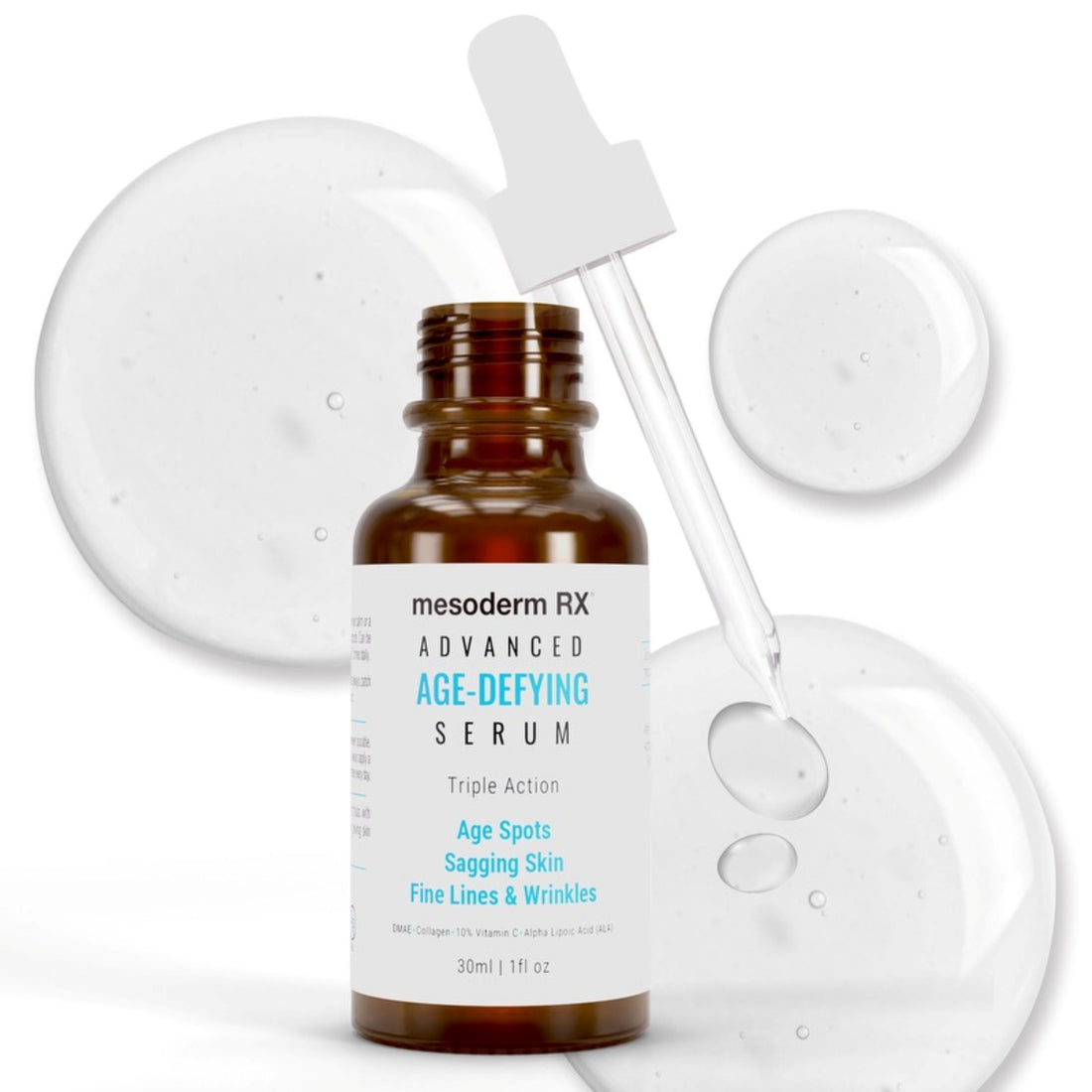
Featured Product
Advanced Triple Action Age-Defying Serum
TURN BACK TIME WITH A SERUM THAT RESTORES, REPAIRS, AND REJUVENATES
Shop Now →Understanding the Cellular Targets of Anti-Aging Serums
Skin doesn't “age” because it suddenly needs more expensive products. It ages because core repair systems become less efficient and because environmental exposure keeps injuring the tissue. A serum only matters if it addresses one of those biological targets.

Collagen and elastin breakdown
Firm skin depends on an intact extracellular matrix. Collagen gives tensile support. Elastin helps tissue recoil. With age and cumulative UV exposure, fibroblast activity becomes less efficient, matrix proteins fragment, and the skin's scaffolding weakens. The result is familiar: laxity, creasing, thinner-feeling skin, and slower recovery after inflammation.
A serum aimed at this pathway usually relies on cell-communicating ingredients rather than just moisture binders. Peptides, retinoid-adjacent strategies, antioxidants, and some growth-factor approaches all try to influence repair signaling or reduce the conditions that accelerate matrix degradation.
For readers who want a broader biology primer beyond skincare, the article at visit Understanding Ageing gives useful context on how aging reflects accumulated biological change across tissues, not a single event.
Oxidative stress and inflammatory injury
UV radiation and pollution generate reactive oxygen species. These unstable molecules damage lipids, proteins, and cellular DNA, and they also amplify inflammatory signaling. In skin, that means faster pigment irregularity, roughness, matrix breakdown, and a duller surface.
Antioxidants are highly valued for their skin benefits. Vitamin C is relevant because it helps neutralize oxidative stress and supports a brighter, more even look. Alpha lipoic acid is often included for antioxidant support as well. These ingredients don't erase years of damage, but they can reduce the daily biochemical pressure that keeps skin in a low-grade injured state.
A formula such as Advanced Triple Action Age-Defying Serum fits this antioxidant-and-support category on paper. The catalog describes a rich, creamy serum with peptides, DMAE, collagen, Vitamin C, and alpha lipoic acid, intended to fortify the moisture barrier and reduce the appearance of fine lines and wrinkles while promoting firmness, resiliency, and hydration.
Slower turnover and impaired repair
Aging skin often looks older before it is structurally older. That's because cell turnover slows, corneocytes accumulate unevenly, and the surface becomes rougher and less reflective. Repair after irritation also becomes less efficient. The skin can look tired, patchy, and texturally inconsistent even when wrinkles aren't yet severe.
This is why some serums seem to “work” quickly. Exfoliating acids and humectants can make the surface look better faster than matrix-directed ingredients can remodel tissue. That's useful, but it needs to be interpreted correctly.
A glowing surface isn't proof of deeper repair. It often means the stratum corneum is better hydrated or more evenly shed.
A disciplined review separates those layers. Surface refinement matters. Structural change matters too. They aren't the same endpoint.
Decoding Serum Reviews and Marketing Claims
Anti-aging serum reviews are often strongest at describing texture and weakest at identifying mechanism. That is why five-star language can attach to a formula that mainly improves light reflection, reduces transient dryness, or leaves a smoother film on the skin surface.
A useful review starts with one question. What biological process is this serum trying to influence?
If that question is missing, the review usually collapses into vague praise. “Glowy.” “Firming.” “My skin drank it up.” Those observations are not useless, but they describe user experience more than tissue change. In clinic, I treat those comments as clues about hydration, barrier compatibility, and cosmetic elegance. I do not treat them as evidence of collagen remodeling, pigment regulation, or improved epidermal turnover.
What short-term reviews can and cannot tell you
A brief trial can judge early performance with reasonable accuracy. It can show whether a serum stings compromised skin, whether it reduces visible dehydration, whether it pills under sunscreen, and whether the user can apply it consistently without irritation fatigue.
It cannot tell you much about matrix repair.
Claims tied to collagen support, elastin preservation, or gradual dyspigmentation correction need longer use and a formula with the right active system. A two-week review that promises “wrinkle reversal” usually reflects better hydration, temporary plumping of fine lines, or improved surface smoothness. Those changes matter. They just belong to a different tier of benefit.
That distinction becomes clearer when you compare review language with formulation logic. Serums built around humectants, silicones, and barrier lipids can produce fast visible improvement. Serums centered on signaling ingredients or slower remodeling pathways tend to show less dramatic early feedback, even when they are better matched to long-term goals. Readers who understand that difference make better decisions than readers chasing the loudest testimonial.
For example, a formula built around hydration and peptide support may be better judged by skin comfort, reduced creping, and steadier texture over time than by an overnight “lift.” That is the lens I would use when assessing serums that combine hyaluronic acid and peptides for smoother, firmer skin.
How to read review language clinically
Translate the claim into a likely mechanism.
If a reviewer says a serum is “tightening,” ask whether that effect came from water-binding humectants, film-formers, or temporary vasoconstrictive ingredients rather than any change in dermal architecture. If they say it is “brightening,” ask whether they mean improved reflectance from hydration and exfoliation, or true reduction in excess pigment production. Those are separate outcomes and they occur on different timelines.
Negative reviews need the same discipline. “Did nothing” may mean the product category did not match the user's problem. A resurfacing serum will not behave like a barrier-repair serum. A peptide serum will not produce the same rapid textural shift as an acid. A retinoid-adjacent formula may be biologically relevant but still disappoint a user who expected immediate softness and glow.
A review has value only when the serum's job is clear.
Review volume also needs context. Brands routinely generate customer reviews as part of standard ecommerce operations. That practice does not automatically invalidate every positive comment, but it does mean quantity is a weak proxy for rigor. The useful signal is specificity. Reviews that describe skin type, tolerance, timeline, concurrent actives, and the exact change observed are far more informative than generic praise.
Claims that deserve skepticism
Some phrases should lower your confidence immediately:
- “Visible wrinkle reversal” without a clear mechanism or timeframe
- “Works for everyone” despite large differences in barrier function, reactivity, and pigment biology
- “Gentle enough to use with anything” for formulas that contain meaningful levels of active ingredients
- “Clinical” without any explanation of what was measured, on whom, and after how long
The best reader of anti aging serum reviews is not the person who finds the most enthusiasm. It is the person who can separate cosmetic performance from biological effect, then decide whether the formula's design matches the actual aging pathway they want to address.
Evaluating Serums by Active Ingredient Efficacy
A useful serum review doesn't start with brand names. It starts with functional categories. Once you know what each category does, ingredient lists become easier to read and buying decisions become less emotional.
Active Ingredient Function and Targets
| Ingredient Category | Primary Function | Targets | Example Actives |
|---|---|---|---|
| Antioxidants | Reduce oxidative stress and support defensive capacity | Dullness, uneven tone, environmental stress | Vitamin C, Alpha Lipoic Acid |
| Cell-communicating agents | Influence repair signaling and skin behavior | Fine lines, firmness, resilience | Peptides, retinoids, growth factors |
| Resurfacers | Increase exfoliation and smooth the surface | Rough texture, clogged pores, uneven tone | AHAs, BHAs, PHAs |
| Humectant and barrier support | Improve water retention and reduce superficial dryness | Dehydration, tightness, flaky texture | Hyaluronic acid, barrier-supporting moisturizers |
Antioxidants
Antioxidants matter because visible aging isn't only a collagen problem. It's also an ongoing damage problem. If skin keeps absorbing oxidative stress from UV exposure and pollution, repair never fully catches up. Vitamin C remains relevant here because it supports antioxidant defense and brightening. Alpha lipoic acid is used for similar reasons in some formulas.
These ingredients are most valuable when your main concerns include dullness, uneven tone, and preventing the daily cascade that worsens aging markers. They're less satisfying if you expect an instant lifting effect.
For readers interested in longevity mechanisms beyond topical skincare, this comprehensive NAD booster analysis is a useful parallel resource. It's not about serums, but it does show how biological support claims should be evaluated through mechanism rather than marketing language.
Cell-communicating ingredients
This category includes peptides, retinoids, and growth factors. These ingredients try to shift how skin behaves rather than how it feels. That makes them central to any serious anti-aging strategy.
The strongest benchmark in this category comes from growth factors, but the lesson is not that every growth-factor serum is exceptional. In a dermatologist-led discussion, the most evidence-backed formulas were identified as SkinMedica TNS Advanced Serum and Neocutis Bio Serum Firm. Both were described as costing about $300 and as having human-subject clinical data showing measurable improvements in skin thickness and collagen, including some biopsy-based findings [dermatologist-led discussion on growth-factor serums]. That tells you something important: when clinically validated serums work at the high end, they tend to deliver modest but measurable structural changes, not miracles.
Clinical takeaway: The benchmark for a truly advanced serum is not dramatic overnight change. It's modest, defensible improvement with consistency.
Peptides belong in this conversation because they're often used to support firmness-focused formulations, especially for people who want a non-retinoid strategy or need a better-tolerated adjunct. If you want a consumer-facing overview of how hydration and peptide support interact, Mesoderm RX's piece on anti-aging serums with hyaluronic acid and peptides frames that relationship clearly.
Resurfacing acids
AHAs, BHAs, and PHAs work closer to the surface. They loosen cohesion between dead cells, improve texture, help brighten uneven tone, and can make pores look less congested. They often produce the quickest visible changes of any serum category, which is why they're frequently overpraised in reviews.
Their limitation is just as important. Surface renewal can make skin look younger without meaningfully changing deeper structural aging. That doesn't reduce their value. It defines it. A resurfacing serum is excellent when roughness, dullness, and discoloration are major concerns. It is not a replacement for a broader repair strategy.
Comparative Analysis of Popular Serum Formulations
Real-world serum shopping usually falls into three lanes. The expensive clinically oriented formula. The simpler single-active product. The multitasker built around several compatible pathways. Each has a legitimate place, but they solve different problems.

Archetype one high-cost dermatologist-brand serum
This is the category most likely to invest in proprietary complexes, physician-channel positioning, and stronger clinical support. The best example from the verified benchmark is the growth-factor class represented by SkinMedica TNS Advanced Serum and Neocutis Bio Serum Firm. The trade-off is straightforward. Potentially stronger evidence, significantly higher cost, and still only modest measurable change even when the data are respectable.
These serums suit the buyer who wants the highest-evidence lane available in topical skincare and accepts premium pricing. They don't suit someone who expects dramatic visible remodeling from one bottle.
Archetype two budget or single-ingredient serum
This category strips the formula down. One hero active. Minimal conceptual complexity. Often easier to troubleshoot because you can isolate what your skin tolerates. That simplicity is useful in sensitive skin or in routines that already contain multiple actives elsewhere.
The weakness is equally clear. A single-active serum rarely addresses the full biology of aging. Skin aging involves oxidation, matrix decline, pigment irregularity, inflammation, barrier status, and slower turnover. A one-note serum may help one pathway while leaving the rest untouched.
Here's a practical video perspective on comparing serum styles and what different formulations are trying to accomplish.
Archetype three multi-active performance serum
This is the most strategic category when formulated well. Instead of betting everything on one ingredient, it combines complementary mechanisms. A formula may pair antioxidants with peptides, or exfoliants with humectants and brightening support, so the serum does more than one job without requiring an overly complicated routine.
That approach is often the most rational for people managing overlapping concerns like fine lines, uneven tone, dehydration, and textural dullness. The challenge is formula discipline. More ingredients doesn't automatically mean better outcomes. The actives need compatibility, tolerability, and a clear role.
How I compare them in practice
I use four filters when reading anti aging serum reviews or assessing a formula in clinic-style terms:
- Target clarity: Is the serum built for structure, surface renewal, oxidation control, or support?
- Synergy: Do the ingredients reinforce each other, or are they just crowded onto the label?
- Tolerance burden: Can normal users apply it consistently without disrupting the barrier?
- Expectation fit: Is the promised result aligned with what that class of ingredients can realistically do?
A high-cost serum is justified when evidence and mechanism are unusually strong. A basic serum is useful when skin is reactive or the budget is tight. A multi-active serum makes sense when someone wants broader coverage with fewer steps.
The mistake is comparing all three as if they were trying to achieve the same endpoint. They aren't.
Integrating Serums Into a Results-Driven Skincare System
A serum doesn't rescue a bad routine. If the barrier is chronically inflamed, if exfoliants are overused, or if UV exposure isn't controlled, even a good formula underperforms. Results come from systems, not from isolated products.

Layering that respects skin physiology
Apply from lighter to heavier textures unless a specific product directs otherwise. That usually means cleanse first, optional hydrating prep second, serum next, moisturizer after. In the morning, sunscreen closes the routine.
That order matters because serums are treatment steps. They need direct contact with skin to do their job. Burying them under heavier occlusives reduces the point of using them at all.
- Morning use: Antioxidant-leaning serums fit well here because they support defense against daily exposure.
- Evening use: Repair-focused or resurfacing formulas are often easier to tolerate at night.
- Neck and hands: If aging is your concern, don't stop at the jawline.
Avoiding common conflicts
Most failures aren't because the serum is weak. They happen because the routine around it is chaotic. People stack exfoliating acids, retinoids, pigment agents, and multiple “anti-aging” serums in the same window, then blame the product when irritation follows.
A better approach is restraint:
- Choose one primary treatment lane based on the dominant concern.
- Add support around it with moisturizer and barrier-friendly care.
- Escalate slowly if skin remains stable.
- Pull back early when you see persistent burning, redness, or scaling.
Consistency beats intensity. Skin usually responds better to a tolerable plan repeated for months than to an aggressive routine abandoned after irritation.
Sun protection is not optional
No anti-aging serum can outwork daily UV injury. If collagen breakdown, uneven tone, and oxidative stress are the targets, then sunscreen is part of treatment, not an accessory. Without it, you're trying to repair while damage continues.
That's why daily broad-spectrum use belongs at the center of any results-driven routine. If sunscreen texture has been a barrier, this guide to non-comedogenic face sunscreen is a practical place to sort through finish and skin-type concerns.
The strongest serum routine is often the least theatrical. Cleanse. Treat with purpose. Moisturize as needed. Protect every morning. Repeat long enough to judge real change instead of chasing novelty.
Mesoderm RX formulates treatment-focused skincare around that same logic: fewer distractions, more purposeful actives, and routines built to brighten, smooth, and protect without turning skincare into a guessing game. If you want to explore the line, visit Mesoderm RX.