


SPF 50 for the Face: The Clinical Guide to UV Protection
The popular advice is that SPF 30 is enough for the face, so SPF 50 must be little more than marketing. That conclusion misses the clinical problem. The difference in laboratory UVB filtration is narrow, but people rarely apply sunscreen in laboratory quantities, often miss the hairline and jaw, and may not reapply when sweat, sebum, water, or friction disrupts the film.
For someone managing melasma, post-inflammatory hyperpigmentation, or persistent uneven tone, SPF 50 for the face is best understood as a behavioral buffer. It won't compensate for a thin layer or poor UVA coverage, but it gives you more practical margin when daily application isn't perfect. The meaningful question isn't only which number is printed on the bottle. It's whether the formula covers the wavelengths that worsen pigment and whether you'll apply enough of it consistently.
The Biological Reality of UV Damage and Melanin
Pigment can worsen without a sunburn. Ultraviolet exposure changes how pigment-producing cells behave, even when the skin looks calm and unred. UV radiation activates signals in the epidermis that stimulate melanocytes, the cells that produce melanin. One important pathway involves tyrosinase, an enzyme that helps convert cellular building blocks into melanin. Repeated exposure can keep this process active beyond the day of exposure, allowing discoloration to persist or deepen.
Melanin provides some biological protection by absorbing radiation and helping shield cellular structures. That protective response still appears clinically as darker patches, uneven tone, or lingering marks. Skin that has already been irritated or injured is more likely to develop an exaggerated pigment response. A blemish, eczema flare, rash, peel, or procedure can leave discoloration that becomes darker after ordinary daylight, even without obvious burning.
Three pigment problems that need different thinking
Melasma is a chronic, frequently recurrent pattern of facial pigmentation influenced by light exposure and hormonal factors. It often appears symmetrically across the cheeks, forehead, upper lip, and nose. Its biology differs from a sun spot, which is generally a more localized sign of accumulated photodamage.
Post-inflammatory hyperpigmentation, or PIH, develops after inflammation or injury. Acne, eczema, irritation, picking, and procedures can initiate the mark. UV and visible light may then darken the remaining pigment and delay a more even appearance. A clinical review of PIH and visible-light protection explains why photoprotection belongs in PIH management rather than being treated as an optional cosmetic measure.
Clinical principle: If inflammation starts the mark, light exposure can help maintain it.
A sun spot, melasma patch, and PIH mark may look similar, but their causes and treatment priorities differ. Brightening products can help regulate pigment formation, yet their effect is limited if daily light exposure continues to stimulate melanogenesis. Treatment therefore has two jobs: reduce new pigment signaling and give the skin barrier and existing discoloration time to recover. Consistent facial photoprotection supports both goals, particularly for patients whose pigmentation returns easily.
Decoding SPF 50 vs SPF 30 and the Under-Application Trap
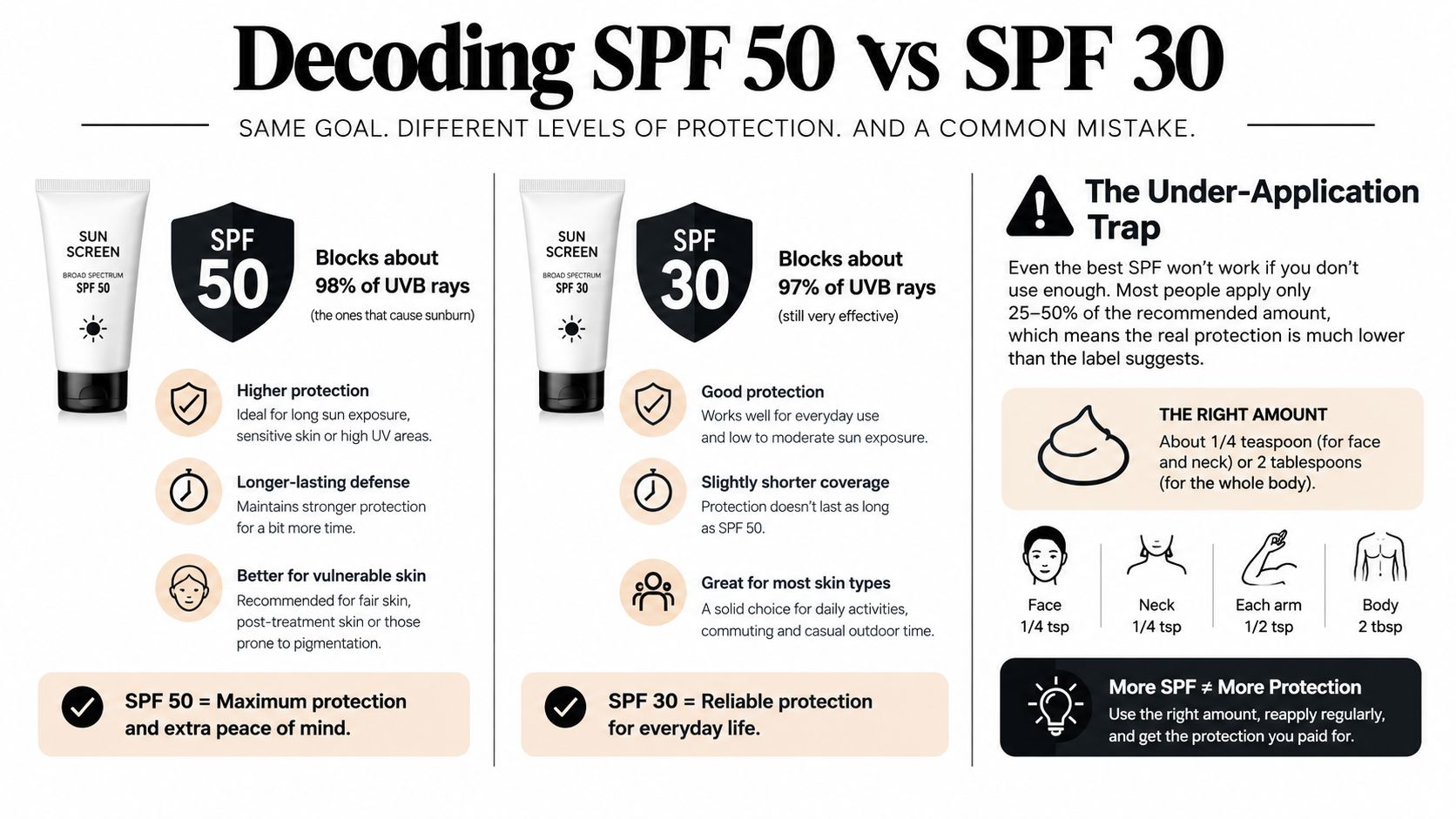
SPF is not a linear promise that you can stay outside a certain number of times longer. It primarily reflects protection against UVB, the radiation most closely associated with sunburn. Under standardized testing, sunscreen is applied at 2 mg/cm², a quantity many people don't achieve in daily use (Stanford's explanation of SPF testing and its limits).
At that test dose, SPF 30 blocks about 97% of UVB, while SPF 50 blocks about 98%, a difference of about one percentage point in UVB filtration (dermatology guidance on SPF 30 and SPF 50). SPF 50 still allows roughly 2% of UVB to reach the skin. The label therefore doesn't mean that SPF 50 is twice as strong as SPF 30.
Why the small difference matters clinically
The practical issue is dose error. Consumer coverage notes that people may apply only about a quarter of the amount required for the labeled protection, meaning an SPF 50 product can perform much closer to a low-SPF product when spread too thinly (coverage of sunscreen under-application and facial use). The precise result depends on the formula, layer thickness, distribution, and exposure, so you shouldn't treat an under-applied SPF 50 as having a predictable replacement number.
That changes the decision. SPF 50 doesn't rescue careless application, but it can provide extra margin for missed areas, uneven spreading, and ordinary variation in the amount used. This matters more for a patient with melasma or PIH than for someone choosing sunscreen solely to avoid an obvious burn.
| Question | What the number tells you | What it doesn't tell you |
|---|---|---|
| SPF 30 or 50 | Relative UVB protection under standardized testing | UVA protection, visible-light protection, or your real-world dose |
| Higher SPF | More UVB filtering and a larger buffer | Permission to apply less or skip reapplication |
| Facial formula | Whether the product feels wearable | Whether you'll use enough to reproduce its labeled protection |
A facial product such as Pigment Restraint Ultra High Sun Protection is described in its product information as fast-absorbing and non-greasy, with a protection complex covering UVA, UVB, IR, and HEV-combination rays. Whatever product you choose, the same rule applies: wearability supports adherence, but only the correct dose delivers the intended protection. For more detail on the relationship between tanning and sunscreen, see whether SPF 30 prevents tanning.
Broad-Spectrum Coverage and Visible Light Triggers
SPF 50 alone does not complete a facial pigment prescription. SPF primarily measures UVB, while UVA penetrates further and contributes to photoaging and persistent discoloration. The FDA identifies broad-spectrum labeling as the indication that a sunscreen addresses both UVA and UVB, rather than relying on the SPF number alone (FDA guidance on sunscreen and broad-spectrum labeling).
Pigment-prone skin may respond to several forms of light exposure at once. Melasma is influenced by UV and hormonal signals, while PIH follows inflammation or injury. Continued environmental stimulation can worsen either condition. A product may carry an SPF 50 label yet remain a poor choice for hyperpigmentation if its UVA protection is limited, its film spreads unevenly, or its finish encourages you to apply too little.
Visible light changes the shopping decision
Visible light, especially blue-light wavelengths, can darken susceptible skin. Reviews focused on PIH in skin of color identify tinted sunscreen containing iron oxides or pigmentary titanium dioxide as the best-supported approach for reducing visible-light-induced pigmentation compared with untinted products (review of visible light and PIH).
Tint serves a biological purpose here, not only a cosmetic one. Iron oxides can add visible-light protection and help the product blend across different skin tones. The trade-off is adherence. A tinted formula that looks unnatural, pills, transfers heavily, or feels uncomfortable may lead to inconsistent use. A transparent sunscreen applied generously can provide more practical protection than a theoretically complete product that you avoid wearing. Patients with persistent melasma or PIH should discuss visible-light coverage with a dermatologist.
Read the label in the right order
- Broad-spectrum statement: Confirm that the product addresses UVA and UVB.
- SPF 50 or higher: Treat the higher factor as a practical buffer, not permission to use less.
- Tint and iron oxides: Consider them when melasma or PIH is a major concern.
- Cosmetic finish: Select a texture that supports generous daily application.
- Exposure resistance: If you sweat or swim, choose a formula designed for those conditions.
A product such as Anti-Aging Powerhouse may support hydration, barrier care, and the appearance of fine lines, but a serum does not replace broad-spectrum sunscreen. For a clearer explanation of how labeling relates to UVA and UVB protection, read this guide to broad-spectrum SPF.
Mineral vs Chemical Filters for Reactive and Pigmented Skin
The mineral-versus-chemical debate becomes unhelpful when it treats one category as universally gentle and the other as irritating. Both categories can protect skin, and the complete formula, concentration, vehicle, preservatives, fragrance, and the user's barrier condition all affect tolerability.
Chemical, also called organic, filters absorb UV energy and convert it into less damaging forms, including heat. Mineral filters use zinc oxide or titanium dioxide. They also absorb much of the incoming UV, with scattering contributing to their optical behavior. The practical distinction for a patient is usually texture, transparency, filter profile, and the likelihood of irritation, not a simplistic claim that one category blocks while the other merely reflects.
Choosing for reactive skin
Mineral sunscreen can be useful when the barrier is sensitized or when a patient reacts to particular organic filters. Zinc oxide formulas may also suit people who want a shorter active-filter list. Their disadvantages are familiar: a thicker film, possible white cast, and a finish that may encourage under-application, especially on deeper skin tones.
Chemical and hybrid formulas often spread more easily and can be cosmetically elegant under makeup. That may improve the amount a person applies and the consistency of daily use. Some users, however, experience stinging around the eyes or discomfort on compromised skin, especially when the formula contains additional irritants or when sweat carries product into sensitive areas.
The right filter is the one your skin tolerates and you can apply generously every day.
For melasma, rosacea, acne, or active dermatitis, patch testing is sensible. Apply the candidate product to a small area and observe whether burning, itching, redness, or new breakouts develop. If a sunscreen repeatedly provokes inflammation, change the formula rather than forcing the skin to tolerate it. A non-irritating SPF 50 that you use correctly beats a theoretically ideal product that causes flares or sits unused in a drawer.
Layering SPF 50 with Brightening Serums and Cosmetics
Brightening serums and sunscreen perform different jobs. A serum may help regulate pigment pathways or support the skin barrier, while sunscreen reduces the light stimulus that can reactivate melanogenesis. The routine fails when active products irritate the skin or when vigorous rubbing disrupts the final protective film.
A stable morning sequence
- Cleanse gently. Remove overnight oil and residue without leaving the skin tight or burning.
- Apply water-based treatment products. Use a brightening serum or other prescribed active in a thin, even layer. Ingredients that target tyrosinase activity, support antioxidant defenses, or improve uneven tone belong before sunscreen.
- Allow the treatment layer to settle. It doesn't need to become completely dry, but it should no longer feel wet or roll under light rubbing.
- Moisturize if needed. Sensitive or dry skin may require barrier support before sunscreen. Oily skin may prefer a sunscreen that supplies enough emollience on its own.
- Apply broad-spectrum SPF 50 as the final skincare step. Spread it evenly over the face, ears, hairline, and neck. Don't mix it into foundation or moisturizer, because dilution and uneven distribution can reduce film integrity.
- Add makeup after the sunscreen has set. Press or glide cosmetics over the surface rather than repeatedly massaging the sunscreen away.
Exfoliating acids and retinoid-type treatments can improve texture and discoloration for some patients, but irritation is a pigment trigger in its own right. If your skin stings, flakes, or develops redness, reduce the frequency of the active and prioritize barrier repair. A stronger routine isn't automatically a better routine if inflammation keeps restarting the discoloration cycle.
Treatment products work on the pigment process. Sunscreen protects the treatment gains from being reversed.
Cosmetic compatibility is a clinical issue, not a luxury. A sunscreen that pills under concealer may lead you to apply less, skip the neck, or avoid reapplication. Select the combination that remains smooth after normal facial movement, because adherence is part of efficacy.
Clinical Dosing and the Mechanics of Reapplication
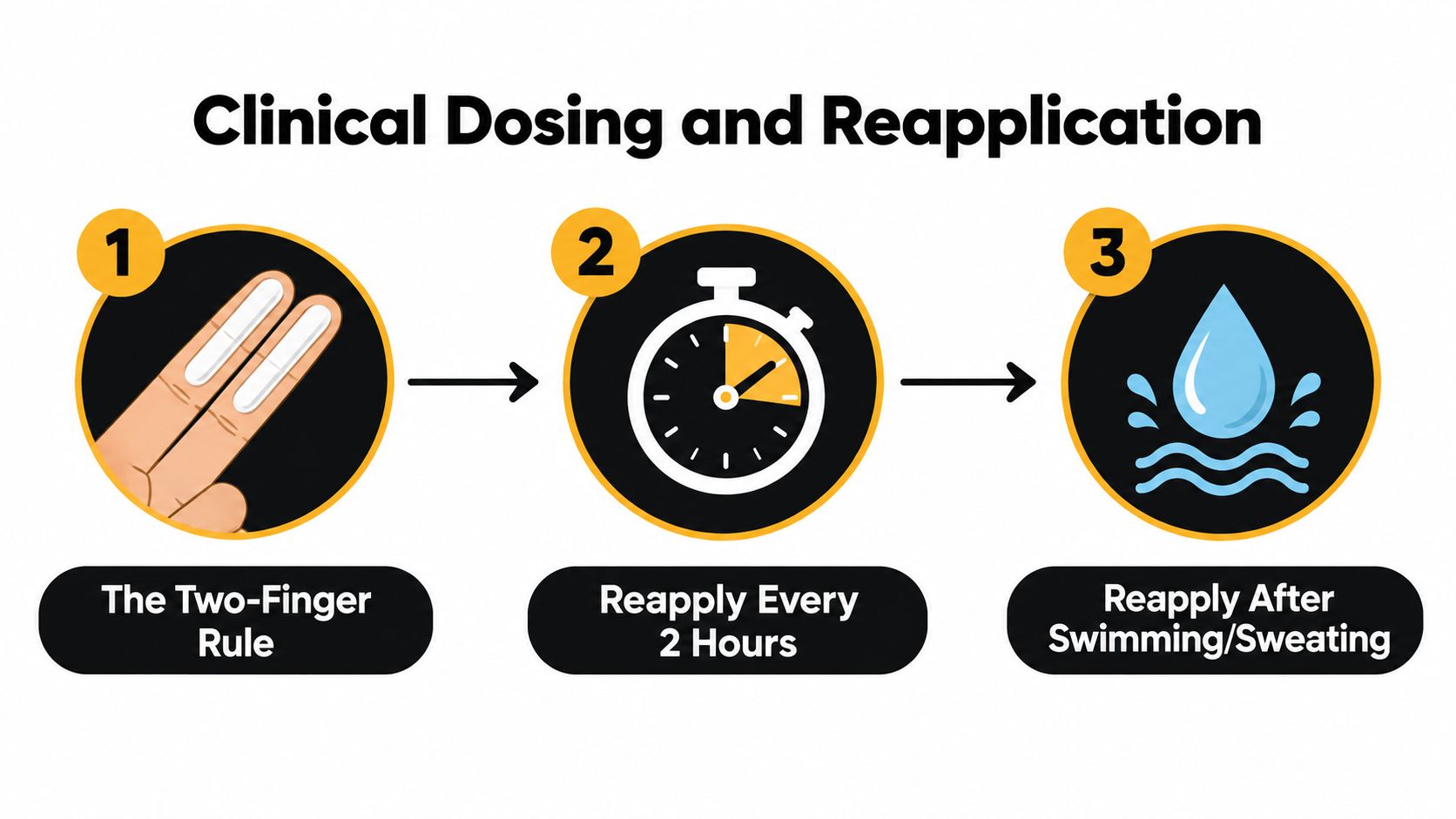
The labeled SPF assumes a defined layer. A thin, translucent smear may look tidy, but it creates weak points where radiation reaches the skin. For the face and neck, the commonly used practical approximation is one-quarter teaspoon or the two-finger rule, meaning a continuous strip of sunscreen along two fingers. The exact quantity depends on the product's texture and the area covered, so use the rule as a repeatable starting method rather than treating it as a decorative gesture.
Apply broad-spectrum sunscreen about 20 minutes before exposure, use the teaspoon approach for the intended coverage, and reapply every 2 hours, with additional application after swimming or sweating, as outlined in health-professional guidance (clinical sunscreen application guidance).
Make the dose workable
Apply the facial amount in two thin passes if a single layer feels heavy. First cover the forehead, cheeks, and nose. Then distribute the remaining product across the jaw, ears, hairline, and neck. This approach reduces the tendency to place most of the sunscreen in the center of the face and leave the perimeter exposed.
Reapplication isn't only about the filter chemically changing in sunlight. Sebum, sweat, water, tissues, hands, masks, collars, and facial friction can remove or thin the film. If you spend time outdoors, reapply directly over clean skin when practical. Over makeup, use a compatible cream or fluid and press it on in sections, accepting that makeup may need to be repaired.
Powders and sprays can be convenient for touch-ups, but they shouldn't become an excuse for applying an uncertain amount. A cosmetic powder may not provide the same dependable film as a measured lotion layer. For a detailed schedule, use this guide to how often to reapply sunscreen.
The Formulation Checklist for Daily Facial Sunscreen
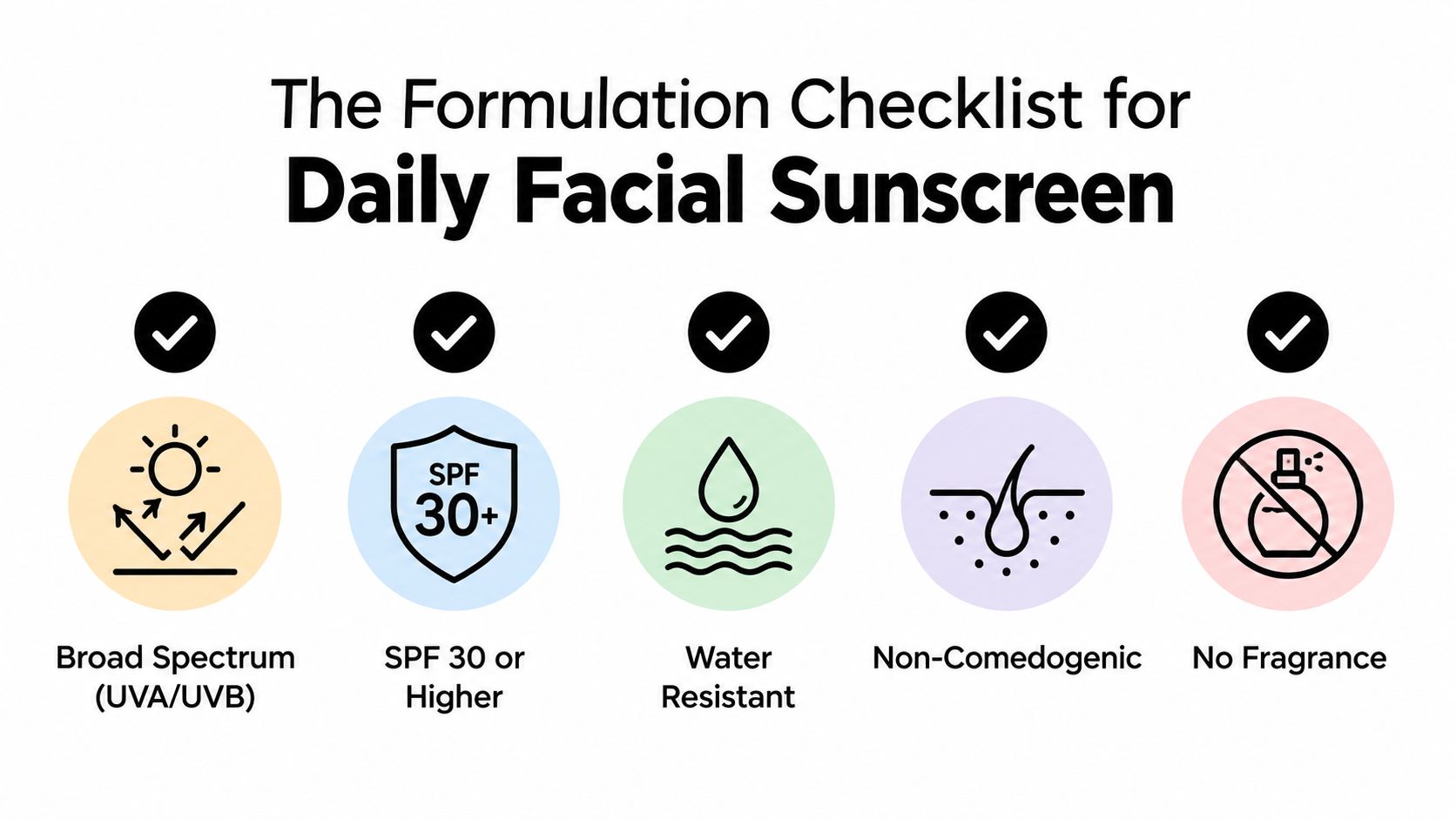
A facial sunscreen should pass a clinical checklist before it passes your bathroom mirror. SPF 50 is useful, but it isn't the whole product. I look for protection that matches the patient's pigment concern, a vehicle that supports adequate dosing, and a formula that doesn't create inflammation or cosmetic resistance.
The non-negotiable checks
- Broad-spectrum coverage: The label should identify UVA and UVB protection. SPF alone doesn't answer the UVA question.
- A high enough factor: SPF 50 or higher is a sensible choice for pigment-prone skin because it provides additional room for real-world application errors.
- Visible-light strategy: If melasma or PIH is central to your concern, consider a tinted formula with iron oxides or pigmentary titanium dioxide.
- A tolerable base: Avoid a product that reliably burns, itches, pills, or triggers breakouts. Added fragrance and heavy, pore-clogging textures can reduce adherence for reactive or acne-prone users.
- Exposure-appropriate wear: Choose water-resistant behavior when you swim or sweat, then reapply after the activity rather than assuming the morning layer remains intact.
Physical protection strengthens the routine. Shade, sunglasses, and everyday summer hats with UPF protection reduce the amount of light reaching the face and can make photoprotection more reliable during prolonged outdoor exposure. They don't replace sunscreen, but they reduce the burden placed on one product.
The best daily sunscreen is not the one with the most impressive claim on the front label. It's the one with broad-spectrum coverage, a clinically appropriate dose, visible-light support when needed, and a finish you'll reapply. That combination protects the biology behind dark spots instead of treating sunscreen as an afterthought.
Mesoderm RX offers targeted skincare for visible concerns such as uneven tone, dark spots, dryness, and signs of aging, including Pigment Restraint Ultra High Sun Protection for daily photoprotection. Review the range and build a consistent brightening and protection routine at Mesoderm RX.