


Dark Spot Corrector for Sensitive Skin: A Clinical Guide
Most advice on a dark spot corrector for sensitive skin gets one thing wrong. It treats pigmentation as a single-ingredient problem. Find niacinamide. Find tranexamic acid. Find azelaic acid. Apply it faithfully and wait.
That approach fails reactive skin all the time.
Sensitive skin doesn't just need a weaker brightener. It needs a system that lowers inflammation, protects the barrier, controls UV re-triggering, and fits around the rest of the routine. If you ignore that biology, even a well-chosen corrector can backfire. The skin stings, turns red, dries out, and the original pigment lingers or darkens.
The better question isn't, “What is the strongest spot treatment I can tolerate?” It’s, “How do I reduce pigment without provoking the skin that created it?” That is a protocol question, not a product question.
Patients often do better when they think in layers: calm the skin, correct the pigment, prevent reactivation, and avoid overlap with other irritating actives. Supportive options can help with that broader strategy. For readers exploring adjunctive approaches, this overview of gentle light therapy for delicate skin is a useful example of how inflammation-focused care can fit beside topical treatment rather than replace it.
The Sensitive Skin Dilemma Effective Correction Without Irritation
The false choice is familiar. “Gentle” products do very little. “Effective” products irritate. Sensitive skin users bounce between the two and conclude their skin can't be treated aggressively enough to fade discoloration.
That conclusion is usually wrong.
What fails is the method. Hyperpigmentation in reactive skin is tightly linked to inflammation and barrier disruption. When treatment itself creates repeated irritation, the skin reads that as another injury. Melanocytes respond, pigment pathways stay active, and the person thinks they need something stronger when they often need something smarter.
Why the usual advice breaks down
Single-ingredient thinking sounds clean, but real skin is more complicated. A serum may target melanin production while doing nothing to reduce the friction from over-cleansing, prescription retinoid overlap, or inconsistent sunscreen use. The result is a biologically mixed message. You are trying to suppress pigment while continuing to trigger it.
Three common failures show up repeatedly in practice:
- Overlapping actives: people layer exfoliating acids, vitamin C, retinoids, and a spot serum in the same window.
- Ignoring barrier status: stinging is treated like proof that the product is working.
- Underestimating UV exposure: visible light and incidental sun keep dark spots active even when the topical is appropriate.
Clinical reality: Sensitive skin can improve pigmentation. It just won't tolerate chaotic treatment.
A dark spot corrector for sensitive skin works best when it sits inside a controlled routine. That means fewer variables, slower escalation, and a clear reason for every step. Once you adopt that frame, the conversation changes from “What miracle ingredient am I missing?” to “What is my skin reacting to, and how do I stop feeding the cycle?”
Understanding Hyperpigmentation in Reactive Skin
Hyperpigmentation isn't one diagnosis. It is a visible result of excess melanin in the wrong pattern, at the wrong intensity, or in the wrong place. If you treat every dark mark as the same condition, you misjudge both the timeline and the treatment.

The three patterns that matter
Post-inflammatory hyperpigmentation or PIH follows injury or inflammation. Acne, eczema flares, picking, aggressive exfoliation, and even friction can leave a mark behind. This is the form most commonly worsened by sensitive-skin mistakes.
Solar lentigines are sun-driven pigment spots. They form after cumulative UV exposure and usually behave differently from PIH because the trigger is chronic photodamage rather than one inflammatory event.
Melasma is more complex. It often appears in patches rather than isolated marks, and it is more easily reactivated by heat, UV exposure, and internal triggers. Melasma usually punishes inconsistent routines.
A useful distinction:
| Condition | Typical trigger | Pattern | Common treatment challenge |
|---|---|---|---|
| PIH | Acne, rash, irritation, trauma | Marks where inflammation occurred | Ongoing irritation keeps creating new pigment |
| Solar lentigines | UV exposure | More discrete sun spots | Sun protection determines whether progress holds |
| Melasma | Multifactorial, often recurrent | Patchy, symmetrical discoloration | Relapse is common if heat and light triggers continue |
What melanin is doing
Melanin is protective pigment. Melanocytes produce it and transfer it into surrounding skin cells. The enzyme tyrosinase helps drive that process. Many brightening ingredients aim at this pathway directly or indirectly.
That mechanism matters, but sensitive skin adds another layer. The pigment pathway is not working in isolation. In reactive skin, inflammation often amplifies pigment signaling. Even low-grade irritation can keep melanocytes active.
This is why the person who “only used a gentle exfoliant” can still worsen dark spots. If the barrier was already fragile, even a modest trigger can create enough inflammatory signaling to deepen pigment.
Why sensitive skin behaves differently
Sensitive skin is not just skin that dislikes strong products. In many people, the barrier is easier to disrupt. Water escapes more readily. Irritants penetrate more easily. Nerve endings react faster. Inflammatory cascades become easier to trigger.
That changes treatment priorities.
- Barrier compromise raises reactivity
- Reactivity increases inflammation
- Inflammation can intensify pigment production
- More pigment invites more aggressive treatment
- Aggressive treatment restarts the cycle
You don't lighten reactive skin by attacking pigment harder. You lighten it by reducing the conditions that keep pigment turned on.
A useful piece of clinical evidence supports that gentler strategies can still produce measurable change. In a 56-day clinical evaluation using LC-OCT imaging, a brightening product reduced melanin volumetric density by 7.3% within dark spots and 12.3% in surrounding skin according to the published study. That matters because it shows non-invasive, sensitive-skin-compatible care can affect pigment at a cellular level without relying on brute force.
Why patients misread their own skin
Reactive skin often gives misleading feedback. Tingling gets interpreted as activity. Dryness gets dismissed as normal adjustment. Redness is blamed on weather instead of the routine. Then the user keeps adding products because the spots haven't faded yet.
Biologically, that makes little sense. If PIH is being driven by inflammation, then every avoidable flare delays the result. If the issue is sun-induced pigment, every skipped sunscreen day undermines the previous week of topical work.
The treatment logic should match the diagnosis:
- If the mark followed acne or irritation, reduce inflammation and avoid additional trauma.
- If it is sun-driven, correction without strict photoprotection won't hold.
- If it is melasma-like, routine consistency matters more than intensity.
Once you understand that hyperpigmentation in sensitive skin is part pigment disorder and part inflammation management, the protocol becomes much clearer.
Ingredient Selection A Clinical Protocol for Sensitive Skin
Sensitive skin does poorly with "strongest ingredient wins" logic. Hyperpigmentation in reactive skin usually improves when several lower-irritation mechanisms are combined in a way the barrier can tolerate for months. That means choosing ingredients that reduce pigment signaling, limit inflammatory spillover, and support recovery between active nights.

What to prioritize first
Start with barrier-supportive brightening. In clinic, these are the ingredients that patients can usually keep using long enough to see change.
- Niacinamide helps reduce transepidermal water loss and can quiet inflammatory signaling that drives post-inflammatory hyperpigmentation. It earns its place because it treats the background problem, not just the spot.
- Azelaic acid fits acne-prone, redness-prone, and PIH-prone skin unusually well. It addresses several problems at once, which lowers the temptation to stack too many products.
- Tranexamic acid is useful for stubborn discoloration, especially when the patient cannot tolerate another exfoliant or does not want a retinoid-based brightener.
- Licorice root extract is supportive, not primary. In a calm formula, that can still be useful.
- Stable vitamin C derivatives can work in sensitive skin if the formula is simple and the skin is not already inflamed from retinoids, acids, or over-cleansing.
The pattern matters more than any single ingredient. Mild to moderate inputs from multiple pathways usually outperform an aggressive formula that the patient has to stop after ten days.
Where exfoliation fits
Exfoliation has a role, but only if the skin can recover from it.
The mistake I see most often is using exfoliation as the main pigment strategy in someone whose barrier is already strained. Once the stratum corneum is disrupted, stinging rises, water loss rises, and inflammation rises with it. In darker skin tones or anyone prone to PIH, that irritation can create the very discoloration the routine was supposed to treat.
For reactive skin, choose resurfacing that stays subordinate to the rest of the routine. Lower-strength AHAs, PHAs, or carefully dosed mixed-acid formulas are often easier to place than a high-percentage peel serum used too often. Kojic acid, azelaic acid, and cysteamine may also fit selected routines, but they still need the same discipline. Skin that is already on edge does not need more stimulation. It needs the minimum effective dose.
Ingredients that often create trouble
Some active categories are effective in the right hands and poorly tolerated in self-directed routines.
| Ingredient category | Why people choose it | Why it often fails reactive skin |
|---|---|---|
| Hydroquinone | Potent pigment suppression | Irritation risk rises quickly when used without supervision or layered with other actives |
| High-concentration AHAs | Faster surface smoothing | Commonly trigger stinging, erythema, and barrier disruption |
| Traditional retinoids | Support turnover and pigment control | Useful, but easy to overlayer with acids and brighteners |
| Fragrance and denatured alcohol | Better cosmetic feel | Add irritation load without helping pigment biology |
Hydroquinone is the clearest example of a good ingredient becoming a poor plan. It can be effective, but sensitive skin users often pair it with exfoliating cleansers, acid toners, and retinoids because they want faster fading. The result is predictable. Redness, peeling, intermittent use, then abandonment.
High-strength acid products fail for a different reason. They can produce a short-lived polished look while increasing inflammation in the deeper routine. Patients then assume the dark spot corrector "isn't working" and add even more.
Selection rule: Choose the strongest routine your skin can repeat calmly, not the strongest ingredient label you can buy.
The retinoid conflict many routines ignore
People already using tretinoin, adapalene, or tazarotene need a different protocol from someone building a routine from scratch. Many pigment guides skip that distinction, which is why sensitive skin users end up layering a dark spot serum on top of a prescription retinoid and then blaming their skin for reacting.
Retinoids already increase cell turnover and can destabilize the barrier during the first phase of use. Adding direct acids, vitamin C in a low-pH formula, or multiple pigment suppressors on the same nights often pushes the routine past tolerance. The better strategy is separation.
A practical framework looks like this:
- Retinoid nights stay narrow. Use cleanser, moisturizer if needed, the retinoid, and barrier support.
- Off-nights carry the pigment work. Azelaic acid, tranexamic acid, niacinamide, or a carefully chosen resurfacing serum can be applied then.
- Morning protects the gains. A dark spot routine without daily SPF is biologically inconsistent.
For readers comparing formula styles, this guide to a brightening serum for sensitive skin shows the kind of low-additive approach that integrates more cleanly into a routine already using stronger actives.
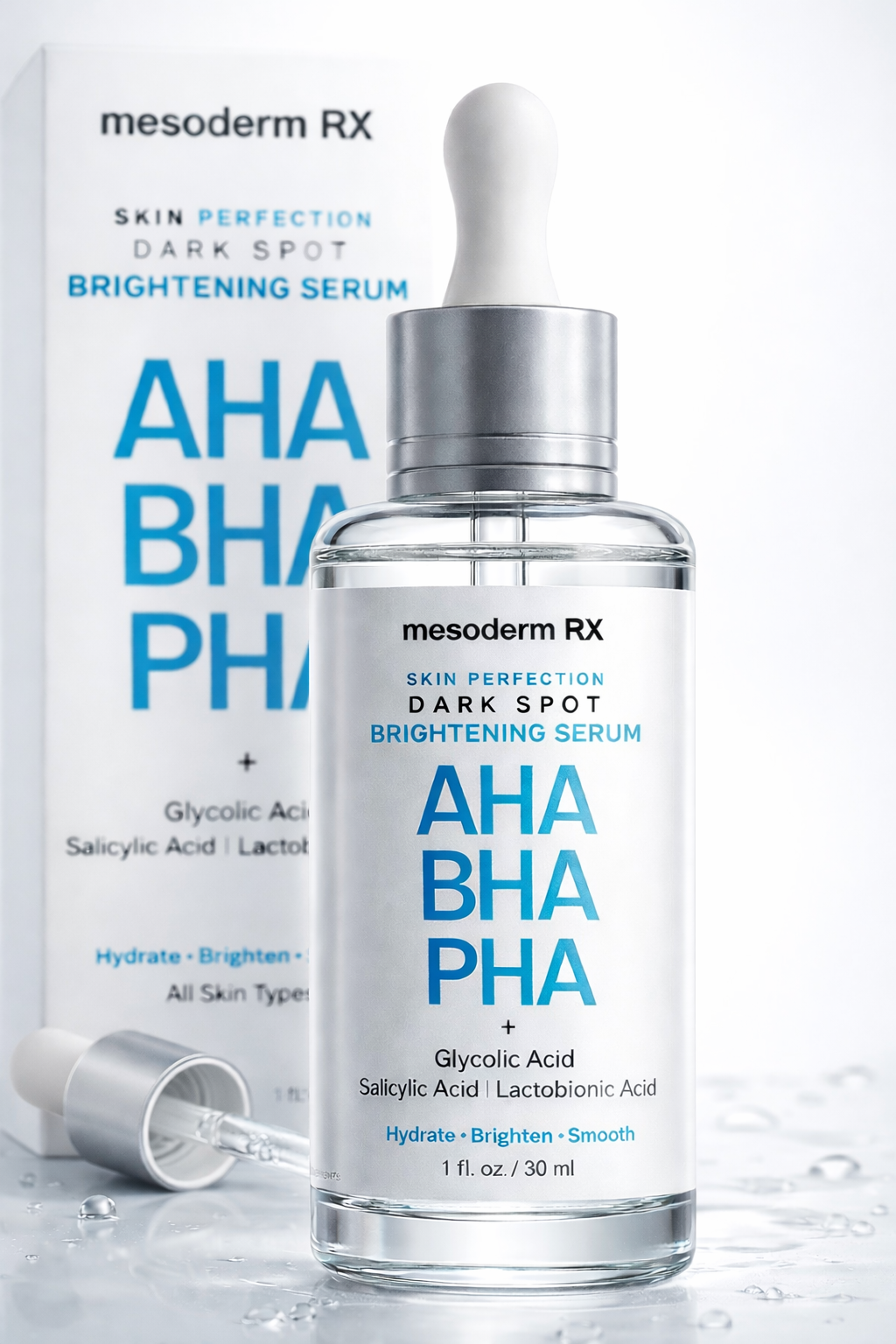
One product example that fits this logic is the Mesoderm RX AHA BHA PHA Dark Spot Whitening Serum. The point is not that it replaces a full protocol. The point is that a mixed-acid formula can sit on selected off-nights for patients who want controlled resurfacing without adding another retinoid to the schedule.
When in-office escalation makes sense
Topicals have limits. Deep dermal pigment, melasma-pattern discoloration, uncertain diagnosis, and recurrent PIH despite a careful home routine often need physician-guided treatment.
Chemical peels can help, but sensitive skin and deeper skin tones require conservative selection, careful priming, and realistic aftercare. If you are considering that route, it makes sense to find Swiss dermatologists for TCA peels through a directory that emphasizes qualified providers rather than informal advice.
Good ingredient selection is really routine architecture. Pick fewer actives, assign each one a role, and leave enough recovery capacity in the system for the skin to stay calm while the pigment gradually clears.
The Application Method A Disciplined Framework
Application technique decides whether a dark spot corrector helps sensitive skin or keeps it inflamed. I see the same failure pattern repeatedly. Someone buys a good formula, applies it too often, layers it with a retinoid and an exfoliating toner, then assumes the product is too harsh. In reality, the routine was poorly engineered.

Sensitive skin does better with controlled exposure, stable support steps, and enough recovery time to keep inflammation low. That matters because every avoidable episode of redness or barrier disruption can prolong post-inflammatory pigment.
Step one patch test in a facially relevant area
A forearm patch test is convenient, but it does not reliably predict how reactive facial skin will respond. The jawline or lower cheek is more useful because it behaves more like the skin you want to treat.
Use a simple sequence:
- Apply to a small discreet area: behind the jawline or near the lower cheek.
- Keep the rest of the routine unchanged: this is not the week to introduce a new cleanser, exfoliant, or mask.
- Watch for delayed reactions: stinging, warmth, rough texture, persistent redness, or itching that shows up the next day still counts.
- Increase surface area before frequency: if a small zone stays calm, expand the area first, then consider adding another application day.
This feels slow. For reactive skin, slow is efficient.
Step two start below tolerance, not at it
Dark spot care fails when patients treat daily use as the default starting point. Sensitive skin usually needs a staged introduction. The goal is not to prove toughness. The goal is to find the highest frequency your barrier can sustain for months.
A practical schedule looks like this:
| Phase | Frequency | Goal |
|---|---|---|
| Week 1 to 2 | 2 nights weekly | Check for stinging, delayed dryness, or redness |
| Week 3 to 4 | Every other night if tolerated | Build repeat exposure without cumulative irritation |
| After that | Adjust based on skin response | Maintain progress with a schedule the skin can tolerate |
If the skin becomes shiny, tight, warm, flaky, or unusually sensitive to moisturizer, reduce frequency. Those are barrier warning signs, not evidence that the product is working harder.
Step three assign different jobs to morning and evening
Pigment routines become much easier to tolerate when each time of day has a clear purpose. Morning is for protection and, if tolerated, gentle correction. Evening is for repair, cell turnover control, or prescription treatment. Problems start when every active is forced into the same session.
Morning routine
- Gentle cleanser, if needed.
- Dark spot corrector, only if the formula is appropriate for daytime use and does not sting.
- Moisturizer.
- Broad-spectrum sunscreen.
Evening routine without prescription retinoid
- Gentle cleanser.
- Dark spot corrector or resurfacing serum on scheduled nights.
- Moisturizer.
Evening routine with prescription retinoid
- Gentle cleanser.
- Moisturizer first, if buffering is needed.
- Prescription retinoid.
- Skip additional exfoliating or pigment-correcting actives in that same session unless a physician has specifically structured that combination.
That separation matters biologically. Retinoids already increase cell turnover and can strain a fragile barrier during the adjustment phase. Adding acids or multiple brighteners in the same window often creates more inflammation than pigment control.
A visual demonstration can help if layering order still feels abstract:
Sunscreen is part of treatment adherence
Pigment cells respond to inflammation and UV exposure by producing more melanin. That means a dark spot corrector without reliable sunscreen use is an incomplete protocol.
For sensitive skin, the best sunscreen is the one that can be worn in an adequate amount every day without stinging, pilling, or leaving a finish that leads to skipped use. Cosmetic elegance is not a superficial concern here. If the product is unpleasant, adherence drops. Once adherence drops, the correction plan loses consistency.
Common failure points include:
- Applying too little product
- Skipping sunscreen on cloudy days or while indoors near windows
- Using sunscreen only during outdoor events instead of as a daily pigment-control step
- Pairing a good treatment serum with a sunscreen that irritates the eyes or causes flushing
Step four simplify the surrounding routine
Sensitive skin rarely benefits from a crowded correction plan. A dark spot corrector works better inside a stable system with fewer variables.
During the first month, keep the rest of the regimen plain:
- Pause fragranced toners and scrubs
- Avoid stacking a second exfoliant
- Do not change cleansers during the adjustment period
- Separate prescription retinoids from correction acids unless your clinician has advised a schedule
- Use a straightforward moisturizer consistently, not only after irritation starts
This is the trade-off patients often resist. Fewer actives can produce better long-term fading because the skin stays calm enough to keep going. In reactive skin, consistency beats intensity.
Calibrating Expectations Timelines and Troubleshooting
Pigment treatment fails when expectations are unrealistic. People either expect overnight fading or they give up just before a properly built routine begins to show cumulative change. Sensitive skin adds another complication. You can't judge progress only by how dark a spot looks this week. You also have to judge whether the routine is keeping the skin calm enough to continue.
What realistic progress looks like
A useful clinical benchmark comes from a 12-week study of a pigment-correcting treatment in a diverse group with mild-to-moderate PIH and solar lentigines. Improvements appeared as early as Week 2, and by Week 12, 85% of participants reported overall improvement, with irritation measures such as burning, stinging, and peeling staying below 0.25, or mild, across visits in the published trial on pigment correction and tolerability.

That is the benchmark to remember. Early change can happen. Dramatic change is not the standard. Steady improvement with low irritation is the standard.
For a broader discussion of realistic fading windows, this guide on how long hyperpigmentation takes to fade is worth reading alongside your routine.
If your skin is red or stinging
The most common reason is not that the product is “too active.” It is that the total routine is too active.
Check these first:
- Overlap with retinoids or exfoliants: many patients are doubling up without realizing it.
- Application on damp or recently exfoliated skin: this can intensify penetration.
- Barrier already compromised: cleanser, climate, over-washing, and acne treatments all matter.
What to do:
- Stop the active for several days.
- Use a gentle cleanser and moisturizer only.
- Restart at a lower frequency once the skin feels normal.
- If stinging returns immediately, that formula may not be the right one.
Redness is not proof of efficacy. In pigment-prone sensitive skin, it is often the opposite.
If you are not seeing results
Lack of visible progress usually comes from one of four problems.
- The diagnosis is wrong: melasma, PIH, and solar lentigines do not behave the same.
- The trigger is still active: acne, rubbing, heat, or UV exposure can keep creating pigment.
- The product is too weak for the problem: mild discoloration and stubborn longstanding discoloration are different clinical tasks.
- Use has been inconsistent: spot treatment done sporadically is rarely enough.
Often, people overreact and buy a harsher acid. A better move is to audit the routine. Is sunscreen applied daily? Is the patient picking at acne? Is the retinoid schedule undermining barrier recovery? Is the corrector being used often enough to matter?
If the spots look darker
This deserves respect. Darker spots can mean ongoing UV exposure, recurrent inflammation, or irritation-induced PIH from the treatment itself.
A short troubleshooting table helps:
| Problem | Likely cause | Correction |
|---|---|---|
| Spots darken after outdoor exposure | Inadequate sun protection | Improve sunscreen use and reapplication habits |
| Spots darken after a new active | Irritant response or overlap | Stop, recover barrier, reintroduce slowly or switch |
| New dark marks keep appearing | Active inflammation such as acne or eczema | Control the primary condition first |
| Patchy relapse | Melasma-like behavior | Seek professional evaluation rather than self-escalating |
When to stop self-managing
If meaningful improvement has not occurred after three months of consistent use with daily SPF, dermatologic consultation is appropriate. At that point the issue may be diagnosis, depth of pigment, the need for a prescription option, or a need for in-office treatment.
That threshold matters because many patients either quit too early or self-treat too long. The middle path is more effective. Give the routine enough time to work. Then escalate intelligently rather than emotionally.
Building a Resilient System for Lasting Skin Clarity
Clearer skin rarely comes from a single corrective serum. It comes from a routine that stops provoking the problem while steadily addressing it. That is why the right approach to a dark spot corrector for sensitive skin is a system.
The system has four parts.
Respect the diagnosis
PIH, sun spots, and melasma can all look like “dark spots” online. They are not interchangeable in practice. The routine only works when it matches the biology of the pigment pattern.
Choose repeatable actives
Sensitive skin needs ingredients it can tolerate often enough to produce change. The goal is not to collect trendy names. The goal is to build a formula strategy that your skin can sustain without tipping into redness and rebound discoloration.
Apply with discipline
Patch test. Introduce gradually. Separate brighteners from prescription retinoids when needed. Keep the rest of the routine plain. Most failures come from excess, not from lack.
Defend results every day
Daily UV protection is what turns progress into stability. If that part is weak, everything else becomes temporary. For anyone still underestimating how much sun protection shapes long-term outcomes, this explanation of whether you can tan with SPF 30 helps clarify why “some protection” and “enough protection” are not the same thing.
Some people eventually need procedures, especially when texture and pigment coexist. If that becomes relevant, physician-directed options within ProMD Health aesthetic skin care show how a procedural plan can complement topical maintenance rather than replace it.
Mesoderm RX’s formulation philosophy fits this system well because it centers on more actives and fewer additives, avoiding common irritant extras while building routines around pigment correction, resurfacing, and sun protection instead of a single “magic bullet.”
If your skin reacts to most brightening products, don't assume you're stuck with discoloration. Build a calmer system, use actives with intent, and protect the results daily. If you want a simplified routine based on that logic, explore Mesoderm RX for hydroquinone-free, minimal-additive options designed to brighten, smooth, and protect sensitive skin without unnecessary complexity.