


Chemical Exfoliant with Salicylic Acid Benefits and Use
You've probably been there: your pores look congested, your skin feels rough, and dark marks seem more obvious after every attempt to “polish” them away. A scrub leaves your cheeks hot, an acid stings when you apply moisturizer, and reducing everything to “salicylic acid is good for oily skin” doesn't tell you what formula, strength, or schedule your skin can tolerate.
A chemical exfoliant with salicylic acid can be useful, but the ingredient name alone doesn't predict the result. Concentration, pH, vehicle, contact time, and the rest of your routine determine whether you get clearer pores and smoother texture or irritation that worsens uneven tone. The practical path is biological: understand how the acid works, diagnose why generic exfoliation advice fails, then choose a structured system that protects the barrier while addressing the right concern.
Why Your Exfoliation Routine Feels Hit or Miss
Consider two people using what appears to be the same salicylic acid product. One has oily skin, visible blackheads, and a resilient barrier. The other has dry cheeks, reactive redness, and a history of dark marks after irritation. Giving both people the same frequency and layering instructions ignores the variables that control tolerance.
The first person may need an oil-compatible exfoliant that reaches pore contents. The second may benefit more from a lower-irritation formula, less frequent use, or a gentler multi-acid approach that supports hydration while refining the surface. Neither outcome is determined by the word “BHA” printed on the label.
The result you're actually trying to create

Featured Product
Skin Perfection Liquid Exfoliant Peel AHA BHA PHA
Reveal your smoothest, clearest skin yet with our best-selling 2% BHA (Beta Hydroxy Acid) exfoliant. This lightweight, leave-on formula works deep within pores to unclog congestion, minimize blackheads, and boost skin clarity — without irritation.
Shop Now →Most exfoliation routines have several overlapping goals:
- Texture: Loosen excess corneocytes so the surface feels more even.
- Pore clarity: Reduce the buildup of sebum and dead cells associated with congestion.
- Tone: Improve the appearance of uneven pigmentation without provoking inflammation.
- Barrier stability: Keep cleansing, moisturizing, and sunscreen comfortable rather than creating chronic tightness or stinging.
These goals can conflict. A formula that aggressively removes surface cells may make texture feel temporarily smoother while weakening the barrier. In melanin-rich skin, inflammation can also stimulate excess pigment. That means a brighter-looking surface isn't a successful result if it leaves behind persistent redness or new dark patches.
Why trial and error creates confusing signals
Scrubs make pressure part of the dose. Stronger rubbing can produce an immediate smooth feeling, but it also makes application inconsistent across the face. Acids create a different problem. The same listed percentage may behave differently depending on acidity, neutralization, solvent system, and whether the product is rinsed off or left on the skin.
Professional treatments belong in a separate category. A resource on chemical peels exfoliation can help clarify how supervised resurfacing differs from an at-home leave-on product. At home, the safer question isn't “What's the strongest exfoliant I can use?” It's “What level of activity can I repeat without triggering irritation?”
That distinction shapes every useful decision that follows. Salicylic acid is often a strong match for oily skin and clogged pores, while tone-focused or sensitive-skin routines may need a more balanced formula and slower cadence.
How a Chemical Exfoliant With Salicylic Acid Works Under Skin
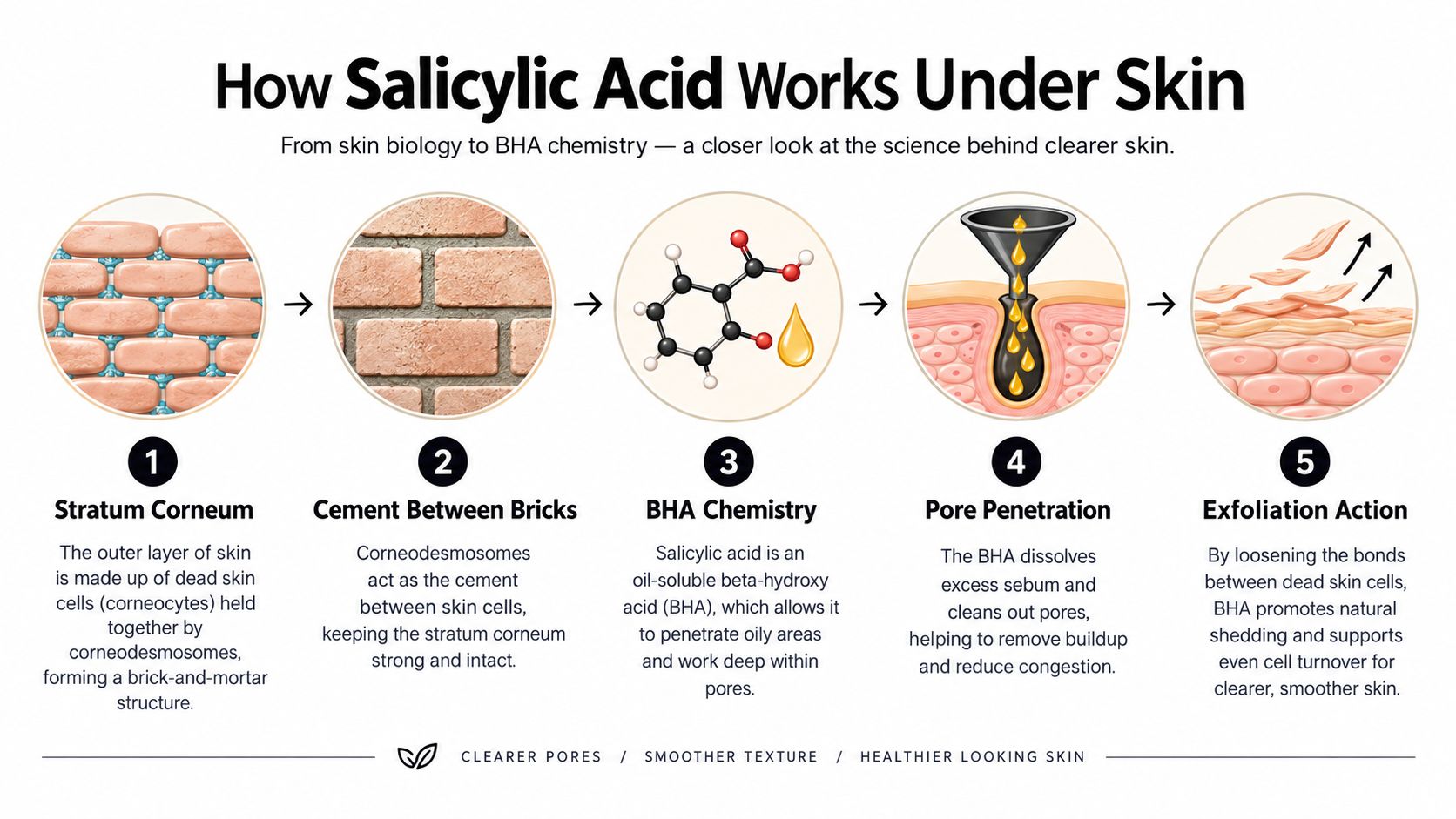
The outermost layer of skin, the stratum corneum, is built like a protective wall. Corneocytes act like bricks, while corneodesmosomes help hold those cells together. Natural shedding requires those connections to loosen in an orderly way, allowing older cells to leave the surface without stripping away the entire barrier.
From intercellular cement to controlled shedding
Salicylic acid is a beta-hydroxy acid, commonly abbreviated BHA. Its dermatologic action is primarily desmolytic and keratolytic. In plain language, it weakens the bonds between corneocytes and helps dissolve the intercellular “cement” that keeps dead cells attached.
That action promotes desquamation, the natural shedding of surface cells. It isn't the same as scraping skin away. The formulation is intended to make the attachments between cells less cohesive, so the surface can become more orderly over time.
At lower concentrations, salicylic acid has keratoplastic activity, supporting changes in how the outer layer forms. At concentrations of 1% or greater, authoritative drug references describe keratolytic activity. At 20% or greater, the action becomes caustic rather than a routine exfoliating effect, which is why professional-strength preparations cannot be treated like daily cosmetic serums. These thresholds are detailed in the salicylic acid drug monograph.
Why oil solubility changes pore behavior
Salicylic acid is oil-soluble. That property allows it to interact with sebum and reach the oily environment inside a pore more effectively than a water-soluble surface exfoliant. For someone with blackheads, whiteheads, or congestion, that makes BHA a logical choice because the target isn't only loose cells on the surface. It's also the mixture of oil and cellular debris within the follicular opening.
This doesn't mean salicylic acid physically “vacuums” a pore or permanently shrinks it. It means the chemistry is well matched to the type of material that contributes to pore blockage. For a broader explanation of how acids differ by working location and skin concern, these Skin Perfection exfoliation tips provide useful context.
A formula can combine this pore-oriented action with surface-focused acids. For example, the AHA + BHA + PHA Skin Brightening Serum 30ml lists glycolic, lactic, salicylic, and lactobionic acids alongside kojic acid, hyaluronic acid, and hexapeptides. Its product information describes use for uneven tone, acne pigmentation, texture, and visible pore clarity, with a fragrance-free, vegan, paraben-free formula made in the USA.
For a concise comparison of how a BHA product can fit alongside AHA products, see AHA and BHA products. The key principle remains simple: chemistry determines where the product can work, while the complete formula determines how comfortably you can use it.
Chemical vs Physical Exfoliation and What Matters for Tone
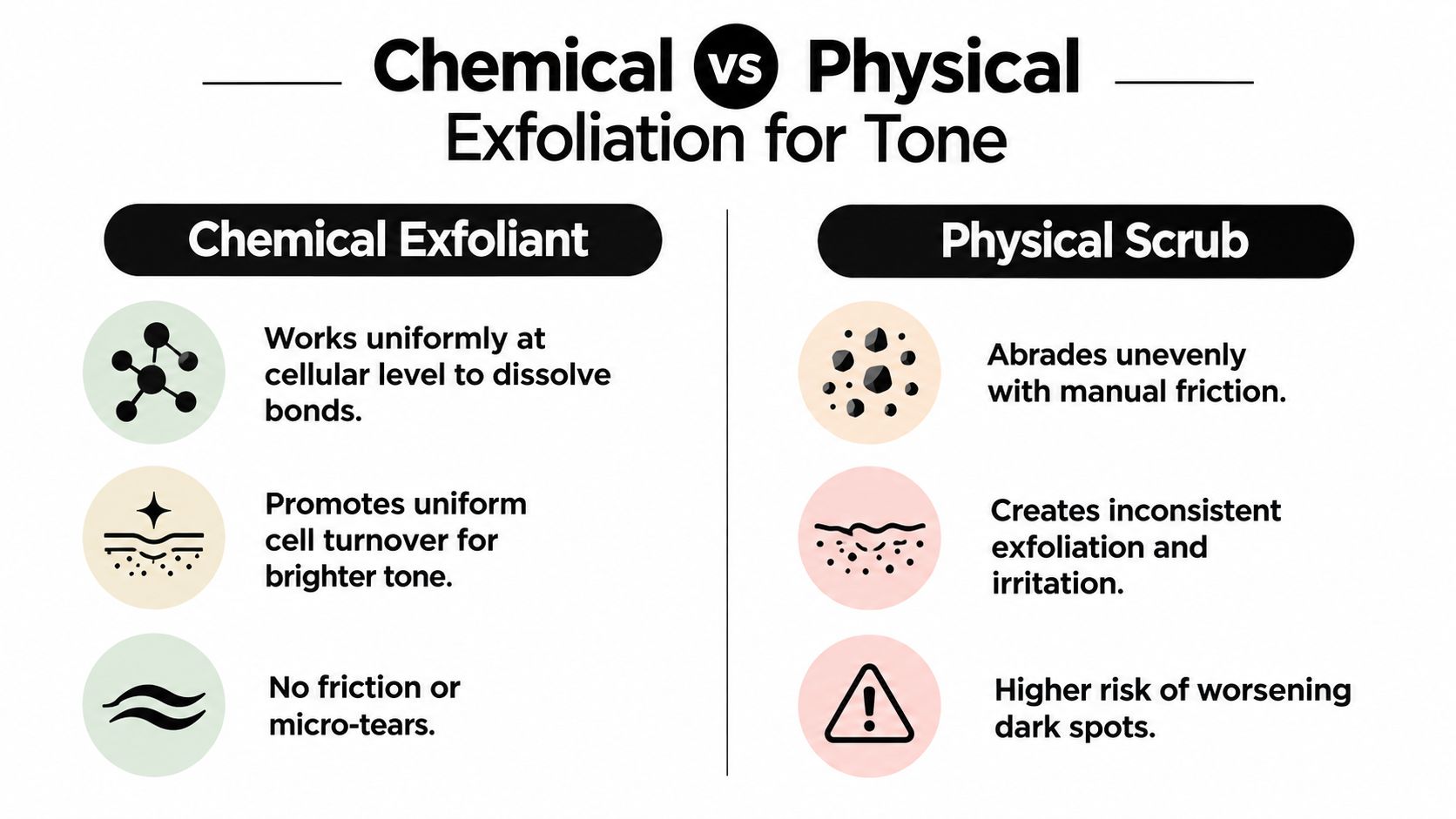
A scrub and a chemical exfoliant remove surface buildup through different routes. A physical product depends on particles, a tool, or your hand moving across the skin. A chemical exfoliant changes the bonds between cells so shedding can happen with less reliance on friction.
Why consistency matters more than intensity
Manual exfoliation is difficult to standardize. You may press harder around the nose, repeat strokes over a rough patch, or scrub longer because the skin doesn't feel smooth immediately. That uneven exposure can produce an uneven result, especially when the barrier is already dry or inflamed.
Chemical exfoliation can be more uniform because the active is distributed through a vehicle across the intended area. It still isn't automatically gentle. A low-pH acid, a high active load, frequent application, or a drying solvent can create irritation even without visible abrasion.
Tone adds another layer. Melanin-producing cells respond to inflammation, so aggressive friction or acid overuse can contribute to post-inflammatory hyperpigmentation. This risk deserves particular attention for darker skin tones, where irritation-related darkening can persist after the original redness has resolved.
| Method | Main action | Useful when | Main concern |
|---|---|---|---|
| Chemical exfoliant | Loosens cellular bonds through chemistry | You want more even surface shedding or pore support | Irritation from unsuitable strength, pH, or frequency |
| Physical scrub | Removes buildup through friction | You prefer a tactile cleansing step and tolerate it well | Uneven pressure, mechanical irritation, and barrier stress |
| Professional peel | Uses a controlled, higher-strength treatment | A clinician is addressing a defined concern | Requires trained assessment and aftercare |
Choosing for the concern, not the trend
Choose BHA when oil, blackheads, whiteheads, and follicular congestion are the dominant problems. Choose a gentler surface exfoliant when the main issue is dullness, roughness, or uneven tone and your skin becomes tight or reactive easily.
A combination system can make sense when both pore clarity and surface tone matter, but “more acids” isn't a treatment plan by itself. You still need a vehicle that supports tolerability and a schedule that leaves room for the barrier to recover.
Procedures such as microneedling and chemical peels also work through different mechanisms and require different safety decisions. This microneedling vs chemical peel guide is useful background when you're comparing professional resurfacing options with home care. A home exfoliant should never be selected as though it were a substitute for a supervised peel.
Ideal Concentrations pH and Formulas for Every Skin Type
Percentage is important, but it's only one part of formulation architecture. The pH, acid form, vehicle, and contact time influence how much active reaches the skin and how much stinging a person experiences.
Regulatory assessments from the European Commission's Scientific Committee describe salicylic acid as safe for non-preservative cosmetic use up to 3.0% in rinse-off hair products and up to 2.0% in other products, while preservative use is capped at 0.5%. An official assessment also notes historical cosmetic concentrations up to 2% in leave-on creams and rinse-off products and up to 1% in leave-on hair care. These limits provide formulation context, not a reason to chase the upper boundary. See the European Commission safety assessment.
For acne preparations, the American Academy of Dermatology guideline lists topical salicylic acid at 0.5% to 2%, with application 1 to 3 times daily, while noting that many users start once daily and increase only if needed. The same guideline distinguishes superficial professional peels, typically 20% to 30% and applied for 2 to 4 minutes depending on clinical response. These are not interchangeable categories. The AAD acne guideline makes that separation clear.
How pH changes the experience
A controlled study compared a 2% salicylic acid preparation at pH 3.12 with a near-neutral 1% salicylic acid and salicylate system at pH 6.50. The acidic preparation increased exfoliation by 10.9% versus placebo, while the near-neutral system produced comparable corneodesmolytic activity after two days. The higher-pH system also produced no stinging, compared with a stinging score of 19 for the acidic preparation. These findings are reported in the controlled salicylic acid formulation study.
That result changes the buying question. A sensitive-skin product doesn't necessarily need to eliminate salicylic acid. It may instead use neutralized chemistry, a suitable vehicle, and a controlled delivery profile to preserve useful activity with less sensory discomfort.
| Skin Type and Goal | Recommended Concentration | pH and Vehicle Note |
|---|---|---|
| Oily skin with blackheads or congestion | Start within the 0.5% to 2% topical range | An oil-compatible leave-on serum or cleanser can target pore contents. Adjust frequency before increasing strength. |
| Acne-prone skin with a fragile barrier | Lower end of the 0.5% to 2% range | Favor a hydrating vehicle and avoid stacking other irritating actives. |
| Dry skin with occasional congestion | Conservative topical strength | Choose a lotion or serum vehicle with barrier-supportive hydration rather than an astringent format. |
| Sensitive or reactive skin | A gentle, neutralized system may be preferable | Look for pH optimization and a soothing, moisturizing vehicle. Stinging is a formulation signal, not proof of effectiveness. |
| Professional resurfacing goal | Not a home-use selection | Peel strengths such as 20% to 30% require professional judgment, controlled contact time, and appropriate aftercare. |
A liquid exfoliant guide such as best liquid exfoliant can help you compare formats, but the label still needs to be read in context. If your broader concern is dullness and age-related loss of firmness rather than pore congestion, Collagen Revitalizer is described in its catalog as an oral daily skin-support product containing hydrolyzed collagen peptides, vitamin C, hyaluronic acid, and an antioxidant complex. It belongs to a different category from a topical exfoliant and shouldn't be evaluated as a replacement for one.
How to Layer Frequency and Sun Protection Without Irritation
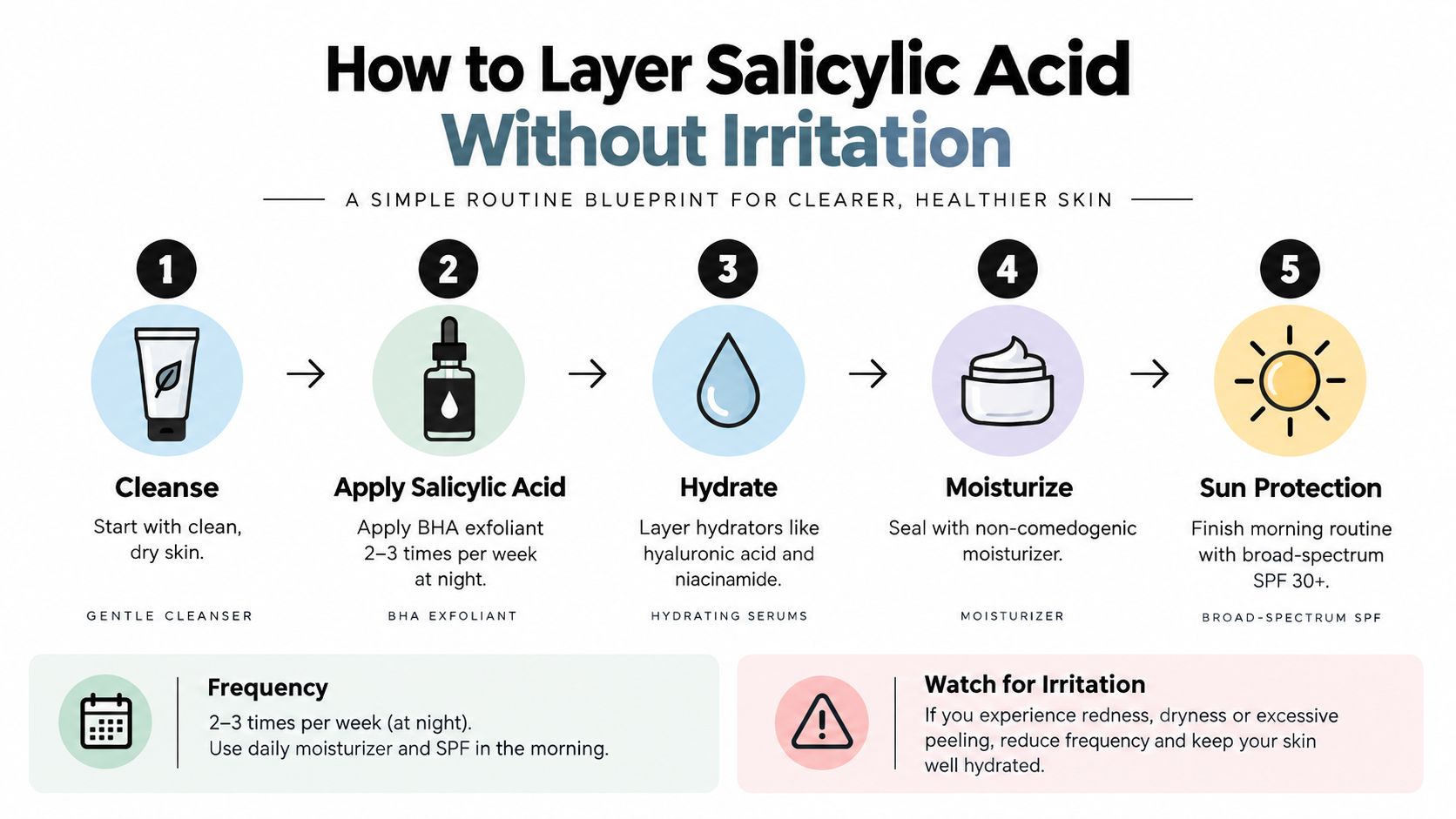
A good exfoliant routine has a clear order and enough restraint to let you interpret your skin's response. Start with a gentle cleanser, apply the salicylic acid product to clean, dry skin, then follow with hydration and moisturizer. In the morning, sunscreen is the final protective step.
A practical cadence
The AAD guidance allows topical salicylic acid 1 to 3 times daily, but it also describes starting once daily and increasing only if needed. That range shouldn't be interpreted as a target for everyone. Your skin's tolerance, the product's vehicle, and whether it's rinse-off or leave-on matter more than maximizing applications.
A cautious routine looks like this:
- Cleanse gently. Avoid using a harsh cleanser immediately before the acid.
- Apply the exfoliant. Use the product as labeled, keeping it away from the eye area and damaged skin.
- Hydrate. A simple humectant layer, such as a hyaluronic-acid product, can support comfort.
- Moisturize. Use a non-comedogenic moisturizer that reduces water loss without adding unnecessary irritation.
- Protect in the morning. Apply broad-spectrum sunscreen every morning, especially when your goal is more even tone.
Begin with a low frequency and increase only after your skin remains comfortable. Don't introduce a salicylic acid leave-on product during the same period as a new retinoid, benzoyl peroxide product, strong AHA, or abrasive scrub. Changing several variables at once makes it impossible to identify what caused a reaction.
Separate brightening from exfoliating nights
Tyrosinase is an enzyme involved in melanin production. If dark marks are the main concern, an exfoliant can help improve the surface environment, but it isn't a complete pigment strategy. Inflammation control, consistent sunscreen, and appropriate brightening ingredients matter because irritation can worsen the very discoloration you're trying to reduce.
Use one active focus per evening while you establish tolerance. A hydrating serum and moisturizer can accompany the exfoliant, but multiple strong treatment layers can turn a measured routine into cumulative barrier stress.
Routine rule: If moisturizer suddenly stings, the skin feels persistently tight, or redness lasts beyond the application period, reduce the exfoliant before adding anything else.
Safety Side Effects and Myths That Worsen Dark Spots
A mild, brief sensation doesn't prove that an exfoliant is working, and the absence of sensation doesn't mean it's inactive. The controlled study described earlier found a major difference in stinging between an acidic and neutralized salicylic acid system, while the neutralized formula retained comparable exfoliating activity.
Signals that require a change
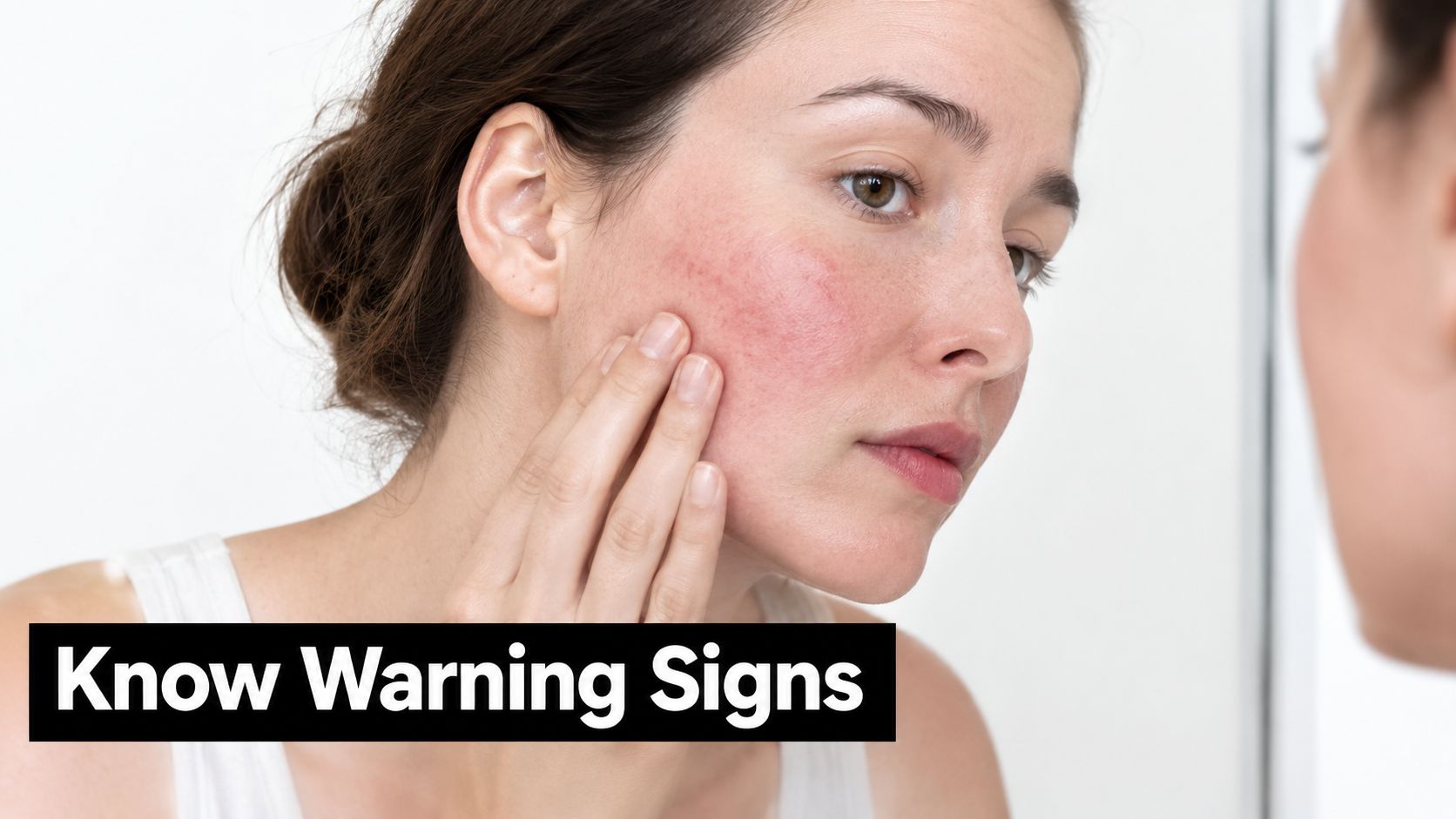
Persistent stinging, visible erythema, marked peeling, worsening tightness, or new pigmentation are not desirable milestones. Pause the exfoliant, simplify cleansing and moisturizing, and avoid adding another active while the skin settles. If symptoms persist or a dark patch develops after irritation, seek professional assessment because post-inflammatory hyperpigmentation, contact dermatitis, and an aggravated underlying pigment condition need different approaches.
The myth that a higher percentage always produces better results is particularly damaging. Concentration, pH, vehicle, and contact time determine delivery, and professional peel strengths are chemically and clinically distinct from everyday leave-on products. A stronger product used inconsistently because it hurts may deliver less practical benefit than a milder formula used steadily.
Daily aggressive exfoliation is another poor shortcut. The skin barrier needs a routine it can tolerate repeatedly, not a cycle of stripping and recovery. For a focused discussion of salicylic acid and dark marks, salicylic acid for dark spots provides additional product-selection context.
Sensitive skin isn't automatically excluded. A clinical source reported that neutralized salicylic acid at pH 6.50 caused no stinging, while the same acid at pH 3.12 caused strong stinging, with no significant erythema difference versus placebo. The authors concluded that neutralized 1% salicylic acid was suitable for sensitive-skin users, supporting a formulation-first approach rather than a blanket ban.
Choosing a Gentle Minimal Additive Formula That Fits Your System
The right product is the one that matches the problem and fits the rest of your routine. For oily pores and comedones, prioritize a well-designed BHA vehicle and a manageable topical strength. For uneven tone with reactive skin, consider whether a multi-acid system can distribute the work across surface exfoliation, pore support, hydration, and pigment care without forcing one aggressive active to do everything.
Check the label and the routine together:
- Identify the target: Oil and congestion point toward BHA. Surface dullness and texture may justify AHA support. Reactive skin may benefit from PHA inclusion.
- Assess the architecture: Look for stated concentration where available, sensible pH positioning, and a vehicle that doesn't leave skin tight.
- Limit additive stress: Fragrance, harsh cleansing, abrasive particles, and multiple simultaneous actives can complicate tolerance.
- Plan the cadence: Start conservatively, track stinging and redness, and don't increase frequency because the product feels mild.
- Protect tone: Consistent broad-spectrum sunscreen matters whenever exfoliation is part of a pigmentation routine.
Mesoderm RX Skin Perfection Liquid Exfoliant Peel AHA BHA PHA is one example of a multi-acid product described in the catalog with 2% salicylic acid, glycolic and lactic acids, lactobionic acid, kojic acid, hyaluronic acid, and hexapeptides. Its listed positioning is a non-abrasive leave-on exfoliant for pore clarity, texture, uneven tone, and hydration, with a formula described as made in the USA, vegan, paraben-free, and fragrance-free.
Treat that type of product as part of a system, not as permission to stack every active in your cabinet. Choose the formula that addresses your dominant concern, introduce it gradually, and let barrier comfort determine whether the routine is sustainable.
Mesoderm RX offers AHA, BHA, and PHA-based formulas designed for resurfacing, pore clarity, hydration, and uneven-tone concerns, including minimal-additive, fragrance-free options made in the USA. Visit Mesoderm RX to compare the Skin Perfection exfoliating systems and choose a formula that fits your skin's tolerance and daily routine.