


Whitening Body Lotion for Dry Skin: A Real Guide
Most advice about whitening body lotion for dry skin starts in the wrong place. It tells you to find the strongest acid, scrub harder, or chase an “instant glow.” That approach can make dry skin look temporarily brighter while increasing irritation, scaling, and the pigment left behind after inflammation.
The more useful question is different: can the formula improve uneven tone without weakening the barrier that keeps the skin calm? In practice, brightening and moisturization are not competing goals. For dry body skin, they're part of the same treatment plan. A lotion that fades the appearance of discoloration but leaves the skin stinging, tight, or flaky is poorly designed for the problem.
Why Whitening and Dry Skin Are the Same Problem
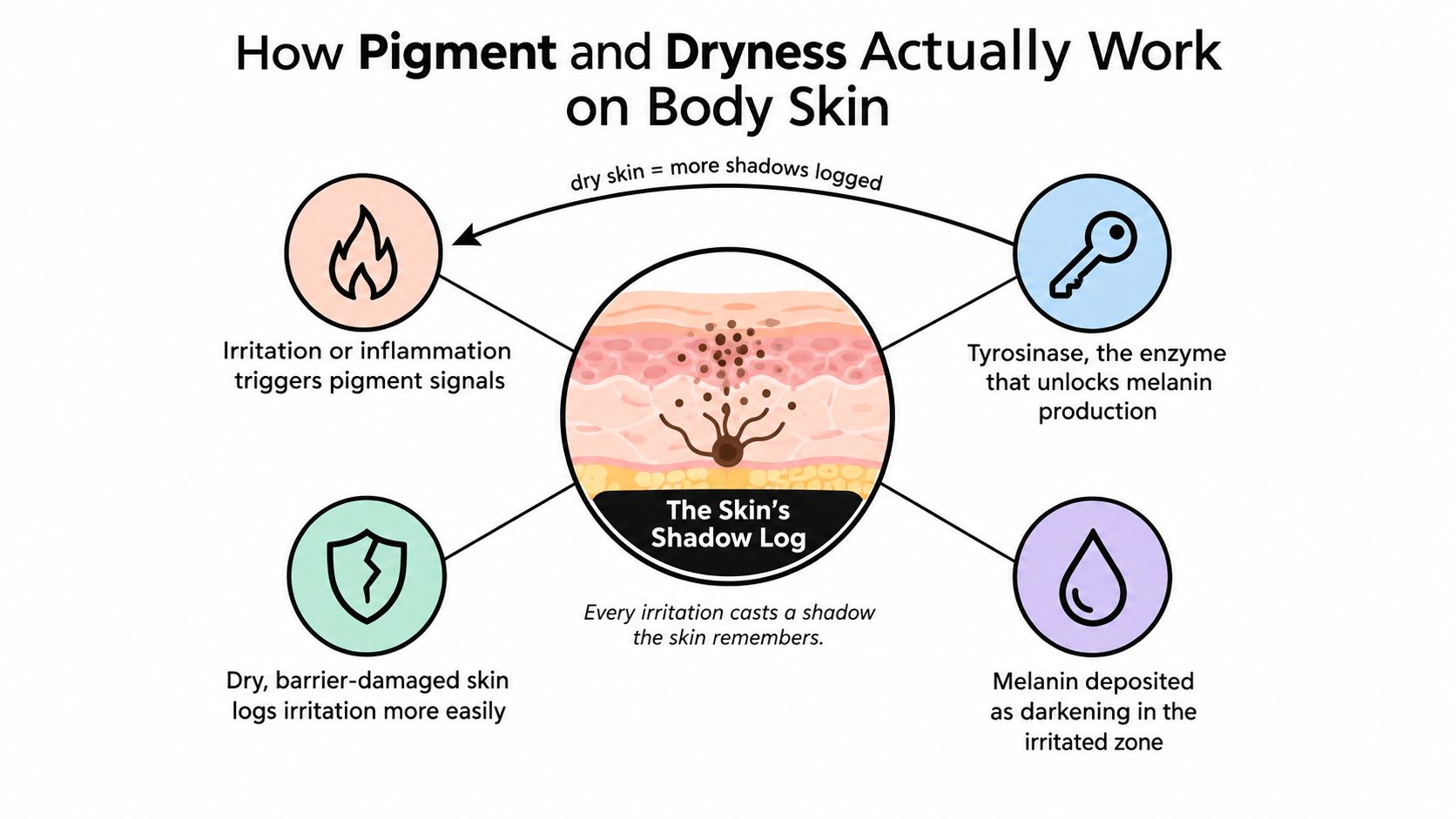
Dryness and uneven tone are often sold as separate concerns, but compromised skin doesn't behave in separate compartments. When the barrier loses water, the surface becomes more vulnerable to friction, hot water, shaving, detergents, and active ingredients. Those irritants can trigger inflammation, and inflammation can intensify the pigment response.
That creates a cycle. The user sees dullness or dark patches, applies a stronger exfoliant, irritates the area, and then interprets the resulting redness or deeper discoloration as proof that the product needs to work harder. The correct response is usually better barrier support, not more aggressive bleaching.
Demand is hydration-first
The commercial context supports this approach. The global body lotion market was valued at USD 21.83 billion in 2025 and is projected to reach USD 50.22 billion by 2034, according to Persistence Market Research's dry-skin cream, lotion, and ointment market analysis. The same source reports that the dry-skin segment represented more than two-fifths of global body lotion revenue in 2022. A separate estimate placed the dry-skin lotion category at about USD 8.7 billion in 2024, with a projection of USD 13.2 billion by 2033 at a 4.7% CAGR. These figures show that dryness isn't a niche issue. It's a central reason people buy body lotion.
That matters for brightening products. Consumers aren't looking for a face-style pigment serum poured into a thin body emulsion. They want hydration first, then a gradual improvement in tone and texture. A body lotion that can't keep roughness under control won't make discoloration look better for long.
Clinical rule: If a brightening product consistently causes burning, persistent redness, or increased flaking, it's not treating dry skin effectively, regardless of how impressive its ingredient list looks.
The framework is straightforward. First, understand how inflammation, melanin, and the barrier interact. Next, identify whether the concern is true hyperpigmentation, an inflammation-related mark, or surface dullness from accumulated scale. Finally, use a low-irritant, fragrance-conscious routine with daytime sun protection. Whitening, in this context, means controlled brightening of uneven tone, not stripping the skin lighter.
How Pigment and Dryness Actually Work on Body Skin
Melanin is the pigment that gives skin much of its color. Tyrosinase is a key enzyme involved in melanin production. When skin experiences inflammation, the surrounding pigment cells can receive signals that increase pigment activity, especially in the area that has been irritated.
I use a simple analogy with patients: post-inflammatory hyperpigmentation is the shadow cast by every irritation the skin has logged. A scratch, rash, shaving injury, or repeated friction can leave a shadow after the original problem has disappeared. On dry body skin, the barrier is less resilient, so ordinary actions such as rubbing with a towel or taking a very hot shower may become more consequential.
Post-inflammatory hyperpigmentation, or PIH, isn't the same as every brown patch. It can develop wherever prior inflammation, irritation, dermatitis, or physical or chemical injury occurred, as described in the NCBI Bookshelf overview of post-inflammatory hyperpigmentation. That distinction matters because a lotion can soften roughness without addressing the pigment pathway that created the mark.
Three concerns often called “dark skin”
True hyperpigmentation is excess visible pigment that remains after the trigger has ended. A brightening active may help, but progress depends on stopping the trigger and protecting the area from further exposure.
Post-inflammatory marks are a specific type of hyperpigmentation. They often follow eczema, folliculitis, shaving irritation, acne on the chest or back, or friction. Niacinamide may support a calmer barrier and improve the appearance of uneven tone, but it won't remove an ongoing source of inflammation.
Surface dullness comes from dryness, compacted scale, and rough corneocytes reflecting light unevenly. Humectants, emollients, and carefully selected keratolytics can make this skin look more radiant because they improve texture. That isn't the same as changing melanin production.
Melasma is another distinct condition. Expert commentary in EMJ Reviews' discussion of hyperpigmentation treatment describes it as involving inflammation, tyrosinase activity, and a vascular component. That complexity is why a single body lotion shouldn't be presented as a universal answer for every dark patch.
A clinically reviewed meta-analysis covering 7 studies and 337 participants found a statistically significant effect of tested formulations on hyperpigmentation versus placebo, with an odds ratio of 4.260, a 95% confidence interval of 2.244 to 8.087, and p<0.001, as reported in the 2025 review and meta-analysis in Archives of Dermatological Research. A separate body-focused trial reported self-reported hyperpigmentation improvement in 84.38% of participants after 60 days, with 62.86% reporting improvement after 30 days. Those findings support measurable potential, but they don't erase the need to identify what caused the discoloration.
Featured Product
Brightening Advanced Body Essence Lotion
Reveal Radiant Skin with Mesoderm RX Whitening Advanced Body Essence This advanced cosmeceutical brightening essence targets hyperpigmentation, sun damage, and age spots on the hands, arms, legs, feet, and back.
Shop Now →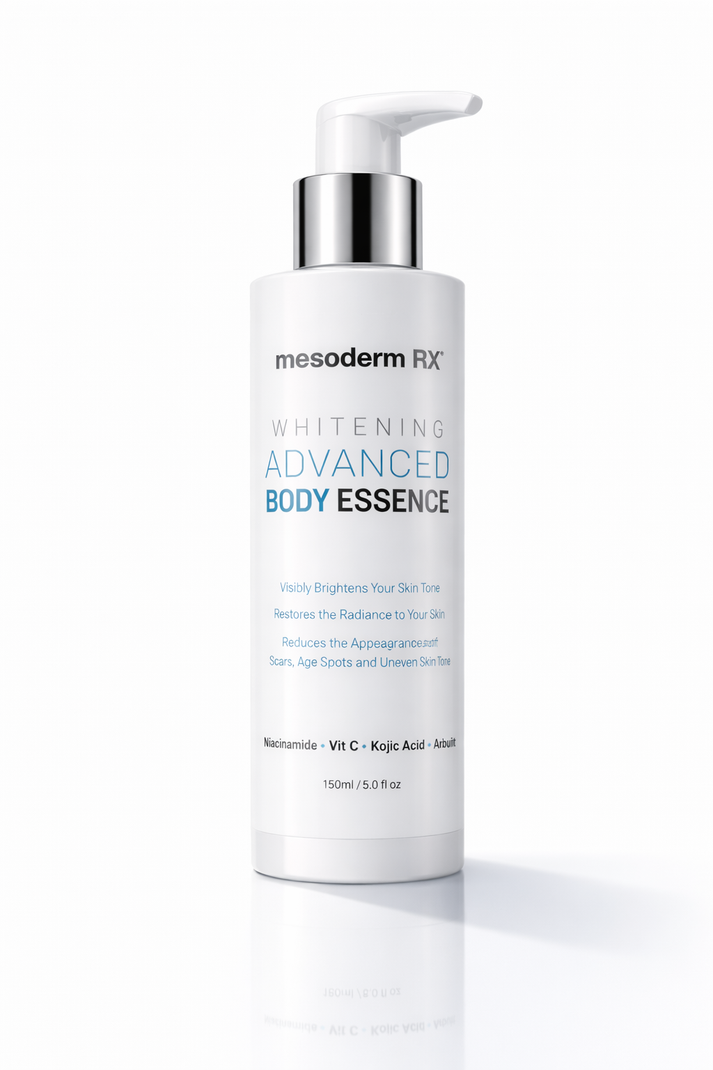
For readers comparing options, Whitening Advanced Body Essence Lotion lists glycerin, niacinamide, vitamin C, kojic acid, alpha arbutin, shea butter, panthenol, vitamin E, and hyaluronic acid among its ingredients. Its product guidance says to apply it at night to clean, dry affected areas and use daytime SPF. The ingredient list also includes fragrance, so someone with reactive or fragrance-sensitive skin should read the full INCI rather than rely only on a sensitive-skin positioning statement.
Why Most Whitening Routines Fail on Dry and Sensitive Skin
The most common failure isn't a lack of effort. It's too much irritation disguised as commitment. People apply a brightening lotion to skin that is already inflamed, add a scrub or acid, notice more roughness, and keep going because the product promises faster results.
Lemon and sugar scrubs are a classic example. Lemon juice can irritate, while abrasive sugar crystals create friction and small areas of barrier disruption. The combination doesn't selectively remove pigment. It can instead create the inflammation that encourages more uneven tone.
Fragrance-heavy lotions and essential-oil blends create a similar problem for some users. “Natural” doesn't mean non-irritating, and a pleasant scent doesn't prove that a formula supports dry skin. If a lotion leaves the body warm, itchy, or prickly after application, repeated use can turn a brightening routine into a steady source of low-grade irritation.
The marketing tricks are easy to spot
Product pages often blur three different outcomes:
- Optical brightness: Silica, mica, iron oxides, or other optical materials can make skin look more luminous immediately. That's a visual effect, not evidence that pigment has been reduced.
- Surface smoothness: A humectant or emollient can soften scale and improve light reflection. This is useful, but it doesn't prove that a dark mark has changed biologically.
- Pigment modulation: Ingredients such as niacinamide or carefully selected brightening agents may gradually improve uneven tone through different mechanisms.
Multiple high-strength acids create another trap. A dry-skin user may layer an exfoliating body wash, an acid serum, and an acidic lotion because each product seems mild on its own. Together, they can increase stinging, redness, and flaking. The skin doesn't care whether the irritation came from three different product categories. It records the total exposure.
Surfactants can also matter. A harsh cleanser may disrupt the organization of the outer barrier, while frequent hot showers and vigorous towel drying remove protective lipids and increase tightness. Once the skin is irritated, even a normally tolerable active can sting.
What I tell patients: A product that makes you red is not proving that it's working. It may be proving that the dose, frequency, or formula is wrong for your barrier.
The “instant glow” promise deserves skepticism. If the immediate result disappears after cleansing, it was probably optical or textural. Sustainable brightening requires a calmer surface, consistent moisturization, correction of the underlying trigger, and protection from new pigment stimulation.
Brightening Actives That Work Without Wrecking the Barrier
The best active depends on what the skin is showing. A dry, rough leg needs a different strategy from a smooth but persistent post-inflammatory mark. The practical mistake is choosing an ingredient by reputation rather than matching it to the condition and the barrier.
Niacinamide is often the most useful starting point because it can support barrier function while addressing the appearance of uneven tone. It doesn't work by directly inhibiting tyrosinase in the way many consumers assume. A controlled study found no effect on mushroom tyrosinase or melanogenesis in cultured melanocytes, but observed 35% to 68% inhibition of melanosome transfer and reduced pigmentation in a skin model, as detailed in the British Journal of Dermatology study on niacinamide. In a randomized clinical study, a 4% niacinamide treatment produced good-to-excellent improvement in 44% of patients, compared with 55% for hydroquinone.
For very dry skin, urea is especially practical. A formula containing around 10% urea can help bind water in the stratum corneum while smoothing scale, and lower-strength systems may be used when the skin is more sensitive. Niacinamide paired with glycerin, ceramides, or similar barrier ingredients is usually more comfortable than a brightener built around repeated exfoliation alone. Ulta's listing for a niacinamide and urea brightening body lotion illustrates this formulation logic.
A practical comparison
| Active | Effective concentration | Dry skin tolerance | Overuse warning |
|---|---|---|---|
| Niacinamide | A clinically studied example uses 4% | Usually compatible with barrier-focused formulas | Flushing, tingling, or irritation can occur in sensitive users |
| Urea | Around 10% can hydrate and smooth rough scale | Useful for dry, rough body skin | Stinging is more likely on cracked or actively inflamed skin |
| Alpha arbutin | Label-dependent, use a transparent formula | Generally gentler than aggressive exfoliation | Avoid stacking multiple pigment actives immediately |
| Licorice derivatives | Label-dependent botanical brightening support | Often well tolerated in a balanced lotion | Botanical extracts can still irritate sensitized skin |
| Lactic acid | Use a clearly disclosed, moderate body-care formula | More forgiving than harsher exfoliation for some users | Burning and scaling indicate excessive frequency or strength |
| Azelaic acid | Formula-dependent, often useful for inflammation-linked tone | Can be effective but may tingle at first | Don't combine with several other irritating actives at once |
| Tranexamic acid | Label-dependent topical brightening support | Tolerance depends heavily on the vehicle | Stop if persistent irritation develops |
The table's central lesson is simple: the vehicle determines whether the active is usable. Glycerin, ceramides, cholesterol, fatty acids, shea butter, and squalane can help a treatment remain comfortable. A lotion that contains a brightener but relies on fragrance, drying alcohol, or excessive exfoliation may perform worse in real life.
For a deeper explanation of how humectants and barrier lipids work together, see this guide to barrier repair moisturizers. If the skin is cracking, weeping, intensely itchy, or developing a persistent rash, stop active treatment and seek a clinical assessment rather than escalating the product.
Building a Morning and Night Routine That Actually Brightens
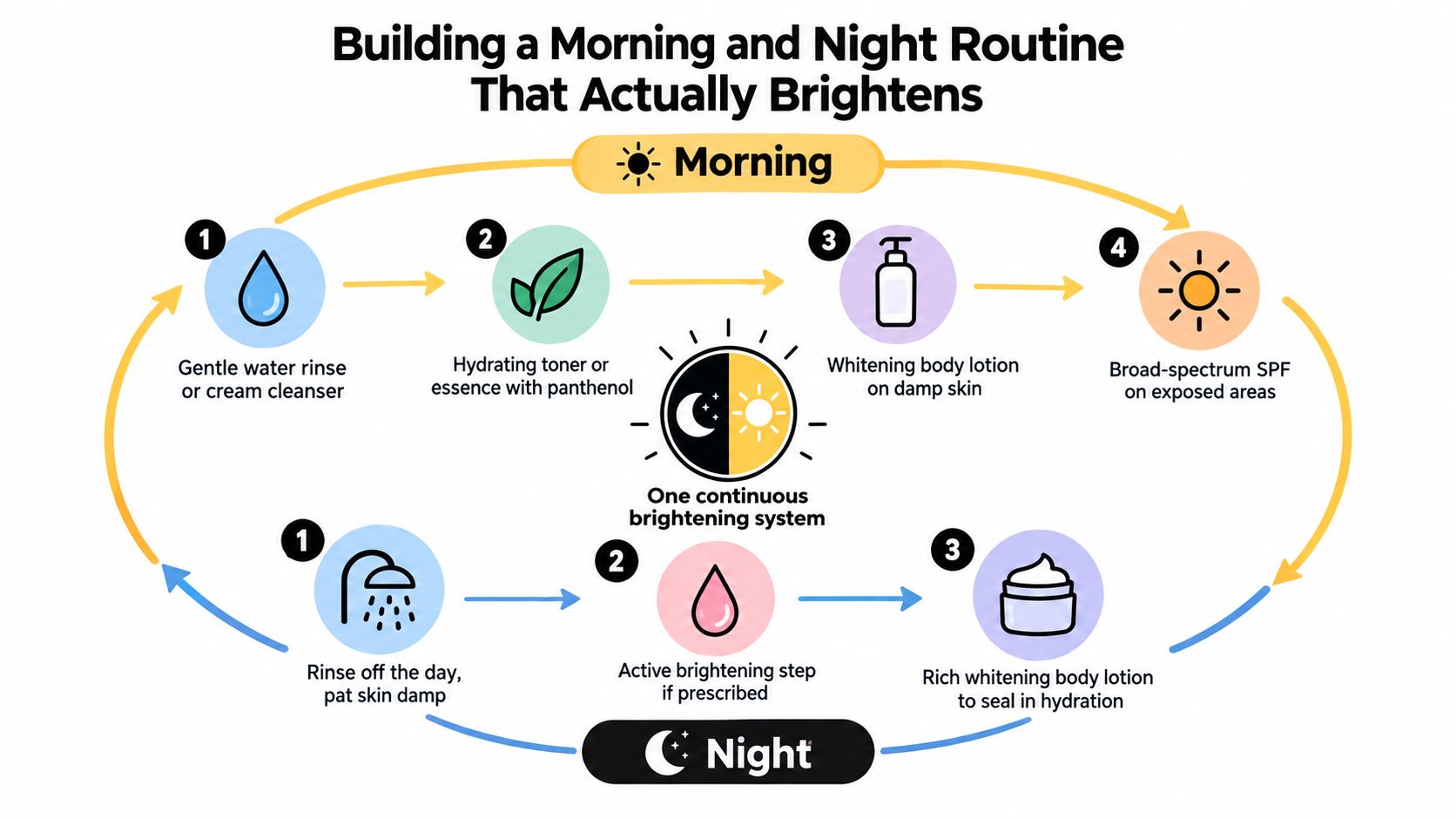
A successful routine is continuous. Morning protection preserves the work done at night, while night treatment allows you to use brightening ingredients without adding unnecessary daytime exposure to freshly treated skin.
Morning begins with comfort
Start with a gentle water rinse or cream cleanser. The goal is to remove residue without leaving the body tight. Follow with a hydrating toner or essence containing ingredients such as panthenol or glycerin if the skin benefits from an extra water-binding layer.
Apply a niacinamide or alpha-arbutin product only if the skin is calm and the formula fits the rest of the routine. Then use a barrier-repair moisturizer with ingredients such as ceramides and squalane. On exposed areas, finish with broad-spectrum sunscreen. Apply the lotion to slightly damp skin when the formula is designed for that use, but follow the product's directions if it specifies clean, dry skin.
Night is for controlled correction
If you wore sunscreen, cleanse with a cream cleanser or an oil-based product that rinses clean. Pat the body dry rather than rubbing it. Use a lactic-acid or azelaic-acid leave-on treatment only on a limited schedule, such as a few evenings weekly, and don't introduce multiple new actives at the same time.
On the remaining nights, choose a peptide or ceramide moisturizer. A rich whitening body lotion can sit within this routine, but it shouldn't be forced over skin that is already burning. The product has to be comfortable enough for repeated use.
Layering principle: Hydration before the active reduces the dry, tight feeling that makes people abandon treatment. If the active still stings, reduce frequency or remove it temporarily.
Body areas respond differently. Elbows and knees may tolerate a more smoothing formula, while the chest, inner thighs, and freshly shaved legs may need a simpler barrier-first lotion. Itching, persistent redness, cracking, and worsening roughness are signs to downgrade the routine, not push through.
The Daytime SPF Rule Most Brightening Guides Skip
A brightening routine on exposed skin is incomplete without sunscreen. Ultraviolet exposure can stimulate new pigment while you're trying to reduce the appearance of existing discoloration. Visible light can also matter for some pigment-prone conditions, which means a person may lose ground even while applying a well-formulated lotion consistently.
The minimum practical standard is a broad-spectrum SPF 30, with SPF 50 preferred for areas that pigment easily or receive substantial exposure. Zinc oxide or titanium dioxide can be useful choices for sensitive skin, although the final decision depends on the complete formula and how well the user tolerates it.
Coverage is where many routines fail. Facial sunscreen doesn't protect the arms, chest, hands, and legs unless it's spread across those areas. Body sunscreen should be applied every morning to exposed skin and reapplied after sweating, swimming, towel drying, or prolonged direct sun. A product marketed as a body lotion with SPF still needs to meet its stated protection claim through proper testing, and a thin casual application may not provide the labeled level of protection.
Protection is part of the treatment
The logic is not complicated. The lotion addresses the appearance and biology of uneven tone, while sunscreen reduces the daily stimulus that can create more pigment. Without protection, a consumer may interpret slow progress as product failure when the underlying problem is ongoing exposure.
Exposed areas such as the forearms, upper chest, and lower legs deserve special attention. Clothing, shade, and physical barriers can reduce exposure too. For people using brightening actives, a hydrating sunscreen for dry skin can make the routine easier to follow because it supports comfort rather than leaving the body chalky or tight.
A lotion can't outwork consistent sun exposure. If the area is repeatedly exposed without protection, pigment may return or remain difficult to change. SPF isn't an optional finishing step. It protects the result the active is trying to create.
Choosing a Whitening Body Lotion You Can Trust
Read the label as if you're evaluating a treatment, not buying a scent. The strongest-looking front label may conceal a formula that is poorly suited to dry or reactive skin. A reliable candidate should pass a practical checklist.
Seven label checks
- Verify the fragrance status. “No perfume” isn't enough if the INCI includes parfum, fragrance, or masking fragrance components. If your skin reacts to scented products, treat fragrance as a meaningful risk factor.
- Identify the brightening mechanism. Look for a clearly disclosed active such as niacinamide, alpha arbutin, licorice derivatives, azelaic acid, lactic acid, or tranexamic acid. The label should make it possible to understand what the product is intended to do.
- Check whether the concentration is transparent. A product can list an ingredient without revealing whether it's present at a meaningful level. The exception is when the brand clearly states a concentration supported by the formula and intended use. The clinically studied 4% niacinamide example is more informative than an unexplained “advanced brightening complex.”
- Look for water-binding ingredients. Glycerin, urea, hyaluronic acid, and natural moisturizing factors are useful signals in a dry-skin formula. A major dry-skin lotion example uses 5% urea, ceramides, and natural moisturizing factors in a combined moisturizing system, as shown by Eucerin's Advanced Repair dry-skin lotion information.
- Confirm barrier lipids and emollients. Ceramides, cholesterol, fatty acids, shea butter, and squalane can help the lotion do more than temporarily wet the surface. A balanced formula combines humectancy with lipid support rather than relying on occlusion alone.
- Reject aggressive or vague bleaching language. Be cautious with promises such as “whitening in three days,” “guaranteed fairness,” or claims that don't identify the active system. Hydroquinone should not appear in a casual body lotion selected without professional guidance. Arbutin isn't automatically a problem, but its form, concentration, and place in the overall routine should be clear.
- Patch test before full use. Apply a small amount to the inner arm twice daily for two weeks before expanding to larger areas. Stop if you develop persistent burning, swelling, marked redness, itching, cracking, or a rash. A patch test can't guarantee full-body tolerance, but it can prevent an avoidable reaction across a large surface.
The practical buying test is whether the lotion complements your routine. If your serum already contains several brightening agents, choose a simpler barrier-focused body moisturizer rather than duplicating every active. If roughness is the dominant issue, prioritize urea, glycerin, ceramides, and a comfortable vehicle before adding more pigment correctors.
You can also compare a candidate against this guide to the best body lotion for dark spots, then check the actual INCI list yourself. Product pages can simplify claims, but the ingredient deck reveals whether the formula is fragrance-conscious, barrier-supportive, and appropriate for repeated use.
The most trustworthy whitening body lotion for dry skin won't promise to change your natural skin color overnight. It should help soften roughness, support the barrier, address uneven tone with tolerable actives, and fit alongside daily sun protection. That combination is slower than a harsh scrub, but it's far more likely to produce skin that looks healthier rather than merely temporarily brighter.
Mesoderm RX offers body brightening care designed around visible uneven tone, dryness, and radiance, including its Whitening Advanced Body Essence Lotion for nighttime body use. Review the formula and usage directions, patch test if your skin is reactive, and visit Mesoderm RX to choose a routine that pairs brightening with barrier support and daytime protection.