


Tinted Sunblock for Body: Clinical Guide to Melasma
You can apply broad-spectrum SPF to your chest, shoulders, arms, and hands every day and still watch dark marks hold on. That doesn't mean sunscreen is useless. It means you may be protecting against sunburn biology better than pigment biology.
That distinction matters for melasma, post-inflammatory hyperpigmentation, and uneven body tone that darkens after heat, friction, breakouts, or sun exposure. Standard sunscreen is built around UVA and UVB. Hyperpigmentation-prone skin often needs more than that. It needs help filtering visible light, especially when the goal is not just avoiding redness, but preventing darkening.
That is where tinted sunblock for body stops being a cosmetic extra and becomes a functional tool.
Is Your Body Sunscreen Failing Your Skin Tone
A high SPF number answers only one question. How well does this formula protect against UVB-driven burning, with varying support for UVA depending on the product? It does not automatically answer whether the product helps prevent visible-light-triggered darkening.
That gap explains a common pattern. You protect your body faithfully, but the chest still looks patchy, acne marks on the shoulders stay brown, and the backs of the hands keep getting darker. Many people assume they need a stronger acid, a stronger brightener, or a higher SPF. Often they need a different kind of shield.
UV protection is not the same as pigment protection
Broad-spectrum sunscreen matters. You still need it. But if your problem is persistent discoloration, broad-spectrum alone can be incomplete.
Visible light can keep melanocytes active even when UV protection is already in place. That is why some people feel as if their sunscreen routine “should” be working, yet their tone still drifts darker over time.
If you've ever wondered why skin can still tan or darken despite diligent SPF use, this breakdown on whether you can tan with SPF 30 helps clarify the difference between label claims and real-world outcomes.
Standard sunscreen is designed first for UV injury. Hyperpigmentation management requires a formula strategy that also addresses the light wavelengths that keep pigment production switched on.
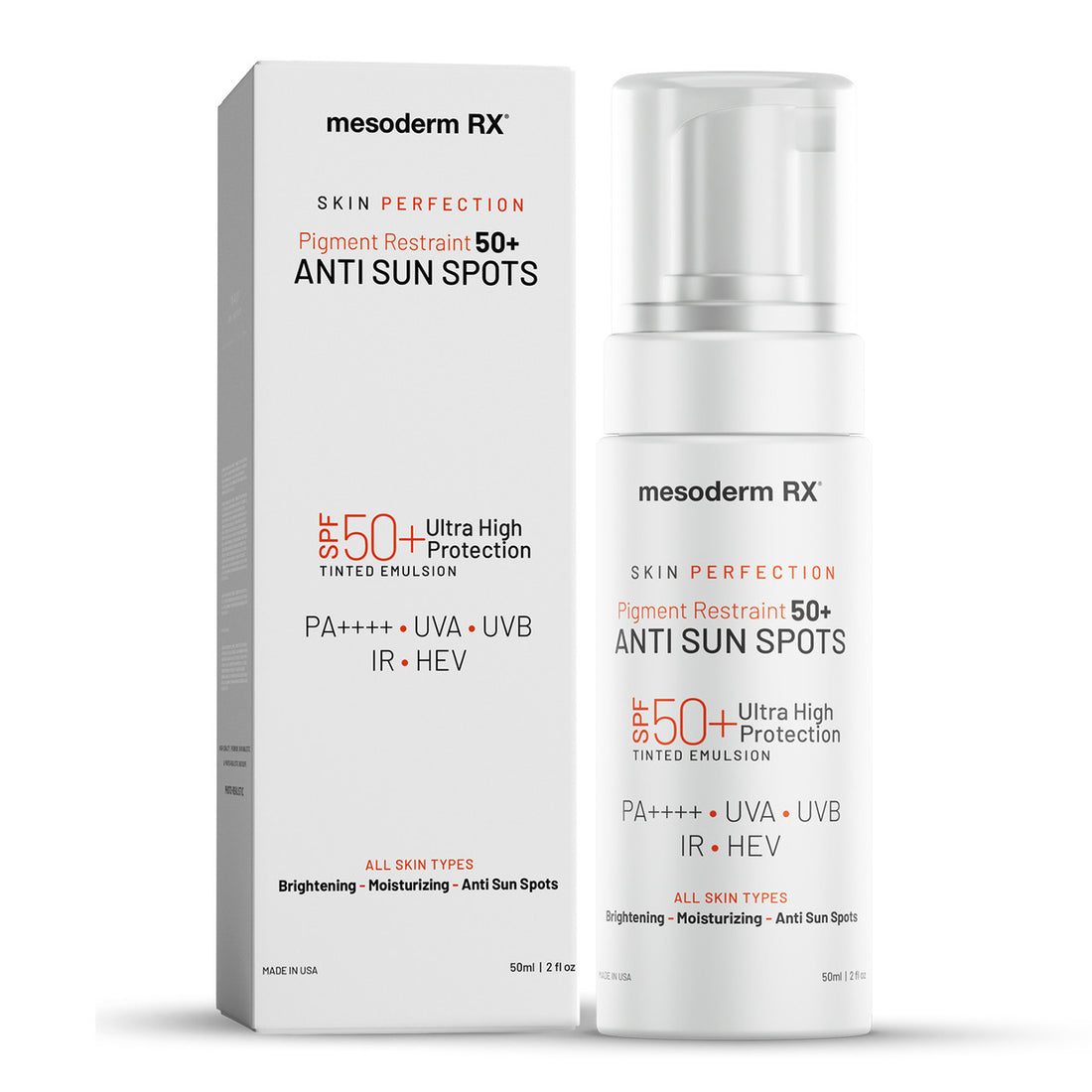
Featured Product
Pigment Restraint Ultra High Sun Protection
SHIELDS FROM UV DAMAGE AND SUN-INDUCED DARK SPOTS
Shop Now →Why body skin gets overlooked
Face products get all the nuance. Body products usually get marketed around beach use, sweat, and convenience. That leaves a blind spot for people managing discoloration on the neck, chest, forearms, shoulders, and hands.
Those sites are exposed often, rubbed by clothing, and harder to keep evenly covered. If the formula also lacks a functional tint, you may be preventing burns while still allowing visible darkening to continue.
This is why tinted sunblock for body deserves a more clinical discussion. The point isn't makeup for the body. The point is multi-spectrum photoprotection for skin that overproduces pigment easily.
The Biology of Body Hyperpigmentation
Hyperpigmentation isn't one condition. It is a visible outcome with different biological drivers. If you treat all dark marks as “sun spots,” you miss the trigger and usually choose the wrong protocol.

What melanocytes are doing
Melanocytes make melanin. Tyrosinase is one of the key enzymes involved in that process. When skin reads danger, whether from UV, inflammation, or other signaling, it can push melanocytes to produce and transfer more pigment.
Think of UV as a damaging insult that also provokes pigment as part of the skin's defensive response. Visible light behaves differently. It can act more like a persistent signal telling pigment-prone skin to stay active. For people with uneven tone, that means dark marks are not just formed once. They are repeatedly reinforced.
Not all dark spots behave the same way
A useful distinction:
- Post-inflammatory hyperpigmentation follows an event. Acne on the shoulders, folliculitis on the back, eczema, bites, shaving irritation, and friction can all leave residual pigment.
- Solar lentigines are localized sun-induced spots. They tend to be more defined and accumulate on chronically exposed areas.
- Melasma is pattern-based dyschromia. It is influenced by light exposure and can also be affected by hormonal signaling. While it is discussed mostly on the face, the principle behind pigment activation still matters for exposed body skin.
For broader body-focused correction strategies, this guide on how to even out skin tone on the body is a useful companion to photoprotection.
Why visible light changes the treatment plan
In a 5-month clinical trial of 42 women with melasma, participants used either a tinted sunscreen containing iron oxides and pigmentary titanium dioxide or an untinted sunscreen at least twice daily. 41 completed the trial, both products were well tolerated, and the difference in color contrast between hyperpigmented and unaffected skin was significantly reduced after 5 months in the tinted group, but not in the untinted group. Melasma severity improved in both groups, with mMASI changes reported as statistically significant at p < 0.001. The tinted formula showed a superior ability to control visible-light-driven pigmentation, according to the 5-month melasma sunscreen study.
That result matters well beyond facial melasma. It shows the principle. If you want to manage pigment, a formula that only addresses UV may not be enough.
Clinical takeaway: If you suppress tyrosinase and accelerate turnover, but keep exposing skin to a wavelength range that sustains pigment signaling, progress slows.
That is why treatment should not rely on exfoliation alone. A product such as AHA + BHA + PHA Skin Brightening Serum 30ml fits better as one part of a broader protocol. Its catalog snapshot describes exfoliating acids, kojic acid, hyaluronic acid, and support for improving the appearance of hyperpigmentation and uneven tone. That kind of corrective step works better when daytime exposure is being controlled instead of repeatedly re-triggering pigment.
Decoding Sunblock Filters and Functional Tints
Sunscreens are often sorted into two groups. Mineral and chemical. For pigment management, that framework is incomplete.
The better framework has three layers. UVB and UVA filters first. Then visible-light attenuation. A body product can be elegant, broad-spectrum, and still not do enough for hyperpigmentation if that third layer is missing.
What the base filters do
Mineral formulas usually rely on zinc oxide, titanium dioxide, or both. They create a particulate film on skin and are commonly chosen for sensitive or reactive skin. Many body formulas built this way are less irritating for users who break out on the chest or back.
Chemical filters absorb UV energy through organic filter chemistry. They can feel lighter and more transparent, which helps on large body areas. But the key issue here is not mineral versus chemical as an ideology. The key issue is what wavelengths the finished formula addresses well.
Why tint can be functional
The useful tint in a body sunscreen is not there just to make skin look warmer. Iron oxides matter because they help attenuate visible light, which is exactly the part of the problem many standard sunscreens leave under-addressed. Dermatology guidance also notes that tinted mineral formulas can reduce the white cast associated with zinc oxide and titanium dioxide, improving usability on deeper skin tones, as outlined in this guidance on tinted vs untinted sunscreen.
That's why not every tinted product deserves credit for pigment protection. A bronze-looking lotion without meaningful iron oxide use is still mostly cosmetic. You need the tint to be doing optical work, not just aesthetic work.
For readers comparing sensitive-skin options, this article on tinted sunscreen for sensitive skin is worth reading alongside body-specific selection criteria.
Sunscreen Filter Comparison
| Filter Type | Mechanism of Action | Protection Spectrum | Primary Benefit |
|---|---|---|---|
| Mineral UV filters | Form a particulate film using zinc oxide and/or titanium dioxide | UVA and UVB | Broad-spectrum UV defense, often preferred for sensitive skin |
| Chemical UV filters | Absorb UV energy through organic filters | UVA and UVB | Often lighter texture and easier spread over large areas |
| Iron oxide tint | Pigment-based attenuation of visible light | Visible light support | Added pigment protection for hyperpigmentation-prone skin |
What usually fails in practice
A few common mistakes show up again and again:
- Choosing by SPF alone: SPF tells you about UVB protection. It does not tell you whether a formula is helping with visible-light-triggered darkening.
- Assuming all tints are equivalent: The presence of color doesn't guarantee functional visible-light protection.
- Using a face tint too sparingly on the body: A tiny amount blended to invisibility won't create a reliable body film.
- Ignoring wear conditions: Sweat, friction, and clothing break body protection down faster than many people realize.
One body-protection option in the Mesoderm RX catalog is Pigment Restraint Ultra High Sun Protection. The catalog snapshot describes it as a fast-absorbing, non-greasy formula with a protection complex for UVA, UVB, IR, and HEV-combination rays, framed for visible sun damage and uneven-looking tone. The important point clinically is not branding language. It is whether the product fits into a daily pigment-control system and whether the user applies enough of it consistently.
The Clinical Selection Protocol for Body Use
Choosing tinted sunblock for body should be systematic. If you buy only on feel or shade, you'll end up with a product that looks nice for ten minutes and fails as a protective film by noon.

Step one starts with the actual goal
Ask one blunt question. Are you trying to prevent burning, or are you trying to manage pigmentation?
If the goal is active pigment management, iron oxides are not optional. You want broad-spectrum UV protection plus visible-light support. If the goal is general incidental exposure only, an untinted broad-spectrum sunscreen may still be adequate. Many readers need the first category and keep buying for the second.
Step two is body-specific durability
Body skin deals with movement, sweat, friction from clothing, and wash-off from ordinary life. That is why 80-minute water resistance matters. For body application, this is a key benchmark because it means the formula is designed to maintain labeled SPF performance after immersion or sweating. High-performance tinted mineral body sunscreens often use a combination of zinc oxide and titanium dioxide in a durable film, according to this body sunscreen benchmark explanation.
Step three is formula behavior, not marketing language
Use this short protocol when screening a product:
- Confirm broad-spectrum protection. If the label doesn't clearly establish this baseline, move on.
- Check for functional tint. For hyperpigmentation-prone skin, tint should serve visible-light control, not just cosmetic warmth.
- Prioritize water resistance for exposed body sites. Neck, chest, forearms, shoulders, and hands lose film integrity fast.
- Choose low-irritation support features. Fragrance-free and non-comedogenic matter if you're applying to acne-prone body areas.
- Match texture to geography. Lotions usually spread better over larger areas. Sticks can work on hands, scars, and focal spots, but they are inefficient for full body coverage.
The best body sunscreen on paper is the one people leave at home. The best body sunscreen in practice is the one that forms an even film, survives your day, and gets reapplied.
What tends to work better
A few practical pairings help:
- For chest and shoulders: Lightweight mineral lotion with tint, especially if breakouts and post-acne marks are part of the picture.
- For hands and forearms: More durable tint, because these areas get repeated incidental exposure.
- For beach or sport use: Water resistance moves from nice-to-have to mandatory.
- For deeper skin tones: Tinted mineral formulas are often easier to wear because they reduce the chalky cast of untinted minerals.
Advanced Application and System Integration
The best formula still fails if the film is uneven. Body users run into the same four issues repeatedly. They under-apply, rush the spread, layer over greasy body products, and then decide tinted sunscreen “doesn't work” because it streaks or transfers.

A better approach is to treat tinted sunblock for body as the final protective layer in a larger pigment-control system.
Morning layering that doesn't sabotage the film
If you're using body treatments for dark marks, keep the order logical. Corrective products go down first. Protective film goes on last.
A practical morning sequence looks like this:
- Start with clean, dry skin: Damp or oily skin makes many tinted mineral products drag or patch.
- Apply targeted treatment only where needed: If you use acids or brightening products, spread thinly and let them settle.
- Use body hydration selectively: Dry areas may need emollience, but a slippery body butter under sunscreen often destabilizes the film.
- Apply tinted sunblock as the shield: Spread methodically over exposed zones, then leave it alone long enough to set.
Often, people make the wrong trade-off. They focus on perfect cosmetic blending and forget that sunscreen needs a continuous film to work.
How to apply without streaking or staining
A few habits improve performance:
- Work in sections: One forearm, then the other. One side of the chest, then the other. Large-area rushed application creates thin spots.
- Use palms, not fingertips alone: Fingertips tend to move pigment around unevenly.
- Let it set before dressing: This reduces transfer and prevents immediate disruption of the film.
- Avoid aggressive rubbing after application: Rubbing in circles long after spreading can lift product instead of improving finish.
A major content gap in this category is exactly this real-life wear guidance around clothing transfer, layering, and reapplication without patchiness, as noted in this retail-category overview of tinted body sunscreen concerns.
Practical rule: If your body sunscreen pills over lotion, the answer usually isn't more rubbing. It's less under-layer slip and more time between steps.
For a visual overview of sunscreen use habits and body coverage reminders, this video is useful:
Reapplication and removal matter more than people think
Reapplication is where many body routines collapse. Users avoid it because they assume tinted products must become muddy or patchy. They usually become patchy only when the first layer was uneven, heavily mixed with oil, or left sitting on flaky skin.
For active outdoor exposure, follow the product's water-resistance limits if you've been swimming or sweating. During sustained sun exposure, reapply regularly and don't wait until the skin feels hot.
At night, remove the film properly. Tinted mineral body sunscreens can leave behind pigments plus a durable particulate residue. If you only do a quick rinse, that residue can stay on skin and contribute to congestion on acne-prone zones. A thorough body cleanse is not glamorous, but it is part of the treatment system.
Frequently Addressed Clinical Questions
Can I just use my tinted face sunscreen on the body
For small target zones, sometimes yes. For full body use, usually no. Face formulas are often too small, too expensive for surface area, and not built for the sweat and friction load of the body. Hands, forearms, chest, and shoulders need a formula you can apply generously and repeatedly.
Is tinted body sunscreen just cosmetic on deeper skin tones
No. For deeper skin tones, the tint can be functionally important. A major consumer question is whether tinted sunscreen offers true protection or just a better finish. The clinical answer is that iron oxide can provide important visible-light photoprotection, which matters because visible light is a known trigger for persistent hyperpigmentation in Fitzpatrick skin types III and above, as discussed in this clinical overview of tinted sunscreen for people of color.
Will tinted body sunscreen break me out
It depends on the formula and the site of use. The chest and back are less forgiving than the forearms. If you're acne-prone, look for fragrance-free and non-comedogenic products, and don't skip proper cleansing at night.
Do I still need brightening products if I use tinted sunblock for body
Yes. Tinted sunblock protects the work. It doesn't replace correction. If you're treating PIH, melasma-pattern darkening, or uneven tone, the stronger strategy combines pigment-control treatment with daytime photoprotection. Correct without protection and you keep retriggering the problem. Protect without correction and old marks fade slowly.
If you're building a routine for dark spots and uneven body tone, Mesoderm RX offers a practical system approach: corrective formulas for discoloration, body hydration that supports barrier comfort, and daily photoprotection that helps defend the progress you're trying to make.