


Sodium Ascorbyl Phosphate Vitamin C Serum: A Real Guide
Have you ever chosen a vitamin C serum because the ingredient sounded powerful, only to abandon it when your cheeks sting, your mouth flakes, or the formula turns yellow before you finish it? The problem may not be vitamin C itself. It may be the form, the pH, the stability of the formula, or the way that product fits your skin's biology.
Sodium ascorbyl phosphate vitamin C serum is often described as the gentle alternative, but that description is incomplete. SAP has a distinct chemical design, a clinically documented relationship with acne-prone skin, and meaningful limitations for people seeking aggressive pigment correction. The right question isn't whether SAP is “better” than L-ascorbic acid. It's whether its stability and tolerability let you use it consistently enough to produce a useful result.
Why Most Vitamin C Serums Burn Reactive Skin
A common pattern appears in practice. Someone with reactive, blemish-prone skin buys a popular L-ascorbic acid serum, applies it nightly, and initially accepts mild tingling as proof that it's working. Within a week, the cheeks feel hot, the skin around the mouth flakes, and inflamed blemishes become harder to interpret. The user stops the serum, repairs the barrier, and concludes that vitamin C isn't suitable for their skin.
The low-pH environment is often the starting problem. Pure L-ascorbic acid generally needs an acidic formula to remain in a form that can penetrate skin, but that acidity can be uncomfortable when the barrier is already compromised by acne treatments, over-cleansing, shaving, weather, or leave-on exfoliants. A reactive barrier allows irritants to reach nerve endings more easily, so a formula that feels acceptable on resilient skin can sting on the cheeks or around the nose.
The bottle creates another challenge. L-ascorbic acid oxidizes when exposed to oxygen, light, and heat, forming breakdown products that can discolor the serum and reduce confidence in its freshness. A darker yellow or brown appearance doesn't automatically tell you the exact remaining potency, but it does signal that the formula has undergone visible chemical change. Storage and packaging matter as much as the ingredient name.
For a useful overview of the biology behind how vitamin C evens skin tone, it helps to separate pigment regulation from the vague promise of “glow.” Vitamin C can support a more even appearance through antioxidant activity and interference with melanin-related pathways, but irritation can work against that goal by sustaining redness and post-inflammatory discoloration.
Practical rule: A serum you can use consistently is often more valuable than a theoretically stronger serum you can tolerate only briefly.

Featured Product
Advanced Triple Action Age-Defying Serum
Defy the signs of aging and restore your youthful glow with a serum that works to smooth, firm, and brighten your skin.
Shop Now →SAP was designed to bypass several of these failure points. Its phosphate group protects the vitamin C structure, its water-soluble form works in a less acidic formulation, and skin enzymes convert it after application rather than requiring the bottle to hold free ascorbic acid in its most reactive state. That doesn't make SAP irritation-proof, and it doesn't make it equivalent to L-ascorbic acid. It gives reactive users a different balance of stability, comfort, and biological activity.
If your skin repeatedly itches or burns after active products, review the practical guidance on itch and burn triggers before adding another serum. Persistent burning, swelling, or dermatitis deserves medical assessment rather than more experimentation.
What Sodium Ascorbyl Phosphate Actually Is
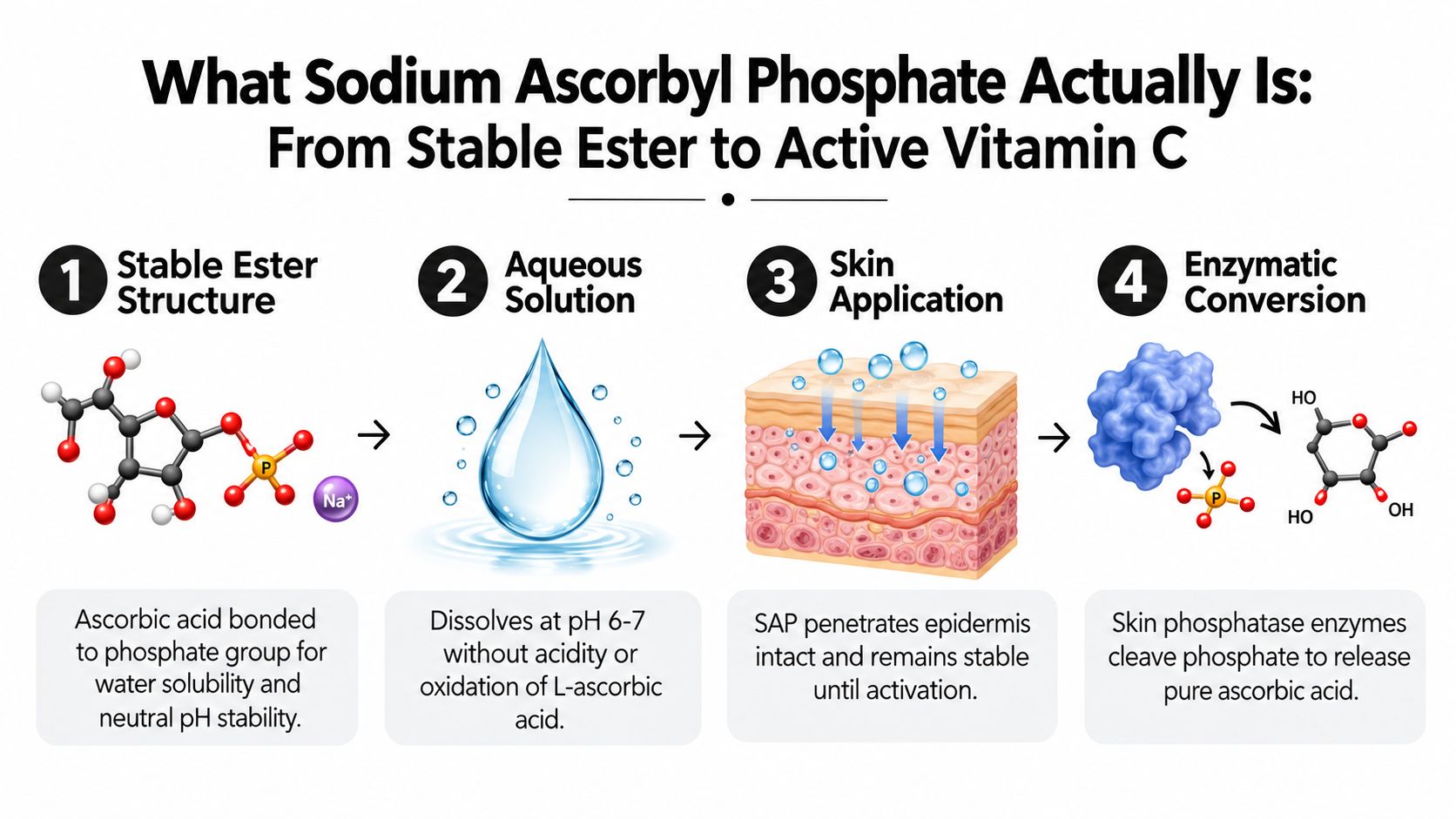
Sodium ascorbyl phosphate, or SAP, is a water-soluble vitamin C derivative. Chemically, it is an ascorbic acid structure bonded to a phosphate group. That modification changes how the ingredient behaves in water, in a cosmetic formula, and on skin.
Pure L-ascorbic acid is already the biologically active vitamin C form, but it's also vulnerable to oxidation and usually requires a strongly acidic environment. SAP functions more like a protected precursor. The phosphate group improves stability and allows formulators to build aqueous products closer to a neutral skin-compatible pH.
The conversion happens in skin
After application, skin-resident phosphatase enzymes can cleave the phosphate bond and release ascorbic acid locally. The simplest analogy is a time-release capsule. SAP isn't the same as swallowing a capsule, of course, but the formulation logic is similar. The molecule stays more protected in the bottle and is then processed by enzymes after it reaches the skin.
That “active” label needs precision. On an ingredient panel, the product contains SAP, not free L-ascorbic acid. In tissue, enzymatic conversion can make ascorbic acid available to interact with pathways involving melanocytes, fibroblasts, and sebocytes. The conversion step is also why a direct comparison between a SAP percentage and an L-ascorbic acid percentage can mislead.
SAP isn't magnesium ascorbyl phosphate, although the two are related phosphate derivatives. Magnesium ascorbyl phosphate uses a different salt structure and has different formulation and penetration characteristics. Treating all vitamin C derivatives as interchangeable is a formulation mistake.
For mature skin, the Advanced Triple Action Age-Defying Serum is a separate Mesoderm RX product described as a rich, creamy moisturizer with peptides, DMAE, collagen, vitamin C, and alpha lipoic acid. Its stated use is three to five drops on clean skin, followed by moisturizer, once or twice daily, on the face, neck, and backs of the hands.
How SAP Compares to Other Vitamin C Forms
The comparison should focus on the trade-off, not on a simplistic ranking. L-ascorbic acid has the deepest direct evidence base for topical vitamin C, especially around collagen support and photoprotection, but its acidic formulation and oxidation sensitivity create practical barriers. SAP is more stable and generally more comfortable in sensitive or acne-prone routines, while ascorbyl glucoside occupies a middle position as another water-soluble precursor.
The pH ranges below are formulation guidance rather than a guarantee that every commercial product uses the same system. SAP technical documentation recommends neutral to mildly alkaline conditions and avoiding prolonged exposure to strongly acidic conditions (formulation guidance for sodium ascorbyl phosphate).
| Property | Sodium Ascorbyl Phosphate | L-Ascorbic Acid | Ascorbyl Glucoside |
|---|---|---|---|
| Formulation tolerance | Works best in neutral to mildly alkaline systems, with technical guidance placing useful formulation conditions around pH 6.0 to 7.5 or higher. | Requires a strongly acidic system for effective delivery, which can be difficult for compromised barriers. | Commonly formulated closer to a skin-compatible range than pure L-ascorbic acid, but the finished formula still determines comfort. |
| Oxidation stability | More resistant to oxidation, light, and heat than free ascorbic acid, although packaging and processing still matter. | More vulnerable to oxygen, light, heat, and water exposure. | More stable than free ascorbic acid, but not automatically stable in every bottle. |
| Irritation profile | Usually the more practical choice for reactive, sensitive, or acne-prone users who can't tolerate acid-heavy serums. | Can sting, flush, or aggravate peeling when the barrier is compromised. | Often suits users who want a derivative without choosing the most acne-specific option. |
| Evidence emphasis | Strongest practical distinction is the acne-focused clinical history and tolerability profile. | Strongest direct evidence for collagen and photoprotection, provided the user tolerates and stores it correctly. | Useful middle ground, but the evidence depends heavily on the specific formula and study design. |
| Wins for | Sensitive skin and acne-prone routines. | Established anti-aging protocols with tolerant skin. | Users seeking a moderate derivative option. |
SAP's advantage is not that it delivers more free vitamin C than L-ascorbic acid. Its advantage is that the formula can remain usable and comfortable under conditions that make free ascorbic acid difficult to manage. L-ascorbic acid remains the more direct choice when maximum evidence depth and high potency matter more than comfort.
Ascorbyl glucoside can work well for someone who wants a gentler brightening serum but doesn't need SAP's acne-specific rationale. None of these forms replaces sunscreen, barrier support, or a diagnosis of the pigment problem. A stable serum can't compensate for daily ultraviolet exposure or an exfoliation routine that keeps the skin inflamed.
What the Evidence Says SAP Can Do
SAP has three credible areas of interest: pigment regulation, antioxidant support, and acne-prone skin. The quality of evidence isn't identical across all three, so the formula should be chosen according to the outcome you care about rather than the broad phrase “brightening vitamin C.”
Vitamin C biology is relevant to pigmentation because topical vitamin C can interfere with the conversion of DOPA to melanin through tyrosinase-related activity, while reviews also discuss effects involving melanosome degradation and melanocyte injury (vitamin C and hyperpigmentation mechanisms). SAP therefore has a plausible brightening pathway, but plausible biology isn't the same as a guaranteed result for every dark mark.
A split-face trial involving 33 female volunteers reported significant reductions in skin melanin and erythema after 12 weeks with formulations containing SAP, while the control emulsion did not produce the same significant result (split-face SAP skin study). That supports a measurable cosmetic effect, but it doesn't prove that SAP will rapidly clear established melasma or deep post-inflammatory hyperpigmentation.
The acne evidence is more distinctive. A randomized, double-blind controlled trial assigned 50 subjects to a 5% SAP lotion or vehicle for 12 weeks and found statistically significant improvement across measured acne parameters, with tolerability similar to the vehicle (5% SAP acne trial). A separate randomized, double-blind study reported inflammatory acne lesion reductions of 20.14% after 4 weeks and 48.82% after 8 weeks with 5% SAP. When SAP was combined with 0.2% retinol, the reported reductions were 29.28% after 4 weeks and 63.10% after 8 weeks (SAP acne evidence).
| Benefit Claim | Concentration Tested | Study Design | Key Outcome |
|---|---|---|---|
| Acne improvement | 5% SAP | Randomized, double-blind controlled trial, 50 subjects, 12 weeks | Statistically significant improvement across measured acne parameters, with tolerability similar to vehicle. |
| Inflammatory lesion reduction | 5% SAP | Randomized, double-blind study | Lesions fell 20.14% after 4 weeks and 48.82% after 8 weeks. |
| SAP with retinol | 5% SAP plus 0.2% retinol | Randomized, double-blind study | Lesions fell 29.28% after 4 weeks and 63.10% after 8 weeks. |
| Melanin and erythema improvement | SAP-containing formulation | Split-face trial, 33 female volunteers, 12 weeks | Significant decreases in melanin and erythema compared with the control emulsion. |
The antioxidant argument is primarily a formulation argument. SAP's relative stability makes it more likely that a well-built serum will retain useful ingredient integrity during storage, but that doesn't establish equal antioxidant potency per molecule compared with free L-ascorbic acid.
For localized friction-related discoloration, a multi-active product such as Bikini Line & Inner Thigh Brightening Cream uses tranexamic acid, kojic acid, arbutin, niacinamide, vitamin C, AHA, azelaic acid, and hexylresorcinol. That is a different treatment strategy from relying on SAP alone, and the area should be managed according to its source of irritation, friction, shaving, or waxing.
For more detail on realistic expectations, see this guide to vitamin C serum for dark spots.
Building a Routine Around SAP
A well-formulated SAP serum should sit near a skin-compatible pH, commonly around 5.5 to 7.0, rather than the highly acidic environment used for L-ascorbic acid. Technical guidance describes SAP as most stable in neutral to mildly alkaline systems, with additional processing precautions around heat, light, oxygen, and metal contamination (SAP stability and processing guidance).
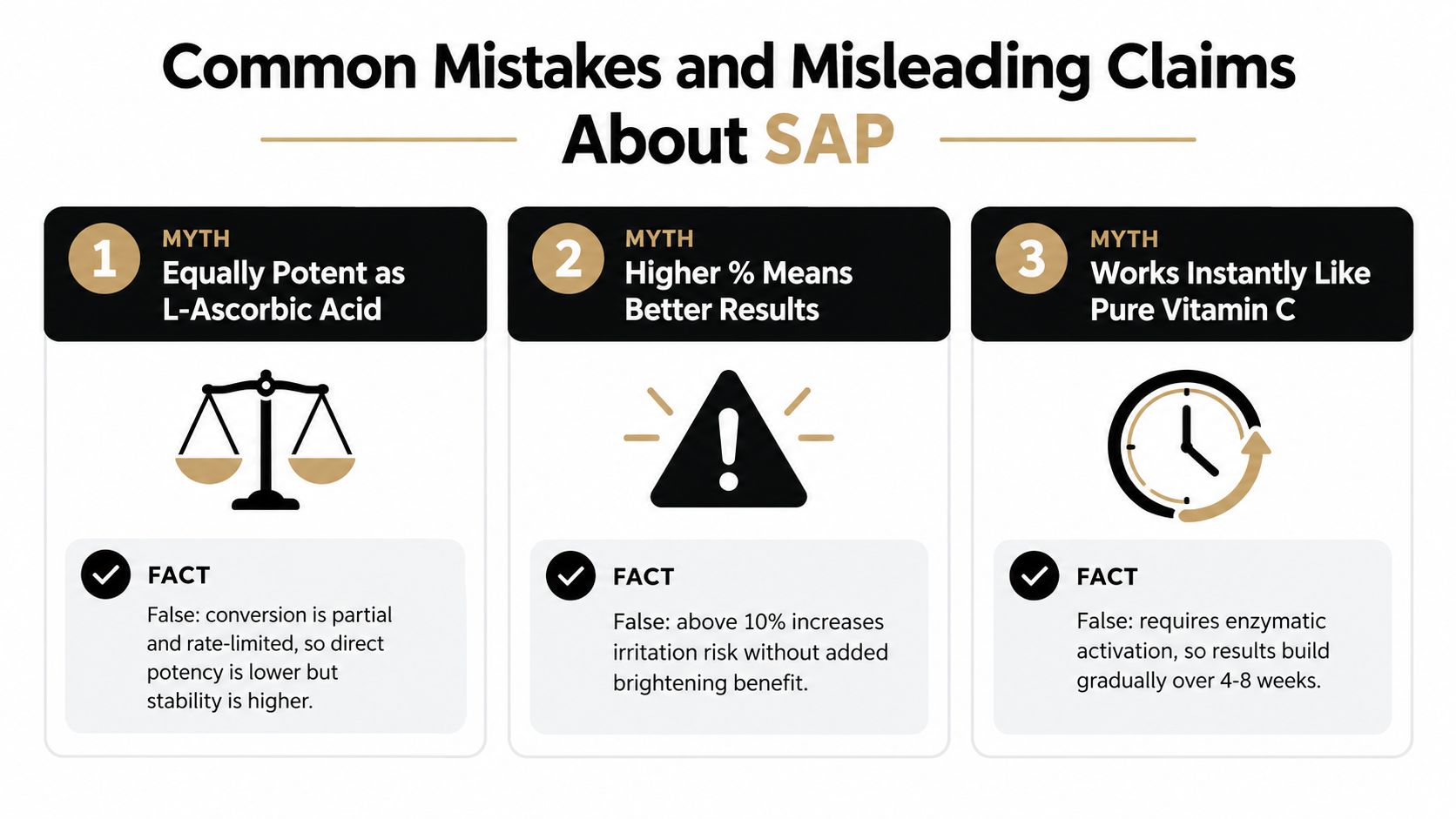
Concentration needs context. A practical SAP serum may fall within a 3% to 10% range, with 5% supported by the acne studies cited above. Higher concentration isn't automatically better because the molecule still requires enzymatic conversion, and the finished formula's pH, preservation, packaging, and supporting ingredients influence real-world performance.
A simple morning protocol
- Cleanse without stripping. Remove sunscreen, oil, and residue without leaving the face tight.
- Hydrate lightly. A simple hydrating layer can reduce friction during application, but it isn't mandatory.
- Apply SAP serum. Use the amount directed by the product, spreading it across the face rather than rubbing repeatedly into reactive areas.
- Moisturize. Choose a barrier-supportive moisturizer if you experience dryness or retinoid-related flaking.
- Finish with sunscreen. SAP doesn't replace broad-spectrum sunscreen. Brightening routines fail when ultraviolet exposure repeatedly stimulates pigment.
SAP generally layers cleanly with niacinamide, hyaluronic acid, peptides, ceramides, and other barrier-supportive ingredients. The neutral pH reduces formulation conflict, but it doesn't make every combination comfortable. Strong leave-on acids and high-strength retinoids can still overwhelm sensitive skin, so alternate-night scheduling is the safer starting point.
Watch the practical layering logic in this resource on vitamin C and niacinamide together. Introduce one active change at a time, especially if acne treatment already includes exfoliating acids or retinoids.
The morning is the most logical placement when the goal includes environmental antioxidant support, but evening use can be reasonable if that improves adherence. Judge the product over a sustained trial rather than after a few applications. A serum can't correct a pigment process or acne pattern overnight.
Common Mistakes and Misleading Claims
The first mistake is treating SAP as equally potent to L-ascorbic acid. It isn't. SAP must be enzymatically converted, and conversion is partial and rate-limited, so a label claiming a particular SAP percentage doesn't mean the skin receives the same direct exposure to free ascorbic acid at that percentage.
That trade-off matters most for people treating stubborn pigmentation under time pressure. SAP may be the better product if irritation has stopped you from using actives, but a person with severe or persistent hyperpigmentation may need a dermatologist-led plan rather than a gentle vitamin C serum alone.
Myth one, all vitamin C works for all skin
Skin type changes the risk calculation. A low-pH L-ascorbic acid serum may be appropriate for someone with a resilient barrier and a well-controlled routine, yet aggravate stinging and peeling in someone using acne medication or managing facial sensitivity.
SAP is a rational choice for a compromised routine because its formulation does not need to recreate the same acidic conditions. That doesn't mean every SAP serum will suit every face. Preservatives, fragrance, solvents, and the rest of the formula can still cause irritation.
Myth two, neutral pH makes exfoliant combinations harmless
SAP can be chemically compatible with many products, but the skin still experiences the total irritation load. Combining it with a strong leave-on acid, a high-strength retinoid, and abrasive cleansing in the same routine can produce redness even when no ingredient “cancels out” another.
Use SAP with gentle hydrators and barrier ingredients first. If you already use an exfoliant or retinoid, place SAP on alternate nights until you know the routine is comfortable.
Myth three, the result should appear immediately
SAP has to undergo conversion in skin, and pigment changes require control of ongoing triggers such as ultraviolet exposure and inflammation. Expect a gradual cosmetic change rather than an instant correction. If a brand promises dramatic overnight lightening, the promise is stronger than the evidence.
A stable formula is an opportunity for consistent use, not permission to stack every active at once.
Who Should Choose SAP and Who Should Skip It
SAP earns its place when tolerability is the bottleneck. Consider it for someone with easily sensitized or rosacea-prone skin who stopped L-ascorbic acid because of stinging and peeling. It also makes sense for an acne-prone user who wants antioxidant and brightening support alongside a blemish-focused routine, particularly when acidic leave-on products repeatedly cause discomfort.
A beginner may prefer SAP because it is less dependent on the storage discipline required by free ascorbic acid. The important routine change is consistency. Start with a well-formulated product, keep the rest of the routine calm, use sunscreen in the morning, and assess progress over a sustained period rather than changing products every few days.
SAP is less compelling for a person pursuing aggressive, time-bound correction of established melasma or dense post-inflammatory hyperpigmentation. The clinical review of vitamin C in dermatology describes potential benefits for texture and pigmentation, including use alongside microneedling, but consumer and clinical discussions still characterize SAP's hyperpigmentation evidence as more limited than the evidence for L-ascorbic acid (clinical review of vitamin C in dermatology).
It may also be the wrong first choice for a mature-skin protocol built around the deepest direct evidence for collagen and photoprotection. In that setting, a tolerant user may reasonably choose L-ascorbic acid and accept its formulation demands. A dermatologist may also recommend prescription options for pigment or photoaging concerns that a cosmetic serum cannot address alone.
| Reader Profile | Best Pick | Why | Recommended SAP % |
|---|---|---|---|
| Easily sensitized or rosacea-prone user who abandons acidic serums | SAP | Better fit for a routine where comfort and repeated use determine success. | 5% to 10% |
| Acne-prone user who wants brightening with blemish support | SAP | SAP has the clearest acne-focused clinical rationale among these choices. | 5% |
| Beginner who wants a stable vitamin C derivative | SAP | Less dependent on the acidic, oxidation-sensitive profile of L-ascorbic acid. | 3% to 5% |
| User pursuing rapid correction of stubborn hyperpigmentation | L-ascorbic acid or clinician-guided treatment | SAP may be too gradual or too limited as a single pigment intervention. | Not the primary choice |
| Mature skin with a tolerant barrier and established anti-aging routine | L-ascorbic acid | Direct collagen and photoprotection evidence is stronger for free vitamin C. | Not applicable |
The minimum effective choice isn't only a percentage. It's the product's stability, packaging, application order, sunscreen use, and the absence of competing irritation. A 5% SAP serum used steadily may outperform a stronger product that repeatedly causes a person to stop.
Choose SAP when tolerability is the bottleneck. Choose L-ascorbic acid when potency and direct evidence are the priority, and your skin can tolerate the formulation.
Mesoderm RX offers targeted skincare options for brightening, barrier support, exfoliation, and visible signs of aging, including formulas designed around clinically studied actives and sensitive-skin considerations. Review the collection at Mesoderm RX and choose a routine that matches your actual skin problem rather than chasing the strongest ingredient label.