


Kojic and Azelaic Acid: The Brightening Pair That Works
Most brightening advice starts with the wrong question: “Which acid is stronger?” That framing treats kojic acid and azelaic acid as interchangeable exfoliants, then encourages people to layer both until their barrier becomes irritated. Pigment rarely improves when inflammation is added to the problem.
Kojic acid and azelaic acid are better understood as two different tools for two different pigment drivers. Kojic acid works primarily at the melanin-production stage by interfering with tyrosinase. Azelaic acid combines pigment control with anti-inflammatory and keratinization-normalizing effects, which makes it more useful when acne, rosacea, or irritated skin is contributing to discoloration.
The practical answer is not always to combine them. It's to identify whether you're treating melasma, post-inflammatory hyperpigmentation, or cumulative sun damage, then build a regimen that suppresses pigment without repeatedly injuring the skin.
Why These Two Acids Get Confused
The brightening aisle creates the confusion. Once shoppers see the word acid, they often assume kojic acid and azelaic acid behave like glycolic acid, salicylic acid, or other exfoliants. They don't. Kojic acid is a fungal metabolite used mainly for pigment suppression, while azelaic acid is a naturally occurring dicarboxylic acid with an established dermatology role in acne and rosacea.
Kojic acid became important in cosmetic brightening because it inhibits tyrosinase, the key enzyme involved in melanin synthesis. Its documented scientific history reaches back to 1907, when it was first isolated from fungal sources, and later reviews describe its development into a widely used depigmenting ingredient (historical review indexed by PubMed). In practical terms, it acts on the pigment-production pathway rather than functioning as a conventional exfoliating acid.
Azelaic acid has a wider clinical brief. It can inhibit tyrosinase, but it also addresses inflammatory signaling, abnormal melanocyte behavior, and aspects of keratinization. That matters when a dark mark follows acne, irritation, or rosacea, because reducing the original inflammatory trigger helps prevent the pigment cycle from repeating.
Clinical rule: Treat the driver, not the label. “Brightening acid” is a category description, not a diagnosis.
The difference becomes especially important in combination routines. Kojic acid can be useful for enzyme-driven pigment, while azelaic acid is often the more rational first choice when redness or active breakouts sit beneath the discoloration. A detailed comparison of kojic acid with hydroquinone can help clarify why mechanism and tolerability matter more than marketing language, especially when choosing a non-hydroquinone approach (kojic acid versus hydroquinone).
How Kojic Acid and Azelaic Acid Actually Work
Featured Product
AHA + BHA + PHA Skin Brightening Serum 30ml
A brightening cream made to target the look of stubborn discoloration, whether it’s from post-blemish marks, sun exposure, or dullness that years of serums haven’t improved.
Shop Now →
Kojic acid and azelaic acid overlap at tyrosinase, but they don't produce the same clinical profile. The distinction is easiest to understand across three questions: what happens to the enzyme, what happens to melanocytes, and how much inflammation the ingredient can address.
Kojic acid at the enzyme level
Kojic acid is a hydrophilic fungal derivative that inhibits tyrosinase by chelating copper at the enzyme's active site. Copper is necessary for tyrosinase activity, so interfering with that site reduces the enzyme's ability to support melanin synthesis. Reviews describe kojic acid as more dependable in combinations than as a stand-alone treatment, with mixed evidence for monotherapy in melasma (review of topical treatments for melasma).
That mechanism doesn't make kojic acid an anti-inflammatory treatment. It can reduce the production of new pigment, but it won't directly correct the inflammatory activity that keeps generating post-inflammatory discoloration. It's also a potential sensitizer, and allergic contact dermatitis is a recognized concern, so concentration, vehicle, and frequency matter.
A split-face study summarized in an evidence review found that 2% kojic acid gel produced comparable melasma improvement to 2% hydroquinone in 58% of subjects, while 28% showed greater reduction on the kojic-acid side and 21% on the hydroquinone side (evidence review). Those results support kojic acid as a credible option, but not as a universal replacement or a guarantee of faster improvement.
Azelaic acid across pigment and inflammation
Azelaic acid is a nonphenolic dicarboxylic acid that competitively inhibits tyrosinase and also inhibits reactive oxygen species involved in melanogenesis (mechanism review). Its value extends beyond enzyme inhibition. It can selectively affect abnormal melanocytes and has anti-inflammatory effects, which helps explain why it fits acne-related PIH and rosacea-prone skin better than a purely pigment-focused ingredient.
Its clinical history is stronger in regulated dermatology than many cosmetic brighteners. U.S. prescription products include 20% azelaic acid cream and 15% azelaic acid gel, and the FDA approved Finacea 15% gel in 2003 for papulopustular rosacea. The ingredient therefore sits between consumer skincare and pharmaceutical treatment, with products outside the U.S. commonly appearing at 10%, 15%, or 20% strengths (market overview).
| Mechanism | Kojic Acid | Azelaic Acid |
|---|---|---|
| Tyrosinase | Chelates copper at tyrosinase's active site | Competitively inhibits tyrosinase |
| Melanocyte behavior | Primarily suppresses melanin synthesis | Selectively targets abnormal melanocytes |
| Inflammation | Limited direct anti-inflammatory role | Addresses inflammatory activity and reactive oxygen species |
| Best clinical logic | Enzyme-driven dark spots and combination brightening | Pigment with acne, rosacea, or irritation |
| Main limitation | Sensitization and allergic contact dermatitis risk | Initial stinging or irritation during introduction |
For readers evaluating how skincare brands communicate ingredient systems, an Obagi case study offers useful context on how a clinical skincare brand can organize education and product positioning around treatment goals rather than isolated ingredients.
A formula such as AHA + BHA + PHA Skin Brightening Serum 30ml illustrates a broader combination approach. Its catalog description lists kojic acid alongside glycolic acid, lactic acid, salicylic acid, lactobionic acid, hyaluronic acid, and hexapeptides, with the stated purpose of addressing pigmentation, uneven tone, texture, hydration, and pore appearance. That type of formula needs to be introduced carefully because multiple active pathways can improve performance, but they can also increase barrier stress.
Matching the Active to the Pigmentation Type
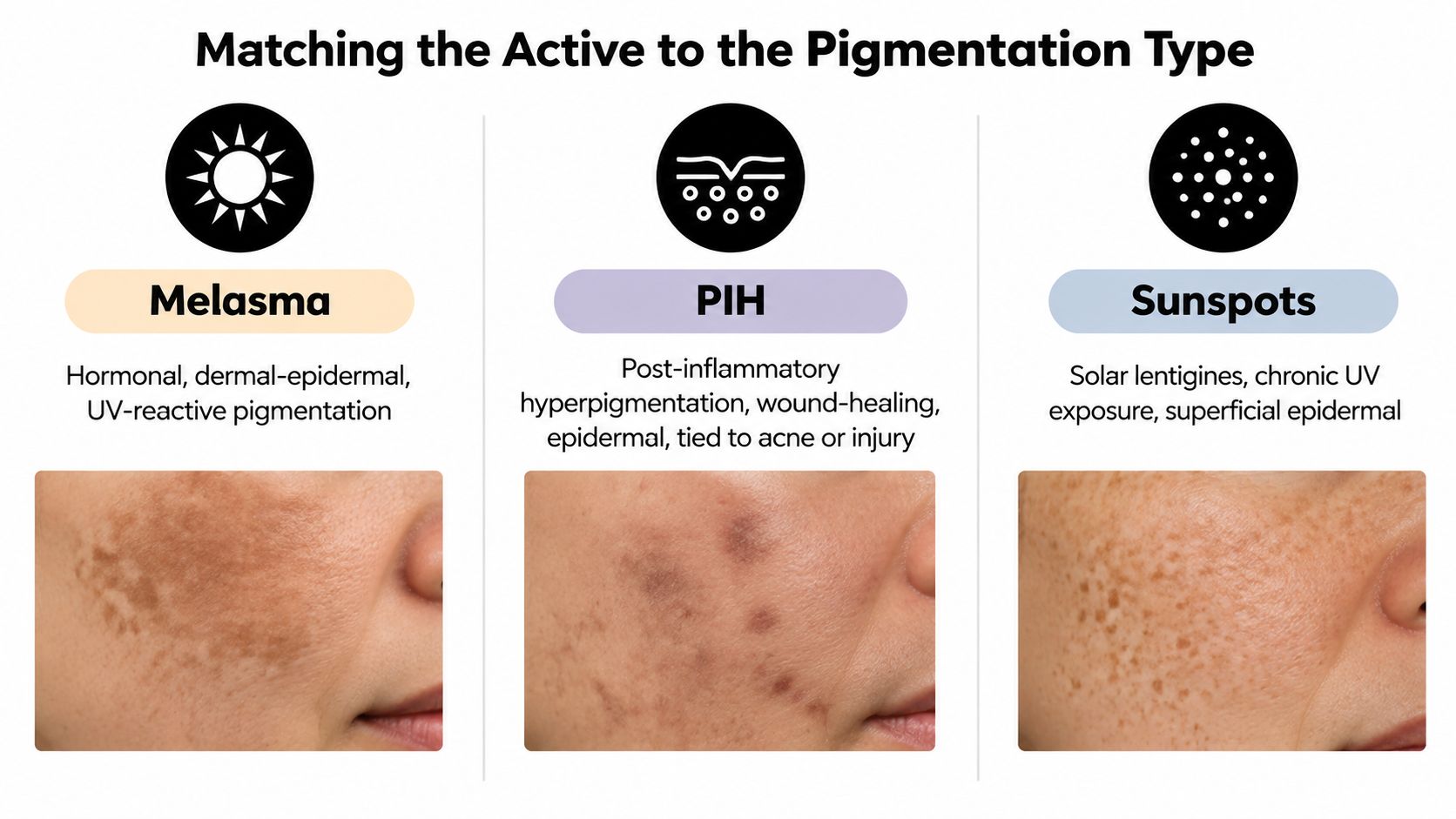
Before choosing an active, identify what you're looking at. Melasma, post-inflammatory hyperpigmentation, and solar lentigines are not interchangeable conditions, even though all three can appear as brown or gray-brown discoloration.
Melasma
Melasma usually presents as symmetrical patches, often across the cheeks, forehead, upper lip, or jaw. It's influenced by hormonal signaling and reacts strongly to ultraviolet exposure, so pigment may persist or recur even after a successful fading phase. Melasma can involve both epidermal and dermal-epidermal pigment, which makes it less predictable than a fresh surface mark.
Azelaic acid has particularly useful evidence here. In a 24-week double-blind study of 329 women with melasma, 20% azelaic acid cream used with broad-spectrum sunscreen produced 65% good or excellent outcomes, with no significant difference from 4% hydroquinone in overall rating, lesion-size reduction, or pigment intensity (clinical study). That doesn't mean every case responds equally, but it supports azelaic acid when a hydroquinone-free regimen is preferred.
Post-inflammatory hyperpigmentation
PIH develops after inflammation or injury. Acne, picking, dermatitis, and other trauma can leave epidermal pigment behind after the original lesion has resolved. The key diagnostic clue is location. The mark follows the previous inflammatory event rather than appearing in a symmetrical facial pattern.
Kojic acid can fit fresh, surface-level PIH because it directly suppresses tyrosinase. Azelaic acid becomes more attractive when acne or rosacea is still active, because it addresses both pigment formation and the inflammatory environment that produces new marks.
Solar lentigines
Solar lentigines are discrete, persistent epidermal spots associated with cumulative UV exposure. They often appear on the face, hands, chest, and other exposed areas. A topical routine may help manage their appearance, but changing or rapidly growing lesions require professional evaluation rather than cosmetic treatment.
A diagnosis-first approach is explained in greater detail in this guide to hyperpigmentation causes, types, and treatment. The ingredient decision follows the pattern: azelaic acid for pigment with inflammation, kojic acid for direct enzyme suppression, and disciplined UV protection for every category.
Why Most Brightening Routines Underperform
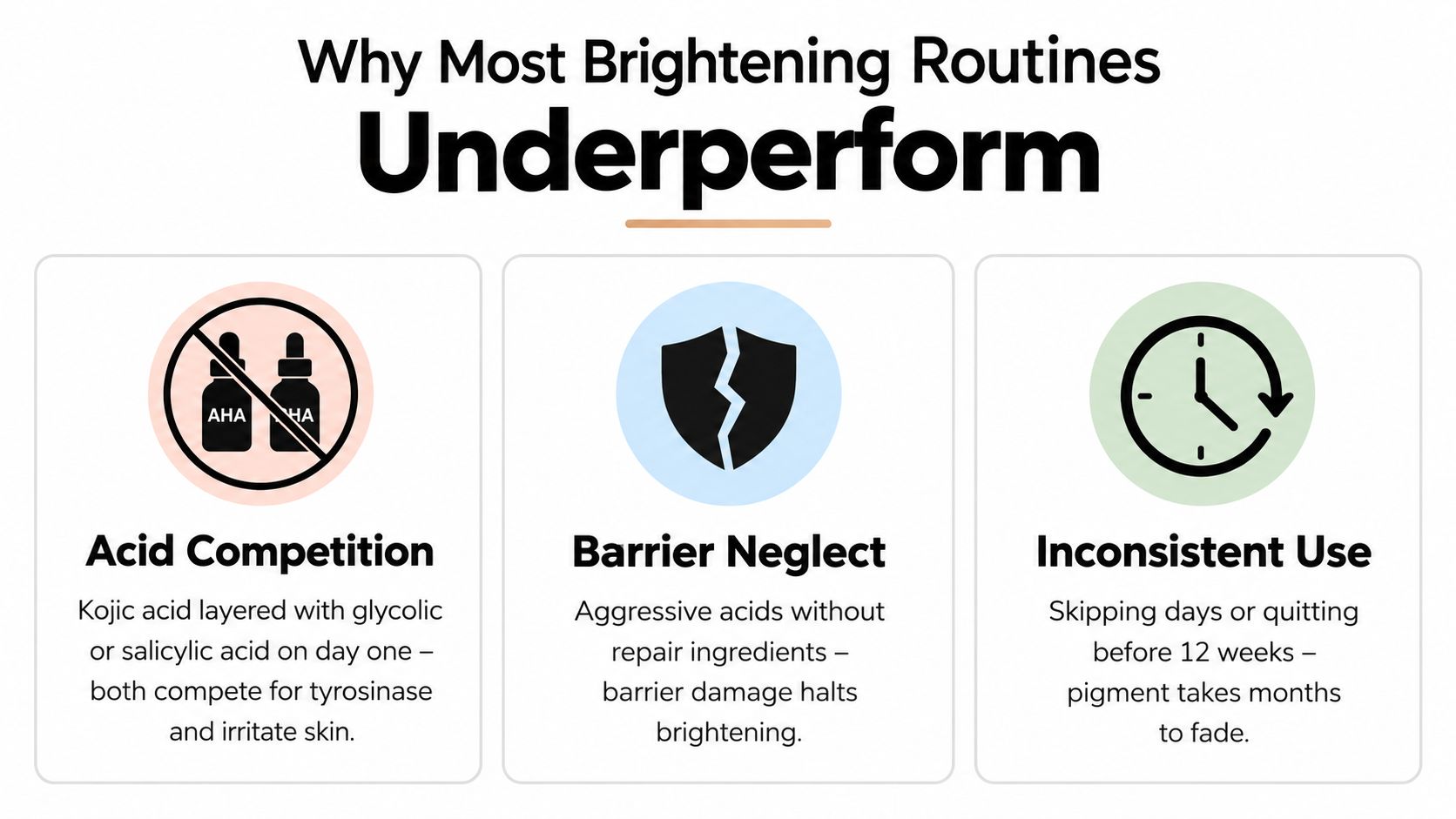
Most failed brightening routines don't fail because the ingredients are inactive. They fail because the user creates inflammation, removes protection, or asks one ingredient to solve several biological problems.
The first failure is aggressive stacking
Layering kojic acid with glycolic or salicylic acid on day one is a common mistake. The issue isn't that the ingredients are automatically incompatible. The issue is that multiple active products can raise irritation before you know which one your skin tolerates. Once the barrier becomes compromised, redness can intensify and post-inflammatory pigment can become harder to control.
The second failure is treating sunscreen as optional
A melanin-suppressing routine cannot outwork repeated UV exposure. Broad-spectrum sunscreen is part of the treatment, not the final cosmetic step. For melasma and persistent PIH, an iron-oxide tinted sunscreen is a practical choice because visible light can also matter for pigment-prone skin.
The third failure is expecting monotherapy to solve a mixed driver
Kojic acid alone doesn't calm the inflammatory cascade behind active acne or rosacea. Azelaic acid alone may not provide sufficient tyrosinase suppression for every entrenched pigment pattern. The evidence for azelaic acid is stronger in comparative hyperpigmentation and acne-related contexts, while kojic acid has been studied more heavily in melasma than PIH, and direct head-to-head data remain limited (pigmentary disorders review).
Practical rule: Add one new active at a time, maintain daily UV protection, and judge the routine by skin stability as well as fading.
A sound replacement strategy is simple. Start one active, use it consistently, protect the skin every morning, and add the second active only when the first has demonstrated tolerability. The goal isn't the most crowded routine. It's the highest pigment control you can sustain without triggering another inflammatory mark.
Concentrations, Vehicles, and Smart Pairings
The product label tells you more than the front panel, but only if you read it clinically. For kojic acid, practical cosmetic concentrations commonly range from 0.1% to 2%, while leave-on formulations are often kept below 1% to balance efficacy and tolerability (practical review). Azelaic acid generally appears at 10%, 15%, or 20%, with the higher strengths more closely aligned with prescription dermatology.
Free kojic acid can be formulation-sensitive, which is why brands may use more stable derivatives such as kojic dipalmitate. A stable vehicle can matter as much as the headline percentage. Azelaic acid is commonly delivered in creams, gels, foams, or serums, and the best choice depends on whether the skin is dry, acne-prone, follicularly congested, or reactive.
| Active | Effective % | Best Vehicle | Pairs With | Avoid Stacking With |
|---|---|---|---|---|
| Kojic acid | 0.1% to 2% | Stable leave-on serum or cream | Vitamin C in a compatible low-pH formula | High-strength AHA or BHA in the same routine |
| Azelaic acid | 10% to 20% | Gel, foam, serum, or cream selected for tolerance | Niacinamide and barrier-supporting moisturizer | Retinoids on a compromised barrier without buffering |
Pairing logic
Kojic acid and vitamin C can provide complementary tyrosinase support when the formula is designed for a compatible low-pH environment. That doesn't mean every vitamin C serum belongs in the same application window. Texture, pH, preservative system, and irritation potential still determine whether the combination is sensible.
Azelaic acid pairs well with niacinamide when the priority is pigment control with barrier support. For acne-prone skin, this pairing can be more rational than adding another exfoliating acid, because the routine addresses both discoloration and the skin's tendency toward irritation.
Use this label checklist before purchasing:
- Confirm the active percentage: A product should disclose whether it contains kojic acid, a derivative, or azelaic acid and at what strength.
- Inspect the vehicle: Gel and foam textures may suit oily or follicularly congested skin, while creams can be more comfortable on dry skin.
- Look for unnecessary irritation: Fragrance, multiple exfoliating acids, and strong retinoid combinations can complicate tolerance.
- Check the usage directions: A formula intended for daily use still needs gradual introduction if the barrier is reactive.
Layering Kojic and Azelaic Acid in a Real Routine
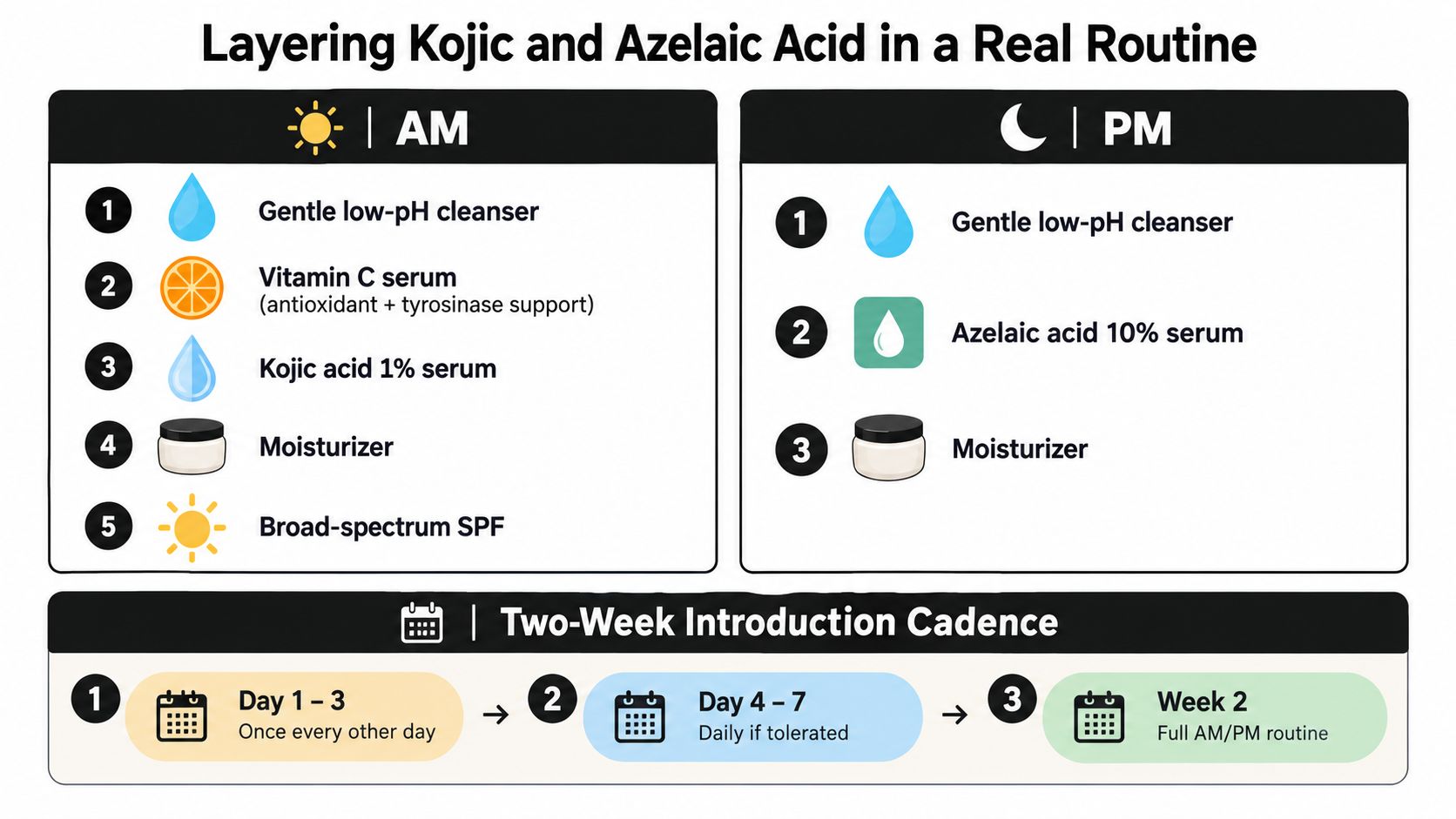
A good regimen separates introduction from escalation. Start with azelaic acid as the foundation when inflammation or acne is present, then add kojic acid once the skin can tolerate the baseline routine.
Morning application
Use a gentle low-pH cleanser, followed by a vitamin C serum if the skin already tolerates it. Apply a 1% kojic acid serum, then moisturizer, then broad-spectrum sunscreen with iron oxides. If vitamin C causes stinging, omit it rather than forcing four active steps into the morning.
Evening introduction
For the first two weeks, keep the evening routine narrow:
- Cleanse gently and let the skin dry fully.
- Apply azelaic acid at 10% to 15% in a thin layer.
- Follow with an occlusive or barrier-supporting moisturizer.
Start every other evening, then move toward daily use only if the skin remains comfortable. Patch-test behind the jaw for 48 hours before applying a new active across the face.
From the third week onward, if the barrier is intact, apply the water-based kojic acid serum first. Wait approximately 10 minutes, then apply azelaic acid at 15% to 20%, followed by moisturizer. This ordering gives the lighter serum first contact and places azelaic acid after it, but the exact sequence can be adjusted if the formula manufacturer specifies otherwise.
For more detail on combining azelaic acid with barrier-supportive ingredients, review this practical discussion of azelaic acid and niacinamide.
If stinging continues beyond the introduction period, step down to azelaic acid 10% and reduce frequency. Persistent burning is a dosing problem, not proof that the product is working.
Safety, Irritation, and Who Should Skip What
Azelaic acid is usually the safer first choice when pigmentation appears with acne, rosacea, or reactive skin. Its anti-inflammatory action addresses a driver that kojic acid does not fully target. A tolerability review supports its practical role for acne-prone and rosacea-prone users, although stinging and dryness can still occur during introduction.
Kojic acid requires stricter screening than many product pages suggest. It is associated with allergic contact dermatitis, temporary erythema, and sensitization. Postpone it during active dermatitis, a compromised barrier, or a known history of reactions to fermented derivatives. Avoid adding it over high-strength AHAs or benzoyl peroxide while the skin is already irritated.
A hydroquinone-free plan can support longer-term pigment management, provided expectations remain realistic. One clinical study found that 20% topical azelaic acid was superior to 2% hydroquinone and as effective as 4% hydroquinone for melasma. Adding tretinoin produced greater lightening after three months than azelaic acid alone (PubMed clinical report). A separate randomized, double-masked trial reported 65.8% good-to-excellent global improvement with 20% azelaic acid versus 72.5% with 4% hydroquinone over 24 weeks. Burning or stinging occurred less often with azelaic acid, 9% versus 24%, as summarized in this 24-week azelaic acid versus hydroquinone trial.
| Factor | Kojic Acid (0.1% to 2%) | Azelaic Acid (10% to 20%) |
|---|---|---|
| Main concern | Sensitization and allergic contact dermatitis | Initial stinging, dryness, or tingling |
| Sensitive skin | Introduce cautiously and avoid compromised barriers | Often a more practical first active |
| Inflammatory pigment | Limited direct action | More useful when acne or rosacea is present |
| Long-term strategy | Maintenance may work if tolerated | Often suitable for continued management |
| When to stop | Rash, persistent redness, or worsening dermatitis | Persistent burning, swelling, or marked irritation |
Vehicle changes tolerability. Kojic dipalmitate may feel more comfortable than free kojic acid, while a low-pH free kojic formula can irritate reactive skin. Azelaic acid at 15% to 20% may suit daily use after gradual introduction, but rosacea and persistent melasma warrant diagnostic oversight and medical supervision. Stop either active when irritation persists, because inflammation can sustain the pigmentation you are trying to reduce.
Your Three-Month Brightening System
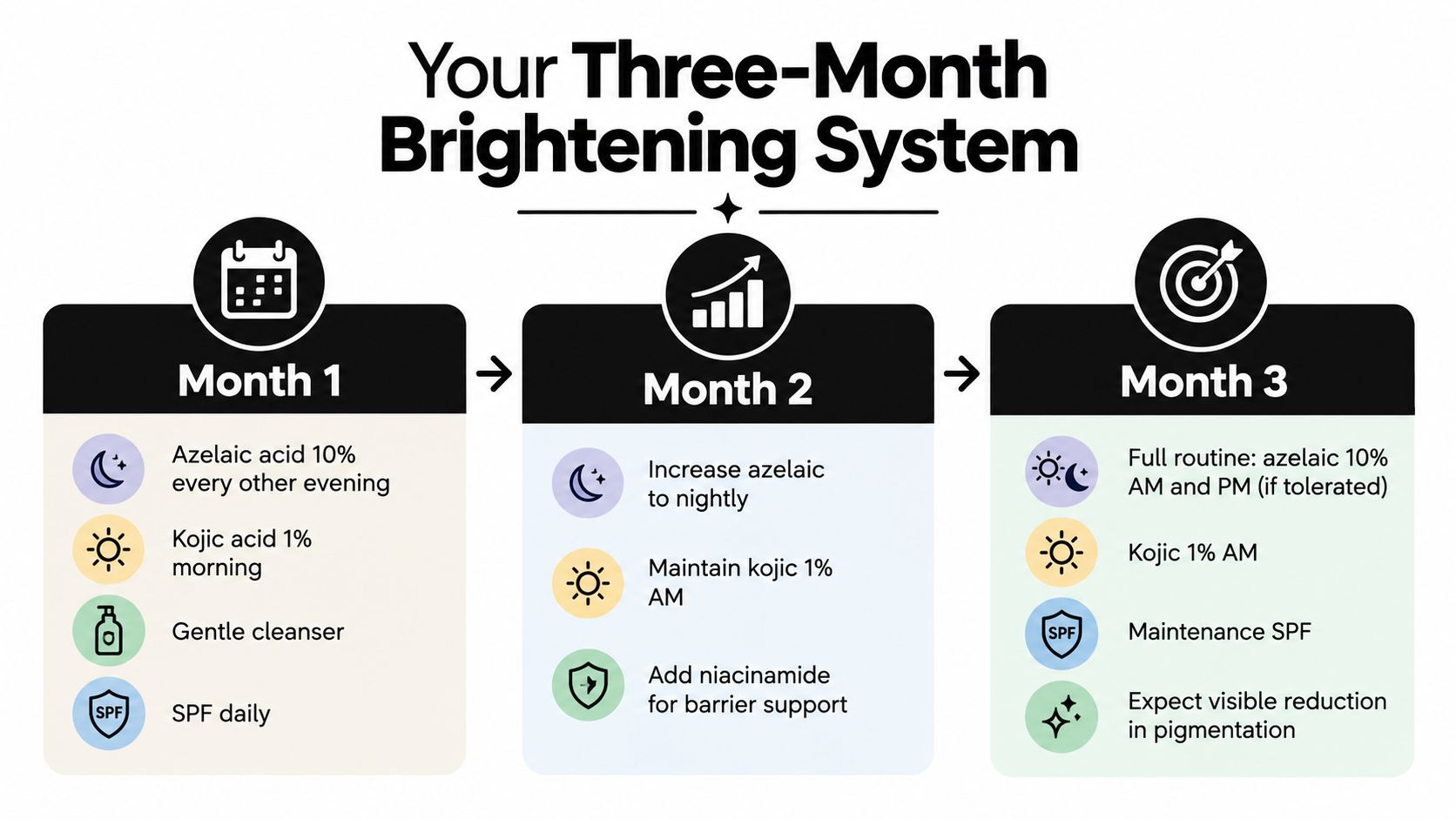
A three-month plan should escalate only when the barrier is stable. The routine below is a sequencing model, not a contest to see how many actives you can tolerate.
Month one
Use azelaic acid 10% every other evening. Add kojic acid 1% twice weekly, preferably in the morning or on evenings separate from azelaic acid while you assess sensitivity. Use broad-spectrum SPF 50 every morning, and remove other active acids from the routine during this stage.
Month two
If there's no persistent burning, rash, or worsening redness, increase azelaic acid toward nightly use and consider 15% to 20% when the product and clinical situation support it. Increase kojic acid to four nights weekly, then add a moisturizer with niacinamide or panthenol to support the barrier.
Month three
A fully paired routine can be considered if the skin remains calm. Add vitamin C in the morning when PIH is the dominant concern, but don't add it because the calendar says month three. Reassess at 12 weeks using standardized lighting and consistent photographs.
Melasma often needs maintenance because its triggers remain active. PIH may improve substantially by the three-month review when the original inflammation has stopped and UV exposure is controlled. If the pattern is spreading, symmetrical, painful, itchy, or resistant despite consistent care, consult a dermatologist rather than escalating acids.
Mesoderm RX offers a U.S.-made, hydroquinone-free approach with products designed around brightening, resurfacing, hydration, and UV defense, including its AHA BHA PHA dark spot serum. Review the available Mesoderm RX collection, then choose a regimen that matches your pigment type and introduce each active slowly rather than layering everything at once.